• العربية
  • فارسی
Brand
  • Iran Insight
  • Politics
  • Economy
  • Analysis
  • Special Report
  • Opinion
  • Podcast
  • Iran Insight
  • Politics
  • Economy
  • Analysis
  • Special Report
  • Opinion
  • Podcast
  • Theme
  • Language
    • العربية
    • فارسی
  • Iran Insight
  • Politics
  • Economy
  • Analysis
  • Special Report
  • Opinion
  • Podcast
All rights reserved for Volant Media UK Limited
volant media logo

Iran Contradicts US, Denying Restrictions On Unfrozen Funds

Mardo Soghom
Mardo Soghom

Iran International

Aug 12, 2023, 11:43 GMT+1Updated: 17:49 GMT+1
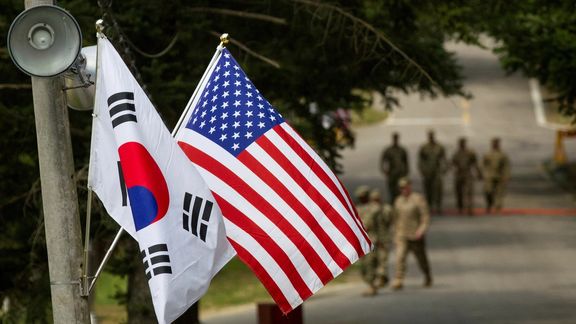
The South Korean and American flags fly next to each other at Yongin, South Korea, August 23, 2016.

Conflicting statements regarding the allocation of Iran's unfrozen funds persist between Washington and Tehran, with Iran refuting any imposed limitations.

The White House stressed on Friday that there would be restrictions on what Iran could do with any funds unfrozen under an emerging agreement that has led to the release of five Americans from prison to house arrest in Tehran.

White House spokesperson John Kirby told reporters that the United States would have "full visibility" into where any released Iranian funds are directed and used. An estimated $6 billion in Iranian assets are now held in South Korea.

"Essentially, the funds can only be accessed for food, medicine, medical equipment that would not have a dual military use," he said. "And there will be a rigorous process of due diligence and standards applied with input from the US Treasury Department."

But Iran immediately had a different reaction to the news of the prisoner release deal. “The Islamic Republic will decide how to use the released funds, and these funds will be appropriated for the various needs of the country by the appropriate authorities,” the foreign ministry said in a statement on Friday.

Iranian media on Saturday insisted that the money, which for now is $6 billion held in two South Korean banks, will go into commercial bank accounts in Qatar and the allocation of these funds “will be under the purview of the Islamic Republic and will be used for various needs of the country,” Faraz daily in Tehran reported based on information from government sources.

White House spokesperson John Kirby  during the daily press briefing at the White House in Washington, July 17, 2023
100%
White House spokesperson John Kirby during the daily press briefing at the White House in Washington, July 17, 2023

Control of the Funds

Faraz Daily, a relatively independent website by Iranian standards, said Saturday that the funds will go from South Korea to Switzerland to be converted into euros, and then wired to two banks in Qatar. 

This sounds simple and non-controversial. But the report added that after reaching Qatari banks the funds will be transferred to a few accounts opened in Qatar by Iranian banks “so the appropriation of the money can be under Iran’s control.”

The Iranian version of the deal becomes more controversial, as Faraz Daily said that once the euro funds are deposited in the Iranian accounts, the Central Bank of Iran “will have 100 percent full and direct control” on how to appropriate the funds “for essential goods, medicine and other needs.”

If Iran has accepted limitations on its nuclear program for freeing its assets, as media reports indicate, it is to be expected that Tehran will try to deny any US control over the unfrozen funds, mainly for domestic public opinion. However, Kirby’s formulation that the United States will have “full visibility” is vague and different from having a veto power on what Iran spends the funds for. 

Here it becomes clear why the funds will be in euros. Washington can control international dollar transactions and be aware of all the details of wire transfers, including the recipients. But in case of euros, the US must mainly rely on information it is given by Qatari banks.

Faraz Daily also said that Iranian businesses can request disbursements of the funds. Most so-called businesses are tied to the Iranian government and the Revolutionary Guard, and the US cannot have full information if sanctioned companies are benefiting from the unfrozen funds being transferred in euros.

While it is clear that a detailed mechanism has been or is being set up for the funds, the Biden administration is not disclosing the full extent of the agreement and the degree to which it will be able to have a say in any inappropriate use of the funds.

South Korea's First Vice Foreign Minister Choi Jong-kun (2nd from L) meets with his Iranian counterpart, Ali Bagheri Kani, in Vienna on Jan. 6, 2021, to discuss the issue of Tehran's frozen assets under US sanctions, in this photo provided by Seoul's foreign ministry.
100%
South Korea's First Vice Foreign Minister Choi Jong-kun (2nd from L) meets with his Iranian counterpart, Ali Bagheri Kani, in Vienna on Jan. 6, 2021, to discuss the issue of Tehran's frozen assets under US sanctions, in this photo provided by Seoul's foreign ministry.

Is there a deal to restrict Iran’s nuclear activities?

Fars news agency affiliated with Revolutionary Guard claimed Friday that the agreement with the United States is not “oil for food” program, similar to a scheme imposed on Iraq 1995, when Baghdad could sell its oil but could only import humanitarian needs.

Fars boasted that while during the presidency of Hassan Rouhani the US was offering to free one or two billion dollars in exchange for Iran not to enrich uranium to 20 percent, “now they will free all the blocked funds for the release of prisoners.”

In another report on Saturday, Fars quoted unnamed Iranian officials as saying that the nuclear program is in full swing, “according to existing plans of Iran’s atomic energy agency.” It also claimed that the December 2020 law passed by parliament mandating reduction of IAEA monitoring and higher uranium enrichment is in place and fully adhered to.

On Friday, the Wall Street Journal cited people familiar with the matter as saying Iran has significantly slowed the pace at which it is accumulating near weapons-grade enriched uranium and has diluted some of its stockpile.

Kirby said he could not confirm the report but said "any steps that Iran might take to slow down enrichment certainly would be welcome."

"We're not in active negotiations about the nuclear program," he added. "But certainly those sorts of steps, if they were to be true, would be welcome."

While a significant opposition is emerging in the United States against the release of the funds, an Israeli source, who wished to remain anonymous, revealed to Iran International's correspondent in Israel that the agreement between the US and the regime is not merely a tentative understanding but a comprehensive accord.

Emphasizing that the agreement carries significant ramifications, signaling a shift beyond conventional diplomatic engagements between nations, the source said the Israeli government is concerned about the expansion of the accord, like many other critics who believe the deal would embolden Iran in its hostage taking policy.

Most Viewed

Iran negotiators ordered to return after internal rift over Islamabad talks
1
EXCLUSIVE

Iran negotiators ordered to return after internal rift over Islamabad talks

2
ANALYSIS

US blockade enters murky phase as tankers spoof signals and buyers hesitate

3
ANALYSIS

Why the $100 billion Hormuz toll revenue is a myth

4

US tightens financial squeeze on Iran, warns banks over oil money flows

5
ANALYSIS

US blockade targets Iran oil boom amid regional disruption

Banner
Banner

Spotlight

  • Hardliners push Hormuz ‘red line’ as US blockade tests Iran’s leverage
    INSIGHT

    Hardliners push Hormuz ‘red line’ as US blockade tests Iran’s leverage

  • Ideology may be fading in Iran, but not in Kashmir's ‘Mini Iran'
    INSIGHT

    Ideology may be fading in Iran, but not in Kashmir's ‘Mini Iran'

  • War damage amounts to $3,000 per Iranian, with blockade set to add to losses
    INSIGHT

    War damage amounts to $3,000 per Iranian, with blockade set to add to losses

  • Why the $100 billion Hormuz toll revenue is a myth
    ANALYSIS

    Why the $100 billion Hormuz toll revenue is a myth

  • US blockade targets Iran oil boom amid regional disruption
    ANALYSIS

    US blockade targets Iran oil boom amid regional disruption

  • Iran's digital economy battered by prolonged blackout
    INSIGHT

    Iran's digital economy battered by prolonged blackout

•
•
•

More Stories

Ex-Hostage Sheds Light On Iran-US Prisoner Deal

Aug 11, 2023, 23:17 GMT+1
•
Iran International Newsroom

A former hostage in Tehran reveals details on the deal between Tehran and Washington to release US hostages in exchange for Iran’s frozen funds.

Nizar Zakka, a Lebanese who spent about four years in prison in Iran on trumped-up charges – like all foreign citizens held hostage in Iran – told Iran International that based on information he received from his sources the amount of money Iran is receiving as part of the deal is said to be over $10 billion, which includes the frozen funds in South Korea, Iraq and Japan.

He said there are conflicting reports on the amount of the money from Iranian and US sources, adding that it is not yet clear if all the frozen funds in Iraq, Japan and South Korea are included in the agreement. “It’s a lot of money,” he said, explaining that the funds will not go to the hands of the regime authorities, and are supposed to “go directly for humanitarian purposes through a third party.”

Iran has tens of billions of dollars worth of funds in foreign banks that it cannot access because of US sanctions. The funds are mostly kept in banks in South Korea ($7 billion), Iraq ($11 billion), Japan ($3 billion) as well as China and India where Iran is owed for shipments of crude and other oil products that took place before the United States pulled out of the 2015 nuclear deal and re-imposed full energy sanctions on Tehran in 2018 and 2019.

“We hope that this deal will put an end... this hostage business model that has been ongoing for so long,” added Zakka, who is the president of Hostage Aid Worldwide -- an NGO to support and help the release of people held hostage for unjust reasons.

The interview followed reports about the deal that will see five US citizens release from Iran in exchange for Iranian funds going from one restricted account to another, only be used for humanitarian purposes such as buying food or medicine.

US State Department spokesperson Matt Miller said, "We are relieved to learn that Iranian authorities have released five US citizens -- Siamak Namazi, Morad Tahbaz, Emad Sharghi (Shargi), and two individuals who at this time wish to remain private -- from prison to house arrest.” Iran's mission to the United Nations told Iranian state media that "Under the deal mediated by a third country, five Iranians jailed in the United States will be released and Iran's frozen funds in South Korea will be unblocked and transferred to Qatar."

Siamak Namazi, Morad Tahbaz, Emad Sharghi (Shargi)  (file photo)
100%
Siamak Namazi, Morad Tahbaz, Emad Sharghi (Shargi)

In reaction to US Secretary of State Antony Blinken's claim that he was not aware of any other Americans still detained in Iran, Zakka said "I personally had discussion and correspondence about (US permanent resident) Shahab Dalili with (former special envoy for Iran) Rob Malley and the State Department. “Everybody is very aware about Shahab's detention in Iran. I believe it may have skipped his (Blinken's) mind at a certain moment that he forgot Shahab Dalili's case exists."

"The Levinson Act does not differentiate between a US green card holder and a passport holder. We know of at least two cases of green card holders (Shahab Dalili and Jamshid Sharmahd) being charged exactly for cooperating with the US and being a US resident," he said, emphasizing that no hostages should be left behind like what happened for Siamak Namazi in 2016. “I hope this time everybody will be home, and we'll put an end to this hostage diplomacy.”

Highlighting that the Islamic Republic took two more hostages during the course of negotiations for this deal, he criticized a lack of deterrence in the deal. “Without deterrence, the Islamic Republic's hostage-taking is going to continue and happen again because they're making money out of this and have so much leverage over the West through these hostages."

Citing sources involved in the matter and close to power circles in Iran, Zakka said the deal "has something to do with the long-range missile agreement that will end next month, and this will put a pause on this as well. This will be good to calm the situation in the region especially now with Iran's supersonic missile."

If the information is right, Iran will not resume ballistic missiles tests after the expiry of the sanctions in October, will pause testing hypersonic missiles and will not transfer ballistic missiles to Russia. These issues are the points that France, Britain and Germany are using to justify retaining ballistic missile sanctions on Iran set to expire in October under the defunct 2015 nuclear deal. In early-July, the UN Security Council held a session on the Joint Comprehensive Plan of Action (JCPOA) and the implementation of resolution 2231, whose clauses are justifying keeping the sanctions in place.

Earlier in the day, an Israeli source, who wished to remain anonymous, revealed to Iran International's correspondent in Israel that the agreement between the US and the regime is not merely a tentative understanding but a comprehensive accord.

Emphasizing that the agreement carries significant ramifications, signaling a shift beyond conventional diplomatic engagements between nations, the source said the Israeli government is concerned about the expansion of the accord, like many other critics who believe the deal would embolden Iran in its hostage taking policy.


The informed source further elaborated that the agreement encompasses more intricate details, which have not yet been disclosed.

"The reason Prime Minister Benjamin Netanyahu has refrained from commenting on this agreement thus far is that he avoids acknowledging that, during his tenure, the United States and the Islamic Republic have reached an accord," the source stated.

His remarks came just hours before The Wall Street Journal reported that Iran has significantly slowed the pace at which it is accumulating near-weapons-grade enriched uranium and has diluted some of its stockpile, citing people briefed on the matter. "Iran has diluted a small amount of 60% enriched uranium in recent weeks and slowed the rate at which it is accumulating new material."

The WSJ said that US officials had hoped Tehran would stop accumulating 60% enriched uranium as one of a series of de-escalatory steps from both sides, which included the prisoners deal.

OPEC Figures Contradict Iran's Oil Production Claims

Aug 11, 2023, 20:25 GMT+1
•
Iran International Newsroom

Latest figures released by OPEC reveal a significant discrepancy between Iran's recent claims about its oil production and the actual data. 

The report was released on Thursday, a day after the National Iranian Oil Company (NIOC) Managing Director Mohsen Khojasteh-Mehr – a deputy oil minister -- claimed that the country's daily oil production would surge by 250,000 barrels to reach 3.5 million barrels by the end of summer, meaning that the current figure stands at 3.25 million barrels.

However, the latest OPEC statistics suggest that Iran's daily oil production amounts to only 2.828 million barrels, indicating a substantial gap of 422,000 barrels with the Islamic Republic’s figure. 

Furthermore, OPEC's new figures highlight that Iran's oil production experienced an 11% growth in the first seven months of the current year, yet the country's oil price has plummeted by over 24%. Iran's daily oil production increased by 274,000 barrels until July, still falling short by a million barrels compared to the reported 3.8 million barrels it used to produce prior to sanctions imposed by the United States. 

Crude oil production of OPEC countries
100%
Crude oil production of OPEC countries

The backdrop of this production surge lies in the aftermath of the 2015 Joint Comprehensive Plan of Action (JCPOA) nuclear deal, which saw the lifting of international sanctions on Iran and a subsequent increase in revenues. Iran's oil revenues temporarily soared to $66 billion in 2017. However, this upward trajectory was disrupted after the United States withdrew from the JCPOA in May 2018, which led to renewed sanctions that intensified a year later. 

As a result, Iran's oil exports faced a significant decline, falling to between $15 - $20 billion by 2020. The tide began to turn towards the close of that year after the election of US President Joe Biden, who expressed his intention to reinstate the JCPOA. China, in response, embarked on a trajectory of more oil imports from Iran.

Presently, China remains the main customers of the Iranian oil. Meanwhile, data from Kepler, a data analytics company that also tracks oil tankers, indicates that Iran's average daily oil and gas condensate exports to China during the first seven months of 2023 have been hovering around one million barrels per day, up from roughly 325,000 bpd in 2020 and just 160,000 bpd in August 2019, in the wake of tightened US sanctions. 

While oil has been trading at around 75-82 dollars in the past several months, Iran International reported in December that Tehran provides huge discounts to China, charging as little as $37 per barrel. A report by The Wall Street Journal in July said Iran is exporting the highest amount of crude oil in five years, but it offers discounts of up to $30 per barrel. 

No matter how many buyers or how much trade Iran manages to secure for its exports, it faces serious obstacles in bringing in the revenues and money transfers due to US banking sanctions, Mohammad-Hossein Malaek, who served as Tehran’s envoy for four years under former president Mohammad Khatami, told the Iranian Labour News Agency earlier in August. 

The former envoy highlighted China’s purchase of Iranian oil never stopped no matter the status of US and international sanctions on the Islamic Republic, but the country faces serious obstacles to pay Iran for its crude, pushing Beijing to barter goods and services to with ally.

Iranians Insist They Will Have Full Control Over Any Released Funds

Aug 11, 2023, 11:27 GMT+1

Mohammad Marandi, a regime insider in Iran, says that Tehran will have full access to its funds when they are released from South Korea following a hostage deal.

It was confirmed on Thursday that five American hostages in Iran were released from prison and put under house arrest, pending the release of $6 billion of Iranian funds held in South Korea due to US sanctions.

Marandi, who was part of Iran’s nuclear negotiating team in Vienna in 2021-2022 tweeted that “Iran will have full and direct access to its released assets, there will be no Qatari companies involved, Iranian banks will have full control, and they can purchase goods and services without any limitation or restriction.”

United States officials have insisted that any frozen funds released from Iraq or South Korea can only be disbursed by US supervision for humanitarian purchases by Iran. The New York Times quoted sources on Thursday that Qatar’s Central Bank might become the repository of Iran’s funds, but the scheme for supervising its expenditure remains unclear.

Iran’s foreign ministry said in a statement on Friday that “The Islamic Republic will decide how to use the released funds, and these funds will be appropriated for the various needs of the country by the appropriate authorities.”

Critics say that the funds would boost the Iranian regime's finances, whether released in cash or with restrictions. If Iran can import food with the funds, it will use its own oil income for its military or malign activities.

Chief of Iran’s central bank visited Qatar in June, in what was interpreted at the time as a trip to begin coordination regarding any possible funds being released from Iraq or South Korea.

Many See Biden's Iran Hostage Deal As Encouraging Enemies

Aug 11, 2023, 08:40 GMT+1
•
Iran International Newsroom

As the White House welcomed the possible release of US hostages in Iran, critics called the $6 billion to be freed in exchange the biggest ransom ever paid by the United States.

Iran immediately corrected the $6-billion amount mentioned by Western media and said that in fact $9 billion was freed, including close to $3 billion frozen in Iraqi banks in addition to $6 billion held by South Korea. In fact, Washington freed the frozen funds in Iraq in June, possibly as the first concession to Tehran in negotiations that seem to have reached a conclusion.

Iranian government media on Friday made it clear that no prisoner will leave Iran until all the money from South Korea is transferred to special accounts in Qatar.

The Biden administration to cushion the negative impact of what is seen as a ransom payment, emphasized that no cash will reach the Iranian government and that the funds will only be disbursed to pay for humanitarian needs, but the exact mechanics of the scheme remain unclear.

The Iranians who see themselves as the big winners in hostage diplomacy, which has often paid off in the past four decades, even claimed that they will be the ones who will decide the fate of the money.

“The Islamic Republic will decide how to use the released funds, and these funds will be appropriated for the various needs of the country by the appropriate authorities,” the foreign ministry said in a statement on Friday.

Mohammad Jamshidi, a top aide to President Ebrahim Raisi, was quoted by the official government news agency IRNA that American prisoners will remain in Iran until all the funds from South Korea are released. Iranian media said that the funds will be exchanged from Korean currency into euros and kept in special accounts in Qatar’s central bank. The White House thanked the Qataris for their good offices in helping secure the deal.

Secretary of State Antony Blinken said on Thursday that the release of five Americans from prison in Iran was a "positive step" and the beginning of a process that he expects will lead to their return to the United States.

Blinken told reporters at a news conference after a meeting with his Mexican counterpart that the State Department had spoken with the five Americans on Thursday and that he was not aware of any other Americans still detained in Iran.

Iranian American activists were deeply dismayed by the Biden administration’s decision to provide a significant financial boost to the clerical regime, which is facing a serious economic crisis.

Amir Hamidi, a former US government official and a political consultant in Washington DC tweeted, “Allocating a staggering $6 billion to Iran amounts to facilitating the transfer of American hostages to a new detention facility, which is an utterly unacceptable concession. We must unwaveringly uphold the principle of not negotiating with terrorists or rewarding hostage-taking.”

Republican law makers almost immediately responded by accusing the Biden administration of caving in to Iran’s hostage diplomacy.

Senator Bill Hagerty (R-TN) said, “The release of American hostages is great and welcome news, But Biden’s policies encourage more hostage taking…The ransom is now $1.2 billion per hostage. Russia and China are taking note.”

Rep. Joe Wilson (R- S. Carolina) posted that “The terrorist regime in Tehran just received a gift of $6 billion from the Biden administration. Biden is showing our adversaries how to evade sanctions & is threatening the safety of Americans around the world.”

The debate around the administration’s Iran policy will take a sharper turn with the hostage deal and will probably become an issue in the 2024 elections. However, President Joe Biden seems to have succeeded in putting a lot of distance between the controversial decision and the election 15 months away.

Iran May Allow US Hostages To Leave Under $6 Billion Deal

Aug 10, 2023, 22:33 GMT+1
•
Iran International Newsroom

The United States has confirmed that five Americans have been released from prisons in Iran and are under house arrest, after what reports say is a deal with Tehran.

Iranian sources told the media that the deal would unfreeze $6 billion in Iranian funds in South Korea and some Iranians from US prisons.

"We are relieved to learn that Iranian authorities have released five US citizens -- Siamak Namazi, Morad Tahbaz, Emad Sharghi, and two individuals who at this time wish to remain private -- from prison to house arrest, State Department spokesperson Matt Miller told the media.

“We are in touch with the families of US citizens involved, and we continue to monitor these individuals’ health and welfare closely. While we welcome the news of these individuals’ release from prison to house arrest, they should never have been imprisoned in the first place. We continue to work diligently to bring these individuals home to their loved ones.They must be allowed to depart Iran and reunite with their loved ones as soon as possible," Miller added.

Allowing the five to leave Iran could take weeks, Reuters said, while it is not clear if all the details of releasing the funds held in South Korea have been agreed or not.

"The move by Iran of the American hostages from Evin Prison ... is an important development," Jared Genser a lawyer representing Namazi said in a statement. "While I hope this will be the first step to their ultimate release, this is at best the beginning of the end."

White House National Security Council Spokesperson Adrienne Watson confirmed that the five were all out of prison and under house arrest, saying they should never have been detained and the White House would have little more to add because talks for their eventual release "remain ongoing and are delicate."

Iran's mission to the United Nations, however, told Iranian state media the release of the dual nationals from prison was part of a US-Iranian prisoner exchange deal.

"Under the deal mediated by a third country, five Iranians jailed in the United States will be released and Iran's frozen funds in South Korea will be unblocked and transferred to Qatar," the mission said, according to state news agency IRNA.

DEPARTURE FROM IRAN COULD TAKE WEEKS

Iranian Americans, whose US citizenship is not recognized by Tehran, are often pawns for the Islamic Republic which has a long history of taking Westerners hostage to use as leverage against the United States and European governments.

The five Americans will be allowed to leave Iran after $6 billion of Iranian funds in South Korea are unfrozen, a source told Reuters. A second source familiar with the talks said it could be weeks before the US citizens leave Iran, saying September was a possible time frame. He confirmed unfreezing the funds may be part of the deal.

However, he said the funds, if transferred from the South Korean banks to another financial institution, would go from one restricted account to another and could only be used for humanitarian purposes such as buying food or medicine.

Iran's semi-official Tasnim news agency said the funds were first to be converted from the South Korean currency into Euros and then sent to an account in Qatar that Iran could access.

Three US hostages, Sharghi, Namazi and Tahbaz
100%
Three US hostages, Sharghi, Namazi and Tahbaz

The potential transfer drew immediate Republican criticism that President Joe Biden, a Democrat, had effectively paid a ransom for the US citizens and that Iran using the money for humanitarian goods could free up funds for its nuclear program or to back militias in nations such as Iraq, Lebanon and Yemen.

Henry Rome, an analyst at the Washington Institute for Near East Policy, told Reuters the deal could help reduce tensions that have boiled since then US President Donald Trump, a Republican, withdrew from a 2015 nuclear deal designed to curb Iran's atomic program.

Rome described the potential release of the five as a step forward "in the broader US efforts to de-escalate tensions in the absence of a nuclear agreement" adding that the White House "wouldn't have gone through with the deal if it wasn't confident it could withstand whatever political blowback is forthcoming."

Karim Sadjadpour, a Carnegie Endowment for International Peace analyst, told Reuters that Iranian Americans should still avoid travel to Iran.

"This deal will reinforce the view of (Iran's) Revolutionary Guards that hostage taking is a lucrative practice with minimal costs," he said.

Namazi, who in 2016 was convicted of espionage-related charges the United States has rejected as baseless, has been detained by Iran for more than seven years.

Tahbaz was arrested in 2018 and sentenced to 10 years in prison for "assembly and collusion against Iran's national security" and working for the United States as a spy. Sharghi was convicted of espionage in 2020 and also sentenced to 10 years.