As US talks stall, Iran moderates warn of renewed unrest
As indirect contacts between Tehran and Washington continue and regional actors push to keep negotiations alive, competing signals continue to emerge from Iran's political establishment.

As indirect contacts between Tehran and Washington continue and regional actors push to keep negotiations alive, competing signals continue to emerge from Iran's political establishment.

Iran's imports of services surged to a record $25.5 billion in 2025 while merchandise imports fell sharply, according to newly released data from the Central Bank of Iran, highlighting a significant shift in the country's trade structure.
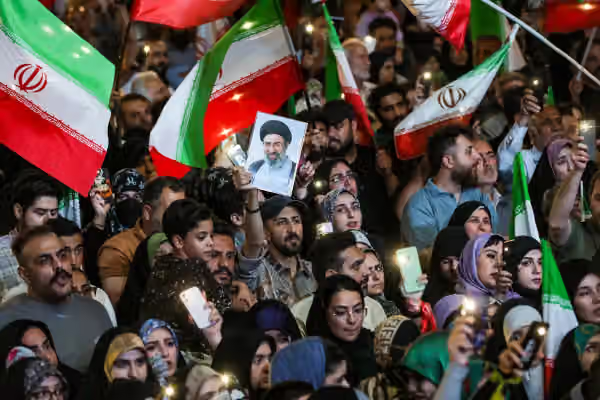
Supporters of the ultra-hardline Paydari Front were removed earlier this week from nightly state-organized rallies backing the Islamic Republic, in an apparent effort to contain hardline pressure as talks with the United States continue, Iran International has learned.
As Tehran reviews US proposals and influential figures increasingly speak openly in favor of negotiations, developments on the ground are pulling Iran and the United States in the opposite direction.

Iran’s conservative establishment appears to be pushing back against its own ultra-radical fringe after a hardline lawmaker accused President Masoud Pezeshkian of bypassing the Supreme Leader over the April ceasefire with the United States.

Despite continued uncertainty over the outcome of the Iran-US talks, signs that some Iranians are positioning for a possible diplomatic breakthrough are emerging in markets, public debate and government-linked circles.

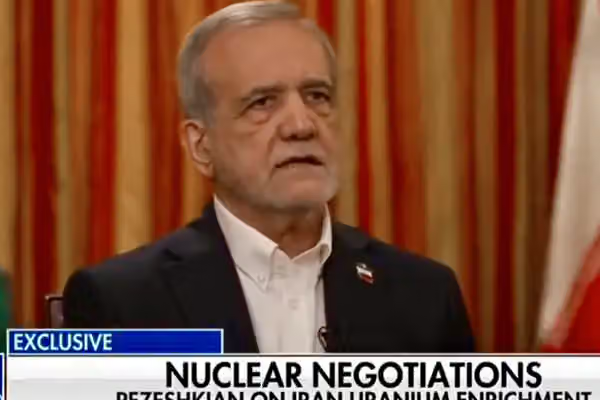
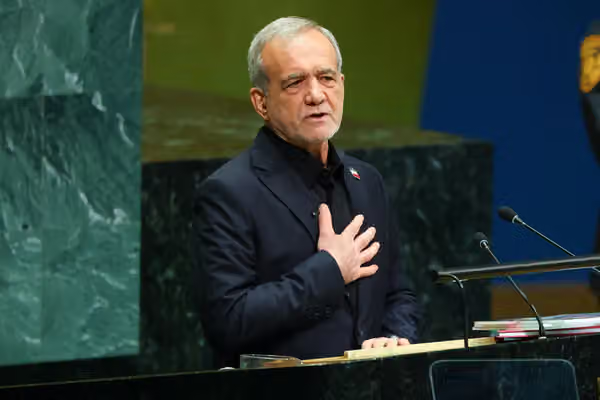
Iranian President Masoud Pezeshkian has submitted an official letter of resignation to the Office of the Supreme Leader, a source familiar with the matter told Iran International.

Hardline Iranian lawmaker Hamid Rasaei has sparked intense controversy after publishing a social media post that many interpreted as an indirect swipe at Mojtaba Khamenei, drawing sharp criticism from supporters of the Islamic Republic.

Names on a memorial poster for four relatives and in-laws of Ali Khamenei offer a rare snapshot of how family ties link Iran’s ruling household to parliament, elite universities and the Supreme Leader’s office.

Iran largely restored internet access on Tuesday after 88 days of near-total isolation, NetBlocks said, while major social media platforms remained blocked and a court challenge cast uncertainty over the government's restoration order.

Talk of a possible agreement between Tehran and Washington has intensified political attacks on parliament speaker Mohammad Bagher Ghalibaf, a central figure in Iran’s diplomatic push and a politician widely seen as backing a more pragmatic approach to negotiations.

The internet was once seen in Iran as a gateway to the outside world, but it is increasingly being reshaped into something narrower and more conditional: a privilege that can be restricted, filtered or priced at will.

A senior Iranian cleric said women without proper hijab should not be excluded from wartime gatherings, while Nour News, affiliated with Iran’s Supreme National Security Council, called for reason and moderation over ideological confrontation.

Hope for a limited US-Iran agreement gained momentum Friday as regional mediators intensified efforts to stabilize the ceasefire, but the fragile diplomacy faced hostility from Iranian hardliners who cast negotiations as a prelude to renewed conflict.

As food prices spiral and farms shut down across Iran, even establishment figures are openly questioning how a country capable of producing precision missiles cannot manufacture affordable cars or keep chicken within reach of ordinary families.

A New York Times report claiming former Iranian president Mahmoud Ahmadinejad was considered by some US officials for a post-war role in Iran triggered a storm of speculation, ridicule and conspiracy theories inside Iran.

A growing range of political voices in Tehran are calling for realism abroad and reconciliation at home rather than deeper confrontation as Washington signals both openness to talks and readiness for further military action.

The comment section under an Iran post can look like a national mood but under a blackout well into its third month, it is often something narrower: a space shaped by whitelisted access, economic privilege, cyber operations and fear.

President Donald Trump’s claim that he postponed a planned military strike on Iran has deepened uncertainty in Tehran, where officials and analysts remain divided over whether Washington is bluffing, buying time or preparing for another round of strikes.

The competing narratives surrounding the latest US-Iran standoff have become so stark that even basic questions—who is deterring whom, who wants talks and who fears escalation—now produce entirely different answers depending on which capital is speaking.

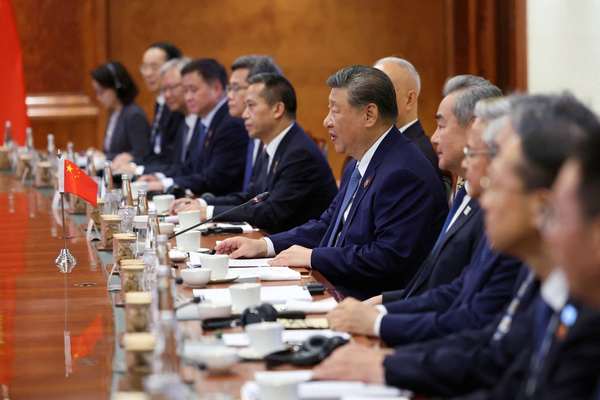
Tehran media coverage of the impasse with Washington following President Donald Trump’s visit to China points to growing frustration, with many insiders voicing concern that diplomacy has stalled and more confrontation may lie ahead.

Tehran commentariat and figures close to the establishment are increasingly accusing hardliners and state television of deepening divisions and undermining national unity as the country faces war, economic strain and growing public anxiety.