• العربية
  • فارسی
Brand
  • Iran Insight
  • Politics
  • Economy
  • Analysis
  • Special Report
  • Opinion
  • Podcast
  • Iran Insight
  • Politics
  • Economy
  • Analysis
  • Special Report
  • Opinion
  • Podcast
  • Theme
  • Language
    • العربية
    • فارسی
  • Iran Insight
  • Politics
  • Economy
  • Analysis
  • Special Report
  • Opinion
  • Podcast
All rights reserved for Volant Media UK Limited
volant media logo

US S. Korea Working To Release Iran’s Frozen Funds - Seoul Officials
Iran International Newsroom
May 30, 2023, 23:26 GMT+1Updated: 17:41 GMT+1
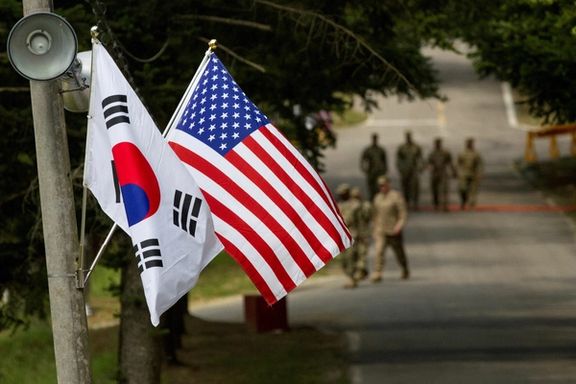
The South Korean and American flags fly next to each other

South Korean media say Seoul and Washington are mulling over ways to release Iran’s $7 billion funds frozen due to US sanctions on Tehran.

In an article on Tuesday, the Korea Economic Daily said the move will help Seoul resume its business ties with Tehran as well as President Joe Biden in the 2024 US presidential election.

Citing diplomatic and government sources in Seoul, the conservative business daily said Korean and US government officials are involved in working-level discussions under Washington’s leadership to unfreeze the Iranian funds.

South Korea has blocked $7 billion which it owes for importing Iranian oil prior to full imposition of US sanctions in May 2019. Bilateral ties between Iran and South Korea are frayed because of Seoul's refusal to release the Iranian money held at two commercial banks – Woori Bank and the Industrial Bank of Korea.

South Korea was previously one of Iran's biggest crude oil buyers in Asia. Before the reimposition of US sanctions, South Korean oil companies paid for their oil imports in their own national currency the won through the Iranian central bank account in Seoul and paid government companies involved in selling the oil in rials.

The report quoted unnamed sources familiar with the matter as saying that the release, if implemented, will come “under stringent conditions that Iran use the funds only for public purposes such as UN dues and purchasing COVID-19 vaccines.”

Previously, there have been reports that the US would agree to the release of the funds solely for humanitarian needs, but Washington has never confirmed the existence of such a plan.

“If all goes to plan, we expect our strained relationship with Iran to improve significantly,” a Seoul government official told the newspaper.

According to the source, if talks turn out to be successful, the frozen money will be allowed to be transferred to Iranian bank branches in neighboring Middle Eastern countries, not directly to Iran, to monitor the flow and use of the funds.

The report came three days after Iran International reported that “the Islamic Republic is expected to free hostages with dual nationality in exchange for its assets in South Korea and show more flexibility on issues related to its nuclear program in exchange for the release of its funds in Iraq.”

Currently there are three dual nationals with American citizenship and two individuals with US permanent residency held by Iran on trumped-up charges of espionage. The three citizens are Siamak Namazi, Emad Sharghi and Morad Tahbaz, while Jamshid Sharmahd and Shahab Dalili are US permanent residents.

Confirming the report by Iran International and those of “some local media in the Middle East,” the South Korean outlet also said a transfer of Iranian funds in Seoul would come with conditions that Tehran release “a US hostage held in Iran on spying charges” and limit uranium enrichment levels during nuclear development at 60%.

South Korea's President Yoon Suk-yeol  (March 2022)
100%
South Korea's President Yoon Suk-yeol

As South Korea-Iran relations turned sour, Tehran once incited a boycott of Korean products in Iran, targeting Samsung Electronics Co. and Revolutionary Guards briefly seized a Korean oil tanker in 2021.In 2022, a newspaper funded by Supreme Leader said Iran must close the Strait of Hormuz to South Korean vessels until Seoul releases $7 billion frozen funds.

Seoul’s relations with Tehran apparently worsened earlier this year when President Yoon Suk Yeol described the Islamic Republic as the “enemy” of the United Arab Emirates during his trip to the UAE, comparing the threat the UAE faces from Iran to the threat South Korea faces from North Korea. Yoon said, “The enemy of the UAE, its most-threatening nation, is Iran.”

The report quoted Sung Il-kwang, a Korea University professor, as saying that “There is nothing South Korea can gain from becoming an enemy of Iran... Korea will benefit from gaining access to Iran’s huge market.”


Most Viewed

Iran negotiators ordered to return after internal rift over Islamabad talks
1
EXCLUSIVE

Iran negotiators ordered to return after internal rift over Islamabad talks

2
ANALYSIS

US blockade enters murky phase as tankers spoof signals and buyers hesitate

3
ANALYSIS

Why the $100 billion Hormuz toll revenue is a myth

4

US tightens financial squeeze on Iran, warns banks over oil money flows

5
ANALYSIS

US blockade targets Iran oil boom amid regional disruption

Banner
Banner

Spotlight

  • Hardliners push Hormuz ‘red line’ as US blockade tests Iran’s leverage
    INSIGHT

    Hardliners push Hormuz ‘red line’ as US blockade tests Iran’s leverage

  • Ideology may be fading in Iran, but not in Kashmir's ‘Mini Iran'
    INSIGHT

    Ideology may be fading in Iran, but not in Kashmir's ‘Mini Iran'

  • War damage amounts to $3,000 per Iranian, with blockade set to add to losses
    INSIGHT

    War damage amounts to $3,000 per Iranian, with blockade set to add to losses

  • Why the $100 billion Hormuz toll revenue is a myth
    ANALYSIS

    Why the $100 billion Hormuz toll revenue is a myth

  • US blockade targets Iran oil boom amid regional disruption
    ANALYSIS

    US blockade targets Iran oil boom amid regional disruption

  • Iran's digital economy battered by prolonged blackout
    INSIGHT

    Iran's digital economy battered by prolonged blackout

•
•
•

More Stories

Hacked Document Shows Tehran Debating To ‘Redefine’ Ties With Baku

May 30, 2023, 11:40 GMT+1
•
Maryam Sinaiee

A report, claimed by an opposition group to have been hacked from the Iranian presidency servers, advises the government to redefine its relations with Azerbaijan. 

“The government of Azerbaijan has misunderstood the self-restraint and good-neighborliness policies of the Islamic Republic of Iran as its weakness and inferred out country’s determination to avoid conflict with itself,” the report released by MEK-affiliated Telegram account GhyamSarnegouni (Uprising till Overthrow) Monday says. 

The group released a trove of secret and top-secret document on Monday that it said were obtained by hacking the government’s servers.

Describing Baku’s actions as “serious threats,” the report provides a summary of recent developments in bilateral relations and a summary of Azerbaijan’s relations with other regional players, Turkey and Israel, in the context of its relations with the Islamic Republic of Iran and says failing to redefine relations will lead to “increased hostility” from Azerbaijan. 

“Undoubtedly, the Zionist regime will be the principal beneficiary of heightened tensions between the two sides,” the report says. 

The report, which MEK claims was among thousands of other documents it acquired, was apparently made by the foreign intelligence and security department of the ministry. The undated report, possibly a draft, is marked as “very confidential” but does not bear a reference number or signature. 

A sample of the leaked documents (May 2023)
100%
A sample of the leaked documents

An official of the presidential office, Mohammad-Mehdi Rahimi, claimed Monday afternoon that the presidency website had only temporarily been deactivated to carry out site security maintenance for a new version launched last week. 

Tensions have been high between Iran and Azerbaijan since November 2022 when both sides accused each other of engaging in terrorism and espionage in the other’s territory. 

Iran has suggested Azerbaijani involvement in the October 26 attack in Shiraz claimed by the Islamic State group (Isis-Daesh) and, also in the report accuses Baku of harboring Israeli intelligence and military elements that plan to use its territory in a possible attack against Iran’s nuclear facilities. 

The two countries in early May expelled each other’s diplomats after incidents that Baku also dubbed as "terrorist attacks". These included a gunman’s attack on Azerbaijani diplomatic mission in Tehran in January after which Baku shut down the embassy and an attack on Azerbaijani lawmaker Fazil Mustafa in March, who is an outspoken critic of the Islamic Republic.

Ethnic and religious issues complicate relations between Tehran and Baku and both parties have been using these factors against each other. 

Around a quarter of Iran’s population is Turki-speaking Azari, with analysts and activists disagreeing over the closeness of their cultural-linguistic links to their neighbors to the north. Iran fears separatism in its northwestern regions encouraged by Azerbaijan. 

On the other hand, Azerbaijan has a large Shiite population that is susceptible to agitation by the Islamic Republic, which considers itself the leader of the Shiite world. Supreme Leader Ali Khamenei is often referred to as the "leader of world Muslims". 

The Albania-based opposition group claimed it had breached 120 servers of the presidential office and accessed internal communications and minutes of meetings as well as President Ebrahim Raisi’s online conference platforms and about 1,300 computers inside the office.

Hackers posted images of MEK leaders, Maryam Rajavi and her husband Masoud who has not been seen in public since 2003, and defaced pictures of Supreme Leader Ali Khamenei and President Ebrahim Raisi on the compromised websites. 

Without any details, some Iranian news websites reported -- a few hours after the MEK’s announcement Monday that they had hacked the website of the presidency – that the website could not be reached. 

In early May the group released hundreds of identification documents, minutes of meetings, copies of correspondence, phone numbers of foreign ministry officials, and the names of 11,000 employees. 

Ukraine Parliament Approves 50-Year Sanctions On Iran

May 30, 2023, 11:33 GMT+1

The Ukrainian Parliament approved the country’s National Security and Defense Council's decision to impose sanctions on Iran.

A massive 328 lawmakers voted in favor of the bill on Monday to endorse the decision to impose sanctions on Iran for 50 years for allegedly supplying Russia with weapons during its ongoing invasion.

"The resolution synchronizes Ukrainian sanctions with the actions of the entire civilized world on the path to the complete isolation of Iran," the parliament’s statement said.

Among the sanctions are a ban on trade, the transit of Iranian resources, flights, and transportation within Ukraine, according to Ukrainian media.

Additionally, any investment in Iran and the transfer of technologies and intellectual property rights by its residents will be banned.

Iranians will also be prohibited from using electronic means to conduct payments, while the Ukrainian National Bank will not be permitted to register international payment systems operated by Iran.

On Sunday, Ukraine's President Volodymyr Zelensky proposed a law seeking sanctions against Iran for 50 years after Tehran supplied Moscow with munitions and drones. Three days earlier he urged Iranians not to cooperate with Russia.

Iran has supplied hundreds of Kamikaze drones to Russia that have been used to target mainly Ukrainian infrastructure and civilians since September 2022. Tehran has denied that it has sent any drones to Moscow since the invasion of Ukraine began in February 2022, but Kyiv has presented overwhelming material evidence showing Russia has used Iranian-made Shahed drones.


OPEC Says Will Welcome Iran’s Return To Oil Market When Sanctions Lifted

May 30, 2023, 06:30 GMT+1

OPEC will welcome Iran’s full return to the oil market when sanctions are lifted, the secretary general of the Organization of the Petroleum Exporting Countries (OPEC) said Monday.

Iran is an OPEC member, although its oil exports are subject to US sanctions aimed at curbing Tehran's nuclear programme.

Secretary General Haitham Al Ghais, who is visiting Tehran for the first time, also told Iranian oil ministry's website SHANA that Iran has the capacity to bring on significant production volumes within a short period of time.

"We believe that Iran is a responsible player amongst its family members, the countries in the OPEC group. I’m sure there will be good work together, in synchronization, to ensure that the market will remain balanced as OPEC has continued to do over the past many years," SHANA's English-language website cited him as saying.

Although US sanctions can penalize any third party engaged in Iranian oil exports, Tehran ships daily close to one million barrels of crude to China, often disguised as cargos from third countries. Before the US imposed its sanctions in 2018 and 2019, Iran was exporting around 2.2 million barrels per day and in if sanctions are lifted Iran’s export capacity can hardly surpass that without major investments in the sector.

Saudi Arabia, the kingpin of OPEC, and Iran announced in March that they would restore diplomatic relations after years of hostility, in a deal brokered by China, the world's No. 2 oil consumer.

Why Is Oman’s Sultan In Iran And Will It See The Revival Of JCPOA?

May 29, 2023, 15:37 GMT+1
•
Iran International Newsroom

Only two days after Muscat mediated a prisoner swap between Iran and Belgium, Sultan Haitham bin Tariq al-Said traveled to Tehran, meeting with President Ebrahim Raisi and Supreme Leader Ali Khamenei.

Traditionally, Oman works as a mediator between Iran and Western countries, and it also plays a role in facilitating relations between Tehran and Arab countries. It was one of the key players in the talks which eventually led to Iran and Saudi’s détente.

Given that this time the Sultan himself has come to Iran, there is no doubt this is a vital visit. Almost all of the reports by Iranian state media on the first day of the visit were focused on bolstering economic cooperation between the two countries, with some discussion on recent developments in the region. However, no details about trade or regional diplomacy were released.

The joint statement released after Oman’s sultan meeting with the Iranian president abounds with clichés such as “strengthening friendly and brotherly relations on the basis of common interests, especially in the fields of trade, energy, investment and culture.”

A meeting between Oman’s Sultan Haitham bin Tariq al-Said and his delegation with Iran’s President Ebrahim Raisi and senior officials in Tehran on May 28, 2023
100%
A meeting between Oman’s Sultan Haitham bin Tariq al-Said and his delegation with Iran’s President Ebrahim Raisi and senior officials in Tehran on May 28, 2023

On the second day of the trip, Sultan bin Tarik met with the Supreme Leader, apparently delving deeper into Iran’s détente with its classic rivals Saudi Arabia and Egypt. The only takeaway from the readout of the meeting by Khamenei’s office, was the Supreme Leader’s welcoming of better relations with Egypt.

Khamenei's comments came as Middle Eastern countries including Egypt are taking steps to ease regional tensions and relations between Egypt and Iran have often been fraught in recent decades although the two countries have maintained diplomatic contacts. In March, regional rivals Sunni Saudi Arabia and Shiite Muslim Iran ended years of hostility and agreed to restore diplomatic relations under a China-mediated deal.

The presence of Iran’s top nuclear negotiator Ali Bagheri-Kani during Oman’s sultan meeting with Khamenei, which is somewhat unusual, indicates that there must have been a nuclear aspect to the meeting, despite a possible media ban on this aspect of the talks. 

Iran’s top nuclear negotiator Ali Bagheri-Kani (center) during a meeting between Supreme Leader Ali Khamenei and Oman’s Sultan Haitham bin Tariq al-Said (not seen) in Tehran on May 29, 2023
100%
Iran’s top nuclear negotiator Ali Bagheri-Kani (center) during a meeting between Supreme Leader Ali Khamenei and Oman’s Sultan Haitham bin Tariq al-Said (not seen) in Tehran on May 29, 2023

The seeming lack of openness about the nuclear side of the talks has drawn suspicion from global Iran watchers who are looking to Oman to mediate in the possible revival of talks on the 2015 nuclear deal, which has fallen apart. There are also rumors that the US and the Islamic Republic are about to reach a deal in the near future, which could be among the secret topics discussed during the visit by Oman’s sultan.

Former diplomat Fereydoun Majlesi told Fararu on Monday that Oman has a respected position in the Persian Gulf. "Oman speaks on behalf of all the countries of the Persian Gulf and what is in the interest of Oman is in the interest of all Arab countries in the region,” he said, noting that minimizing the risks of tensions or wars and unease between the Islamic Republic and the US and Israel plays an important role in that.

“These countries are worried that any kind of conflict between Iran and its long-time enemies would overshadow all the peace and security they have achieved during the last half century," added Majlesi who said that Iran’s foreign minister has recently assessed the revival of the JCPOA as “important and vital and expressed willingness to restore the deal”.

Ali Bigdeli, another pundit, told Fararu that the most important possible reason for Sultan of Oman's visit to Iran is mediating for exchange of dual-national prisoners.

A source told Iran International last week that talks between Iran and the US on the release of Tehran's frozen assets could result in a deal soon.

Apparently, the talks that have made progress focused on Iranian funds held in Iraq and South Korea. Iran is apparently expected to show more flexibility on issues related to its nuclear program in exchange for the release of its funds in Iraq, and free hostages with dual nationality in exchange for its assets in South Korea.

Currently there are three dual nationals with American citizenship and two individuals with US permanent residency held by Iran on trumped-up charges of espionage.

Also on Monday, Israel’s state television channel Kan 11 reported that a deal between Tehran and Washington will be finalized in the coming weeks.

During an interview with Reshet Bet on Monday, Israeli opposition leader Yair Lapid expressed alarm about reports of the imminent nuclear agreement, saying: "Such an interim agreement is dangerous. Every effort must be made to prevent this from happening.”

Iran Says Efforts Underway To Release Another Regime Convict

May 29, 2023, 11:32 GMT+1

Iranian authorities say efforts are underway to release Hamid Nouri, a former Iranian jailor who is serving a life sentence in Sweden.

Nouri, 61, was given a life sentence last July for his leading role in the massacre of large numbers of jailed opposition members at Gohardasht Prison in July and August 1988.

Askar Jalalian, Deputy Director of International Affairs and Human Rights at the Ministry of Justice, called prospects of his release "good news”.

The development comes after Iranian diplomat Assadollah Assadi, convicted of terrorism, was freed on Friday in exchange for a Belgian aid worker, causing global outrage.

Assadi, a former attaché at the Iranian embassy in Austria, was convicted of plotting to bomb a gathering of the exiled opposition group Mujahedin-e Khalq Organization (MEK) near Paris on June 30, 2018.

Belgian Olivier Vandecasteele, who was detained in 2022 and sentenced to 40 years in prison and 74 lashes for alleged “spying and cooperation with the United States, money laundering and smuggling $500,000 out of Iran,” was also released as part of a deal mediated by Oman.

Critics of the deal warned that such a treaty would effectively establish Belgium as a “sanctuary country” for terrorist operations, and a haven for Iranian intelligence services to maintain a European command center, setting a dangerous precedent for the future.

Iran has become notorious for its ‘diplomatic hostage taking’ and the latest developments are causing alarm among rights groups and international diplomatic circles that the tactic is succeeding.