• العربية
  • فارسی
Brand
  • Iran Insight
  • Politics
  • Economy
  • Analysis
  • Special Report
  • Opinion
  • Podcast
  • Iran Insight
  • Politics
  • Economy
  • Analysis
  • Special Report
  • Opinion
  • Podcast
  • Theme
  • Language
    • العربية
    • فارسی
  • Iran Insight
  • Politics
  • Economy
  • Analysis
  • Special Report
  • Opinion
  • Podcast
All rights reserved for Volant Media UK Limited
volant media logo

Sanctions Hinder China Paying For Iranian Oil - Ex-Envoy
Iran International Newsroom
Aug 1, 2023, 23:31 GMT+1Updated: 17:27 GMT+1
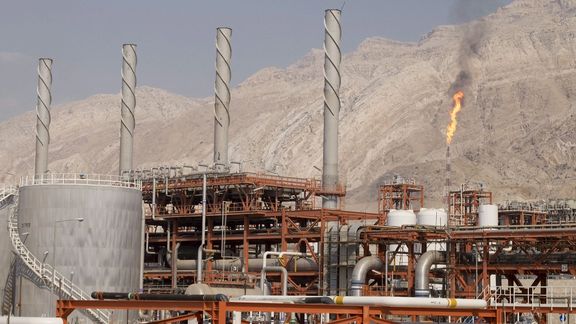
A general view shows a unit of South Pars Gas field in Asalouyeh Seaport, north of Persian Gulf, Iran November 19, 2015.

Amid reports of a rise in Iran’s oil exports to China, the regime’s former envoy in Beijing has shed light on Tehran’s mechanisms to collect the revenues.

Mohammad-Hossein Malaek, who served as Tehran’s envoy for four years under former president Mohammad Khatami, told the Iranian Labour News Agency on Tuesday that China’s purchase of Iranian oil never stopped no matter the status of US and international sanctions on the Islamic Republic.

“China has a principled and consistent approach to its relations with Iran, and for about 10 to 15 years, both when Iran was under sanctions and when they were removed, China has been importing an average of 600,000 barrels of oil per day from Iran,” he said.

However, he explained that Beijing was supposed to open credit lines for Iran, but it never did due to the sanctions. Malaek did not elaborate if these “low-cost credits” were supposed to be earmarked for Chinese products or the regime would have been able to use them on international markets.

No matter how many buyers or how much trade Iran manages to secure for its exports, Iran faces serious obstacles in bringing in the revenues and money transfers due to banking sanctions, the former envoy highlighted.

Iran's former ambassador to China Mohammad-Hossein Malaek (undated)
100%
Iran's former ambassador to China Mohammad-Hossein Malaek

His remarks came as head of the Iran-China friendship association Allaedin Boroujerdi said Monday, “Necessary agreements have been made between the central banks of the two countries, and we do not have the problem of blocking Iran's money and assets in China, like we have in South Korea.”

While China has a diversified oil supply portfolio that has seen Iran contributing over one million barrels per day in some periods, the lion’s share of China’s daily import of 10 million barrels are from Russia and Saudi Arabia.

He did not explain how exactly Iran is receiving money from China but there are several known methods that have been used in the past, including a barter system and China’s investment in Iran’s development projects. “There is an annual exchange of $15-16 billion worth of goods with the Chinese, some through banking channels and some through barter," Malaek said.

In 2020, Iran and China quietly drafted a sweeping economic and security partnership that would potentially clear the way for billions of dollars of Chinese investments in Iran’s energy and other sectors, undercutting the Donald Trump White House efforts to isolate the regime over its nuclear and military ambitions. Then-foreign-minister Mohammad Javad Zarif and his Chinese counterpart Wang Yi signed the controversial 25-year deal at a ceremony at the Iranian Foreign Ministry in Tehran in March 2021. The deal was first proposed by Iran's Supreme Leader Ali Khamenei during President Xi Jinping’s visit to Tehran in 2016.

The pact has been controversial in Iran because its details have never been disclosed. According to a copy of the draft obtained by The New York Times, the 18-page agreement detailed $400 billion of Chinese investments in banking, telecommunications, ports, railways and dozens of other projects. In exchange, China would receive a regular and heavily discounted supply of Iranian oil for the following 25 years.

Although Iran has not revealed the details of the agreement with China and what it will entail in political, economic and military terms, it has caused resentment from Iranians who claim the Islamic Republic is "selling out the country and its people" to China and Russia.

While oil has been trading at around 75-82 dollars in the past several months, Iran International reported in December that Tehran provides huge discounts to China, charging as little as $37 per barrel. A report by The Wall Street Journal in July said Iran is exporting the highest amount of crude oil in five years, but it offers discounts of up to $30 per barrel.

Kpler, a data and analytics firm, said in its latest report last week that Iran’s oil shipments to China have more than tripled over the past three years despite the US sanctions. Based on the data, Iranian crude exports to its major trade partner have been hovering around one million barrels per day in 2023, up from roughly 325,000 bpd in 2020 and just 160,000 bpd in August 2019, in the wake of tightened US sanctions. 

Also in January, the US Energy Information Administration (EIA) put Iran’s average oil production in 2022 at 2.54 million bpd. According to energy consultant SVB International earlier this year, Iran’s crude exports in December averaged 1.137 million barrels per day, up 42,000 bpd from November and the highest 2022 figure SVB has reported based on earlier estimates.

Iran needs around $50 billion from oil exports to balance its flailing budget, but estimates say actual annual proceeds are around $25 billion. Another reason for Iran’s oil revenues being probably less than $25 billion is the costs involved in illicit shipments to evade sanctions, and losing money in trying to repatriate the money in hard currencies. Iran’s banking system is also under US sanctions and any oil revenues are laundered through intermediaries.

The main question that remains unanswered is how all these oil revenues are spent when inflation is still soaring, national currency is on a nosedive and Iranians are getting poorer every day with no prospect of bouncing back in sight.


Most Viewed

Iran negotiators ordered to return after internal rift over Islamabad talks
1
EXCLUSIVE

Iran negotiators ordered to return after internal rift over Islamabad talks

2
ANALYSIS

US blockade enters murky phase as tankers spoof signals and buyers hesitate

3
ANALYSIS

Why the $100 billion Hormuz toll revenue is a myth

4

US tightens financial squeeze on Iran, warns banks over oil money flows

5
ANALYSIS

US blockade targets Iran oil boom amid regional disruption

Banner
Banner

Spotlight

  • Hardliners push Hormuz ‘red line’ as US blockade tests Iran’s leverage
    INSIGHT

    Hardliners push Hormuz ‘red line’ as US blockade tests Iran’s leverage

  • Ideology may be fading in Iran, but not in Kashmir's ‘Mini Iran'
    INSIGHT

    Ideology may be fading in Iran, but not in Kashmir's ‘Mini Iran'

  • War damage amounts to $3,000 per Iranian, with blockade set to add to losses
    INSIGHT

    War damage amounts to $3,000 per Iranian, with blockade set to add to losses

  • Why the $100 billion Hormuz toll revenue is a myth
    ANALYSIS

    Why the $100 billion Hormuz toll revenue is a myth

  • US blockade targets Iran oil boom amid regional disruption
    ANALYSIS

    US blockade targets Iran oil boom amid regional disruption

  • Iran's digital economy battered by prolonged blackout
    INSIGHT

    Iran's digital economy battered by prolonged blackout

•
•
•

More Stories

Heat Wave Forces Shutdown In Iran

Aug 1, 2023, 12:50 GMT+1

Due to a heat wave across the country, the Iranian government has declared a national holiday on Wednesday and Thursday.

The government claims the move is to safeguard the well-being of its citizens as soaring temperatures continue to pose health risks, though it raises questions as to the country's readiness for a crisis amidst an already overburdened health system.

Last month, Iran International reported that the system needs 60,000 personnel to cope with rising demands amidst a collapsing economy and a disappearing workforce. 

Ali Bahadori Jahromi, the government's spokesperson, took to Twitter on Tuesday to announce the decision, stating, "In view of the unprecedented heat in the current days, in order to protect the health of the citizens, the government agreed with the proposal of the Ministry of Health to close on Wednesdays and Thursdays throughout the country."

Sadegh Ziyaian, the head of the National Center for Forecasting and Crisis Management of Weather Risks, reported an alarming increase in temperatures. The southern city of Ahvaz in particular is expected to experience temperatures of up to 50 and 51 degrees celsius during Tuesday and Wednesday, becoming the hottest center of the province.

Ziyaian also warned that the capital, Tehran, will witness temperatures reaching up to 40 degrees Celsius on Thursday.

In light of the extreme weather conditions, the Ministry of Health issued a public advisory, urging special attention to vulnerable groups. Children under four years old, individuals over 65 years old, and those with pre-existing health conditions are at higher risk of heatstroke.

Child Labor On Rise In Iran Amidst Poverty Crisis

Aug 1, 2023, 11:32 GMT+1

Iran's Parliament Research Center has released a report highlighting an alarming rise in the number of working children.

The report indicates that 15% of the child population is now engaged in labor activities. At least 10% of working children do not have the opportunity to attend school, depriving them of essential educational opportunities.

While the exact number of working children in Iran remains undisclosed, the Ministry of Labor indicated that in 2017, out of nine million Iranian children, 499,000 were considered "active," signifying that nearly half a million children in the country were either engaged in labor or searching for work.

The report suggests that the population of working children has now reached approximately one million and 350,000 individuals, based on an estimated 15% involvement in child labor.

The primary reason attributed to the growing phenomenon of child labor is "household poverty" which forces children to work to support their families' financial needs.

The report underscores that child labor is prohibited and criminalized by both international and domestic laws, obliging the government to implement necessary measures to address and reduce this issue. However, monitoring and preventing child labor have proven to be challenging, particularly in cases of household work, labor in difficult and unsupervised areas, illegal activities like drug trafficking, and instances of sexual abuse of children.

Senior Convicted Official In Iran Sending Assets Abroad Even From Jail

Aug 1, 2023, 00:23 GMT+1
•
Iran International Newsroom

A former deputy of Iran’s judiciary, released from prison last year after serving only a fraction of his sentence, has been taking his illicitly gained assets abroad. 

Iran International has obtained a long list of Akbar Tabari’s properties, such as large shopping malls, houses, large land holdings, apartments and shops, that were not even mentioned during the numerous hearing sessions held after he and 21 others were arrested in 2019 for running a bribery ring inside the regime’s judiciary department.

Almost all the people implicated in the case were released before completing their sentences. Late in June, Gholamali Mohammadi, the head of Iran's Prisons Organization, announced that Tabari -- the highest-ranking judiciary official in the case -- was released from prison after serving just 45 months of a 31-year prison term, posting a bail of 3 trillion rials ($6 million). 

Before being arrested in July 2019, Tabari held senior financial and executive positions within the Iranian judiciary for nearly 20 years. He was eventually sentenced to 31 years in prison for leading a bribery network and receiving multiple bribes and for money laundering. 

According to Iran International’s investigative journalist Mojtaba Pourmohsen, Tabari continued his illegal activities from inside the prison as the court sessions were being held. 

Our sources said that several of his associates have been converting his assets into foreign currencies and sending to Portugal and the Canadian city of Vancouver, adding that authorities turn a blind eye -- or facilitate -- his affairs to protect Chief Justice Gholamhossein Mohseni Ejei and Gholam-Hossein Esmaeili, a senior justice and former spokesman of the Judiciary who is now the chief of staff of President Ebrahim Raisi. Tabari was removed from his posts in the judiciary only seven days after Ebrahim Raisi was appointed as Chief Justice in March 2019.

Chief Justice Gholamhossein Mohseni Ejei (left) and President Ebrahim Raisi   (undated)
100%
Chief Justice Gholamhossein Mohseni Ejei (left) and President Ebrahim Raisi

Delving into evidence pertaining to the list of Tabari’s assets would have opened the pandora’s box and revealed the deep corruption in the highest levels of the country’s judiciary, our sources said, justifying the reason why Supreme Leader Ali Khamenei gave the green not to investigate the case thoroughly. Another piece of evidence that was buried would have led to further investigation about Sadeq Larijani, another former Chief Justice and the current chairman of Expediency Discernment Council -- an advisory body appointed by the Supreme Leader. 

One of our sources claimed that the known facts and figures about Tabari’s case are only the tip of the iceberg in the judiciary’s corruption that may include a large number of senior officials of the country’s judicial system. 

Mohammadi, the head of Iran's Prisons Organization, said in the late June TV interview that Tabari's release was the result of a "judicial authority's decision within legal parameters," a reference to Mohseni-Ejei, the current head of the judiciary.

Tabari's release cast aspersions about the fairness of Iran's judiciary in high-profile cases, showing preferential treatment to former regime officials and those who can buy their way out of jail. While regime opponents are subjected to immediate secret trials and severe punishment, including those arrested during the recent nationwide protests, the process of reviewing the charges of officials and their affiliates is usually slow, and their sentences are usually suspended after a short period.

Another question raised following Tabari’s release was how a former government employee can post a $6 million bail when monthly salaries of top officials is around $1,000. According to official documents of the case, a copy of which was obtained by Iran International, well-known Iranian tycoon Mohammad (Dariush) Afrashtehpour paid the bail money. Afrashtehpour is one of the so-called ‘major debtors’ to state banks who has been involved in a plethora of financial schemes under several administrations.


Spate of Suicides Raise Concerns Over Iranian Petchem Co.

Jul 31, 2023, 19:29 GMT+1

The suicide of a worker at Iran's Chovar Petrochemical Company due to his dismissal has brought attention to the dire situation within the firm.

According to a report by ILNA news agency in Tehran, Heydar Mohseni, a married father of two, took his own life on Thursday after receiving a dismissal order following 18 years of service at the petrochemical complex in the southwestern province of Ilam. This marks the fourth such incident within the past 12 months.

The news of Mohseni's suicide prompted a gathering of workers at the petrochemical area and the Chovar governorate. As a consequence, the Chovar security council restricted the entry of several petrochemical managers into the workplace. Nevertheless, some workers expressed concern that those responsible for Mohseni's dismissal have yet to face repercussions.

In a similar incident in December, Arash Tabarrork, a contracted worker at the plant, committed suicide after ingesting aluminum phosphide after he was prohibited from entering Chovar Petrochemical Company. Furthermore, in August 2022, Mohammad Mansouri and Ali Mohammad Karimi, both young workers, also took their lives within a 24-hour period.

Reports indicate that employees at Chovar have to endure hard working conditions and receive very low wages. This, compounded with worsening economic situation in Iran has contributed to unbearable livelihood problems and have driven at least 10 individuals to end their lives between June and August 2022.

A notable issue highlighted by ILNA is the absence of an independent trade union organization for the over 1000 workers at Chovar Petrochemical, most of whom are contracted employees, meaning that they lack job security, insurance and benefits. Their appeals to the labor ministry and governorship have not yielded positive outcomes.

Potential Earthquake In Tehran Raises National Crisis Concerns

Jul 31, 2023, 10:32 GMT+1

Amidst fears of a devastating earthquake in Tehran, a City Council member issued a stern warning about its potential impact.

Mohammad Aghamiri emphasized that if an earthquake were to strike the capital, which is located in an area of high seismic activity with these the risks compounded by increasing land subsidence, the city’s current infrastructure would not withstand and a national crisis would ensue.

Aghamiri spoke to Etemad newspaper, expressing his deep apprehensions about the current subsidence situation in Tehran, terming it unacceptable and extremely worrying. Recognizing the gravity of the issue, he stressed the crucial need for national support to effectively address and contain the looming threat.

"If an earthquake occurs in Tehran, the capital, which should itself be the command center, will experience a crisis," he said.

His concerns align with the sentiments expressed earlier this year by Mehdi Pirhadi, another member of Tehran City Council, who also underscored the urgency of renovating buildings in the capital to withstand potential earthquakes. Pirhadi emphasized that a quake with a magnitude of over 7 could lead to hundreds of thousands of casualties and deaths, due to 166,000 hectares of worn-out structures across the country.

In light of this grim outlook, experts have predicted that in the event of a magnitude 7 earthquake, at least one and a half million people could lose their lives in Tehran alone.

Iran, situated at the convergence of the Arabian, Indian, and Eurasian tectonic plates, is known for its high seismic activity, making it one of the most earthquake-prone countries in the world. The nation has experienced several massive earthquakes in recent history, resulting in tens of thousands of casualties and substantial economic losses.