• العربية
  • فارسی
Brand
  • Iran Insight
  • Politics
  • Economy
  • Analysis
  • Special Report
  • Opinion
  • Podcast
  • Iran Insight
  • Politics
  • Economy
  • Analysis
  • Special Report
  • Opinion
  • Podcast
  • Theme
  • Language
    • العربية
    • فارسی
  • Iran Insight
  • Politics
  • Economy
  • Analysis
  • Special Report
  • Opinion
  • Podcast
All rights reserved for Volant Media UK Limited
volant media logo

US House Overwhelmingly Passes Sanctions Bill On Iran
Iran International Newsroom
Sep 13, 2023, 07:24 GMT+1Updated: 17:57 GMT+1
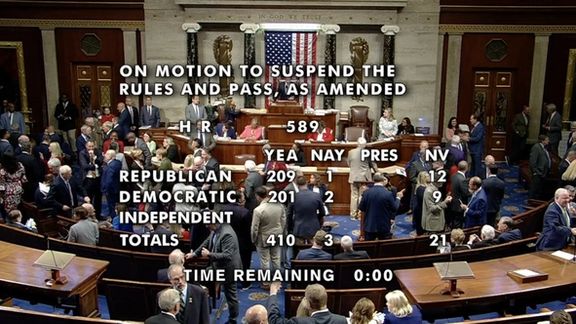
The result of the vote in House of Representative on September 12, 2023

The US House of Representatives has voted 410-3 for a bill that hardens the sanctions against the Supreme Leader and the President of the Islamic Republic of Iran.

The Mahsa Amini Human Rights and Security Accountability Act (MAHSA) requires the President to report to Congress every year whether those officials should remain under current sanctions.

Ali Khamenei and Ebrahim Raisi were first sanctioned by President Donald Trump by an executive order in 2019. The Mahsa Act would make it much more difficult to lift those sanctions for the current and future administrations.

The resolution will have to pass the Senate to become law. The Senate is controlled by Democrats, who may not be as eager as the majority Republicans in the lower chamber to consider the bill.

The Mahsa Act was first introduced in January 2023, a few months after Mahsa Amini, a 22-year-old woman, was killed in hijab police custody in Tehran, triggering months of widespread protest which challenged the Islamic Republic like never before.

Referring to the regime’s human rights abuses following the protests, Rep Michael McCaul, the Chairman of House Committee on Foreign Affairs, called out the international community for “failing to compel” the oppressors of the Iranian people “to stop this abuse”.

“We have many sanction laws designed to address Iran’s regime’s human rights violations,” McCaul said, “however, it is clear that many officials and institutions in Iran have not yet been sanctioned for their role in these abuses.”

McCaul also attacked the Biden administration for its “political agenda” in dealing with Iran’s government and said: “We must not sell off the Iranian people to reach a bad nuclear deal.”

Young Iranian American activists who had worked hard for months to ensure support for MAHSA Act were jubilant on social media, and more confident about advocating a tougher US stance toward the Islamic Republic.

The rift between the House and the Biden administration over Iran policy has become clearer in recent weeks: first over Robert Malley, US Special Envoy on Iran, whose security clearance has been revoked and is currently the subject of a FBI investigation, and then the prisoner swap deal that would release $6 billion of Iran’s assets frozen in South Korea.

Secretary of State Antony Blinken has signed off a sanction waiver to allow international banks to transfer the funds. He had done so last week, AP reported, whereas the Congress was informed of the measure only on Monday (September 11).

Earlier on Tuesday, Senator Ted Cruz (R-TX) lambasted the US government for its secret deal with the Islamic Republic and said: “The Biden administration must keep their deal secret because if they disclosed it, the law requires them to come to Congress and defend it, and this appeasement is utterly indefensible.”

Jim Risch (R-ID), Ranking Member of the Senate Foreign Relations Committee, warned that the prisoner swap deal “creates dangerous incentives to capture Americans abroad”. He pointed out that striking such a deal “is tone deaf on the anniversary of Mahsa Amini death."

September 16 marks one year since the killing of Mahsa Amini.

The bill bearing her name was not the only Iran-related bill to pass the House on Tuesday. The Representatives also voted to target Iran’s production and exports of missiles and drones by sanctioning those involved in such programs. The last of the bills was specifically designed to condemn the Islamic Republic’s persecution of the Baha’i minority.

All three bills passed almost unanimously, indicating an increasingly united front against Iran’s rulers in the US House of Representatives.


Most Viewed

Iran negotiators ordered to return after internal rift over Islamabad talks
1
EXCLUSIVE

Iran negotiators ordered to return after internal rift over Islamabad talks

2
INSIGHT

Iran's digital economy battered by prolonged blackout

3
ANALYSIS

US blockade enters murky phase as tankers spoof signals and buyers hesitate

4
ANALYSIS

Why the $100 billion Hormuz toll revenue is a myth

5

US tightens financial squeeze on Iran, warns banks over oil money flows

Banner
Banner

Spotlight

  • Hardliners push Hormuz ‘red line’ as US blockade tests Iran’s leverage
    INSIGHT

    Hardliners push Hormuz ‘red line’ as US blockade tests Iran’s leverage

  • Ideology may be fading in Iran, but not in Kashmir's ‘Mini Iran'
    INSIGHT

    Ideology may be fading in Iran, but not in Kashmir's ‘Mini Iran'

  • War damage amounts to $3,000 per Iranian, with blockade set to add to losses
    INSIGHT

    War damage amounts to $3,000 per Iranian, with blockade set to add to losses

  • Why the $100 billion Hormuz toll revenue is a myth
    ANALYSIS

    Why the $100 billion Hormuz toll revenue is a myth

  • US blockade targets Iran oil boom amid regional disruption
    ANALYSIS

    US blockade targets Iran oil boom amid regional disruption

  • Iran's digital economy battered by prolonged blackout
    INSIGHT

    Iran's digital economy battered by prolonged blackout

•
•
•

More Stories

European Parliament Gets Into Hot Debate Over Bloc’s Iran Policy

Sep 12, 2023, 22:52 GMT+1
•
Iran International Newsroom

Members of the European Parliament Tuesday grilled EU’s foreign policy chief Josep Borrell over the bloc’s Iran policy as he tried to defend the trite strategies.

The plenary session opened in Strasbourg to discuss the effectiveness of European measures “one year after the murder of Mahsa Amini” in custody of the Islamic Republic’s hijab police that ignited the Women, Life, Freedom protests, the boldest revolt against the regime since its establishment in 1979.

Opening remarks by European Parliament President Roberta Metsola a day earlier sounded vapid as she reiterated that “Parliament proudly stands with the brave, defiant women and men who continue to fight for equality, dignity and freedom in Iran...” She also “strongly” condemned the Iranian regime for “taking EU and dual nationals hostage” and called for “the immediate release of EU official Johan Floderus and Professor Ahmad Reza Jalali.”

EU foreign policy chief Joseph Borrell opened similarly, claiming that "the EU has stood united over the past 12 months on Iran.” “The last 12 months marked a clear change in our relations with Iran. We've adopted nine consecutive rounds of sanctions...Our relations with Iran are at a low point, but we need to keep diplomatic channels open."

EU foreign policy chief Joseph Borrell during a European parliament session about the situation in Iran on September 12, 2023
100%
EU foreign policy chief Joseph Borrell during a European parliament session about the situation in Iran on September 12, 2023

After Borrell, dozens of MEPs took turns decrying what they dubbed as toothless measures against the regime that failed to prevent killing of protesters, taking hostages, supplying arms to Russia and wreaking havoc across the region through the Revolutionary Guards as well as its proxy militias. Their demands included labeling the IRGC as a terrorist outfit, more comprehensive sanctions against the regime's human rights abusers, and refusing any negotiations with the regime until all EU citizens unjustly held are freed.

German MEP Hannah Neumann said, "Mr. Borrell, it's time to clearly spell it out: The EU's Iran policy of the last 44 years has failed. Stop meeting regime representatives! Start meeting the many different people that advocate for a free Iran! Stop financial flows of the regime and start exploring avenues for the diaspora to send home remittances for strike funds!”

“Spell out the truth: This regime terrorizes its own citizens and the whole region, it systematically uses rape to force political prisoners into confessions, and it is already preparing to crack down on the protests planned for September 16 (the death anniversary of Mahsa Amini). Mr. Borrell, you have to stop stabilizing a brutal regime while the people in Iran are prepared to die for its downfall!" she added.

German MEP Hannah Neumann during a European parliament session about the situation in Iran on September 12, 2023
100%
German MEP Hannah Neumann during a European parliament session about the situation in Iran on September 12, 2023

Guy Verhofstadt, a former Belgian prime minister, denounced EU’s approach and strategy on the Islamic Republic, saying, “Let's be honest: the policy and the strategy of Europe towards Iran is purely symbolic. It has nothing to do with stopping the regime.”

“This parliament wants another approach! I request that in two months, we revisit this matter on the plenary of this parliament so that we can see the change in your strategy and that you can also convince your colleagues, the ministers of foreign affairs, because a new course of action is not solely your responsibility,” he added.

“What is happening in Iran is a disgrace. It's a regime of violence and murder,"Verhofstadt underlined.

Charlie Weimers, a Swedish conservative democrat, noted that “EU leaders have expressed support for the protests against the mullahs. But the EU has continued its failed policy of appeasement.”

He called on all the decision makers to “unite -- from left to right -- for a new EU policy: Maximum support for the people. Maximum pressure on the regime.”

Bart Groothuis, a Dutch MEP, called on the bloc to “expel all Iranian ambassadors from Europe” and cut diplomatic ties “until all European hostages are freed."

Borrell, the High Representative for Foreign Affairs and Security Policy, took the floor again after the MEPs, saying, “I don't think it is acceptable to say that the European Union supports this regime, which is what I just heard... You've expressed your moral indignation, and that's okay, but I don't think that that is actually going to solve miraculously the problems.”

"We've been working to help support Iranian women in their fight for their fundamental rights and will continue to do so. We are also working with the member states to try and solve many of the cases of European citizens that have been illegally detained in Iran. And we're trying to help and provide support for them to come back to Europe,” he stated.

Regarding calls for the designation of IRGC as a terrorist group, Borrell reiterated his earlier position that a national authority or court should find the IRGC complicit in terrorism before the EU takes a step to designate it.

Borrell claimed that "At the moment, we don't have that, and well, I can't take this step. We need the unanimity of the 27 member states and that is the basis. So, I'm afraid I can't do this. If you think that I'm wrong, tell me why."

His remarks came despite numerous efforts by MEPs and activists to provide the necessary groundwork for the EU to act on calls to list the IRGC as a terror group. In July, two MEPs stated that according to the “Common Position 2001/931/CFSP, Article 1(4) which sets out the parameters for the inclusion of persons and entities on the EU terrorist list,” the IRGC can be listed without any legal barriers. In June, a similar line of arguments was put forth by Iran’s exiled prince Reza Pahlavi, citing a group of French-Iranian lawyers who reasoned that there are no legal obstacles for the EU to blacklist the Revolutionary Guards.

In January, the European Parliament overwhelmingly passed a resolution calling on the EU and member states to designate the IRGC as a terrorist group, as it does not have such an authority. If the resolution garners enough support, it is then upon the national governments of the EU member states to make the final decision. The listing of the IRGC must have a unanimous vote by all 27 EU members in the EU Council.

US Insists It Has Strict Control Over Iran’s Released Funds

Sep 12, 2023, 20:06 GMT+1

The United States can freeze $6 billion in Iranian funds released in a prisoner swap deal into Qatari accounts if needed, according to the State Department.

In August, the United States agreed to unblock $6 billion of Iran’s money frozen in South Korea for the release of five US dual nationals held hostage by Tehran, insisting that the agreement restricts the funds to purchases of food and medicine.

However, the State Department’s statement came after Iran’s President Ebrahim Raisi told NBC News that the money will be spent on whatever the Iranian people need.

"This money will be budgeted for those needs and the needs of the Iranian people will be decided and determined by the Iranian government," Raisi said.

Although some Iranian officials have acknowledged that the funds can be spent only for “non-sanctionable” goods, the foreign ministry insisted early on that Iran can do whatever it wanted with the released money.

"The Treasury Department has strict oversight over the use of those funds. We have visibility into how they are used, and we have the ability to police their use," State Department spokesperson Matthew Miller told reporters, adding that the criterion is that the funds be spent for humanitarian purposes.

The funds are currently being transferred from South Korea to Qatar via Switzerland and the hostages will be allowed to leave when all the money is deposited in a special Iranian account in Qatar.

There has been strong criticism of the Biden administration’s move in Congress. Many Republicans have accused the White House of caving in to Iran and by offering a large ransom endangering the lives of other Americans.

US Lawmakers Slam Biden’s Hostage Ransom Deal With Iran On 9/11

Sep 12, 2023, 15:15 GMT+1
•
Iran International Newsroom

Criticism is raining down on the White House after its release of $6 billion into Iran’s coffers on 9/11 in addition to freeing the regime's men caught in the US. 

After months of secrecy surrounding the Biden administration’s clandestine agreement with the regime in Tehran, new information was disclosed on Monday, a very disturbing timing for Americans marking the anniversary of the 9/11 and for Iranians readying for the anniversary of the Women, Life, Freedom protests. 

The US Congress was informed on September 11 that Washington had cleared the way for the release of five American citizens detained in Iran by issuing a blanket waiver for international banks to transfer $6 billion in frozen Iranian money from South Korea to Qatar without fear of US sanctions. In return, five Iranians held in the US will also be released, four charged with sanctions violations and a fifth, acting as an unregistered foreign agent of Iran.

Both Washington and Tehran since announcing the prisoner release deal in August were hinting that the deal and the unblocking of the funds were separate issues, but the waiver document released Monday clearly links the two as one agreement, rendering the whole scheme a ransom payment. It also raises serious questions as to how the administration has skirted legislation that requires approval of Congress before taking such action. The Iran Nuclear Agreement Review Act was passed in 2015, and gave Congress the right to review all agreements with Tehran.

Senator Tom Cotton (R-AR) calls it “shameful” that President Joe Biden first used 9/11 as an excuse to flee Afghanistan and “now he desecrates this day by paying ransom to the world’s worst state sponsor of terrorism.” 

Senator Bill Hagerty (R-TN) seconded the reprimand, saying that “on the 22nd anniversary of 9/11, the biggest terrorist attack on US soil, President Biden is waiving sanctions and allowing the transfer of $6 billion in frozen funds for a ransom payment to Iran, the world’s biggest terrorist sponsor." 

Senator Ted Cruz (R-TX) decried Biden for keeping the Congress and the American people in the dark about the deal. “Today’s news confirms there has already been a side deal including a $6 billion ransom and the release of Iranian operatives,” he said, adding: “The Biden administration must keep their deal secret because if they disclosed it, the law requires them to come to Congress and defend it, and this appeasement is utterly indefensible.”

Representative Cory Mills (R-FL) vehemently opposed the decision that will “ultimately fund terrorist activities” against Americans and their allies. “This is Obama 2.0 and the same policy failures that resulted in Iran’s advancements in nuclear weapon technology, uranium enrichment, and billions to Iran in the failed JCPOA,” referring to the 2016 deal Obama made sending $400 million in cash to Iran in exchange for four American prisoners. 

“The Biden regime in the matter of days has embarrassed us...releasing $6B to a terroristic regime who’s politically aligned to China while ignoring the 9/11 anniversary sites on what is the worst terrorist attack in US history,” he added.

US Senate Foreign Relations Committee Ranking Member Jim Risch (R-ID) reiterated that this deal “creates dangerous incentives to capture Americans abroad, provides Iran a cash windfall as it continues to attack US troops and sell drones to Russia.” He pointed out that striking such a deal “is tone deaf on the anniversary of Mahsa Amini death," which sparked the boldest challenge against the regime that shaped the Women, Life, Freedom movement. 

Iranian political commentator Reza Taghizadeh described the deal as a slap in the face of Iranians who have revolted against the regime and a betrayal to the blood of 600 people killed during the regime’s crackdown on protests since September and the death of Mahsa Amini. 

The five Iranians' identities were revealed Monday by Al-Monitor citing the Islamic Republic’s mission to the United Nations, Kambiz Attar Kashani, Mehrdad Moein-Ansari, Reza Sarhangpour Kafrani, Amin Hasanzadeh, and Kaveh Afrasiabi. 

Kashani is an engineer who in February was sentenced to 30 months in prison for allegedly sending electronic equipment and technology to the Iranian government, including the Central Bank of Iran, using front companies in the United Arab Emirates. Moein-Ansari is a resident of the United Arab Emirates and Germany and was sentenced in September 2021 to five years in prison for his role in a scheme to obtain sensitive dual-use items that could have been used for nuclear weapons, missile guidance and development, and other military purposes. 

Sarhangpour Kafrani, aka Reza Sarhang, is a Canada-based Iranian charged in July 2021 with illegally exporting laboratory equipment to Iran. Hasanzadeh is a US permanent resident living in Michigan, who was indicted in December 2020. Federal prosecutors accused Hasanzadeh, an engineer, of stealing confidential information from his employer and sending it to his brother in Iran, who had ties to the Islamic Republic’s military. 

Kaveh Lotfolah Afrasiabi was a Boston-based political scientist and author, arrested by the FBI in January 2021 on charges of working as an unregistered agent of the Iranian government, and was charged in with violating the law that requires individuals acting as foreign agents in the United States to register with the US government. 

Military Convoy Near Mahsa Amini’s Hometown

Sep 12, 2023, 10:19 GMT+1

An Islamic Republic military convoy has been shown headed toward Saqqez, the birthplace of the late Mahsa Amini as security forces move to preempt protests on the eve of her anniversary.

The Hengaw Human Rights Organization, specializing in coverage of events in Kurdish regions of Iran, released the video, coinciding with an announcement made by Amini's parents on Instagram indicating their intention to conduct a commemorative ceremony at her gravesite, marking the anniversary of her death aged just 22.

Amini died nearly a year ago during her detention by the morality police while en route to Tehran.

She is said to have died of brutal head wounds and her passing sparked one of the most substantial anti-government protests in the 44-year history of the Islamic Republic of Iran.

The aftermath of last year's protests saw a deadly crackdown by the regime, resulting in the tragic loss of more than 500 civilians, with thousands sustaining injuries and tens of thousands arrested.

The Iranian regime has neither disclosed official figures nor assumed responsibility for any of the casualties.

US Nods $6b To Iran Amid EU Concern For Swedish Hostage In Tehran

Sep 12, 2023, 07:35 GMT+1
•
Iran International Newsroom

US Secretary of State Antony Blinken has signed a sanction waiver to allow the release of $6 billion of Iran’s frozen assets in a hostage release deal with Tehran.

The move will allow the funds blocked in two South Korean banks to reach Qatar without violating US banking sanctions imposed on Iran. According to the State Department document, Secretary of State Blinken determined that waiving the sanctions was in the national security interests of the United States.

Sources told AP that Blinken had approved the waiver last week, but Congress was only informed on Monday.

Both Washington and Tehran since announcing the prisoner release deal in August were hinting that the prisoner release deal and the unblocking of the funds were separate issues, but the waiver document clearly links the two as one agreement.

"Allowing these funds to be transferred from restricted Iranian accounts held in the (Republic of Korea) to accounts in Qatar for humanitarian trade is necessary to facilitate the release of these US citizens," the document said.

The news about the waiver came hours after an EU Commissioner expressed deep concern over the situation of Johan Floderus, a Swedish diplomat detained in Iran more than 500 days ago.

Johan Floderus, a Swedish diplomat detained in Iran
100%
Johan Floderus, a Swedish diplomat detained in Iran


Floderus seems to be yet another victim of Iran's 'hostage diplomacy'. His case was kept secret for a long time by Sweden and the European Union in the hope that silence would secure his release.

On Monday, Ylva Johansson, the EU Commissioner previously responsible for Floderus's work, publicly addressed his case for the first time. "I'm very sad. I'm very worried," she said, “let’s hope that we can have him home soon”.

The long-kept secret of Floderus' plight first came to light in a New York Times report on 1 September. Shortly after, his family broke their silence and set out some details of his mistreatment in prison, including 24-hour lighting in the cell and over 300 days in solitary confinement.

Floderus turned 33 in prison last week.

In a statement published by a Swedish newspaper, Floderus’ family said he had spent some time in Iran on EU official business and had no issues. Sometime in early April 2022, he went back to Iran for vacation with his Swedish friends. On 17 April, he wanted to fly back home but was detained at Tehran’s international airport.

It’s not clear if Floderus had been advised against traveling to Iran on a personal capacity.

He has now joined a long list of foreigners and Iranian dual-nationals who in recent years have been detained in Iran and used as bargaining chips to force prisoner exchange or financial concessions.

Early August, four US dual-nationals were released from prison into house arrest in Tehran. Blinken said at the time that the move was the first step of a process to fly them home.

Opponents of the prospective deal say it encourages the Islamic Republic to detain more American and EU citizens.

Michael Rubin, a senior fellow at the American Enterprise Institute and a former Pentagon official, is a vocal critic of what seems to be the current EU/US policy towards Iran.

In a piece for Washington Examiner on Monday, he wrote: "When Iran brings a gun, Biden and his European partners wave cash. No wonder it is open season for Americans and Europeans worldwide."

Rubin lamented the 500-day silence over Johan Floderus' detainment and suggested that the authorities in Iran are looking to "trade him for Hamid Nouri".

Nouri is a former official of the Islamic Republic Judiciary who was arrested in Sweden and is now serving a life sentence for his involvement in the mass execution of up to 5,000 Iranian political prisoners in 1988.





