• العربية
  • فارسی
Brand
  • Iran Insight
  • Politics
  • Economy
  • Analysis
  • Special Report
  • Opinion
  • Podcast
  • Iran Insight
  • Politics
  • Economy
  • Analysis
  • Special Report
  • Opinion
  • Podcast
  • Theme
  • Language
    • العربية
    • فارسی
  • Iran Insight
  • Politics
  • Economy
  • Analysis
  • Special Report
  • Opinion
  • Podcast
All rights reserved for Volant Media UK Limited
volant media logo

European Parliament Votes To Urge Terrorist Listing Of IRGC
Iran International Newsroom
Jan 19, 2023, 13:28 GMT+0Updated: 17:52 GMT+1
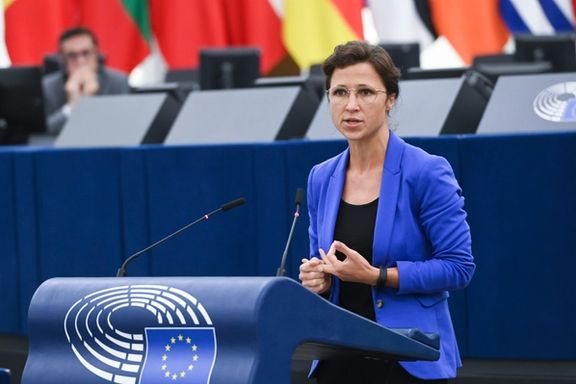
Germany's Hannah Neumann a strong proponent of listing the IRGC speaking in the European Parliament

The European Parliament overwhelmingly passed a resolution Thursday calling on the EU and member states to designate Iran’s Revolutionary Guard as a terrorist group.

The resolution demands Iranian authorities end the crackdown on popular protests that started last September after a 22-year-old woman was killed in hijab police custody.

It also demands that Europe should sanction the Islamic Republic’s Supreme Leader Ali Khamenei and its president Ebrahim Raisi.

The issue of adding the Revolutionary Guard (IRGC) to the list of Europe’s terrorist entities became a rallying point for the Iranian diaspora, which launched online campaigns and held a large protest in Strasbourg on January 16 to lobby the European Parliament for passing the resolution.

MEPs demand that all those responsible for human rights violation should face EU sanctions and the IRGC should be on the EU terrorist list.

The resolution is not binding on the European Council that defines the general political direction and priorities of the European Union andcan make final decisions on sanctions.

The European Parliament’s resolution urgesthe EU to expand its sanctions list to cover all individuals and entities responsible for human rights violations and their family members, including Supreme Leader Ali Khamenei, President Ebrahim Raisi, Prosecutor General Mohammad Jafar Montazeri and all foundations (‘bonyads’) linked to the Islamic Revolutionary Guard Corps (IRCG).

It also calls on the Council and the member states to add the IRGC and its subordinate forces, including the paramilitary Basij militia and the Quds Force, to the EU terrorist list. Any country in which the IRGC deploys military, economic, or informational operations should sever and outlaw ties with this entity.

The IRGC played a major role in suppressing antigovernment protests in the past four months, overseeing several security agencies that have killed over 500 civilians, jailed over 20,000 people and inflicted lasting injuries on hundreds of people.

Reports, however, say that the European Union foreign policy chief Josep Borrell is not in favor of sanctioning the IRGC, concerned that the Islamic Republic will not be forthcoming in nuclear talks with the West.

Negotiations that began in April 2021 to revive the 2015 Iran nuclear deal, known as the JCPOA, came to a deadlock in September. In the meantime, Tehran has supplied kamikaze drones to Russia, which are used in attacks on Ukraine’s civilian infrastructure.

The Islamic Republic and its officials, extremely concerned about IRGC’s designation, have been warning Europe in recent days against “the consequences” of such a decision.

The resolution also calls on Tehran in “strongest terms” to stop the execution of detained protesters. So far, the government has hanged four young men after sham trials. It also urges “the authorities of the Islamic Republic to ensure the immediate and unconditional release of all protesters sentenced to death and condemn the fact that criminal proceedings and the death penalty have been weaponized by the regime to stamp out dissent and to punish people for exercising their basic rights.”

The European Parliament also condemned Iran’s military assistance to Russia and its “transnational repression carried out by the authorities of the Islamic Republic, which includes espionage and assassinations, against the Iranian diaspora living in the EU. They call on the EU and the member states to protect those affected more robustly against such repression.”

Most Viewed

US blockade enters murky phase as tankers spoof signals and buyers hesitate
1
ANALYSIS

US blockade enters murky phase as tankers spoof signals and buyers hesitate

2

US tightens financial squeeze on Iran, warns banks over oil money flows

3
INSIGHT

Ideology may be fading in Iran, but not in Kashmir's ‘Mini Iran'

4
INSIGHT

Hardliners push Hormuz ‘red line’ as US blockade tests Iran’s leverage

5
VOICES FROM IRAN

Hope and anger in Iran as fragile ceasefire persists

Banner
Banner

Spotlight

  • Hardliners push Hormuz ‘red line’ as US blockade tests Iran’s leverage
    INSIGHT

    Hardliners push Hormuz ‘red line’ as US blockade tests Iran’s leverage

  • Ideology may be fading in Iran, but not in Kashmir's ‘Mini Iran'
    INSIGHT

    Ideology may be fading in Iran, but not in Kashmir's ‘Mini Iran'

  • War damage amounts to $3,000 per Iranian, with blockade set to add to losses
    INSIGHT

    War damage amounts to $3,000 per Iranian, with blockade set to add to losses

  • Why the $100 billion Hormuz toll revenue is a myth
    ANALYSIS

    Why the $100 billion Hormuz toll revenue is a myth

  • US blockade targets Iran oil boom amid regional disruption
    ANALYSIS

    US blockade targets Iran oil boom amid regional disruption

  • Iran's digital economy battered by prolonged blackout
    INSIGHT

    Iran's digital economy battered by prolonged blackout

•
•
•

More Stories

Fears Growing Over Health Of French-Irishman Imprisoned In Iran

Jan 19, 2023, 09:21 GMT+0

A French diplomatic source says the health condition of the Irish-French prisoner Bernard Phelan, who is behind bars in Iran, is deteriorating.

Bernard Phelan was arrested on October 3 during anti-regime protests that have swept the country following the death of Mahsa Amini in police custody on September 16.

His family says he has been on hunger strike since the beginning of the New Year and has even stopped taking medication for a heart condition. He is also refusing water.

Bernard Phelan, 64, who is a travel consultant has been accused by the Islamic Republic of "propaganda against the establishment" and "photographing police and security officers". He is imprisoned in Vakil Abad prison in Mashhad northeast of Iran.

"He is showing serious signs of physical and psychological exhaustion" added the official, saying despite repeated requests of the governments of France and the Republic of Ireland to release him for medical reasons, the Islamic Republic has refused to do so.

Phelan’s sister, Caroline Masse-Phelan, told AFP Wednesday that her brother was an innocent man detained for reasons "beyond our comprehension."

She said his health condition meant he had to be released urgently.

"It's a matter of days. He's an innocent man caught in the middle of I don't know what. He loves Iran, he is 64, sick, and wants to go home," she said.

"I think he is part of a group of Europeans imprisoned for political reasons ... of which I know nothing," his sister added. "We have nothing to do with this story."

Several foreigners visiting Iran have disappeared during the nationwide protests, confirming earlier reports that the Islamic Republic is taking foreign citizens hostage.

In Phone Call To EU Iran Warns Not To List IRGC As Terrorist

Jan 19, 2023, 08:28 GMT+0

Iran warned the European Union on Thursday against listing the Revolutionary Guard (IRGC) as a terrorist entity, amid a strong push by European politicians.

Foreign Minister Hossein Amir-Abdollahian told the EU's High Representative for Foreign Affairs Josep Borrell that the EU will "shoot itself in the foot" state media said.

"We have repeatedly said the Revolutionary Guards are a formal and sovereign organization whose role is central for guaranteeing Iran's security. Steps taken by the European Parliament to list the organization as terrorist are in a way a shot in the foot of Europe itself," Iran's foreign minister said.

On Wednesday the European Parliament in an overwhelming vote called for the EU to list the Revolutionary Guard as a terrorist organization, blaming it for the repression of domestic protesters and the supply of kamikaze drones to Russia's military, which uses it to attack Ukraine’s civilian infrastructure.

While the regime in Tehran insists that the IRGC is the country’s formal military organization and should be immune from sanctions by other states, the entity engages in widespread unconventional activities, such as domestic repression and foreign interferences in region countries. It maintains a domestic intelligence organization and prisons for dissidents, as well as engages in torture and other human rights violations.

Widespread anti-government demonstrations erupted in Iran in September after the death of Kurdish Iranian woman Mahsa Amini, who had been detained over flouting the strict dress code imposed on women.

The European Parliament condemned the crackdown on protesters by Iran's security forces, led by the powerful Revolutionary Guard Corps, as "brutal".

These security and intelligence forces have killed around 500 civilians during the protests, maimed hundreds of other, jailed thousands and executed for detainees.

Both the resilience of the protest movement and the strong foreign reactions to government brutality have posed the most serious challenge to the clerical regime in Iran since its establishment in 1979.

The US State Department Wednesday refused to comment on specific steps by the EU, but spokesperson Ned Price told reporters, “What – where we do see eye to eye with our European partners is a recognition that Iran is the world’s leading sponsor of terrorism. There is no more nefarious exporter of international terrorism than Iran. There is no disagreement between the United States and our European allies on this.”

"It is necessary to respect mutual security in the world of diplomacy and increase mutual trust instead of following the language of threats and unfriendly actions. In any case of a terrorist listing, Iran will take reciprocal measures," Amir-Abdollahian said.

The foreign minister’s remarks contradict the behavior of Islamic Republic officials who for decades have threatened the West, Israel and some Arab regional countries.

Iran and world powers, including EU members France and Germany, have engaged in negotiations since 2021 to revive a 2015 nuclear deal, with discussions in a stalemate since September.

Iran’s Judiciary Claims 98% Of Detained Protesters In Tehran Released

Jan 18, 2023, 17:56 GMT+0
•
Iran International Newsroom

Iran’s judiciary spokesman claims about 98 percent of those arrested in Tehran province during the nationwide protests have been released, without mentioning a total number.

Masoud Setayeshi said Wednesday that a total of 5,200 people arrested in the capital Tehran have been freed.

Setayeshi had previously announced 1,200 detained demonstrators across the country had been released, alleging that “a population of about 4,000 people are now freed from prisons throughout the country.”

However, he did not provide any details about the current legal status of the 5,200 people and refused to say how many of them been released on bail or awaiting trial.

The judiciary spokesperson noted that the number of detainees released in Tehran province is "98.5% and it seems to be the same across the country".

It is not clear what the reason for this ambiguity is, but if the percentage is true, the total number of detainees based on the claim of the Judiciary spokesperson is less than 5,500 people, which is so different from the numbers provided by human rights organizations.

Some human rights sources say between 19,000 and 20,000 people have been detained during the suppression of the protests following the death of Mahsa Amini in police custody four months ago.

Iranian protesters (file photo)
100%
Iranian protesters

However, all those who are released have emphasized their release is "temporary" and on bail.

According to a part of the Fars news agency's confidential bulletins that were leaked last month, "29,400 people" had been arrested during the recent protests in Iran.

Setayeshi also talked about the execution of the British-Iranian national Alireza Akbari, but without mentioning the details of the case, he called the UK’s strong reaction a sign of "the malevolence of the British government."

Alireza Akbari was one of Iran's senior military and defense officials in early 2000s. He travelled to Britain with his family and became a citizen of the UK, but the Iranian regime claims granting him the citizenship was a "reward" for "espionage".

Akbari was arrested in 2019 while travelling from the United Kingdom to Iran and sentenced to death for spying for Britain.

On January 14, the Iranian Judiciary announced Akbari had been hanged after having been convicted of espionage.

Setayeshi said that his execution was a sign of Iranian Judiciary’s “strength and sensitivity,” adding, “

British Prime Minister Rishi Sunak condemned Akbari's execution, saying “this was a callous and cowardly act, carried out by a barbaric regime with no respect for the human rights of their own people.”

Elsewhere in his remarks, Setayeshi once again accused detained Belgian national Olivier Vandecasteele of “espionage” stressing that there will be no "concessions" in his case.

Vandecasteele, who was detained in 2022, has been sentenced to 40 years in prison in a secret trial without a fair chance to defend himself.

He worked in Iran for humanitarian organizations for more than six years and left the country. Later, he was lured back by “a girlfriend” and was detained in February 2022.

Belgium and Vandecasteele’s family believe he is innocent and a victim of hostage taking by the Iranian regime. They say Tehran intends to force Brussels to release Iranian diplomat Assadollah Assadi who was sentenced to 20 years in prison in Belgium in 2021.


EU's Von der Leyen Backs Listing Iran's Guards As Terrorist Group

Jan 17, 2023, 16:33 GMT+0

European Commission President Ursula von der Leyen said Tuesday she backed listing Iran's Revolutionary Guards (IRGC) as a terrorist organization.

She emphasized that the step would be a necessary response to the "trampling" of "fundamental human rights" in the country.

Iranians living in Europe held a large rally on Monday in Strasbourg outside the European Parliament to demand the listing of the IRGC as a terrorist group.

Many politicians in the European Union have voiced support to proscribe the IRGC. The British House of Commons last week voted to urge the government to designate the group as terrorist.

Ties between the EU member states and Tehran have deteriorated in recent months as efforts to revive nuclear talks have stalled. Tehran has detained several European nationals and the bloc has become increasingly critical of a continuing violent crackdown on protesters, including executions.

"The reaction of Iran regime is atrocious and horrible, and they are trampling over fundamental human rights," she told reporters on the sidelines of the World Economic Forum in the Swiss ski resort of Davos.

The European Union is discussing a fourth round of sanctions against Tehran over the crackdown and Iran's supply of weapons to Russia. Diplomatic sources have said members of the Islamic Revolutionary Guard Corps (IRGC) will be added to the sanctions list next week.

The IRGC leads most government forces in Iran that have used deadly violence against protesters. More than 500 civilians have been killed in four month of unrest by security forces using beatings, shotguns and even military weapons.

Iranian, Belgian FMs Hold Phone Calls Reportedly For Prisoner Swap

Jan 17, 2023, 16:20 GMT+0
•
Iran International Newsroom

Amid simmering tensions over the fate of a Belgian aid worker sentenced to 40 years in prison in Iran, the foreign ministers of the two countries are in constant contact.

Belgium's Foreign Minister Hadja Lahbib and her Iranian counterpart Hossein Amir-Abdollahian held two phone conversations on Saturday and Monday – January 14 and 16. In the readout of both calls, the Islamic Republic’s foreign ministry did not mention the case of the aid worker and only said the two diplomats discussed bilateral ties and ways to expand cooperation as well as latest state of consular cooperation between the two countries. 

Earlier in the month, the Islamic Republic’s judiciary sentenced Olivier Vandecasteele, who was detained in 2022, to 40 years in prison and 74 lashes for alleged “spying and cooperation with the United States, money laundering and currency smuggling $500,000 out of Iran.”

Vandecasteele, 41, has served in various international humanitarian organizations since at least 2006, including, Médecins du Monde, Norwegian Refugee Council (NRC), and Relief International. He worked in Iran for humanitarian organizations for more than six years and left the country. Later, he was lured back by “a girlfriend” and was detained in February 2022. A spokesman for Vandecasteele’s family announced in December that he has been sentenced to 28 years in prison.

Belgian aid worker Olivier Vandecasteele (file photo)
100%
Belgian aid worker Olivier Vandecasteele

However, according to French daily Libération, Tehran has explicitly informed Belgium that Vandecasteele will only return to his country only if Asadollah Asadi -- an Iranian diplomat imprisoned in Belgium, returns to Iran. Assadi, 50, a former attaché at the Iranian embassy in Austria, was convicted of plotting to bomb a gathering of the exiled opposition group Mujahedin-e Khalq Organization (MEK) near Paris on June 30, 2018. He is currently serving a 20-year sentence in Belgium for “attempted murder and involvement in terrorism.”

Earlier in the year, the Belgian parliament passed a law proposed by the government about a prisoner exchange treaty between Tehran and Brussels, creating an uproar in the international community since it could lead to the release of Assadi, and potentially turning Belgium to a safe haven for the agents of the Islamic Republic to operate in Europe. Numerous people and groups from around the world warned about the imminent perilous consequences of the prisoner exchange treaty, calling it “the green light to state terrorism” that only emboldens the Islamic Republic.

The phone conversations between Lahbib and Amir-Abdollahian took place a few days after the Belgian minister vowed at the parliament that her ministry would do its best to improve the conditions of Vandecasteele in prison and work for his release. She said her ministry is doing everything it can for the release of Vandecasteele noting that they have stepped up diplomatic efforts and are exhausting all possible leads. 

Asadollah Asadi, an Iranian diplomat imprisoned in Belgium
100%
Asadollah Asadi, an Iranian diplomat imprisoned in Belgium

However, according to the Brussels Times, the liberal party in the parliament deemed such promises insufficient and called on Lahbib to travel to Iran and increase the political pressure on the Islamic Republic’s authorities about his case. 

Belgium and Vandecasteele’s family believe he is innocent and a victim of hostage taking by the Iranian regime.

In the past years, 49 European citizens have been arrested in Iran. Eighteen of them are still in prison, including the Belgian citizens. Two of them have been killed: one has been executed and one died due to lack of medical access.

There were speculations that the prisoner swap agreement would lead to Asadi’s exchange with Swedish-Iranian professor Ahmadreza Djalali (Jalali), who was arrested during a working visit to Iran about seven years ago. He was sentenced to death in October 2017 on charges of spying for Israel.

Amnesty International released a detailed research and analysis paper in May to prove that Iranian authorities were threatening to execute Djalali to compel Belgium and Sweden to hand over Asadi and Hamid Nouri who is in prison in Sweden for involvement in mass execution of prisoners in 1980s, and “to deter them and others from future prosecutions of Iranian officials”.

UN experts and international human rights organizations say that the Islamic Republic takes foreigners hostage to extract concessions from the West.