• العربية
  • فارسی
Brand
  • Iran Insight
  • Politics
  • Economy
  • Analysis
  • Special Report
  • Opinion
  • Podcast
  • Iran Insight
  • Politics
  • Economy
  • Analysis
  • Special Report
  • Opinion
  • Podcast
  • Theme
  • Language
    • العربية
    • فارسی
  • Iran Insight
  • Politics
  • Economy
  • Analysis
  • Special Report
  • Opinion
  • Podcast
All rights reserved for Volant Media UK Limited
volant media logo

US Nods $6b To Iran Amid EU Concern For Swedish Hostage In Tehran
Iran International Newsroom
Sep 12, 2023, 07:35 GMT+1Updated: 18:08 GMT+1
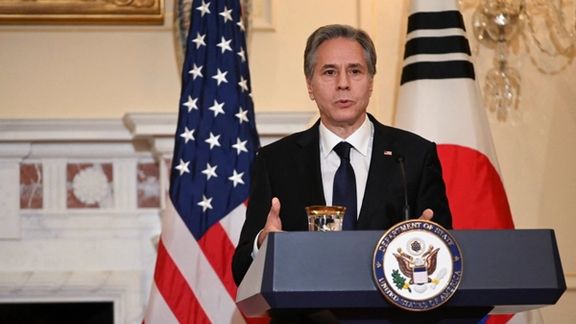
US Secretary of State Antony Blinken - FILE PHOTO

US Secretary of State Antony Blinken has signed a sanction waiver to allow the release of $6 billion of Iran’s frozen assets in a hostage release deal with Tehran.

The move will allow the funds blocked in two South Korean banks to reach Qatar without violating US banking sanctions imposed on Iran. According to the State Department document, Secretary of State Blinken determined that waiving the sanctions was in the national security interests of the United States.

Sources told AP that Blinken had approved the waiver last week, but Congress was only informed on Monday.

Both Washington and Tehran since announcing the prisoner release deal in August were hinting that the prisoner release deal and the unblocking of the funds were separate issues, but the waiver document clearly links the two as one agreement.

"Allowing these funds to be transferred from restricted Iranian accounts held in the (Republic of Korea) to accounts in Qatar for humanitarian trade is necessary to facilitate the release of these US citizens," the document said.

The news about the waiver came hours after an EU Commissioner expressed deep concern over the situation of Johan Floderus, a Swedish diplomat detained in Iran more than 500 days ago.

Johan Floderus, a Swedish diplomat detained in Iran
100%
Johan Floderus, a Swedish diplomat detained in Iran


Floderus seems to be yet another victim of Iran's 'hostage diplomacy'. His case was kept secret for a long time by Sweden and the European Union in the hope that silence would secure his release.

On Monday, Ylva Johansson, the EU Commissioner previously responsible for Floderus's work, publicly addressed his case for the first time. "I'm very sad. I'm very worried," she said, “let’s hope that we can have him home soon”.

The long-kept secret of Floderus' plight first came to light in a New York Times report on 1 September. Shortly after, his family broke their silence and set out some details of his mistreatment in prison, including 24-hour lighting in the cell and over 300 days in solitary confinement.

Floderus turned 33 in prison last week.

In a statement published by a Swedish newspaper, Floderus’ family said he had spent some time in Iran on EU official business and had no issues. Sometime in early April 2022, he went back to Iran for vacation with his Swedish friends. On 17 April, he wanted to fly back home but was detained at Tehran’s international airport.

It’s not clear if Floderus had been advised against traveling to Iran on a personal capacity.

He has now joined a long list of foreigners and Iranian dual-nationals who in recent years have been detained in Iran and used as bargaining chips to force prisoner exchange or financial concessions.

Early August, four US dual-nationals were released from prison into house arrest in Tehran. Blinken said at the time that the move was the first step of a process to fly them home.

Opponents of the prospective deal say it encourages the Islamic Republic to detain more American and EU citizens.

Michael Rubin, a senior fellow at the American Enterprise Institute and a former Pentagon official, is a vocal critic of what seems to be the current EU/US policy towards Iran.

In a piece for Washington Examiner on Monday, he wrote: "When Iran brings a gun, Biden and his European partners wave cash. No wonder it is open season for Americans and Europeans worldwide."

Rubin lamented the 500-day silence over Johan Floderus' detainment and suggested that the authorities in Iran are looking to "trade him for Hamid Nouri".

Nouri is a former official of the Islamic Republic Judiciary who was arrested in Sweden and is now serving a life sentence for his involvement in the mass execution of up to 5,000 Iranian political prisoners in 1988.


Most Viewed

Iran negotiators ordered to return after internal rift over Islamabad talks
1
EXCLUSIVE

Iran negotiators ordered to return after internal rift over Islamabad talks

2
ANALYSIS

US blockade enters murky phase as tankers spoof signals and buyers hesitate

3
ANALYSIS

Why the $100 billion Hormuz toll revenue is a myth

4

US tightens financial squeeze on Iran, warns banks over oil money flows

5
ANALYSIS

US blockade targets Iran oil boom amid regional disruption

Banner
Banner

Spotlight

  • Hardliners push Hormuz ‘red line’ as US blockade tests Iran’s leverage
    INSIGHT

    Hardliners push Hormuz ‘red line’ as US blockade tests Iran’s leverage

  • Ideology may be fading in Iran, but not in Kashmir's ‘Mini Iran'
    INSIGHT

    Ideology may be fading in Iran, but not in Kashmir's ‘Mini Iran'

  • War damage amounts to $3,000 per Iranian, with blockade set to add to losses
    INSIGHT

    War damage amounts to $3,000 per Iranian, with blockade set to add to losses

  • Why the $100 billion Hormuz toll revenue is a myth
    ANALYSIS

    Why the $100 billion Hormuz toll revenue is a myth

  • US blockade targets Iran oil boom amid regional disruption
    ANALYSIS

    US blockade targets Iran oil boom amid regional disruption

  • Iran's digital economy battered by prolonged blackout
    INSIGHT

    Iran's digital economy battered by prolonged blackout

•
•
•

More Stories

Leaders Advise Iranian Jews To Maintain Low Profile For Rosh Hashanah

Sep 11, 2023, 23:17 GMT+1
•
Benjamin Weinthal

The one-year anniversary of Mahsa Amini’s murder coincides with the Jewish New Year on September 16, prompting community leaders to warn Jews to stay off the streets.

In a Telegram posting from Iran’s Jewish community on Sunday, the leadership wrote “All worshipers are strongly requested to refrain from stopping and gathering in the streets for any reason during Rosh Hashanah and after performing religious duties in synagogues.”

Alireza Nader, an Iran scholar based in Washington, DC, told Iran International, “The remaining few members of the Jewish community in Iran live in constant fear. Any sort of public pronouncement or guidance from their leadership should be seen in light of the community’s extreme vulnerability.” Nader has written about the persecution of Iranian Jews.

Beni Sabti, an expert on Iran from the Israeli National Security and Strategy Institute, who first located the Telegram post, told Iran International that the Jewish leadership is “worried that Jews can be in trouble if they stay in the streets” and urged them “to rapidly go from the synagogues to their houses.”

Sabti is a Tehran-born Jew who speaks fluent Persian and has extensively documented the Iranian regime’s repression of the country’s tiny Jewish population, which is estimated to number 9,000 members.

An Iranian woman walking past a Hanukkah menorah symbol   (file photo)
100%
An Iranian woman walking past a Hanukkah menorah symbol

In April, Iran International reported that the Islamic Republic ordered Jews to participate in the antisemitic al-Quds Day rally during the Jewish holiday of Passover.

Sabti said the situation with Rosh Hashanah is comparable to Passover because the Jewish leadership said at the time on its Telegram platform: “Please do not go for picnics or enjoyable activities on al-Quds Day.”

Sabti added, “It is like al-Quds Day. They have to show their loyalty. They use delicate words. They use the kind of words that the regime can’t be upset with them for. The regime and Jews understand it.

They don’t say directly there are protests. This would be forbidden. They go around it. This is the kind of cultural talking for people with a Persian background in Iran.”

Prior to Iran’s Islamic revolution in 1979, Iran’s Jewish population numbered at least 100,000, most of whom fled after Ayatollah Ruhollah Khomeini seized power.

Iranian Jews preparing for prayers at the Abrishami synagogue at Tehran’s Palestine street   (undated)
100%
Iranian Jews preparing for prayers at the Abrishami synagogue at Tehran’s Palestine street

According to the Telegram post, the Jewish community wrote: “Coordination with the police force to create security and comfort for the grand ceremony of Rosh Hashanah .Respectfully, while congratulating in advance on Rosh Hashanah and wishing you a prosperous year, we inform you that by the grace of the Almighty and with the coordination made with the respected police force of Greater Tehran, the necessary arrangements have been made for the safety and comfort of our dear fellow believers for the celebration of the glorious and fateful day of Rosh Hashanah.” 

Sabti noted the “Iranian Jewish leadership complimented the Iranian regime police. This is what they have to do.” He says the Iranian Jewish community has to “show they are loyal to the Iranian regime.”

The Telegram post noted “The public relations of the Tehran Jews Association, while thanking the loved ones of the police force for their unquestionable and constant help, has no doubt that the Kalimi community will once again draw a line against the evil plans of Iran's enemies and celebrate the magnificent ceremony of Rosh Hashanah away from any sidelines.”

Anniversary of Islamic Republic’s founder Ruhollah Khomeini at Yusef Abad Synagogue in Tehran (undated)
100%
Anniversary of Islamic Republic’s founder Ruhollah Khomeini at Yusef Abad Synagogue in Tehran (Photo: Mehdi Marizad)

Sabti said the word Kalimi is a “polite word for Jewish” and “They don’t use the Jew because it means Zionist for the regime.” He said the Iranian word Kalimi can be loosely translated as the people from “Moses’s nation.”

Iran International exclusively reported in December that the Islamic Republic imposed pressure on religious minorities to compel them to condemn the uprising of the Iranian people following the murder of Amini in police custody.

Also in December, the regime arrested five Iranian Jews during the nationwide protests.

Iran’s regime and its foreign policy are based on an antisemitic world view, according to experts on the Middle East. The Middle East Media Research Institute (MEMRI) exposed Iran’s former foreign minister Mohammad Javad Zarif using an antisemitic term for Jews. “In a December 9, 2020 interview with Arman TV, Zarif used the antisemitic term for Jews – johood in Persian,” wrote MEMRI.

MEMRI noted, “A few days later, he attempted to cover up his statement with a dishonest attack on MEMRI. On December 16, he tweeted: ‘MEMRI has sunk to a new low in taking my pejorative usage of a word to accuse me of Antisemitism..."’

MEMRI added, “Foreign Minister Zarif is lying about Iran's positions on Jews and Israel. The MEMRI archives are full of research proving that the Iranian regime and its leaders are antisemitic and call openly for the annihilation of Israel.”

George Haroonian, one of the leading voices of the Iranian-Jewish community in the US, told Iran International "Contacting and coordinating with police in High Holidays is common practice wherever Jews are, but this announcement has some peculiar 'matters.' Who they mean by 'enemies' who might seize the occasion? Seems they are concerned about anti-Jewish elements within the country who might want to cause harm. As always, Jews are at the mercy of the regime."

He added, "I believe majority of Iranian people do not wish anything negative for Iranian Jewish community, but there is a minority who justifies their antisemitism based on variety of rationals. Based on Islamic beliefs as well as their hate for Israel."

Iranian Teenage Bride Murdered While Seeking Divorce

Sep 11, 2023, 20:44 GMT+1

A tragedy unfolded in Ravansar in the Iranian province of Kermanshah as a 14-year-old child bride, Mona Aghaie, lost her life at the hands of her own brother.

According to the Center For Human Rights In Iran, the victim had been seeking a divorce before her life was cut short. Apparently, the brother killed her to uphold the family's honor.

The death of Mona Aghaie is not an isolated incident. Individual acts of violence, often referred to as honor killings, remain alarmingly intertwined with certain societal beliefs and Iran's legal framework. Many perpetrators of such acts are not brought to justice, especially when they are family members of the victim. This is particularly true if the perpetrator is the victim's father.

Iran's Islamic Penal Code includes a provision that fathers, and paternal grandfathers cannot be sentenced to death for killing their child or grandchild. Instead, they may face prison sentences and the obligation to pay "blood money" to the next of kin, typically the mother if demanded. Moreover, mothers have the authority to forgive the murderer entirely, waiving the blood money.

In cases of particularly violent crimes or those deemed to harm society, judges have the authority to impose additional sentences "on behalf of the public." However, the prevalence of honor killings in certain parts of Iran persists, largely due to the Islamic Republic's lenient laws and light sentences, which can encourage such behavior.

Advocates and organizations dedicated to women's rights and human rights have been calling for immediate action to address these pressing issues and ensure justice for victims like Mona.

Israel Accuses Iran Of Establishing Airport In Southern Lebanon

Sep 11, 2023, 19:40 GMT+1

Israeli Defense Minister Yoav Gallant has leveled accusations against Iran, alleging the establishment of an airport facility in southern Lebanon.

Gallant asserted Monday that Iran's intention behind establishing the airport is to facilitate potential attacks against Israel.

Addressing an international security conference hosted by Reichman University, Gallant presented evidence in the form of aerial images of the alleged site. According to the defense minister, the site is strategically situated approximately 20 kilometers (12.4 miles) from the Israeli border town of Metulla and possesses the capacity to accommodate mid-sized aircraft.

The backdrop to this accusation is the current control of southern Lebanon by Hezbollah, an armed militant group backed by Iran, with which Israel engaged in a war in 2006. Recent months have witnessed a resurgence of tensions in the region, raising concerns about regional stability and renewed large-scale armed conflict.

For Iran's clerical regime, Lebanon serves as a foothold dominated by Hezbollah, affording them the means to threaten Israel. While many Shiites view Iran as a source of financial support, a significant portion of Lebanon's Christian and Sunni populations resent Hezbollah and Iran's growing influence.

The founder of the Islamic Republic of Iran, Ayatollah Ruhollah Khomeini and his successors, have consistently expressed enmity towards Israel and have repeatedly called for its destruction over the years. Iran's arming of Hezbollah with a substantial arsenal of rockets and missiles further compounds the security challenges, directly threatening Israeli cities due to Hezbollah's operational presence in Shiite-dominated southern Lebanon.


UN Nuclear Watchdog Confirms US-Iran Nuclear Talks

Sep 11, 2023, 15:27 GMT+1
•
Iran International Newsroom

The head of the UN's nuclear watchdog, IAEA's Rafael Grossi, has said that bilateral talks between Iran and the United States could "provide clarity" and be beneficial.

Speaking at a news conference on Monday, Grossi acknowledged that Washington has informed the International Atomic Energy Agency of confidential talks with Iran, but he clarified that he is not privy to the details.

“We are aware that there is a bilateral process of sorts. We have been informed by the United States about this…and cooperation is good.” However, he commented on the nuclear part that "we are not clear about" what is being discussed/agreed. He also added that Washington might be discussing the 2015 JCPOA nuclear deal with Tehran but the IAEA has a host of outstanding issues with Iran, including monitoring of its nuclear activities.

He cautioned that his agency is not happy with how relations with Iran progress on the outstanding nuclear issues and has expressed its concerns in reports to the Board of Governors of the IAEA, as they hold their quarterly meeting this month.

UN nuclear watchdog chief Rafael Grossi waits for the start of International Atomic Energy Agency 's (IAEA) 35-nation Board of Governors meeting in Vienna, Austria, September 11, 2023.
100%
UN nuclear watchdog chief Rafael Grossi waits for the start of International Atomic Energy Agency 's (IAEA) 35-nation Board of Governors meeting in Vienna, Austria, September 11, 2023.

Iran and the United States announced a hostage release deal last month that also included the release of $6 billion in Iranian funds blocked South Korea due to US sanctions. Earlier, the US had also agreed to Iraq releasing $2.7 billion of its energy debts to Iran. 

Western media began reporting that talks between the two countries go beyond a prisoner release agreement and the two sides are engaged in a “de-escalation” effort. Washington will allow the gradual release of all Iranian frozen funds, estimated to be around $20 billion and Iran would slow down its uranium enrichment.

The IAEA has reported to member states that Iran’s pace of enriching uranium to 60-percent purity has slowed in recent weeks, which could signal an understanding with the United States to de-escalate.

Asked about IAEA not having access to the data of monitoring cameras re-installed at an Iranian nuclear facility in Esfahan (Isfahan) in June, he acknowledged the reality and said that the issue is open for negotiations with Iran, but “at this time we are nowhere near this point,” Grossi announced. He acknowledged that the data from the cameras are important and “we need to reconstruct” what transpires at Natanz “as a baseline.”

Mohsen Naziri-Asl, Iranian ambassador to the IAEA, arrives for the start of International Atomic Energy Agency 's 35-nation Board of Governors meeting in Vienna, Austria, September 11, 2023.
100%
Mohsen Naziri-Asl, Iranian ambassador to the IAEA, arrives for the start of International Atomic Energy Agency 's 35-nation Board of Governors meeting in Vienna, Austria, September 11, 2023.

Behrouz Kamalvandi, the spokesman of Iran’s atomic agency, was quoted by local media June 15 as saying that ten of these cameras were re-installed in Esfahan’s Natanz facility, which is a major enrichment center, and apparently has a centrifuge production facility making the machines used in uranium enrichment.

Grossi also asked for more support from member states, emphasizing that IAEA depends on states to do its job.

Trade Offers Economic Diplomacy Channel Between UAE And Iran

Sep 11, 2023, 13:05 GMT+1
•
Iran International Newsroom

As diplomatic ties between the United Arab Emirates and Iran strengthen, economic and trade ties are also growing.

The two countries resumed diplomatic relations last year, the UAE sending its ambassador back to Tehran after six years of Cold War style ties.

The UAE downgraded its ties with Iran after Saudi Arabia severed its own relations with Tehran in January 2016. The move followed the storming of the Saudi embassy in Tehran by Iranian protesters after Riyadh executed a prominent Shiite cleric.

After years of animosity on different sides of geo-political rivalries, the UAE started re-engaging with Tehran in 2019 following attacks in Gulf waters and on Saudi energy sites amid heightened tensions after Washington quit global powers' nuclear pact with Iran.

In recent months, the UAE has rolled back limits on corporate registrations and the issuance of visas to companies from Iran, which remains subject to tough US sanctions. Iranian financiers are also exploring how to enhance bilateral trade by creating financial mechanisms to fund legitimate transactions, the Financial Times reported Sunday.

Iranian Foreign Minister Hossein Amir-Abdollahian (left) and his Emirati counterpart Abdullah bin Zayed Al Nahyan in Abu Dhabi (June 2023)
100%
Iranian Foreign Minister Hossein Amir-Abdollahian (left) and his Emirati counterpart Abdullah bin Zayed Al Nahyan in Abu Dhabi (June 2023)

The UAE, a traditional center for re-exports into the Islamic Republic, offers a boon to the two countries’ ties, which continue to be blighted by geopolitical tensions including disputed islands which both claim to be their territory, and Iran’s ongoing nuclear ambitions. Around half a million Iranians live in the country, one of the biggest centres for the Iranian diaspora after the US.

UAE diplomatic outreach to Iran since 2019, in response to attacks on international shipping around the Gulf, has been strengthened by the China-brokered breakthrough this year that re-established relations between the Islamic republic and its traditional foe Saudi Arabia.

China remains the regime’s top trade partner but the UAE is its second, according to The Financial Times, which claims trade between Iran and the UAE has recovered from a pandemic slump of $11bn in 2020/2021 to $24bn in the 12 months ending in March, according to Iranian data.

The increase surpasses the $22bn recorded in 2012 before US-led sanctions started to bite. Iranian officials have said they are now targeting a further increase in bilateral trade towards $30bn in the next two years.

“Pressure from the UAE central bank has decreased and some Emirati banks have started opening bank accounts,” said Masoud Daneshmand, a former head of Iran-UAE chamber of commerce, speaking to the FT.

“Currently, some Iranian companies which used to be in the UAE but had become inactive have become active again. Some new companies have also started business.”

Sanctions against Iran have made the UAE wary, but not so wary as to stop business entirely. Just like their relationship with Russia, the show must go on.

Some Iranian companies and banks have used trustees in the UAE who can act as a proxy for cross-border transactions as a way of sidestepping the current restrictions. “When goods come from Europe and Canada to Iran’s market, an Emirati pays for them and Iranians pay the Emirati,” said Daneshmand, speaking to the FT, which claims even some Iranian banks are now approaching counterparts in the UAE in a bid to formalise the previously grey nature of their business.

However, the UAE’s newfound relationship with Israel, following the 2020 US-brokered Abraham Accords, has also created tensions between the two nations.

The UAE has deployed Israeli missile defense technology to protect against possible attacks, stepping up security in the wake of the country’s worst attack in its history in 2022, when Iranian drones killed three, in the hands of Houthi rebels, an Iran backed proxy in Yemen. The act was retaliation for the UAE’s support of Saudi in the Yemen war.

While the UAE largely remains quiet on sensitive topics on the public stage, in August, Hamad Alkaabi, the UAE's permanent representative to the UN's International Atomic Energy Agency (IAEA), made a rare public voicing "profound concern" regarding Iran's nuclear program and called on Tehran to cooperate fully with United Nations inspectors, stressing that Iran's uranium enrichment activities lacked "realistic peaceful uses.”

In July, Iran summoned Russia's ambassador over the islands dispute following a statement in which Russia and the Gulf Cooperation Council (GCC) issued a statement calling for a “a peaceful solution” to the dispute over the Abu Musa and Greater and Lesser Tunbs islands “in accordance with international law.” The dispute remains a thorn in the side to both countries which both lay claim to the territorial sovereignty.

If trade between the UAE and Israel is anything to go by, economics could well be the path to peace, offering the UAE a position of strength to do soft diplomacy behind the scenes.

Last year private trade between Israel and the UAE reached $2.56 billion, excluding software, putting the UAE at number 16 out of Israel’s 126 trading partners. In the first four months of 2023 trade reached $990 million. The expectation is that this will rise to around $3 billion by the end of the year. Such numbers could only be a dream for Iran, but act as a bitter carrot to Tehran, nonetheless.





