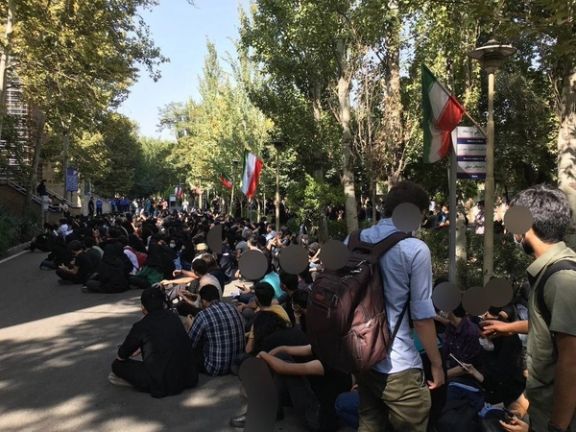
A protest by students at Dentistry Faculty of Tehran University of Medical Sciences in October 2022
An Iranian academic has argued that purging university professors and other similar measures will not calm the country’s volatile situation and can even backfire.
Bijan Abdolkarimi, a philosopher and academic who upholds an ontological world view rather than the Iranian regime’s Islamic ideology, made the comments in an interview published by the reformist Etemad daily Tuesday. At the same time, perhaps trying to protect himself, he denied being an opponent of the regime.
“The revolt of the [religious] masses and hardliners against the elite is one of the serious dangers to the Iranian Revolution,” he said in the interview that mainly focused on the recent purge of the academia and the announcements of several die-hard regime eulogist (maddah) having been invited to teach in universities.
The recent purge which some have dubbed as “homogenization” of the academia, limitations imposed on students, persecution of journalists and the parliament’s attempt to destroy independence of the country’s bar association, are examples of the campaign against the elite, he added. Persons and groups who “do not belong to the elite in any way” are seeking to find their way into the academia with the government’s help, he said.
Academic Bijan Abdolkarimi
Saeed Haddadian, one of the three maddahs who has gained a tutorial seat at Tehran University’s Literature and Humanities Faculty will be teaching “Analysing Resistance Verse”.
Resistance verse refers to poetry written about the Islamic Revolution and the eight-year-war with Iraq in 1980s.
The role of maddahs in Shiite mourning ceremonies is reciting the praises of the prophet and his companions and mourning the slaying of his grandson, Imam Hussein in the battle of Karbala, which in reality was a struggle over power in the nascent Islamic empire in the seventh century.
In the past, most maddahs had very low education or were even illiterate but in recent years some have gained university degrees, mainly in religion-related or humanities fields with the establishment’s support.
The 58-year-old Haddadian holds a PhD in Quran and Hadith and has previously been a tutor of subjects such as Islamic Revolution and Quran Interpretation at the same university. He is one of the maddahs who is often invited by Supreme Leader Ali Khamenei to perform at his own religious ceremonies on special occasions.
During his three-decade rule Khamenei has hugely encouraged the growth of the maddah establishment against the seminary-educated clerics. Less educated or even illiterate maddahs whose role was singing mourning songs in graveyards at funerals or during religious mourning occasions for a small fee have now attained high status and political influence. The majority are aligned with hardliners.
“These methods [Islamification of the academia] will not calm the country’s fueled circumstances but will rather make it worse,” Abdolkarimi said while pointing out that there is a massive class gap in the Iranian society where the middle class as “the engine of development” is excluded from involvement in decision-making by the state controlled by the hardliners.
The purge of academia, which is now being referred to by some pundits as ‘the second cultural revolution’, has shaken many Iranians who are already grappling with various pressures. The purge comes amid loss of hope in improvement of the country’s circumstances, including its economy, better relations with the international community and removal of sanctions, as well as even relative social and political freedom.
It appears from social media posts that loss of hope has even affected some religiously people who formerly supported the establishment for ideological reasons. Financial corruption and same-sexvideo scandals involving regime officials could have been the last blow to those whose world-view is centered around Sharia laws and had so far put up with economic pressures for “the greater good” of the society.
Among those who have lost hope, particularly the younger generation from all walks of life, emigration seems the only option for a better life. A recent poll by the US-based Statis Consulting found that almost half of Iranian youth want to leave the country amid pessimism about their future.
“All around me there are people who are emigrating, who never wished or liked to leave. I wish you [the Islamic Republic] were gone and all of these people stayed,” an anonymous person wrote in a post.
Mowlavi Abdolhamid, the Sunni Friday prayer leader in Zahedan
Mowlavi Abdolhamid, the Sunni Friday prayer leader in Zahedan, has expressed deep concern over the recent deaths of prisoners, including that of Javad Rouhi.
Speaking on Wednesday, Abdolhamid stated, "The sudden deaths of certain detainees, both during their incarceration and after their release, have left a profoundly negative impression on the international stage, exacerbating pessimism."
Rouhi, a prominent figure in the Woman, Life, Freedom movement, is the latest activist to have passed away in prison last week, purportedly due to a "seizure," as claimed by Iranian judicial authorities, his death echoing the tragic circumstances which led to the death of Iranian-Kurd, Mahsa Amini, in morality police custody. Her death subsequently triggered a year of uprising against the regime.
Rouhi had become one of the most prominent faces of the recent Woman, Life, Freedom movement, and had been held at the northern Nowshahr prison and initially sentenced to death, a sentence later overturned by the Supreme Court, pending re-sentencing.
Amnesty International previously documented extensive instances of severe physical and psychological abuse during the young man's detention. His death has sparked outrage among Iranians demanding action, while international human rights organizations are urging a comprehensive investigation into the circumstances surrounding his death.
Calls for a United Nations investigation and international accountability measures against the Islamic Republic regime are growing louder among human rights organizations, while activists are rallying for a declaration of public mourning and nationwide protests in Rouhi's memory.
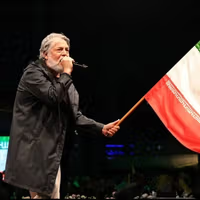
Iran's exiled prince Reza Pahlavi during a rally in Washington
Iran's exiled prince, Reza Pahlavi, has called on Iranians to unite and ignite new national protests on the anniversary of Mahsa Amini's death in morality police custody.
"We are a great nation; we will reclaim Iran", he said, as he called on the nation to rise up. In a video message, Pahlavi emphasized the necessity for millions of Iranians to take to the streets with the aim of "toppling the oppressive regime of Iran" as the key to achieving "the freedom and prosperity of the beloved country, Iran."
Pahlavi, who continues to be one of the most popular figures among Iranians to take over from the regime, called on the country's diverse population to join the uprising, including "laborers deprived of their wages for months, employees and retirees struggling with insufficient income, students and university professors facing expulsion and imprisonment, military personnel subjected to harassment by corrupt leaders, and police officers whose uniforms have been transformed into tools of suppression by the Islamic Republic".
Highlighting the ongoing plight of Iranians under the regime, he drew attention to the many areas of social, economic and political struggle, including censorship and religious oppression.
Last year's brutal crackdown by the regime during the protests following Amini's death, resulted in the deaths of over 500 civilians, with thousands more sustaining injuries and tens of thousands imprisoned. Pahlavi issued a warning to the Islamic Republic leaders, placing the responsibility fo any violence against the Iranian people squarely on their shoulders.
A woman stands on top of a car as protesters make their way toward the cemetery where Mahsa Amini is buried.
Six Kurdish political parties have jointly issued a call for a general strike on September 16, coinciding with the first anniversary of the tragic murder of Mahsa Amini who died in the hands of morality police.
In a show of unity, the parties emphasized that the people's movement for freedom in Iran has taken "irreversible and unstoppable steps" over the past year.
Expressing their solidarity with civil society activists and independent organizations, the parties have declared September 16th as the Day of General Strike throughout Kordestan. However, Iranians criticized the statement for announcing a strike on a national holiday, when businesses will be closed, and for not calling for protest rallies as many other activist groups have.
One of the actions planned for the day is a gathering at the gravesite of Mahsa and all the martyrs of the Woman, Life, Freedom movement in various cities and villages across Kordestan.
The authors of the statement have called upon women, youth, workers, teachers, retirees, environmental activists, and other segments of the population across Iran to actively participate in the general strike as a show of solidarity against the regime's brutality and oppression.
Prior to this, 27 institutions and groups had already issued similar calls for a global gathering on the same day, in honor of Kurdish-Iranian Amini, who was arrested for the inappropriate wearing of her hijab before dying in morality police custody from what evidence suggests were massive blows to the head.
Anti-regime protests in the city of Javanroud (Javanrud)
Two human rights groups have published a report shedding light on the Islamic Republic regime’s atrocities against protesters in Iran’s Kurdish regions.
In their comprehensive report sourced from the most recent evidence, Kurdistan Human Rights Network (KHRN) and the Center for Human Rights in Iran (CHRI) unveiled fresh insights into a series of harrowing events that unfolded during the crackdown on protests last fall and winter in the city of Javanroud (Javanrud) in western Kermanshah province.
The 100-page report, titled “Massacre in Javanrud,” is the result of an exhaustive examination of hundreds of photographs and videos, as well as interviews conducted with 38 eyewitnesses, victims' families, and individuals who were detained or injured from early October until the end of December 2022. The findings revealed disturbing accounts of tortures, severe beatings, mass detentions, and threats of sexual harassment against numerous protesters, including minors.
For several weeks after the death in custody of 22-year-old Mahsa Amini in mid-September, Iran's Kurdish-majority cities were also at the forefront of the protests that started with Amini’s hometown Saqqez. People in most Kurdish-populated areas in Kordestan, West Azarbaijan and Kermanshah provinces relentlessly protested and defied government forces.
The regime deployed military forces to these areas to quash the uprising, practically putting a military siege on several cities such as Javanrud. During last year’s protests, which lasted for months, over 500 people were killed by regime security forces and over 22,000 people were arrested.
Anti-regime protests in the city of Javanroud (Javanrud)
According to the report, security forces intentionally shot peaceful protesters in the Kurdish city of Javanrud with military-grade weapons, killing eight unarmed civilians, including one child, and injuring at least 80 protesters.
The wounded were beaten by security forces and prevented from receiving medical care without risking arrest. About 90 people, including 26 minors, were apprehended, and detained arbitrarily. A significant number of them endured physical abuse and torture during their time in custody. Furthermore, the families of those who were injured, killed, detained, or mistreated found themselves under state pressure to maintain silence.
Calling them “crimes against humanity,” the human rights groups said the heinous acts perpetrated by the agents of the regime were committed with the full knowledge and direction of state authorities, and included “deliberate and systematic killing, maiming, and abuse of unarmed civilians on a large scale.”
Anti-regime protests in the city of Javanroud (Javanrud)
The groups also called on the UN Human Rights Council’s International Independent Fact-Finding Mission on the Islamic Republic of Iran to fully investigate the events in Javanrud from October 2022 – January 2023.
“The international community should directly address the massacre and state crimes that took place in Javanrud, through every diplomatic, political, economic, and legal means available, including pursuing criminal responsibility for the perpetrators of these crimes through international courts or national judicial systems under the principle of universal jurisdiction,” the groups stressed.
Rebin Rahmani, a board member of KHRN, expressed concern about the increasing wave of arrests of Kurdish activists now taking place ahead of the anniversary of the uprising, noting that “The Islamic Republic feels there are no repercussions for their crimes in marginalized regions such as Kordestan and Sistan-Baluchestan, so it is intensifying its violent and unlawful suppression in these areas.”
CHRI executive director Hadi Ghaemi said, “As the one-year anniversary of the ‘Women Life Freedom’ protests approaches, the potential for renewed protest in Iran—and a violent state response aimed at crushing it—is high. The international community must remain extraordinarily vigilant, warning the Iranian authorities of intense political and economic consequences at the first sign of state violence.”
In anticipation of the anniversary of the protests, the Islamic Republic has intensified its intimidation campaign over the last several weeks, detaining family members of dead protesters, locking up activists, targeting community leaders, and escalating persecution of minority groups and academia.
A recent opinion survey has shown that the majority of Iranians follow news from foreign-based media outlets, with Iran International being their top choice.
The survey by the Netherlands-based Gamaan institute collected information from 38,445 people inside Iran about their views on media, revealing that only about 21 percent of the respondents followed the developments about Iran from the state-run Islamic Republic of Iran Broadcasting (IRIB).
This 10-day online survey titled "Iranians' Attitudes Towards Media in 1402 Persian Calendar Year” (started March 21), targeted literate individuals aged 19 and above, a sample from 90% of the country's adult population. GAMAAN, the Group for Analyzing and Measuring Attitudes in Iran, is an independent, non-profit research foundation, focused on Iranians’ attitudes towards social and political topics.
The survey explored key indicators such as the "most popular channel," the "most trustworthy channel according to the audience," and the "primary source for following news of protests in Mahsa's movement." The results indicate that more than half of the respondents consider Iran International as their primary source of information and news about Iran.
Iran International leads the pack with 54% cited as "often" or "sometimes" following the media outlet. Manoto TV garnered 42%, BBC Persian" 37%, IRIB 36%, and Voice of America Persian 34%. Additionally, about 32% claim to occasionally or more frequently watch Jam-e-Jam (the international bundle of IRIB channels) and 30% tune into MBC Persia. On the other hand, 48% of the population have stated that they never watch or listen to programs on the state broadcaster.
When asked, "Which media outlets did you primarily follow for news about recent protests in Iran?" 57% indicated they followed news from Iran International, 30% from Manoto, 26% from BBC Persian, and 20% from Voice of America. Approximately 19% also received news about the protests from the IRIB, the state broadcaster tightly reflecting the views of the regime's hardliners.
In response to a question regarding the level of trust in media outlets, 50% express "a great deal" or "some" confidence in Iran International, 44% in Manoto, 42% in Voice of America, 40% in Radio Farda, and 34% in BBC Persian. On the other hand, only about 21% of the population trust state-run IRIB, while 59% have stated that they have "no trust at all" in the regime’s broadcaster.
According to the results of this survey, 68% of the population "often" use social media networks for obtaining information and news about Iran and the world, while 35% are viewers of satellite channels, 12% rely on state broadcaster IRIB, and 8% tune into foreign radio for the news.
Among social media platforms, approximately 65% of the population "often" use Instagram, 46% use WhatsApp, 43% use Telegram, 17% use YouTube, 8% use domestic app Rubika, 8% use Twitter, 5% use Facebook, 3% use state-run platform Soroush, and 2% use Clubhouse for their online activities. All international social media platforms are blocked Iran, with people using VPNs to circumvent the censorship.
IRIB is tightly controlled by the office of Iran’s authoritarian ruler Ali Khamenei and has been losing its audience with its heavy religious programming and heavily censored news and biased programs. Critics say it is nothing but a propaganda toolwith a hefty government subsidy of at least $600 million and no accountability.
In June, the regime took one more step to tighten its control over entertainment content in line with its policy of enforcing religious restrictions on the population, gaining full control over content shown by privately-owned streaming services based on a decision taken by Iran's Supreme Cultural Revolution Council.
Streaming services such as Filimo, an online video on demand (VOD) service like Netflix, have gained great popularity in Iran where there are no privately-owned television networks. These services provided an opportunity for independent and sometimes dissident filmmakers and artists to showcase their work. The head of the state broadcaster (IRIB), hardliner Payman Jebelli, in a letter to President Ebrahim Raisi in January demanded that Filimo be blocked on the internet.
Earlier this year, NGO Reporters Sans Frontiers, ranked Iran 177/180 nations for press freedom, citing the arrest of 70 Iranian journalists since the death of Mahsa Amini as one example of the regime's crackdown on voices of dissent. Iran International's reporters were threatened earlier this year by IRGC and intelligence (MOIS) agents, forcing some to relocate from London to Washington amidst security threats. Iranian journalists abroad have also been deluged with threats to their lives.
This year's Freedom House report on global freedoms also ranked Iran 12th in the 100 least free countries in the world.