• العربية
  • فارسی
Brand
  • Iran Insight
  • Politics
  • Economy
  • Analysis
  • Special Report
  • Opinion
  • Podcast
  • Iran Insight
  • Politics
  • Economy
  • Analysis
  • Special Report
  • Opinion
  • Podcast
  • Theme
  • Language
    • العربية
    • فارسی
  • Iran Insight
  • Politics
  • Economy
  • Analysis
  • Special Report
  • Opinion
  • Podcast
All rights reserved for Volant Media UK Limited
volant media logo

Iran State Television Is Simply A Propaganda Tool, Critics Say

Iran International Newsroom
Apr 1, 2023, 07:01 GMT+1Updated: 17:36 GMT+1

Reformist commentator and seasoned journalist Abbas Abdi says the "Iranian state television is not a media outlet. It is a propaganda tool that has lost its influence."

Speaking to Jamaran News website, Abdi said that that the Iranian state TV wishes to be the only organization that sends messages to the people, but this is no longer possible.

Abdi argued that the state TV disseminates its ideological and propaganda programs and foreign-based Persian speaking media broadcast a different message, but it is the public who decides which one to follow and believe.

"Any media outlet that is used as a tool for political propaganda will lose its influence," Abdi said, adding that "the fact that the state TV sends messages does not mean that the nation will necessarily get those messages. The public in Iran has its own expectations and awaits messages that are based on those expectations." That probably is why the audiences welcome the messages that come from foreign-based media particularly when there are very few independent media outlets in Iran , he said.

Reformist journalist Abbas Abdi (undated)
100%
Reformist journalist Abbas Abdi

Abdi said, "Twenty years ago we used to tell the government that you cannot stop satellite television. Now we tell the officials that you cannot stop the Internet." He added that trying to stop the Internet is a mistake. "When the official media of a country is as inefficient as Iran's state TV, naturally foreign-based media take the lead," he said.

He further added, "The state television's performance is based on presenting narratives, not truth. And it fails to understand that five different reporters might tell the truth in five different ways without telling lies. The main material the media use is the truth."

Abdi said that social media have removed the borders between Iran and other countries. Nonetheless, what it presents is not exactly the truth or the whole truth. Those who are on social media do not necessarily represent the whole population. "It would be a mistake to generalize what you see on social media," he warned. "For example, social media has portrayed regime change as an easy task." He reminded that "You could be active on social media without your comments costing you too much. Of course, social media are part of the society, but you cannot reduce the society to what is going on social media platforms."

Abdi added that one of the reasons why social media are so effective is that the real world has many problems. Currently, he stressed, the Iranian government has lost the war of narratives to foreign-based media.

A March 30 report on Khabar Online website assessed a talk show on state TV which tried to give voice to Iranian intellectuals and academics in the aftermath of recent protests giving them an opportunity to offer their solutions for the dangerous political impasse. However, according to Khabar Online, it appears that open-mindedness did not last more than two months on the Iranian state TV.

Taghi Azad Armaki, an Iranian sociologist (undated)
100%
Taghi Azad Armaki, an Iranian sociologist

In one program, sociologist Taghi Azad Armaki observed that the middle class as part of the society that could have mediated between the government and the rest of the population no longer exists, because of growing poverty. In another program academic Mohammad Fazeli called on the fundamentalist government to understand Iran's modern society and stop intervening in people’s private lives.

As the broadcast of the program stopped after some 8 weeks and the state TV returned to its unilateral rhetoric against the people and their civil liberties, this could mean that the government is not interested in listening to well-wishing voices.

This once again recalls Abdi's statement about the Islamic Republic's defeat in the war of narratives, and the state TV's solution, like always is typical of government officials: Ignoring the problem rather than bothering to solve it.


Most Viewed

Worst outcome is Islamic Republic’s survival, ex-CIA official says
1
PODCAST

Worst outcome is Islamic Republic’s survival, ex-CIA official says

2
ANALYSIS

Iran brings unusually broad team to US talks to blunt future blame

3
INSIGHT

Tehran sends tough message but keeps diplomacy door open

4

Zoroastrian religious figure arrested in Iran

Banner
Banner

Spotlight

  • What the US naval blockade would mean for Iran’s economy
    INSIGHT

    What the US naval blockade would mean for Iran’s economy

  • Tehran sends tough message but keeps diplomacy door open
    INSIGHT

    Tehran sends tough message but keeps diplomacy door open

  • Worst outcome is Islamic Republic’s survival, ex-CIA official says
    PODCAST

    Worst outcome is Islamic Republic’s survival, ex-CIA official says

  • Why the Iran-US truce is more likely to buy time than peace
    ANALYSIS

    Why the Iran-US truce is more likely to buy time than peace

  • Engaged but uncommitted: China watches Iran and US fight and talk
    ANALYSIS

    Engaged but uncommitted: China watches Iran and US fight and talk

  • A truce for the world, a reckoning for Iran’s economy
    ANALYSIS

    A truce for the world, a reckoning for Iran’s economy

•
•
•

More Stories

Iran Burning Off 17.5bln Cubic Meters Of Natural Gas Per Year – World Bank

Mar 31, 2023, 23:57 GMT+1
•
Iran International Newsroom

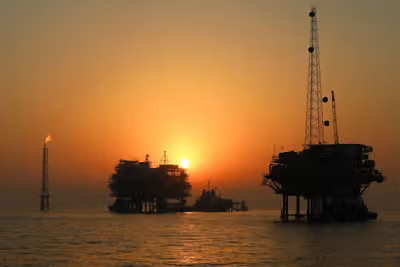
Despite Iran’s severe shortages of natural gas and inability to attract foreign investment in the sector, the country is among the most wasteful in terms of gas flaring. 

In its annual report released on Thursday, the World Bank said while significant progress has been made in reducing gas flaring worldwide in 2022, the top nine flaring countries continue to be responsible for the vast majority of the waste. 

Second only to Russia, Iran is on top along with Iraq in terms of volume and intensity. These are, in order, Russia, Iraq, Iran, Algeria, Venezuela, the United States, Mexico, Libya, and Nigeria, the report revealed. These countries account for nearly three-quarters of flare volumes and just under half of global oil production.

world-bank-report-gas-flaring
100%

“Consistent with previous years, flaring during 2022 was dominated by a relatively small number of countries, with the top nine flaring countries responsible for 74% of flare volumes and 45% of global oil production," the report read. 

According to the report, volumes flared fell by 5 billion cubic meters (bcm) to 139 bcm, the lowest level since 2010 but Iran burned and wasted about 17.5 billion cubic meters of its gas while pumping out crude oil in 2022. Considering global gas prices last year, the value of such a huge loss is estimated at about $10 billion.

world-bank-gas-flaring
100%

Iran, which has not installed the needed equipment to collect the gas that is extracted while drilling for oil at oilfields, burns it off in a wasteful process known as "gas flaring." The flares are the giant flames often seen near oil fields.

Gas flaring has been condemned as a danger to the environment and human health, as well as a waste of fuel, and the World Bank has been calling on energy companies to stop almost all flaring by 2030.

According to the Iran’s oil ministry, some $5 billion is needed for curbing gas flaring, which constitutes about 7% of the country’s total gas production. For comparison, it is equal to 30% of Turkey’s total gas consumption in 2021 or Iran’s total gas exports to Iraq and Turkey during 2021. Iran’s gas flaring levels increased by 32% year-on-year to 17.4 billion cubic meters (bcm) in 2021 and stayed about the same during the previous year. 

Abouzar oilfield in southern province of Bushehr  (February 2022)
100%
Abouzar oilfield in southern province of Bushehr

Despite regime officials predicting a "harsh winter" for Europe, most countries have managed their energy needs, but a serious natural gas shortage gripped Iran in winter. Reports from Iran said in January that many state organizations and industrial towns in different provinces were forced to reduce working hours because of the energy shortage. With natural gas shortage, Iran resorted to burning mazut at power stations, which is an extremely polluting fuel compared with cleaner diesel.

Iran, which has the world’s second largest gas reserves, has failed to make significant investments in its oil and gas sectors for at least 10 years as international sanctions (2011-2015) and US oil export sanctions since 2018 have limited the country’s financial resources. The distribution network also needs upgrades as more than 25 percent of the gas is lost during transfer. In November 2022, Owji said that at least $160 billion in investments is needed to revitalize oil and gas sectors.

Iran's gas production and extraction capacity is limited to around 800 million cubic meters per day. According to the ministry of energy, about 650 million cubic meters are consumed in the domestic, commercial, and administrative sectors, however, the data has changed a lot in different years and contradict international estimates. 

US Files Forfeiture For Iranian Ammunition Seized By Navy

Mar 31, 2023, 18:53 GMT+1
•
Iran International Newsroom

The United States has filed a forfeiture complaint over one million rounds of ammunition and other materiel seized by the US Navy in December during transit on the high seas.

The Justice Department announced Friday that in addition to the rifle and machinegun ammunition, the Navy also seized thousands of proximity fuses for rocket-propelled grenades and thousands of pounds of propellent, disrupting “a major operation by Iran’s Islamic Revolutionary Guard Corps (IRGC) to smuggle weapons of war into the hands” of Iran-backed Houthis in Yemen.

Both the US and British navies have seized weapons and ammunition in recent months enroute to Yemen in Gulf of Oman or the Arabian Sea.

Iran has been rendering military and financial support to the Houthis who overthrew Yemen’s government in 2014 and have continued to fight a Saudi-led coalition that backs the internationally recognized government.

“The Justice Department is now seeking the forfeiture of those weapons, including over one million rounds of ammunition and thousands of proximity fuses for rocket-propelled grenades,” Attorney General Merrick B. Garland was quoted as saying in the statement. “The Justice Department will be relentless in holding accountable those who break our laws and threaten our national security.”

Thousands of AK-47 assault rifles sit on the flight deck of guided-missile destroyer USS The Sullivans (DDG 68) during an inventory process on January 7, 2023.
100%
Thousands of AK-47 assault rifles sit on the flight deck of guided-missile destroyer USS The Sullivans (DDG 68) during an inventory process on January 7, 2023.

The Biden Administration has adopted a tougher stance toward the Iranian regime since September after long-running nuclear talks reached a deadlock in what the US says was unreasonable demands by Tehran.

A deadly crackdown on protests by the regime that killed more than 500 civilians and delivery of killer drones to Russia that have been used against civilian targets, have also played a role in shaping Washington’s tougher position.

“This forfeiture action prevents ammunition and dangerous weapons from falling into the wrong hands and highlights the importance of our investigative work to deny criminal and terrorist networks their instruments of violence and destruction,” said Secretary of Homeland Security Alejandro N. Mayorkas. “I am extremely proud of the critical investigative role played by Homeland Security Investigations alongside our law enforcement and Department of Defense partners in a collaborative whole-of-government effort.”

It is not clear what practical difference the forfeiture would make in this case after the weapons were seized from an un-flagged vessel with no proper documentation to carry weapons in international waters. With no clear owner of the goods, there would be no legal party to claim the cargo.

“This forfeiture action aims to stop in its tracks yet another attempt by Iran’s Islamic Revolutionary Guard Corps and its proxies to fuel violence and conflict around the globe,” US Attorney Matthew M. Graves for the District of Columbia said. “The US Attorney’s Office for the District of Columbia will use all our tools, including our jurisdiction to seize and forfeit assets, located abroad, to disrupt the IRGC’s efforts to sow discord.”

Iran and Saudi Arabia, the two main foreign parties to the conflict in Yemen, sign a deal March 10 to restore diplomatic ties. Analysts believe that Riyadh’s main goal for the agreement is to end the conflict and focus on its economic progress.

However, this would take further negotiations and it is not clear to what extent the Iranian regime is willing to compromise, without making more demands, such as economic benefits from any cooperation.

Iran also ships weapons to its allies and militant proxies in Syria and Lebanon. Israel has been conducting air and missile strikes on Iranian warehouses and weapons shipments since 2017, to deny the arming of hostile forces.

Threatened By Israel-Azerbaijan Ties, Iran Urges Clarification On Partnership

Mar 31, 2023, 16:59 GMT+1

The Iranian Foreign Ministry has called crisis talks with Azerbaijan officials after comments at the opening of its embassy in Israel suggested a united front against Iran.

Israel’s foreign minister, Eli Cohen, called Iran “a regional threat”, raising alarm bells among regime officials who fear its archenemy is using Azerbaijan as a base to launch attacks on the Islamic Republic.

Cohen said, “Israel and Azerbaijan must share the same understanding regarding the Iranian threat. Iran threatens our region, and creates non-stability in the Middle East by supporting and financing terrorism. We should jointly act against Iran. We should not allow Iran to expand its nuclear opportunities.”

In a stark warning, Iran’s foreign ministry spokesman, Nasser Kanaani, said the regime is watching. “It is expected from Azerbaijan's government to stay away from the trap set by enemies of the two countries' relations," he said.

Though Israel has had a diplomatic presence in Azerbaijan since the 90s, the move to open an embassy in Tel Aviv was a major diplomatic coup for Israel, as it further deepens ties with its Muslim neighbors.

”It is evident that the Islamic Republic of Iran cannot remain indifferent to the Zionist regime's plot from the soil of the Republic of Azerbaijan,” Kanaani added.

Earlier in the month, Azerbaijan's new ambassador to Israel Mukhtar Mammadov, said his country would not let Israel’s military to use Azerbaijan as a base for a possible attack against Iran, denying previous reports about preparing an airfield to assist Israel during possible attacks on the Islamic Republic.


Rising Inflation Might Trigger More Protests In Iran, Say Commentators

Mar 31, 2023, 13:21 GMT+1
•
Iran International Newsroom

Media in Iran have been warning this week about the consequences of rising inflation, in the light of recent antigovernment protests.

According to the latest official figures, the annual inflation rate reached 47.7 percent in February-March, while point to point inflation is estimated to be at 64 percent in the same period.

According to Khabar online this level of inflation is unprecedented during the past 50 years, adding that some government officials' wishful thinking about the possibility of reducing inflation to 30 and even 20 percent is a "dream."

Last week, when President Ebrahim Raisi called on government officials to offer their solutions for lowering the inflation rate, former Central Bank Governor Abdolnaser Hemmati sarcastically said: "Don’t you believe it is a bit too late after 1.5 years in office as President?"

Nonetheless, the new Central Bank Governor Mohammad Reza Farzin promised to lower inflation to 20 to 30 percent but did not say how. Supreme Leader Ali Khamenei has called the new Iranian year "the year of controlling inflation and boosting production." However, experts say that it is unlikely for any government to be able to bring the inflation rate to the level of a decade ago when it was between 16 to 22 percent.

Inflation began to rise when the United States withdrew from the Obama-era nuclear accord with Iran and imposed crippling sanction in 2018.

Massopud Mirkazemi, the chairman of Iran's Planning and Budget Organization has also said that lowering inflation to 30 percent is feasible. He said this can be done by introducing monetary discipline in all government offices.

Massopud Mirkazemi, chairman of Iran's Planning and Budget Organization. File photo
100%
Massopud Mirkazemi, chairman of Iran's Planning and Budget Organization

Economist Saeed Mesgari told Khabar Online that "the best any government can do is to reduce the current inflation rate by only 10 percent, but I cannot see the will to do that in this government." He added that an inflation rate between 40 to 50 percent will linger in Iran as long as the government refuses to bring about economic reform.

The economy, he said is suffering from accumulated challenges which have brought inflation to a new level.

Meanwhile, Khabar Online wrote in another report that hard-line political figure Yaser Jebraili, and Mohsen Rezaei who happens to be the vice president for economic affairs, have started a move to take over the government's economic team. Apart from Rezaei, the team includes Economy Minister Ehsan Khanduzi, budget chief Mirkazemi and Vice President Mohammad Mokhber.

The report added that the brother of President Ebrahim Raisi’s son-in-law, Meysam Nili has teamed up with Rezaei and Jebraili to pursue this goal. Rezaei who has been sidelined in the government economic team, has always claimed that he has the definite solution for Iran's economic crisis but has never offered a clear plan other than suggesting to make money by taking US soldiers in the Persian Gulf region hostage and demanding ransom before releasing them!

In the absence of government measures to control rising prices, some clerics have come up with rather funny solutions. Davoud Mehdizadegan, a cleric in charge of compiling university textbooks has said that a serious campaign against women who remove their hijab can help solve the country's economic problems!

While the pressure of increasing prices have been mounting, some pro-government officials' suggestion to increase the price of gasoline has caused more worries among the public. Such suggestions come although throughout Iran's modern history, any increase in the price of gasoline has had a dramatic domino effect on other prices and has led to unrest.

According to Aftab News, some experts have even warned the government that there is a limit to price increases that the nation can tolerate. During the past months many commentators in Iran have warned that further price hikes are likely to trigger another round of protests.

In November 2019, a sudden government decision to double the gasoline price led to protests in more than a hundred Iranian cities which left at least 1,500 dead.

US Convenes International Forum On Iran’s ‘Transnational Terrorism’

Mar 31, 2023, 09:31 GMT+1

An inter-governmental forum focusing on terrorism by the Islamic Republic of Iran convened its second meeting in Budapest this week, the US State Department said.

Countering Transnational Terrorism Forum (CTTF) was established as a global forum in 2019 during the Trump administration to “improve international awareness and coordination on Iran’s terrorist and other illicit activities,” a State Department statement issued March 30 said.

It did not provide details about the discussions during the conference or a list of participants, but said, “Governments and organizations from around the world, including from the Middle East, Europe, Africa, Asia and the Americas, participated in this session.”

The Biden Administration has toughened its position toward Iran since last September when talks to revive the 2015 nuclear deal reached an impasse and Iran launched a deadly crackdown against antigovernment protesters.

The meeting that was organized by the department of State and Justice “discussed how Iran continues to engage in brazen terrorist plotting across the globe, including through the Islamic Revolutionary Guard Corps – Qods Force, and how Iran continues to use a variety of mechanisms to evade international terrorism sanctions. “

Last week militia forces controlled by Iran’s Revolutionary Guard launched at least two attacks on US forces stationed in Syria, killing one contractor and injuring at least 12 US servicemen.

The statement went on to say that “Participants discussed how Iran continues to engage in brazen terrorist plotting across the globe, including through the Islamic Revolutionary Guard Corps – Qods Force, and how Iran continues to use a variety of mechanisms to evade international terrorism sanctions.”