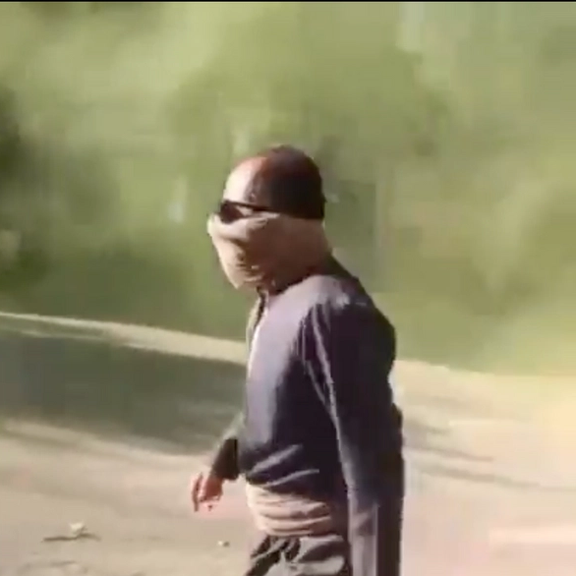
A protester walks through the green smoke on a street in the city of Javanroud (Javanrud) in Kermanshah province on November 21, 2022.
The reported government use of a “green gas” against protesters Kurdish cities of Javanrud and Piranshahr Monday has raised serious concerns among Iranians.
Two videos were posted on social media that showed thick green smoke wafting through the streets in Javanrud, a city of around 50,000 in the western province of Kermanshah, amid heavy clashes between stone-throwing protesters and security forces shooting at them. Reports also emerged on the same day of the use of a similar green gas in Piranshahr in West Azarbaijan Province.
The use of an unidentified gas that causes skin irritation, nausea and other symptoms has conjured up memories of Saddam Hussein’s chemical attack on the Kurdish border city of Sardasht, also in West Azarbaijan during Iran-Iraq War (1980-1988) in the minds of many, particularly people in Iran's Kurdish areas.
Saddam’s chemical attack during which mustard gas was used killed at least 130 people and injured 8,000 of the 12,000 inhabitants of the city in 1983. Many victims still struggle with respiratory and other health issues.
The canister is marked with the word “irritant” only, but posts shared on social media claim these are perceived as chemical weaponry that has been banned.
Iran's Kurdish cities have been at the forefront of the protests that started with the death is custody of the 22-year-old Mahsa Amini from the Kurdish city of Saqqez two months ago.
People in most Kurdish-populated areas in Kordestan, West Azarbaijan and Kermanshah provinces have relentlessly protested and defied government forces since Masha’s death. Security forces have killed and wounded dozens of protesters and bystanders including children in these provinces.
Some chemists and physicians have identified the green gas used in Javanrud and Piranshahr as hexachloroethane, others say it is adamsite (DM), a chemical used as a riot control agent.
Hexachloroethane has been used by the military in smoke compositions, such as smoke grenades worldwide. DM belongs to the group of chemical warfare agents known as vomiting agents or sneeze gases.
Most western countries have abandoned the use of smoke grenades but some activists have accused police of using it against protesters in Portland, Oregon, in 2020.
US-based physician Dr. Mohammad-Kazem Attari told Iran International Tuesday that hexachloroethane is used widely in military exercises in open air but unlike extremely toxic Sarin, VN and other nerve gases, it does not cause death or permanent disabilities.
According to Dr. Attari hexachloroethane can cause serious skin irritation, partial paralysis of facial muscles and fogginess of mind but temporarily. The chemical is also considered as a carcinogen.
“It is mainly used on the streets [for crowd control] to inspire fear due to its color. It is characterized as a nerve gas but is not as dangerous as nerve gases used in wars,” he said and added that the use of this gas is not likely to scare people who are not afraid of firearms used by Iranian regime forces.
Iran’s judiciary says the Islamic Republic has issued indictments for over 1,100 protesters detained during the nationwide protests.
Judiciary Spokesman Masoud Setayeshi said Tuesday that among those arrested in the last two months in Tehran, “indictments have been issued for 1,118 people so far.”
In comments carried by Mizan Online news website, Setayeshi further threatened prominent figures who express solidarity with the people saying that the judiciary will deal with them.
Hengameh Ghaziani and Katayoun Riahi are the latest celebrities arrested by the regime on Sunday. They both are famous Iranian actresses who supported the protest movement.
Last week, the spokesperson of the Judiciary had announced that the policy of the Judiciary and the government is based on “tolerance” in the face of protests.
He did not give any detail about the total number of arrests, but noted that “so far, 2,432 people have received a preliminary verdict.”
The revolutionary court in Tehran hasalready handed down six death sentences over the protests after convicting the accused of being "enemies of God" or "corrupt on Earth", both capital offences in Iran.
Setayeshi further noted that forty foreign nationals implicated in the recent “riots” have been arrested, but he did not elaborate on the nationalities of those detained.
Iranian officials have repeatedly accused Western governments of stoking the protests over Amini's death.
Yahya Rahim-Safavi, former IRGC commander and senior adviser to Iran's ruler Ali Khamenei
A former IRGC Commander says even if the current unrest comes to an end, protests and uprisings may reoccur if the government fails to solver Iran's problems.
Yahya Rahim-Safavi, who is now military adviser to Supreme Leader Ali Khamenei, reassured the nation that the unrest will come to end, however, he warned that it might not be the last one. He asked: "Cannot the IRGC and the Basij militia sort out what we are currently seeing in this country?" The general was talking about the violent uprising that has entered its third month.
This comes while many in Iran and abroad, including French President Emmanuel Macron have attested that the uprising in Iran has already turned into a revolution.
According to Ettela'at newspaper, Jalaeipour said that protesters in the streets of Iranian cities are demanding "structural changes," which is Iranian politicians' euphemism for "regime change." This is evident, he said in the slogans heard in the streets and at the universities.
He added that when society moves toward revolutionary conditions and governments try to stop the revolution, it means that those governments have already lost legitimacy, efficiency, and many other things.
Hamidreza Jalaeipour, 'reformist' commentator in Tehran
He argued that in such societies the opposition has been successful in winning the protesters trust. However, Jalaeipour argued that protesters do not trust the Iranian opposition, without saying who that opposition is in his view.
It is possible that he mentioned lack of trust in opposition to protect himself against censure by the government. Self-censorship is an important tool for pundits in Iran who are quoted in government-controlled media.
The popular protests, however, have no known leaders, although some figures in the diaspora do appear as possible influencers, especially in a transition period.
Jalaeipour went on to say that around 80 percent of Iranians are unhappy with the government's performance, stressing that the current situation is worrying.
Protesters in the religious city of Mashhad setting fire to a police car on Nov. 16, 2022
The commentator added that the bazaars in Tehran, Rasht and some other cities are on strike and if this continues and spreads to other cities, this means that part of the Iranian society that has been silent so far has been activated and is going toward a revolutionary situation.
Meanwhile, another reformist activist, Gholam Ali Rajaei has said that "A change in approach is in the interest of the government, the regime and the country." Rajai added: "It is getting late for a change."
Rajaei added: "So far there has been no sign to indicate that the message of the ongoing protests has been heard, and I think it is getting late for that."
Other analysts have maintained that it is Khamenei who has to listen to the solutions politicians offer for Iran's problems. Nonetheless, pundits like Rajaei shy away from naming Khamenei or simply fear the repercussions.
Rajaei added: "I even doubt that the government [Khamenei] would even bother to read the message of reconciliation." He reiterated that "reforms are the best solution but not the kind of reforms advocated by political parties." Once again, Rajaei stopped short of naming Khamenei as the individual who should listen to the people and change his autocratic way of running the country.
In the meantime, most of the insulting slogans chanted in the streets call for Khamenei's removal.
Differences are emerging in Iran’s parliament over how to justify the bloody crackdown on protesters, particularly the recent bloodshed in Kurdish regions, with hardliners hindering investigation.
According to an article in reformist daily Etemad Online on Tuesday, Tabriz representative Ahmad AlirezaBeigi – himself a conservative politician and a retired police officer – said that despite demands to hold special sessions in parliamentary committees to discuss the protests, some representatives create obstacles to prevent any probe into the high number of people killed.
He said constituents have been demanding special meetings either at the Internal Affairs or the National Security committees. He also dais the interior ministry should be held accountable.
Tabriz representative in the parliament Ahmad Alirezabeigi
He claimed that the attempts have been stifled mainly by the members of the Front of Islamic Revolution Stability (Paydari), a so-called “principlist” political party sometimes described as the "extreme end of the fundamentalist camp" and "Iran’s most right-wing party."
Alireza Beigi added that how authorities react to the current developments is very important in shaping the unfolding events. He mentioned the bloody crackdown on protesters in Sistan-Baluchestan province as an example, saying that people sought accountability over the rape of a young girl in the city of Chabahar by a police officer and shooting nearly 100 people in the provincial capital Zahedan on September 30, that became known as the Bloody Friday of Zahedan. But when a representative from the province talked about the incidents in parliament, his microphone was turned off as hardliners reacted harshly. As a result, the protests escalated, and the Sunni leader of the Baluch people Molavi Abdolhamid criticized Supreme Leader Ali Khamenei’s rule. Then Khamenei’s sent an envoy to the region and suddenly all those who were killed as “rioters” were labeled “martyrs.”
Reports about the alleged rape of a 15-year-old Baluch girl in June by a police commander in Chabahar, who has remained immune to prosecution, sparked protests in Zahedan on September 30.
In the past few days, the Islamic Republic has intensified its repression on Kurdish-majority cities and towns in western provinces following reports that parts of some small towns had fallen into the people’s hands. The majority of Iran's 10 million Kurds live in the western parts of the country. It has also launched repeated attacks against Iranian Kurds sheltering in Iraqi Kurdistan. The Islamic Republic’s military crackdown on Kurdish regions can be construed as a new episode of escalating the unrest beyond Iran’s borders.
Member of the Parliament's Internal Affairs committee Mohammad Hossein Asafari
To check the veracity of the claims by Alirezabeigi, the newspaper contacted member of the Internal Affairs committee Mohammad Hossein Asafari -- a former senior commander of the Revolutionary Guard, IRGC, who said the issue is not within the jurisdiction of the parliament's National Security committee. He added that the recent incidents in Kurdish regions are not the result of the demands by the people, and those who are on streets to protests “are the terrorists and must be dealt with decisively."
There are increasing indications that Iran's so-called neo-cons are attacking the ultraconservative Paydari Party to end its dominance in the administration of President Ebrahim Raisi. The neo-cons led by Majles (parliament) Speaker Mohammad Bagher Ghalibaf have been trying to convince others in Iran’s political circles that they are prepared to establish "new governance," and bring about "reforms in the system" based on "new plans." These are the buzzwords heralding change from within the system at a time when young men and women in the streets do not seem to be listening to anyone representing the regime.
A man targeted by a shotgun 'bird shot' shell in Iran in September, frequently used by security forces
The United Nations has once again denounced the Islamic Republic’s crackdown on mass protests that have been rocking Iran for over two months.
UN Human Rights Chief Volker Turk said Tuesday that the rising number of deaths from protests in Iran, including those of two children at the weekend, and the hardening of the response by security forces, underline the critical situation in the country.
“We urge your authorities to address the people's demands for equality, dignity and rights instead of using unnecessary or disproportionate force to suppress the protests,” said a spokesperson for UN human rights chief at a Geneva press briefing.
Iran has been gripped by nationwide protests since the death of 22-year-old Kurdish woman Mahsa Amini in morality police custody on September 16 after she was arrested for wearing clothes deemed "inappropriate".
The United Nations’ top rights body will hold an urgent meeting this week to consider launching an international probe into the deadly clampdown on protests in Iran.
The UN Human Rights Council is due to host a specialsession on Thursday on "the deteriorating human rights situation", following a request by Germany and Iceland.
At least 378 people, including 47 children, have been killed in the crackdown since Amini's death, according to the Norway-based group Iran Human Rights (IHR). Other human rights monitors say the number of protesters killed has surpassed 400.
Canada’s Ministry of Foreign Affairs has told Iran International that it condemns threats by the Islamic Republic against journalists inside and outside the country.
Responding to a query, the ministry said journalists and media workers must freely do their job without political interference or intimidation.
“Freedom of expression, online or offline, is a fundamental human right, enshrined in the Universal Declaration of Human Rights. Journalists, activists and media workers are the cornerstone of any fair, strong and vibrant society and must be free to do their work without fear of reprisals. Any violence and intimidation against journalists or activists are completely unacceptable and must be condemned,” reads the statement.
Canada's spy agency has launched an investigation on what it calls multiple “credible” death threats against individuals on its soil by the Islamic Republic.
CBC News said Friday that the Canadian Security Intelligence Service (CSIS) is aware that some state agents of the Islamic Republic are “monitoring and intimidating” people inside Canada to silence those who speak against the regime.
On November 7, Iran International released a statement that its journalists have received “credible threats” from Iran’s Revolutionary Guard. Some employees were informed of the threats by the Metropolitan Police.
After the publication of this statement, international organizations supporting journalists condemned any plots by the Islamic Republic against Iran International on British soil.
UK’s intelligence authorities also announced they have discovered at least 10 “potential threats” since January to “kidnap or even kill British or UK-based individuals perceived as enemies of the regime.”