• العربية
  • فارسی
Brand
  • Iran Insight
  • Politics
  • Economy
  • Analysis
  • Special Report
  • Opinion
  • Podcast
  • Iran Insight
  • Politics
  • Economy
  • Analysis
  • Special Report
  • Opinion
  • Podcast
  • Theme
  • Language
    • العربية
    • فارسی
  • Iran Insight
  • Politics
  • Economy
  • Analysis
  • Special Report
  • Opinion
  • Podcast
All rights reserved for Volant Media UK Limited
volant media logo

Report Reveals Harrowing Atrocities In Iran’s Kurdish Regions
Iran International Newsroom
Sep 7, 2023, 08:29 GMT+1Updated: 17:53 GMT+1

Two human rights groups have published a report shedding light on the Islamic Republic regime’s atrocities against protesters in Iran’s Kurdish regions.

In their comprehensive report sourced from the most recent evidence, Kurdistan Human Rights Network (KHRN) and the Center for Human Rights in Iran (CHRI) unveiled fresh insights into a series of harrowing events that unfolded during the crackdown on protests last fall and winter in the city of Javanroud (Javanrud) in western Kermanshah province. 

The 100-page report, titled “Massacre in Javanrud,” is the result of an exhaustive examination of hundreds of photographs and videos, as well as interviews conducted with 38 eyewitnesses, victims' families, and individuals who were detained or injured from early October until the end of December 2022. The findings revealed disturbing accounts of tortures, severe beatings, mass detentions, and threats of sexual harassment against numerous protesters, including minors.  

For several weeks after the death in custody of 22-year-old Mahsa Amini in mid-September, Iran's Kurdish-majority cities were also at the forefront of the protests that started with Amini’s hometown Saqqez. People in most Kurdish-populated areas in Kordestan, West Azarbaijan and Kermanshah provinces relentlessly protested and defied government forces. 

The regime deployed military forces to these areas to quash the uprising, practically putting a military siege on several cities such as Javanrud. During last year’s protests, which lasted for months, over 500 people were killed by regime security forces and over 22,000 people were arrested. 

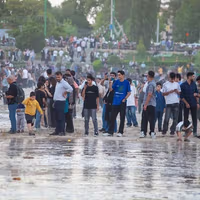
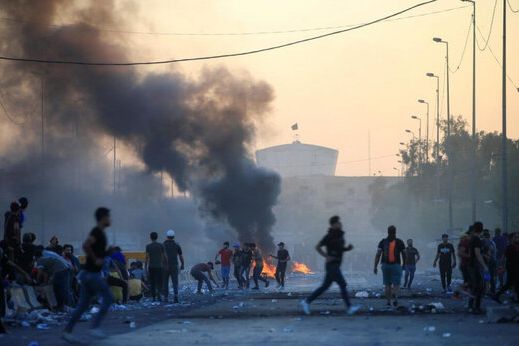
Anti-regime protests in the city of Javanroud (Javanrud)  (undated)
100%
Anti-regime protests in the city of Javanroud (Javanrud)

According to the report, security forces intentionally shot peaceful protesters in the Kurdish city of Javanrud with military-grade weapons, killing eight unarmed civilians, including one child, and injuring at least 80 protesters. 

The wounded were beaten by security forces and prevented from receiving medical care without risking arrest. About 90 people, including 26 minors, were apprehended, and detained arbitrarily. A significant number of them endured physical abuse and torture during their time in custody. Furthermore, the families of those who were injured, killed, detained, or mistreated found themselves under state pressure to maintain silence. 

Calling them “crimes against humanity,” the human rights groups said the heinous acts perpetrated by the agents of the regime were committed with the full knowledge and direction of state authorities, and included “deliberate and systematic killing, maiming, and abuse of unarmed civilians on a large scale.” 

Anti-regime protests in the city of Javanroud (Javanrud)
100%
Anti-regime protests in the city of Javanroud (Javanrud)

The groups also called on the UN Human Rights Council’s International Independent Fact-Finding Mission on the Islamic Republic of Iran to fully investigate the events in Javanrud from October 2022 – January 2023. 

“The international community should directly address the massacre and state crimes that took place in Javanrud, through every diplomatic, political, economic, and legal means available, including pursuing criminal responsibility for the perpetrators of these crimes through international courts or national judicial systems under the principle of universal jurisdiction,” the groups stressed. 

Rebin Rahmani, a board member of KHRN, expressed concern about the increasing wave of arrests of Kurdish activists now taking place ahead of the anniversary of the uprising, noting that “The Islamic Republic feels there are no repercussions for their crimes in marginalized regions such as Kordestan and Sistan-Baluchestan, so it is intensifying its violent and unlawful suppression in these areas.” 

CHRI executive director Hadi Ghaemi said, “As the one-year anniversary of the ‘Women Life Freedom’ protests approaches, the potential for renewed protest in Iran—and a violent state response aimed at crushing it—is high. The international community must remain extraordinarily vigilant, warning the Iranian authorities of intense political and economic consequences at the first sign of state violence.” 

In anticipation of the anniversary of the protests, the Islamic Republic has intensified its intimidation campaign over the last several weeks, detaining family members of dead protesters, locking up activists, targeting community leaders, and escalating persecution of minority groups and academia. 

Most Viewed

Worst outcome is Islamic Republic’s survival, ex-CIA official says
1
PODCAST

Worst outcome is Islamic Republic’s survival, ex-CIA official says

2
ANALYSIS

Iran brings unusually broad team to US talks to blunt future blame

3
INSIGHT

Tehran sends tough message but keeps diplomacy door open

4

Zoroastrian religious figure arrested in Iran

Banner
Banner

Spotlight

  • What the US naval blockade would mean for Iran’s economy
    INSIGHT

    What the US naval blockade would mean for Iran’s economy

  • Tehran sends tough message but keeps diplomacy door open
    INSIGHT

    Tehran sends tough message but keeps diplomacy door open

  • Worst outcome is Islamic Republic’s survival, ex-CIA official says
    PODCAST

    Worst outcome is Islamic Republic’s survival, ex-CIA official says

  • Why the Iran-US truce is more likely to buy time than peace
    ANALYSIS

    Why the Iran-US truce is more likely to buy time than peace

  • Engaged but uncommitted: China watches Iran and US fight and talk
    ANALYSIS

    Engaged but uncommitted: China watches Iran and US fight and talk

  • A truce for the world, a reckoning for Iran’s economy
    ANALYSIS

    A truce for the world, a reckoning for Iran’s economy

•
•
•

More Stories

Iranians Trust Foreign-Based Media For News On Iran - Survey

Sep 6, 2023, 19:31 GMT+1
•
Iran International Newsroom

A recent opinion survey has shown that the majority of Iranians follow news from foreign-based media outlets, with Iran International being their top choice. 

The survey by the Netherlands-based Gamaan institute collected information from 38,445 people inside Iran about their views on media, revealing that only about 21 percent of the respondents followed the developments about Iran from the state-run Islamic Republic of Iran Broadcasting (IRIB). 

This 10-day online survey titled "Iranians' Attitudes Towards Media in 1402 Persian Calendar Year” (started March 21), targeted literate individuals aged 19 and above, a sample from 90% of the country's adult population. GAMAAN, the Group for Analyzing and Measuring Attitudes in Iran, is an independent, non-profit research foundation, focused on Iranians’ attitudes towards social and political topics.

The survey explored key indicators such as the "most popular channel," the "most trustworthy channel according to the audience," and the "primary source for following news of protests in Mahsa's movement." The results indicate that more than half of the respondents consider Iran International as their primary source of information and news about Iran. 

Iran International leads the pack with 54% cited as "often" or "sometimes" following the media outlet. Manoto TV garnered 42%, BBC Persian" 37%, IRIB 36%, and Voice of America Persian 34%. Additionally, about 32% claim to occasionally or more frequently watch Jam-e-Jam (the international bundle of IRIB channels) and 30% tune into MBC Persia. On the other hand, 48% of the population have stated that they never watch or listen to programs on the state broadcaster. 

Iran International-RadioFarda-Manoto-BBCPersian-VOAPersian
100%

When asked, "Which media outlets did you primarily follow for news about recent protests in Iran?" 57% indicated they followed news from Iran International, 30% from Manoto, 26% from BBC Persian, and 20% from Voice of America. Approximately 19% also received news about the protests from the IRIB, the state broadcaster tightly reflecting the views of the regime's hardliners.

In response to a question regarding the level of trust in media outlets, 50% express "a great deal" or "some" confidence in Iran International, 44% in Manoto, 42% in Voice of America, 40% in Radio Farda, and 34% in BBC Persian. On the other hand, only about 21% of the population trust state-run IRIB, while 59% have stated that they have "no trust at all" in the regime’s broadcaster.

According to the results of this survey, 68% of the population "often" use social media networks for obtaining information and news about Iran and the world, while 35% are viewers of satellite channels, 12% rely on state broadcaster IRIB, and 8% tune into foreign radio for the news. 

Among social media platforms, approximately 65% of the population "often" use Instagram, 46% use WhatsApp, 43% use Telegram, 17% use YouTube, 8% use domestic app Rubika, 8% use Twitter, 5% use Facebook, 3% use state-run platform Soroush, and 2% use Clubhouse for their online activities. All international social media platforms are blocked Iran, with people using VPNs to circumvent the censorship.

Iran International-RadioFarda-Manoto-BBCPersian-VOAPersian
100%

IRIB is tightly controlled by the office of Iran’s authoritarian ruler Ali Khamenei and has been losing its audience with its heavy religious programming and heavily censored news and biased programs. Critics say it is nothing but a propaganda tool with a hefty government subsidy of at least $600 million and no accountability. 

In June, the regime took one more step to tighten its control over entertainment content in line with its policy of enforcing religious restrictions on the population, gaining full control over content shown by privately-owned streaming services based on a decision taken by Iran's Supreme Cultural Revolution Council. 

Streaming services such as Filimo, an online video on demand (VOD) service like Netflix, have gained great popularity in Iran where there are no privately-owned television networks. These services provided an opportunity for independent and sometimes dissident filmmakers and artists to showcase their work. The head of the state broadcaster (IRIB), hardliner Payman Jebelli, in a letter to President Ebrahim Raisi in January demanded that Filimo be blocked on the internet. 

Earlier this year, NGO Reporters Sans Frontiers, ranked Iran 177/180 nations for press freedom, citing the arrest of 70 Iranian journalists since the death of Mahsa Amini as one example of the regime's crackdown on voices of dissent. Iran International's reporters were threatened earlier this year by IRGC and intelligence (MOIS) agents, forcing some to relocate from London to Washington amidst security threats. Iranian journalists abroad have also been deluged with threats to their lives.

This year's Freedom House report on global freedoms also ranked Iran 12th in the 100 least free countries in the world.

Rumors Of Possible Khamenei Meeting With Zahedan Victims' Families

Sep 6, 2023, 18:37 GMT+1

Supreme Leader Ali Khamenei may meet with some of the families of the victims of Bloody Friday, the massacre that killed over 120 civilians in the wake of Mahsa Amini's death.

Halvash, which specializes in news from Sistan and Baluchestan Province where the massacre of dozens of civilians happened last year, suggested that Iranian security forces are seeking the assistance of trusted and influential local figures for the potential meeting in a bid to quash further unrest.

The tentative date for the meeting is rumored to be September 11 in Tehran, according to Mostafa Mahami, a representative of Khamenei in Sistan and Baluchestan Province, with the government using promises of compensation and security to encourage participation.

During the suppression of the September 30 protests, known as Bloody Friday, at least 123 citizens, including women and children, lost their lives due to direct gunfire from military and security forces, with many succumbing to head and chest injuries.

The Sunni Friday Prayer Imam of Zahedan, Mowlavi Abdolhamid, persistently called for an investigation into the massacre and the prosecution of those responsible. However, to date, no one has been charged or tried in connection with the incident.

As the first anniversary of the nationwide uprising against the Islamic Republic, sparked by the government's killing of Mahsa Amini, approaches, the government has intensified pressure on families of victims seeking justice to stay quiet and refrain from further protest.


Iranian Dissident In Finland Targeted By Pro-Regime Imam

Sep 6, 2023, 15:00 GMT+1

Calls to shut down an Iran-linked mosque are growing among Iranians in Finland after the Islamic center admitted that one of its imams snatched a protester’s cellphone. 

Parvin Shokri, an Iranian protest organizer based in Helsinki, was returning from an anti-regime demonstration on April 24, when her cellphone was seized by a stranger in the street. She was streaming live on Instagram, something the snatcher was not aware of. As the footage shows, he grabbed the phone, ran away for nearly a minute and while panting took a peek at the phone screen, making his face seen by Shokri’s followers.

Upon seeing his face on the phone screen, the snatcher decided to bury the phone in a nearby lawn in eastern Helsinki, where Shokri would ultimately find it via geolocation, she told Iran International.

The protester, who has been an active organizer of anti-regime events in Finland, immediately reported the matter to the police, triggering an an ongoing investigation. She also started spreading the word by talking to Finnish and Persian media, saying that the man, who appeared on her Instagram Live video, is actually Behrouz Hosseinpour, an imam connected to Resalat Islamic center in Helsinki.

Shokri said that she “did not even know” the man before the incident, and that she learned of his identity through other anti-regime activists after releasing the footage on social media.

Upon these revelations, Resalat Islamic Community released a statement on its Telegram channel on September 1, admitting that it was indeed Hosseinpour, a “guest speaker,” who grabbed Shokri’s phone. The regime-linked Islamic Community cited her “threats” against members of the mosque as well as attempts to record video of religious events “without permission” as reasons that prompted the imam to act. 

After reviewing the recorded video, Shokri noticed that Hosseinpour and another man had been following her prior to the attack and she believes they must have tracked her by following her 11-year-old daughter, who was supposed to meet her at a flea market in eastern Helsinki following the protest.

Behrouz Hosseinpour (left) and Abbas Bahmanpour, the main imam of the Resalat Islamic Center in Helsinki  (undated)
100%
Behrouz Hosseinpour (left) and Abbas Bahmanpour, the main imam of the Resalat Islamic Center in Helsinki

Shokri, who is originally from the southern Iranian city of Izeh, an epicenter of protests in the Woman, Life, Freedom movement, told Iran International that her daughter also recognized the snatcher as the man who had been following her to and from school for a while. 

The Iranian diaspora in Finland has been calling for a shutdown of the center, arguing that similar to many other so-called Islamic centers such as the ones in Frankfurt or London, it is funded by Iran’s regime to track and bully Iranian dissidents.

Resalat Islamic Center in Helsinki (file photo)
100%
Resalat Islamic Center in Helsinki

Resalat Islamic Center said in its statement, published in both Finnish and Persian, that Hosseinpour “notified us later,” of the incident, indirectly claiming that it had no prior knowledge of the assault on Shokri. Resalat said that it is a victim of “baseless harassment and threats” by Islamophobes and right-wing activists, who frequently vandalize its premises and intimidate its members. 

The statement also described Hosseinpour’s phone grabbing as an attempt to delete videos and photos that the protester had shot to “destroy his character”. Shokri said that her 42-minute live streaming, whose footage is still available on her phone, was merely about the flea market in Helsinki and had nothing to do with the mosque. She also said that this is not the first time she has been assaulted by people allegedly linked to the mosque.

The Islamic center claims that it is independent but has also shrugged off calls by Finno-Iranians to condemn violence perpetrated by Iran’s regime against protesters and activists. According to Helsingin Sanomat, Finland's largest subscription newspaper, Resalat founder Madjid Bahmanpour has “said in several interviews that the mosque received funding from ayatollahs in Iran and Iraq.”

Bahmanpour, whose son, Abbas, is an imam at the Islamic center, is a former member of the Iran's Revolutionary Guards Corps (IRGC), designated as a foreign terrorist organization by the United States. Majid and Abbas Bahmanpour, who are quite well known among the Iranian diaspora in Finland, have been at the helm of the center since 2001 and managed to recruit some 1,500 members, who are mostly first-generation immigrants from Afghanistan, Iraq and Iran.

Majid Bahmanpour
100%
Majid Bahmanpour

While an investigation into the matter continues, the Islamic center is also busy holding events in and outside of the mosque, which occasionally draw ire from the Iranian community in the Helsinki area.

Ever since Mahsa Amini’s death in custody of hijab police in Iran on September 16, 2022, Finnish Iranians have held several protests, some in front of the Resalat mosque, calling on the Finnish government to support the movement and shut down the Islamic center. Protests against Iran’s regime in Finland have taken place not only in the capital, but also in much smaller cities, where the number of resident Finno-Iranians is not necessarily large.

MEPs Seek Answers On Prolonged Imprisonment Of EU Citizen In Iran

Sep 6, 2023, 14:59 GMT+1

Member of the European Parliament Hannah Neumann led a petition addressed to EU Foreign Policy Chief Josep Borrell concerning the prolonged imprisonment of an EU citizen by the Islamic Republic.

In a message on X social network, MEP Neumann along with Cornelia Ernst, Bart Groothuis, and Dietmar Köster, expressed their concerns, stating, "We have some questions regarding the hostage-taking case of Johan Floderus."

Johan Floderus, a 33-year-old member of the EU diplomatic corps, has been held covertly in Iran for over 500 days as part of Iran's hostage diplomacy, as reported by The New York Times. Floderus was arrested at Tehran airport in April 2022, during what was described as a private tourist trip with friends.

MEP Neumann said the issue raises concerns for the safety of other EU citizens. "Any European in Iranian captivity is one too many. However, with the arrest of Johan Floderus, the Iranian regime is escalating the situation further and worsening already strained relations. This incident is outrageous and requires prompt clarification," she said.

The letter directed to Josep Borrell seeks answers to critical questions, including how long the EU has been aware of the Swedish citizen's imprisonment in Iran, reasons behind the lack of public communication on this matter, and the measures undertaken by the EU to secure the release of Floderus.

Members of the European Parliament have pressed Josep Borrell for answers, urging him to respond to the inquiries urgently.

Iranian Universities Continue Purge On Dissident Professors

Sep 6, 2023, 13:51 GMT+1

Iranian authorities have ordered the prevention of lectures by two former regime officials at the University of Tehran and the University of Science and Research as the regime continues to purge dissident voices from academia.

Reza Salehi Amiri, who previously held key positions in the Ministry of Sports and Youth and chaired the National Olympic Committee, was among those affected. Meanwhile, Brigadier General Hossein Alai, a former commander of the Navy of the Revolutionary Guards, and a former Deputy Minister of Defense, also faced restrictions.

Further exacerbating concerns to academic freedom, reports from human rights media indicate that two professors, Maham Mighani from the Faculty of Drama at the University of Tehran and Sara Malekan from the Faculty of Management at Amir Kabir University, have been expelled from their positions. Mighani had halted his classes in protest against the detention of his students last year, while Malekan had been critical of security measures at her university.

The purge of dissident professors in Iran has gained momentum since the protests associated with the Woman, Life, Freedom movement which began in September. The situation escalated when Professor Ali Sharifi-Zarchi, a member of Sharif University of Technology's bioinformatics and AI Faculty, announced his expulsion on August 26. Sharifi-Zarchi had supported dissident students during nationwide protests that followed Mahsa Amini's tragic death in custody on September 16.

Observers speculate that these dismissals may be a preemptive measure to quell potential campus protests on the upcoming first anniversary of Amini's death.