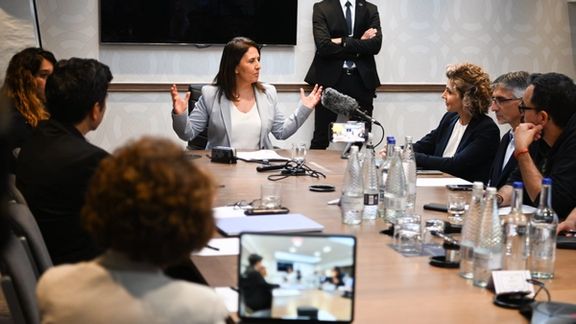
Israeli Intelligence Minister Gila Gamliel during a meeting with a group of Iranian journalists and activists in London on September 6, 2023
Israeli intelligence minister, Gila Gamliel, on Wednesday met Iranian journalists and activists in London, where she called on Iran’s opposition to unite.
She also was in the British capital to promote a campaign to sanction the IRGC as a terrorist organization. The meeting was unique because as a senior Israeli official she met with Iranian reporters and activists and she also said that she wants to put the focus on the IRGC, and convince European countries to sanction Iran's Revolutionary Guard, the IRGC.
The United States government sanctioned Iran’s Islamic Revolutionary Guard Corps as a Foreign Terrorist Organization in 2019, but European states have hesitated to take the step, although they have imposed many sanctions on IRGC officials and entities.
The Israeli minister said wishes to send “support messages to the Iranian people and that the West should be with the Iranians and not make it easy for the regime.”
She also talked about the importance of unity among the Iranian opposition figures and groups and how opinions should be respected and not be a reason for discord. The main goal should be against the regime, and this is the reason that she met with Prince Reza Pahlavi and she meets all kinds of opposition groups.
(Right to left) Israeli Prime Minister Benjamin Netanyahu and his wife Sara Netanyahu, Iran’s exiled prince Reza Pahlavi and his wife Yasmine Pahlavi, and Israeli Intelligence Minister Gila Gamliel in Israel
Iran’s exiled Prince Pahlavi made a historic trip to Israel in April, where Gamliel hosted him and his wife. Pahlavi also met Prime Minister Benjamin Netanyahu and Israelis of Iranian descent. At the time, the Israeli minister tweeted in Hebrew that "The visit of the Iranian crown prince that I led this week is only the beginning on the way to bringing hearts together and building bridges between the nations.“
Gamliel’s visit comes a little more than a week ahead of the one year anniversary of the Iranian regime’s murder of the 22-year-old Iranian woman Mahsa Amini, who was killed while in the custody of the notorious hijab police. The regime’s infamous morality police fatally wounded Amini for her alleged failure to properly wear her hijab.
Gamliel also issued two postings on X, formerly known as Twitter, about her meetings in London. She wrote an “important meeting with activists who are against the regime.” She noted the Iranian regime is not just a problem for Israel but for the entire world and Tehran spreads its weapons across the globe.
Gamliel also talked how the Islamic Republic is a murderous and violent regime. “The Iranian people and Israel should join hands and be united and solve the problem that bothers the world, “said the source about the minister’s comments. “She mentioned many Iranian victims in the protests, the children, the girls and many others.”
She stressed that “her goal is to change the opinions of leaders in the West so they go for sanctioning Iran and the IRGC. This is the reason that she meets a lot of leaders in the West, Italy, London and in the US.”
Gamliel wrote in the Israeli Maariv newspaper on International Women's Day in March, "The citizens of Iran are not Israel's enemies. Peaceful relations, respect and appreciation prevailed between the peoples for many years" before the Islamic Revolution in 1979.
A US House of Representative subcommittee will hold a hearing next week to examine the Biden administration’s secret dealings with the Islamic Republic of Iran.
Subcommittee on National Security, the Border, and Foreign Affairs of the House Oversight Committee will hold the hearing titled “A Dangerous Strategy: Examining the Biden Administration’s Failures on Iran.” The sessionwill examine “how the Biden administration has repeatedly engaged in secret negotiations with Iran, ignoring the emerging threats arising from Iran and its proxies.”
The hearing on September 13 “will also look at ways the Biden administration has fallen short in assisting Americans trapped abroad and circumstances around dismissals of high-level officials.”
This appears to be the first full-fledged examination of the administration’s Iran policy after several revelations since late in June that have worried many observers and the Iranian American community.
In late June, Iran International first reported that President Joe Biden’s envoy for Iran, Robert Mallay was put on unpaid leave after his security clearance was suspended and the case was being examined by the FBI. To date, the administration has remained silent about what the underlying reasons were for Malley’s suspension, while other officials continued to hold secret talks with Iran with the mediation of Oman and Qatar.
President Joe Biden’s envoy for Iran, Robert Mallay
In August, it was announced that the United States had agreed to unblock $6 billion of Iranian funds frozen at South Korean banks, weeks after it allowed Iraq to unfreeze $2.7 billion.
At the same time, it was announced that Iran had released five American hostages form prison into house arrest pending the full release of its funds before they would presumably be allowed to leave the country.
Critics accused the administration of paying outright ransom for the hostages, while the deal still left two more prisoners behind.
The media have also reported that the Biden team is secretly negotiating with Iran over a partial, unofficial understanding to reduce Tehran’s high-level uranium enrichment. The UN nuclear watchdog, the International Atomic Energy Agency (IAEA) says that Iran has accumulated more than 120 kilograms of uranium enriched to 60 percent, which can be easily purified further to reach 90-percent, enough for up to five nuclear bombs. However, the pace of the enrichment has slowed down in recent weeks, giving credence to reports of a secret deal with Washington.
According to a 2015 INARA law, any administration trying to reach a nuclear agreement with Iran should keep Congress informed, which has the right to review the deal.
With the release of Tehran’s blocked funds and reports of more secret talks, Republicans in Congress began accusing the administration of potentially violating the Iran Nuclear Agreement Review Act of 2015 (INARA).
The Subcommittee on National Security is headed by Glenn Grothman (R-Wis.). At this point, details about the hearing and potential participants are not clear.
In announcing the hearing Rep. Grothman said in a statement, “The Biden administration’s foreign policy decisions regarding Iran continue to defy logic and are actively making Americans less safe at home and abroad. Despite promises, the Biden administration has failed to deliver transparency throughout negotiations…”
The Subcommittee Chairman went on to say, “The Iranian regime poses a great threat to American foreign interests and stability in the Middle East region and this hearing is a great opportunity to examine all these issues and provide Americans at home with what the Biden administration refuses to: transparency and answers.”
A Greek shipping company has pleaded guilty in the United States to smuggling sanctioned Iranian oil and agreed to pay a $2.4 million fine the Associated Press reported.
Documents unsealed by a US court made the case of tanker a seized by the US public part of the public record. US prosecutors acknowledgedfor the first time the government seized around one million barrels of Iranian crude from the tanker Suez Rajan.
The saga began in February when the advocacy group United Against a Nuclear Iran reported the tanker’s involvement in illicit transfer of Iranian oil in the South China Sea. For months, the vessel was stranded off the coast of Singapore and then it sailed for the Gulf of Mexico, in what appeared to be seizure of the oil by the United States.
For a while, the oil was not offloaded, as it was reported that US companies were reluctant to get involved presumably because of threats by Iran. In the meantime, the Biden administration was involved in behind-the-scenes negotiations with Tehran over the release of five American hostages and potentially an unofficial nuclear deal.
Since the Trump administration pulled out of the JCPOA nuclear deal in 2018 and imposed sanctions on the sale of Iranian oil, Tehran found ways to boost its illicit shipments using a fleet of tankers, often moving without identification signals, and transferring cargoes to other ships in Asian waters before delivery to China.
These shipments have increased during the Biden administration. According to the latest figures, Iran shipped close to 2 million barrels a day in August, close to pre-sanction days.
A recent opinion survey has shown that the majority of Iranians follow news from foreign-based media outlets, with Iran International being their top choice.
The survey by the Netherlands-based Gamaan institute collected information from 38,445 people inside Iran about their views on media, revealing that only about 21 percent of the respondents followed the developments about Iran from the state-run Islamic Republic of Iran Broadcasting (IRIB).
This 10-day online survey titled "Iranians' Attitudes Towards Media in 1402 Persian Calendar Year” (started March 21), targeted literate individuals aged 19 and above, a sample from 90% of the country's adult population. GAMAAN, the Group for Analyzing and Measuring Attitudes in Iran, is an independent, non-profit research foundation, focused on Iranians’ attitudes towards social and political topics.
The survey explored key indicators such as the "most popular channel," the "most trustworthy channel according to the audience," and the "primary source for following news of protests in Mahsa's movement." The results indicate that more than half of the respondents consider Iran International as their primary source of information and news about Iran.
Iran International leads the pack with 54% cited as "often" or "sometimes" following the media outlet. Manoto TV garnered 42%, BBC Persian" 37%, IRIB 36%, and Voice of America Persian 34%. Additionally, about 32% claim to occasionally or more frequently watch Jam-e-Jam (the international bundle of IRIB channels) and 30% tune into MBC Persia. On the other hand, 48% of the population have stated that they never watch or listen to programs on the state broadcaster.
When asked, "Which media outlets did you primarily follow for news about recent protests in Iran?" 57% indicated they followed news from Iran International, 30% from Manoto, 26% from BBC Persian, and 20% from Voice of America. Approximately 19% also received news about the protests from the IRIB, the state broadcaster tightly reflecting the views of the regime's hardliners.
In response to a question regarding the level of trust in media outlets, 50% express "a great deal" or "some" confidence in Iran International, 44% in Manoto, 42% in Voice of America, 40% in Radio Farda, and 34% in BBC Persian. On the other hand, only about 21% of the population trust state-run IRIB, while 59% have stated that they have "no trust at all" in the regime’s broadcaster.
According to the results of this survey, 68% of the population "often" use social media networks for obtaining information and news about Iran and the world, while 35% are viewers of satellite channels, 12% rely on state broadcaster IRIB, and 8% tune into foreign radio for the news.
Among social media platforms, approximately 65% of the population "often" use Instagram, 46% use WhatsApp, 43% use Telegram, 17% use YouTube, 8% use domestic app Rubika, 8% use Twitter, 5% use Facebook, 3% use state-run platform Soroush, and 2% use Clubhouse for their online activities. All international social media platforms are blocked Iran, with people using VPNs to circumvent the censorship.
IRIB is tightly controlled by the office of Iran’s authoritarian ruler Ali Khamenei and has been losing its audience with its heavy religious programming and heavily censored news and biased programs. Critics say it is nothing but a propaganda toolwith a hefty government subsidy of at least $600 million and no accountability.
In June, the regime took one more step to tighten its control over entertainment content in line with its policy of enforcing religious restrictions on the population, gaining full control over content shown by privately-owned streaming services based on a decision taken by Iran's Supreme Cultural Revolution Council.
Streaming services such as Filimo, an online video on demand (VOD) service like Netflix, have gained great popularity in Iran where there are no privately-owned television networks. These services provided an opportunity for independent and sometimes dissident filmmakers and artists to showcase their work. The head of the state broadcaster (IRIB), hardliner Payman Jebelli, in a letter to President Ebrahim Raisi in January demanded that Filimo be blocked on the internet.
Earlier this year, NGO Reporters Sans Frontiers, ranked Iran 177/180 nations for press freedom, citing the arrest of 70 Iranian journalists since the death of Mahsa Amini as one example of the regime's crackdown on voices of dissent. Iran International's reporters were threatened earlier this year by IRGC and intelligence (MOIS) agents, forcing some to relocate from London to Washington amidst security threats. Iranian journalists abroad have also been deluged with threats to their lives.
This year's Freedom House report on global freedoms also ranked Iran 12th in the 100 least free countries in the world.
Mahan Air, a sanctioned Iranian airline with ties to the Islamic Revolutionary Guard Corps (IRGC), has reportedly imported an Airbus A340 to Iran via Indonesia.
The aviation news website ch-aviation, revealed that Mahan Air successfully imported the Airbus A340-200, with the registration EP-MJA (serial number 75), to Iran, raising questions as to its procurement.
The 28-year-old Airbus A340, adorned with Mahan Air's livery, was seen at Tehran Mehrabad Airport in early August, although it has not yet been put into active service.
This latest addition marks the tenth A340 in Mahan Air's fleet. The airline, nominally a privately-owned entity, maintains close affiliations with the Islamic Revolutionary Guard Corps-Quds Force (IRGC-Quds Force), which resulted in Western sanctions.
In 2011, the United States imposed sanctions on Mahan Air, accusing the airline of aiding the Quds Force in covertly transferring weapons and personnel to various regions, including Syria.
Mahan Air currently operates six A340-300s and three A340-600s, making it the second-largest operator of the A340 globally, trailing behind Lufthansa (LH) based in Frankfurt International Airport.
Dutch sources reported earlier this year that the aircraft sold to Mahan Air previously belonged to the French Air Force. It was also reported that Mahan Air had not provided details regarding the purchase amount of the aircraft, citing the severe sanctions imposed on Iran's aviation industry as a possible reason for the lack of transparency.
Behrouz Hosseinpour, an Imam at Resalat Islamic Center in Helsinki
Calls to shut down an Iran-linked mosque are growing among Iranians in Finland after the Islamic center admitted that one of its imams snatched a protester’s cellphone.
Parvin Shokri, an Iranian protest organizer based in Helsinki, was returning from an anti-regime demonstration on April 24, when her cellphone was seized by a stranger in the street. She was streaming live on Instagram, something the snatcher was not aware of. As the footage shows, he grabbed the phone, ran away for nearly a minute and while panting took a peek at the phone screen, making his face seen by Shokri’s followers.
Upon seeing his face on the phone screen, the snatcher decided to bury the phone in a nearby lawn in eastern Helsinki, where Shokri would ultimately find it via geolocation, she told Iran International.
The protester, who has been an active organizer of anti-regime events in Finland, immediately reported the matter to the police, triggering an an ongoing investigation. She also started spreading the word by talking to Finnish and Persian media, saying that the man, who appeared on her Instagram Live video, is actually Behrouz Hosseinpour, an imam connected to Resalat Islamic center in Helsinki.
Shokri said that she “did not even know” the man before the incident, and that she learned of his identity through other anti-regime activists after releasing the footage on social media.
Upon these revelations, Resalat Islamic Community released a statement on its Telegram channel on September 1, admitting that it was indeed Hosseinpour, a “guest speaker,” who grabbed Shokri’s phone. The regime-linked Islamic Community cited her “threats” against members of the mosque as well as attempts to record video of religious events “without permission” as reasons that prompted the imam to act.
After reviewing the recorded video, Shokri noticed that Hosseinpour and another man had been following her prior to the attack and she believes they must have tracked her by following her 11-year-old daughter, who was supposed to meet her at a flea market in eastern Helsinki following the protest.
Behrouz Hosseinpour (left) and Abbas Bahmanpour, the main imam of the Resalat Islamic Center in Helsinki
Shokri, who is originally from the southern Iranian city of Izeh, an epicenter of protests in the Woman, Life, Freedom movement, told Iran International that her daughter also recognized the snatcher as the man who had been following her to and from school for a while.
The Iranian diaspora in Finland has been calling for a shutdown of the center, arguing that similar to many other so-called Islamic centers such as the ones in Frankfurt or London, it is funded by Iran’s regime to track and bully Iranian dissidents.
Resalat Islamic Center in Helsinki
Resalat Islamic Center said in its statement, published in both Finnish and Persian, that Hosseinpour “notified us later,” of the incident, indirectly claiming that it had no prior knowledge of the assault on Shokri. Resalat said that it is a victim of “baseless harassment and threats” by Islamophobes and right-wing activists, who frequently vandalize its premises and intimidate its members.
The statement also described Hosseinpour’s phone grabbing as an attempt to delete videos and photos that the protester had shot to “destroy his character”. Shokri said that her 42-minute live streaming, whose footage is still available on her phone, was merely about the flea market in Helsinki and had nothing to do with the mosque. She also said that this is not the first time she has been assaulted by people allegedly linked to the mosque.
The Islamic center claims that it is independent but has also shrugged off calls by Finno-Iranians to condemn violence perpetrated by Iran’s regime against protesters and activists. According to Helsingin Sanomat, Finland's largest subscription newspaper, Resalat founder Madjid Bahmanpour has “said in several interviews that the mosque received funding from ayatollahs in Iran and Iraq.”
Bahmanpour, whose son, Abbas, is an imam at the Islamic center, is a former member of the Iran's Revolutionary Guards Corps (IRGC), designated as a foreign terrorist organization by the United States. Majid and Abbas Bahmanpour, who are quite well known among the Iranian diaspora in Finland, have been at the helm of the center since 2001 and managed to recruit some 1,500 members, who are mostly first-generation immigrants from Afghanistan, Iraq and Iran.
Majid Bahmanpour
While an investigation into the matter continues, the Islamic center is also busy holding events in and outside of the mosque, which occasionally draw ire from the Iranian community in the Helsinki area.
Ever since Mahsa Amini’s death in custody of hijab police in Iran on September 16, 2022, Finnish Iranians have held several protests, some in front of the Resalat mosque, calling on the Finnish government to support the movement and shut down the Islamic center. Protests against Iran’s regime in Finland have taken place not only in the capital, but also in much smaller cities, where the number of resident Finno-Iranians is not necessarily large.