• العربية
  • فارسی
Brand
  • Iran Insight
  • Politics
  • Economy
  • Analysis
  • Special Report
  • Opinion
  • Podcast
  • Iran Insight
  • Politics
  • Economy
  • Analysis
  • Special Report
  • Opinion
  • Podcast
  • Theme
  • Language
    • العربية
    • فارسی
  • Iran Insight
  • Politics
  • Economy
  • Analysis
  • Special Report
  • Opinion
  • Podcast
All rights reserved for Volant Media UK Limited
volant media logo
INSIGHT

Tehran seeks to draw a line around Lebanon

Maryam Sinaiee
Maryam Sinaiee

Iran International

Jun 9, 2026, 00:38 GMT+1
An Israeli ultra-Orthodox Jewish man reacts near a part of a missile protruding from the ground, following strikes from Iran, in the central Israeli-occupied West Bank, June 8, 2026.

Iranian officials and media outlets say Tehran's missile strike on Israel in response to attacks on Beirut has established a new red line: future attacks on Hezbollah and Lebanon could trigger direct Iranian retaliation.

The debate emerged after Iran launched missiles at Israel following Israeli strikes in Beirut's southern suburbs, at a time when negotiations between Tehran and Washington were widely described as nearing an agreement.

Although Iran's Khatam al-Anbiya Central Headquarters announced on Monday that it was halting further strikes, it warned that attacks would resume if Israel targeted either Iran or Lebanon again.

US President Donald Trump called on both sides to halt retaliatory attacks, while Foreign Ministry spokesman Esmail Baghaei said Washington bore "direct responsibility" for any action taken by Israel against Iran.

Speaking to the Revolutionary Guards (IRGC)-linked Tasnim News Agency, an unnamed military source dismissed Washington's lack of public endorsement for Israeli attacks as a "purely propagandistic and deceptive act."

"If the Israelis and Americans believe they can, through 'controlled escalation,' make Iran and the Resistance Front predictable or limit the nature of Iran's response, they are making a foolish mistake," he said.

A new strategic doctrine?

Among the most notable reactions came from Sadegh Larijani, chairman of Iran's Expediency Council.

In a post on X, Larijani described the strike carried out in defense of Lebanon as "the official declaration of a strategic doctrine" and the opening of "a new chapter in defense policy," in which Iran would pursue its regional power through initiative and offensive capability.

Parliament Speaker Mohammad Bagher Ghalibaf, who also heads Iran's negotiating team in talks with Washington, argued that Iran had "overturned the equation of a ceasefire on paper and its repeated violation on the battlefield."

"As long as there is no genuine will for confidence-building, Iran's response will remain the same," he wrote on X.

President Masoud Pezeshkian struck a more measured tone, arguing that diplomacy and deterrence remained complementary rather than contradictory.

"We will firmly defend the rights of the nation and retreat before no threat," he wrote. "Diplomacy and defense are the two wings of national power; we have abandoned neither the battlefield nor the negotiating table."

Media echo the new strategy

Iranian media quickly expanded on that interpretation, arguing that the strike reflected a broader shift in Tehran's deterrence strategy.

Farda News, a website close to Ghalibaf, argued that attacks on Lebanon would no longer be cost-free and that Israeli actions on one front could trigger responses on another. The outlet also interpreted the reported targeting of the Haifa refinery—described by the IRGC as retaliation for attacks on Iran's petrochemical industry—as an example of "strategic symmetry."

"The era of cost-free attacks on the Resistance Front has ended," it wrote.

Other conservative outlets advanced similar arguments. Tabnak, which is considered close to Mohsen Rezaei, an adviser to Iran's supreme leader, argued that Tehran had for the first time retaliated militarily for an Israeli attack on a country other than Iran itself.

Khabar Online described the strike as a redefinition of deterrence equations in the Middle East, while Rouydad24 argued that Tehran was signalling a willingness to expand both the geography and scope of future confrontations.

Several commentators framed the issue not simply as support for Hezbollah but as a test of Iran's credibility with its regional allies. Allowing Hezbollah to be weakened or destroyed without a response, they argued, would undermine decades of Iranian regional strategy and raise questions about the reliability of Tehran's support for its partners.

Mixed reactions online

Public reactions on social media were more divided.

Some users criticized Iran's involvement on behalf of Hezbollah. One commenter wrote that Iran had effectively become "the proxy force of a foreign group called Hezbollah," arguing that resources intended to strengthen Iran's own security were instead being spent defending an ally.

Others focused on the domestic costs of escalation.

"If they hit our water, electricity, refineries and power plants tomorrow, remember that your Revolutionary Guard brothers dragged Iran into war because of Lebanon," one user wrote.

Several users expressed concern that prolonged conflict could make Iran resemble Lebanon, a country long marked by instability and recurring wars.

"I fear the Beirutization of Tehran," one commenter wrote. "I am terrified of the Beirutization of Iran."

Together, the reactions highlighted a widening debate over the costs and benefits of Tehran's regional strategy. While officials and conservative media presented the strike as the emergence of a new deterrence doctrine, many ordinary Iranians appeared more concerned about the risks that such a doctrine could bring at home.

Most Viewed

Delayed burial, absent successor: Questions over post-Khamenei Iran
1

Delayed burial, absent successor: Questions over post-Khamenei Iran

2

Student protests over university entrance exam rules continue across Iran

3
INSIGHT

Iran turns to LA-based singer for state-backed religious event

4
INSIGHT

What Israel hit at Iran's Karoon Petrochemical and why it matters

5

New tool helps Iranian fans display Lion and Sun flag at World Cup

Banner
Banner

Spotlight

  • Tehran seeks to draw a line around Lebanon
    INSIGHT

    Tehran seeks to draw a line around Lebanon

  • 'Nothing is over':  Iran-Israel conflict enters a new phase
    ANALYSIS

    'Nothing is over': Iran-Israel conflict enters a new phase

  • Delayed burial, absent successor: Questions over post-Khamenei Iran

    Delayed burial, absent successor: Questions over post-Khamenei Iran

  • From banks to blockchains: US opens new front in Iran sanctions
    ANALYSIS

    From banks to blockchains: US opens new front in Iran sanctions

  • Can Trump crack Iran's negotiating playbook?
    PODCAST

    Can Trump crack Iran's negotiating playbook?

  • Explained: Iran's frozen assets around the world

    Explained: Iran's frozen assets around the world

•
•
•

More Stories

'Nothing is over': Iran-Israel conflict enters a new phase

Jun 8, 2026, 21:33 GMT+1
•
Negar Mojtahedi
'Nothing is over':  Iran-Israel conflict enters a new phase
100%
This photograph captures two armed soldiers standing in front of a large Lebanese flag during a public event. The scene appears to be part of a security operation or demonstration, with the soldiers positioned in front of a crowd.

Iran and Israel have paused direct attacks, but Tehran's latest warning suggests the conflict may be evolving rather than ending.

On Monday, Iran said it would suspend operations against Israel but warned attacks would resume if Israel continued striking Lebanon.

Israel rejected the condition, with Prime Minister Benjamin Netanyahu accusing Tehran and Hezbollah of trying to create a new equation in which attacks on Israel would no longer carry consequences.

The development has fueled debate over whether the latest ceasefire represents the end of the fighting—or merely the end of its first phase.

A ceasefire tied to Lebanon

For UAE-based analyst Amjad Taha, the answer is straightforward.

"It's a pause rather than a ceasefire or an end of war," he told Iran International.

Taha argues that Tehran's decision to link its ceasefire to Lebanon reveals that the Islamic Republic continues to view regional conflicts through the lens of its proxy network.

"The fact that the Islamic regime right now says it's fighting and its condition in Lebanon ceasefire with its own, it tells us that Iran's, the Islamic Regime still sees Lebanon and other countries as its own proxy and its own extension," he said.

In his view, the current calm risks postponing rather than resolving the underlying conflict.

"If the ceasefire happens right now, we are just postponing another 7th of October-style event, but this time across the Middle East, not just the state of Israel."

Elizabeth Tsurkov, a fellow at the New Lines Institute, sees Iran's Lebanon condition as part of a broader effort to shape the post-war landscape.

"It appears clear that the Iranian regime believes that it won the 40-day war and is therefore trying to establish new rules of the game to project its power and deter Israeli action in Lebanon as well," she said.

Tsurkov also rejected suggestions that apparent tensions between Washington and Jerusalem amount to a coordinated strategy.

"I don't think that this is a matter of bad cop, good cop," she said. "Trump genuinely wants a deal."

Her assessment points to a broader reality emerging from the latest crisis: Lebanon is no longer a separate arena. It has become intertwined with negotiations over Iran, regional deterrence and the future of the ceasefire itself.

A new equation?

The debate over Iran's intentions has exposed sharply different interpretations of the latest escalation. While some see Tehran acting from a position of weakness, others argue it has successfully shaped events since the ceasefire.

Avi Melamed, a former Israeli intelligence official, believes Iran has managed to place itself at the center of multiple interconnected disputes.

"The Iranian regime, as of now, has been quite clearly able to dictate the pace," he said.

Melamed argued that Tehran is attempting to connect "the story of the Hormuz Strait, Iran, the nuclear program and the situation in Lebanon," creating additional pressure points for both Washington and Jerusalem.

As the dispute over Lebanon intensified, Iranian Foreign Minister Abbas Araghchi shared an image on X showing the Iranian and Lebanese flags intertwined, reflecting Tehran's position that the two fronts are inseparable.

Still, Melamed cautioned against drawing firm conclusions.

"I think we are at a phase where you could say that, at the same time, the Iranian regime could mark some significant achievements as far as the Iranian regime is concerned," he said, describing the current situation as an "ongoing ping pong game."

Others reject the notion that Iran is acting from a position of confidence.

John Craig, a former US ambassador and senior fellow at the Transatlantic Leadership Network, sees the latest missile attack as an attempt to undermine diplomacy rather than demonstrate strength.

"Iran is desperate to slow/stop any negotiations," Craig said.

He remains skeptical that the current pause will hold.

"Nothing is over," he said. "The IRGC does not want any agreement. Ever."

For military analyst Andrew Fox, the future of the ceasefire may depend less on Tehran and Jerusalem than on developments in Lebanon.

"I think it very much depends on what happens in Lebanon," Fox said.

While describing Israel's latest response as limited compared with the broader war phase, Fox said the underlying conflict remains unresolved.

"It clearly wasn't a full-scale return to combat operations. It was nothing like the scale or intensity of what we saw during the war phase. But it did send a message."

And despite the current lull, he does not believe hostilities have truly ended.

"I don't think it is an end to hostilities," Fox said. "I don't think it is an end to attempts to overthrow the Iranian regime, but I think it will draw a line under this phase."

That may be the clearest point of agreement among analysts. Whether they view Iran as emboldened, opportunistic or desperate, few believe the latest ceasefire has settled the larger struggle.

Trump continues to pursue negotiations with Tehran. Netanyahu has vowed Israel will respond forcefully to future attacks. And Iran has made clear that its restraint is conditional on events beyond its borders.

The missiles may have stopped flying between Iran and Israel. But by tying its ceasefire to Lebanon, Tehran has ensured that the next test of the truce may come not in Tehran or Tel Aviv, but on Israel's northern border.

Inside the Iranian missile base hit by Israel near Najafabad

Jun 8, 2026, 20:30 GMT+1
Inside the Iranian missile base hit by Israel near Najafabad
100%

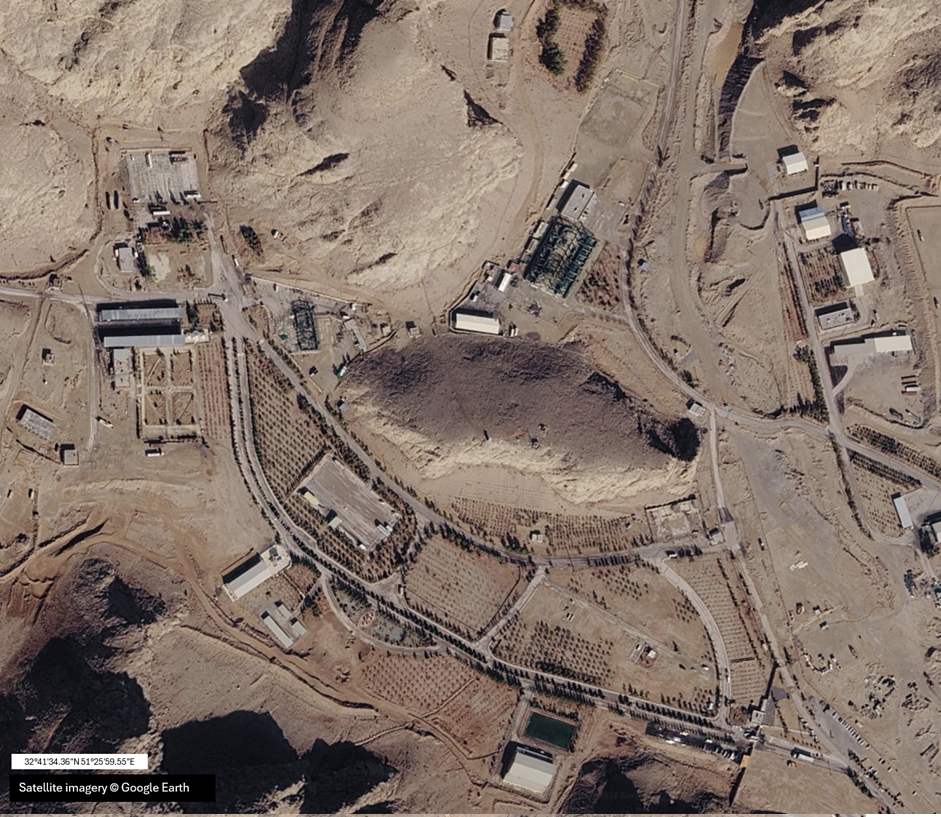
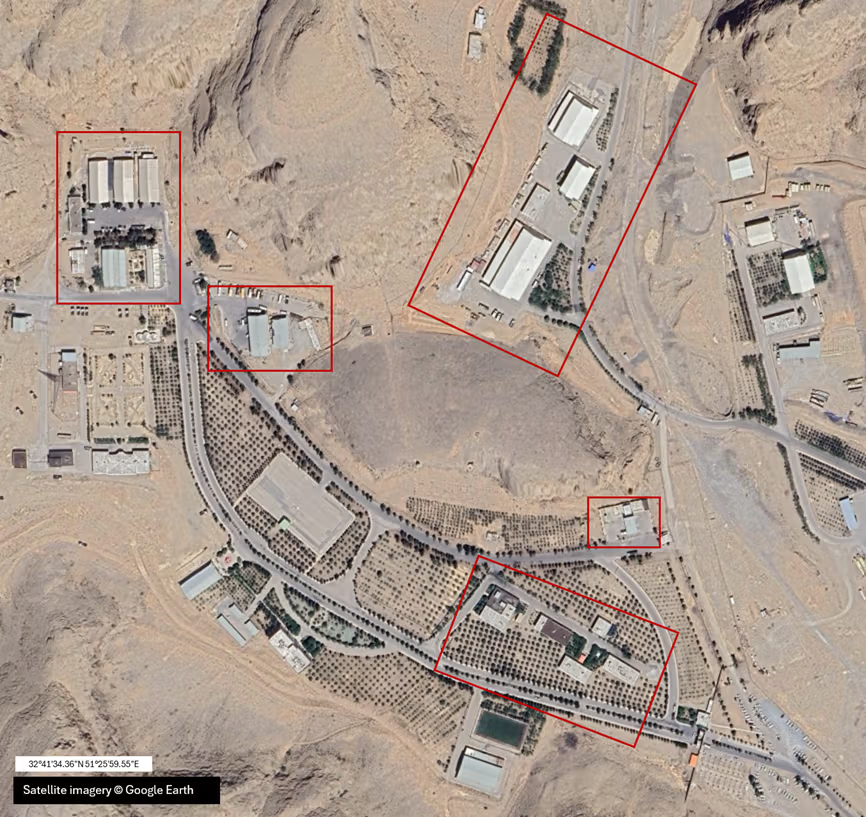
Videos showing explosions, smoke and possible missile impacts in areas near Najafabad in central Iran appear to point to Israeli attacks on the Ahmad Kazemi complex, one of the Revolutionary Guard's most important missile bases.

Citizens who sent the videos to Iran International described the locations as the mountains near Najafabad or areas around Vilashahr, Khomeini-Shahr and Homayoun-Shahr.

The Ahmad Kazemi facility is located in that same area, five kilometers west of Khomeini-Shahr, 1.5 kilometers north of Vilashahr and seven kilometers northeast of Najafabad.

Officially named after Ahmad Kazemi, a late commander of the IRGC Air Force, the roughly two-square-kilometer complex is used for the production, assembly and storage of the IRGC’s strategic missiles.

Iranian state media usually describe such sites as “missile cities.”

A cluster of 12 tunnel entrances can be seen at the complex in aerial images.

100%

The site’s storage capacity has reportedly been estimated at up to 2,000 missiles, though that refers to its overall capacity. After two wars, it is unclear how many missiles actually remain there.

Prepared berms for deploying launchers and missile transport frames are visible across the complex.

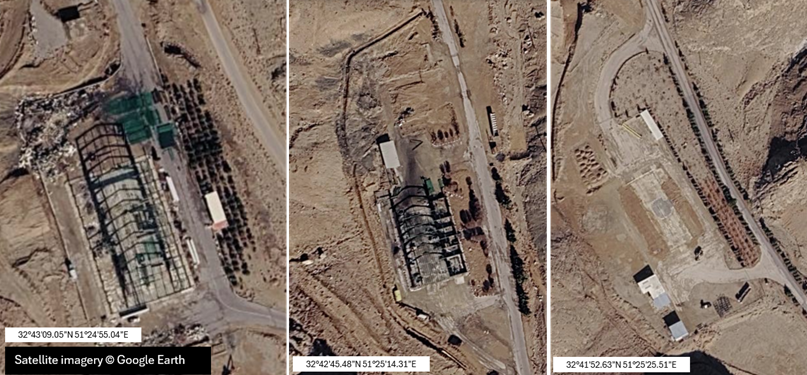
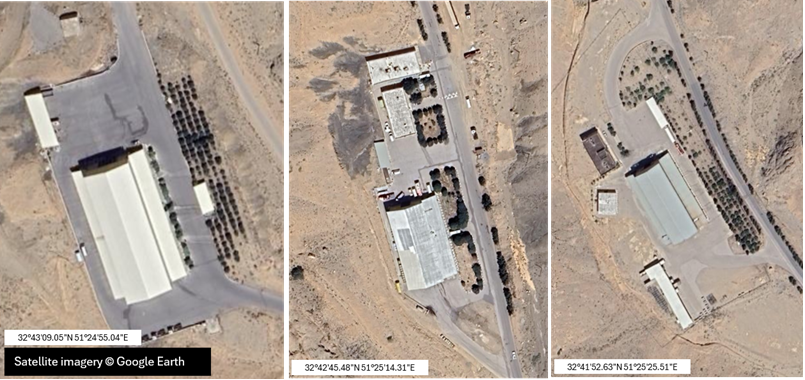
A comparison of images from before the 12-day war in July 2024 and after it in December 2025 shows that large parts of the base were destroyed during that conflict.

(To compare the images below, move the slider from right to left or vice versa.)

After
After
Before
Before
Drag to compare

During the clashes on Sunday night and Monday morning, June 8, there were reports both of missile launches from the area and of explosions at the site following Israeli attacks.

The Nuclear Threat Initiative (NTI) has described the complex as Iran’s largest missile assembly and production facility.

The Ahmad Kazemi complex was built in the late 1980s with assistance from North Korea and China. Solid and liquid fuels, missile components, Shahab missiles and Chinese-made Silkworm and M-class missiles are assembled and produced there.

During both the 12-day war in 2025 and the 2026 war, known as the 40-day war, powerful explosions were repeatedly reported in the area.

Aerial imagery partly revealed the extent of the damage after the 12-day war.

(To compare the images below, move the slider from right to left or vice versa.)

After
After
Before
Before
Drag to compare

During the 2026 war, multiple reports were published about attacks on the base, including on March 13, 2026, and March 27, 2026.

What Israel hit at Iran's Karoon Petrochemical and why it matters

Jun 8, 2026, 11:50 GMT+1
What Israel hit at Iran's Karoon Petrochemical and why it matters
100%
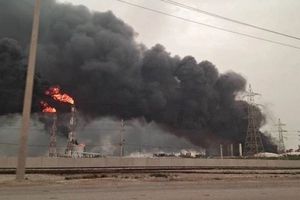
Photo published by Tasnim News Agency, affiliated with Iran’s Revolutionary Guards, shows damage following the June 8 attack on the Karoon Petrochemical Complex.

A strike on the Karoon Petrochemical complex in southwestern Iran on Monday put the spotlight on a key industrial facility with roles in both civilian production and sectors tied by Israel and Western governments to Iran's military capabilities.

Officials in Khuzestan province said the facility was hit during Israeli attacks, with reports indicating damage to chlorine-related units and storage facilities. Any prolonged disruption could affect both domestic supply chains and exports from one of Iran's most important petrochemical hubs.

Karoon is located in Mahshahr, home to a concentration of petrochemical facilities that form a major pillar of Iran's non-oil economy.

Links to the IRGC

Karoon is owned by Persian Gulf Petrochemical Industries Company (PGPIC), Iran's largest petrochemical holding group.

The United States sanctioned PGPIC and dozens of affiliated companies in 2019, saying the group generated billions of dollars that helped finance the Islamic Revolutionary Guards Corps and its construction arm, Khatam al-Anbiya.

According to the US Treasury, PGPIC subsidiaries worked with Khatam al-Anbiya through engineering, construction and financing contracts worth hundreds of millions of dollars. Washington said revenue from the petrochemical sector provided an important source of funding for the IRGC's military activities.

The Guards have long maintained a significant presence in Iran's energy and industrial sectors through a network of companies, contractors and affiliated organizations that oversee major infrastructure projects and benefit from export revenues.

Role in missile-related industries

Petrochemical facilities are primarily civilian enterprises, but some of their products can have military applications.

Chemical compounds produced in Mahshahr and other petrochemical centers such as Assaluyeh can be used as precursor materials in the production of propellants and other components associated with missile programs.

During previous operations targeting industrial facilities in the Mahshahr area, Israel said sites in the region were involved in producing materials used by Iran's missile program.

Israeli military officials said on Monday that one of their objectives was to destroy infrastructure used to manufacture raw materials essential for ballistic missile production.

The dual-use nature of petrochemical production means facilities can simultaneously support civilian industries while supplying materials that may have military applications.

Critical supplier for domestic industry

Despite scrutiny over military links, Karoon remains one of the most important suppliers to Iran's civilian manufacturing sector.

The company is the region's only producer of isocyanates, advanced chemical compounds used in the production of polyurethane materials.

These products serve as the foundation for a wide range of industrial and consumer goods, including insulation, adhesives, coatings, automotive components, footwear, furniture and household appliances.

Karoon receives feedstock such as benzene and toluene from neighboring petrochemical plants and combines them with chlorine, carbon monoxide and hydrogen to produce isocyanates and related products.

The facility's strategic importance increased after the implementation of the HYCO (Hydrogen and Carbon Monoxide) project, which enabled domestic production of carbon monoxide and hydrogen and reduced dependence on imported supplies.

Impact on supply chains and exports

Industry experts say damage to chlorine production units could have consequences beyond the immediate facility.

Chlorine is essential for the production of phosgene, a key intermediate chemical used in manufacturing isocyanates. Any interruption to chlorine supplies can halt downstream production, affecting multiple industries dependent on polyurethane products.

  • Strikes on petrochemical hubs leave Iran short of plastics

    Strikes on petrochemical hubs leave Iran short of plastics

The effects could extend throughout the Mahshahr industrial zone, disrupting manufacturers that rely on Karoon's output.

Karoon also serves export markets. The company ships products including aniline to India and sells other chemical products to customers in Turkey, Russia and neighboring countries.

Those exports have helped Iran maintain a regional presence in specialty chemical markets while generating valuable foreign currency earnings.

A strategic target

The strike illustrates how Iran's petrochemical sector occupies a position at the intersection of economic and security concerns.

For Tehran, facilities such as Karoon support industrial self-sufficiency, exports and employment. For Israel and Western governments, parts of the sector are viewed as supporting broader military and missile-related capabilities through financial links to the IRGC and the production of dual-use materials.

As a result, major petrochemical complexes have become increasingly significant targets in a confrontation that extends well beyond the battlefield and into the infrastructure underpinning Iran's economy and defense industries.

Iran turns to LA-based singer for state-backed religious event

Jun 7, 2026, 08:32 GMT+1

The appearance of Iranian pop singer Gheysar, who has spent nearly four decades living in Los Angeles, at a state-backed religious celebration in Tehran has sparked widespread debate over politics, culture, and the possible return of exiled artists.

The performance took place on Thursday during Eid al-Ghadir celebrations at Imam Hossein Square in central Tehran. The event, which received extensive coverage from official and semi-official media outlets, featured Binesh Bolour, known professionally as Gheysar, who has lived outside Iran for nearly four decades.

In recent years, the Islamic Republic has sought to transform Eid al-Ghadir into a broader national celebration through large-scale public events held in city streets and squares.

Continue reading

Iran turns to LA-based singer for state-backed religious event

Jun 7, 2026, 08:30 GMT+1
•
Maryam Sinaiee
Iran turns to LA-based singer for state-backed religious event
100%

The appearance of Iranian pop singer Gheysar, who has spent nearly four decades living in Los Angeles, at a state-backed religious celebration in Tehran has sparked widespread debate over politics, culture, and the possible return of exiled artists.

The performance took place on Thursday during Eid al-Ghadir celebrations at Imam Hossein Square in central Tehran. The event, which received extensive coverage from official and semi-official media outlets, featured Binesh Bolour, known professionally as Gheysar, who has lived outside Iran for nearly four decades.

In recent years, the Islamic Republic has sought to transform Eid al-Ghadir into a broader national celebration through large-scale public events held in city streets and squares.

The festival included speeches by clerics, performances by government-approved pop singers and religious vocalists closely associated with hardline political groups. Gheysar took the stage as some members of the crowd chanted “Long Live Iran” and “Death to America.”

  • Tehran Aims To Prevent Concerts By Iranian-American Singers From LA

    Tehran Aims To Prevent Concerts By Iranian-American Singers From LA

Official and semi-official media outlets, including state broadcaster IRIB, widely circulated videos of his appearance. In a caption accompanying one of the videos, IRIB wrote that Gheysar had “shouted out his patriotism and returned to Iran” after the outbreak of the recent war involving Iran, the United States, and Israel.

The newspaper Haft-e Sobh described Gheysar’s participation in an official event as both “surprising” and “taboo-breaking,” noting that it was unprecedented since the 1979 Islamic Revolution.

The newspaper wrote: “Gheysar’s presence in Tehran and his performance should be regarded as an important development with dimensions beyond an artistic event. This form of participation in an official ceremony could symbolize the breaking of one of the cultural boundaries of the past four decades.”

Anti-western statements during the war

During the recent conflict involving Iran, the United States and Israel, Gheysar repeatedly criticized US President Donald Trump and Israeli Prime Minister Benjamin Netanyahu on social media. He also strongly attacked Crown Prince Reza Pahlavi and opposition groups that advocated foreign support for the overthrow of the Islamic Republic.

In one video, he said the Iranian nation had broken the “hegemony of the West” and that he was proud of being Iranian. Following the military confrontation, he published additional videos praising Iran’s military capabilities and said: “We shattered the West’s grandeur, and I am proud of that.”

Mixed reactions online

The singer’s appearance has generated sharply divided reactions on social media. Some users described the government’s decision to allow him to perform as hypocrisy, arguing that the authorities embrace nationalism only when they need public support.

One user, Mehrdad Raha, wrote: “Whenever you see a veteran Iranian singer abroad becoming softer in tone toward the Islamic Republic, know that the government has probably been in contact with them for some time, using intermediaries, with promises of money, sponsorship, travel opportunities to Iran, or other incentives to win them over.”

Gheysar rejected such accusations in a video circulated online. He said this was not his first visit to Iran and insisted that he had not returned for money or to obtain a permanent license to work in the country.

He said he had participated in the ceremony because, like many Shiites, he holds a deep respect for Imam Ali, whom Shiites believe was designated by the Prophet Muhammad as his successor at Ghadir.

The legacy of the “Los Angeles singer”

The controversy also revived discussion about the long-standing phenomenon of the so-called “Los Angeles singer.”

Following the 1979 revolution, many Iranian pop stars and actors left the country, particularly female performers whose singing careers were effectively prohibited under the new political order. Many settled in the United States, especially in Southern California.

For years, recordings by exiled singers circulated inside Iran through cassette tapes and videotapes that were copied and distributed despite official restrictions. Possession or distribution of such material could expose people to legal penalties.

The style of dance-oriented Persian pop music associated with Los Angeles was often portrayed in official discourse as morally corrupt, and the term “Los Angeles singer” frequently carried a derogatory connotation in state media.

Several Iranian outlets referred to Gheysar, who has also performed in Israel, a destination Iranian citizens are generally prohibited from visiting, in exactly those terms while reporting on his recent appearance.

Yet the two songs he performed in Tehran differed markedly from the repertoire that made him famous.

One song was dedicated to his hometown, Tehran. The second, titled “The Children of Minab,” was inspired by damage to a school in the southern city of Minab during the first day of the recent conflict. Iranian media reported that 120 schoolchildren and nearly 40 teachers, staff members and parents were killed in the attack.

Could other exile artists return?

Gheysar’s official appearance has renewed speculation about whether other prominent exile artists might be allowed to return.

Haft-e Sobh asked: “Now we must wait and see whether Gheysar’s return is an exception or whether this path will be opened for other artists as well. Will this remain limited to one person, or could it become a model for the future?”

In recent months, several well-known Los Angeles-based Iranian singers have publicly expressed a desire to spend their final years in Iran.

Among those expressing a desire to return is veteran singer Shahram Shabpareh, who has said he would like to spend the final years of his life and career in Iran.

The possibility of a return by singer Moein has also been the subject of recurring speculation, although reports about potential concerts in Iran have repeatedly been denied by him or those close to him.

  • Iran Halts Music Fest As It Teases Diaspora Singer's Return

    Iran Halts Music Fest As It Teases Diaspora Singer's Return

For supporters, Gheysar’s appearance may signal a gradual easing of long-standing cultural restrictions surrounding exiled performers.

Skeptics, however, point to the experience of singer Habib, who returned to Iran in 2009 but was repeatedly denied permits to perform, arguing that official approval can be fleeting and does not necessarily translate into lasting artistic freedom.