• العربية
  • فارسی
Brand
  • Iran Insight
  • Politics
  • Economy
  • Analysis
  • Special Report
  • Opinion
  • Podcast
  • Iran Insight
  • Politics
  • Economy
  • Analysis
  • Special Report
  • Opinion
  • Podcast
  • Theme
  • Language
    • العربية
    • فارسی
  • Iran Insight
  • Politics
  • Economy
  • Analysis
  • Special Report
  • Opinion
  • Podcast
All rights reserved for Volant Media UK Limited
volant media logo

Iran's Frozen Asset Release Sparks Mixed Reactions In Iran
Iran International Newsroom
Aug 12, 2023, 19:47 GMT+1Updated: 17:43 GMT+1
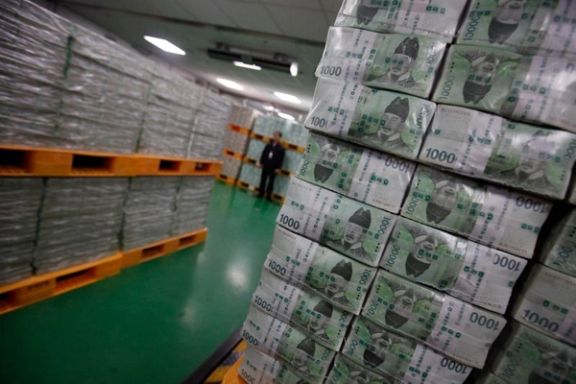
An employee from the Bank of Korea stands in front of stacks of South Korean won at the Bank of Korea's headquarters in Seoul.

Some Iranian politicians and many citizens on social media have offered mixed reactions to the news about the release of Iran's frozen assets as part of a prisoner swap.

However, most Iranian social media users were explicit in stating that the Iranian American dual nationals are hostages, not individuals who were wrongly imprisoned, a euphemism that even some US sources and figures tend to use.

President Ebrahim Raisi’s Deputy Chief of Staff for Political Affairs, Mohammad Jamshidi wrote in a tweet on Thursday night: “After releasing Iran’s Frozen assets in Iraq, the release of all of Iran’s funds in South Korea has started. The prisoners the United States is interested in will remain in Iran until the money is fully transferred to Iran.”

Meanwhile in a tweet in English, Jamshidi wrote: “Hopefully, Iranians held hostage by the US will be freed. US prisoners in Iran will leave simultaneously with the irreversible release of our illegally held citizens and the full transfer of illegally held assets in South Korea, similar to the recently freed assets in Iraq.”

President Ebrahim Raisi’s Deputy Chief of Staff for Political Affairs, Mohammad Jamshidi  (undated)
100%
President Ebrahim Raisi’s Deputy Chief of Staff for Political Affairs, Mohammad Jamshidi

An Iranian commented on social media, “There is no money. This is a credit held by banks in Qatar for purchasing food and medicine,” and that "Well-connected individuals are getting ready to embezzle the money."

A former reformist lawmaker reacted to the news by tweeting "Can one ever be humiliated more than this? According to Iran’s laws, those prisoners are Iranian citizens, and their release has nothing to do with the United States. By the way, If they were spies, why they are being released, and if they were not spies, why they have been arrested?”

Conservative journalist Vahid Hajipour quoted Fars News Agency in a tweet as having reported that Iran’s frozen money in South Korea will go to Qatar and will be used to import goods that are not subject to US sanctions. Hajipour added: "This is exactly the same mechanism that was used for Iran’s frozen money in Iraq. What does this mean? It means that it is the United States that makes the decision about which goods can be bought by Iran’s money.” Using the Islamic Republic officials’ jargon about the deals between Iran and the United States, Hajipour added: “Welcome to watch Iran’s dignified diplomacy.”

Journalist Vahid Hajipour  (undated)
100%
Journalist Vahid Hajipour

Meanwhile, a member of the Iranian nuclear negotiator team, Mohammad Marandi wrote on Twitter: "This is a dishonest claim manufactured by bitter people. Iran will have full and direct access to its released assets, there will be no Qatari companies involved, Iranian banks will have full control, and they can purchase goods and services without any limitation or restriction." Marandi was responding to US an Iran-watcher who had quoted Ali Vaez of the Iran Crisis Group as having said: " All Iran can do...is submit orders to a bank in Doha for food and medicine and a limited number of medical equipment...The bank in Doha would pay for the goods, and Qatari companies would deliver them to Iran. Iran has no direct access to the funds at all.'

In an optimistic analysis published by Etemad Online website political analyst Abdolreza Faraji Rad opined that the development is part of a wider unwritten agreement between Iran and the United States which is supposed to also cover other issues. Although Faraji wrote the piece in a way as if a nuclear deal is going to be within reach, the media in Europe and United States reported that any wider agreement is meant to also restrict Iran's regional military ambitions and prevent its proxy groups from attacking US bases in the region. 

Meanwhile, Nour News, a media outlet close to Iran's Supreme Council of National Security also wrote that although negotiations between Tehran and Washington took a long time to lead to an agreement, "Now the situation is changing."


Most Viewed

US blockade enters murky phase as tankers spoof signals and buyers hesitate
1
ANALYSIS

US blockade enters murky phase as tankers spoof signals and buyers hesitate

2

US tightens financial squeeze on Iran, warns banks over oil money flows

3
INSIGHT

Ideology may be fading in Iran, but not in Kashmir's ‘Mini Iran'

4
INSIGHT

Hardliners push Hormuz ‘red line’ as US blockade tests Iran’s leverage

5
VOICES FROM IRAN

Hope and anger in Iran as fragile ceasefire persists

Banner
Banner

Spotlight

  • Hardliners push Hormuz ‘red line’ as US blockade tests Iran’s leverage
    INSIGHT

    Hardliners push Hormuz ‘red line’ as US blockade tests Iran’s leverage

  • Ideology may be fading in Iran, but not in Kashmir's ‘Mini Iran'
    INSIGHT

    Ideology may be fading in Iran, but not in Kashmir's ‘Mini Iran'

  • War damage amounts to $3,000 per Iranian, with blockade set to add to losses
    INSIGHT

    War damage amounts to $3,000 per Iranian, with blockade set to add to losses

  • Why the $100 billion Hormuz toll revenue is a myth
    ANALYSIS

    Why the $100 billion Hormuz toll revenue is a myth

  • US blockade targets Iran oil boom amid regional disruption
    ANALYSIS

    US blockade targets Iran oil boom amid regional disruption

  • Iran's digital economy battered by prolonged blackout
    INSIGHT

    Iran's digital economy battered by prolonged blackout

•
•
•

More Stories

New EU Countries Align With Sanctions On Iran's Russia Support

Aug 12, 2023, 17:08 GMT+1

A group of European Union candidate countries have aligned themselves with a recent decision by the bloc to impose sanctions on Iran for its support for Russia's war on Ukraine.

On July 20, the EU Council adopted a decision introducing a fresh sanctions framework aimed at Iran's involvement in supporting Russia's military. This framework includes a ban on exporting components for Unmanned Aerial Vehicles (UAVs) from the EU to Iran, as well as provisions for potential travel bans and asset freezes targeting individuals connected to Iran's UAV program.

The candidate countries - North Macedonia, Montenegro, Albania, Ukraine, Republic of Moldova, and Bosnia and Herzegovina - along with EFTA members Iceland and Liechtenstein, have aligned themselves with this Council decision. This alignment signifies their commitment to adapting their national policies to reflect the provisions outlined in the decision.

The European Union commended these countries for their commitment and welcomes their alignment with the sanctions.

This alignment comes in the wake of a contentious international debate sparked by the delivery of Iranian-manufactured drones to Russia. This issue gained significant attention following Russia's invasion of Ukraine. While Iran initially refuted allegations of supplying Shahed suicide drones to Russia, Foreign Minister Hossein Amir-Abdollahian later admitted to the transfers in November 2022. He asserted that the deliveries occurred before the Ukrainian conflict commenced, and on a limited scale.

However, Ukrainian authorities strongly contested Iran's account, presenting substantial physical evidence suggesting ongoing and substantial drone deliveries from Iran.

In response to these allegations, the European Union, along with the United Kingdom, the United States, and Canada, implemented punitive measures against Iran.


Hijab Police Remains Holy Grail For Iran's Regime

Aug 12, 2023, 15:58 GMT+1
•
Iran International Newsroom

While updates about Iran’s contentious new hijab bill are trickling out, a newspaper in Tehran says the so-called morality police is still the regime’s preferred strategy. 

Farhikhtegan newspaper, affiliated with Ali Akbar Velayati, a close advisor to Supreme Leader Ali Khamenei, said in an article published Saturday that a parliamentary committee in charge of the bill has eliminated the only possible benefit of the bill aimed at reducing police confrontations with people. 

The main idea of the bill was to introduce a new way for hijab enforcement in the streets that would not lead to violent confrontation between police and people, reminiscent of the death of Mahsa Amini that ignited nationwide protests last September, shaking the foundations of the clerical regime. It put the emphasis on non-policing measures, rather than hijab patrols who confront the people on the streets.

The bill, which was sent to the Islamic Consultative Assembly by the administration of President Ebrahim Raisi, initially was comprised of only 15 articles. Now undergoing its final deliberations, it has become more unwieldy with 70 articles while the parliament has decided to discuss it without an open session in fear of further backlash.

An Iranian woman without mandatory hijab in Tehran   (August 2023)
100%
An Iranian woman without mandatory hijab in Tehran

According to lawmaker Ahmad Naderi, a member of the parliament's presidium, a joint committee will make “the decision on the bill's passage into law discreetly and without being presented in the open session of the parliament.”

“The bill, fraught with suspicions and flaws both from a legal and societal perspective, has become a topic of national discussion,” said Farhikhtegan daily. “Now even more alarming news is being heard,” added the paper, explaining that lawmaker Amirhossein Bankipour has made the hijab patrols by police as the only viable option to crush the civil disobedience movement that is translated into society as women unveiling in public. “This means going back to square one,” said the article. 

The uprising last September has made it increasingly difficult for the clerical regime to enforce the mandatory Islamic dress code. Since the beginning of the ‘Women, Life, Freedom’ movement, tens of thousands of girls and women have shed their compulsory hijab. The regime seeks to criminalize hijab defiance, but no branch of the government wants to be solely responsible for complications and the risk of social backlash.

Iranian women without mandatory hijab in Esfahan (Isfahan)  (August 2023)
100%
Iranian women without mandatory hijab in Esfahan (Isfahan)

According to Farhikhtegan newspaper, the bill has evolved to the point where instead of rectifying the existing issues, its new addendums will further exacerbate the situation.

In recent weeks, the regime has intensified measures to intimidate people against defying hijab such as shutting down restaurants, cafes, small businesses and even online shops. The regime has also summoned students and has moved to make university lectures online in fear of renewed protests. However, the common belief is still the same: Regime cannot retain control of women’s dress code on streets. 

Veteran hardliner lawmaker Hossein-Ali Haji-Deligani said that to keep its head above water, the regime must act promptly. “Every day, the situation worsens, thus requiring preventive actions; otherwise, we risk entering irrecoverable circumstances. Due to inaction, defiance against hijab has deteriorated further, and if we don't stop its progress, it will sweep us away,” he said, justifying the haste and secrecy in finalizing the hijab bill. 

Responding to Haji-Deligani, political analyst Ali-Hossein Ghazizadeh said, “The regime is rushing to secretly approve the bill. This bill represents the last arrow in the quiver of the regime to confront the women who have come to make history. Mark my word! This bill does not work; the flood that has been unleashed will sweep you all away,” he said in a tweet. 

Reformist activist Saeed Shariati quipped on a television debate earlier in the week that it is not "religious minorities" but the "irreligious majority" who do not adhere to the regime's interpretation of Islamic laws.

Iran Contradicts US, Denying Restrictions On Unfrozen Funds

Aug 12, 2023, 11:43 GMT+1
•
Mardo Soghom

Conflicting statements regarding the allocation of Iran's unfrozen funds persist between Washington and Tehran, with Iran refuting any imposed limitations.

The White House stressed on Friday that there would be restrictions on what Iran could do with any funds unfrozen under an emerging agreement that has led to the release of five Americans from prison to house arrest in Tehran.

White House spokesperson John Kirby told reporters that the United States would have "full visibility" into where any released Iranian funds are directed and used. An estimated $6 billion in Iranian assets are now held in South Korea.

"Essentially, the funds can only be accessed for food, medicine, medical equipment that would not have a dual military use," he said. "And there will be a rigorous process of due diligence and standards applied with input from the US Treasury Department."

But Iran immediately had a different reaction to the news of the prisoner release deal. “The Islamic Republic will decide how to use the released funds, and these funds will be appropriated for the various needs of the country by the appropriate authorities,” the foreign ministry said in a statement on Friday.

Iranian media on Saturday insisted that the money, which for now is $6 billion held in two South Korean banks, will go into commercial bank accounts in Qatar and the allocation of these funds “will be under the purview of the Islamic Republic and will be used for various needs of the country,” Faraz daily in Tehran reported based on information from government sources.

White House spokesperson John Kirby  during the daily press briefing at the White House in Washington, July 17, 2023
100%
White House spokesperson John Kirby during the daily press briefing at the White House in Washington, July 17, 2023

Control of the Funds

Faraz Daily, a relatively independent website by Iranian standards, said Saturday that the funds will go from South Korea to Switzerland to be converted into euros, and then wired to two banks in Qatar. 

This sounds simple and non-controversial. But the report added that after reaching Qatari banks the funds will be transferred to a few accounts opened in Qatar by Iranian banks “so the appropriation of the money can be under Iran’s control.”

The Iranian version of the deal becomes more controversial, as Faraz Daily said that once the euro funds are deposited in the Iranian accounts, the Central Bank of Iran “will have 100 percent full and direct control” on how to appropriate the funds “for essential goods, medicine and other needs.”

If Iran has accepted limitations on its nuclear program for freeing its assets, as media reports indicate, it is to be expected that Tehran will try to deny any US control over the unfrozen funds, mainly for domestic public opinion. However, Kirby’s formulation that the United States will have “full visibility” is vague and different from having a veto power on what Iran spends the funds for. 

Here it becomes clear why the funds will be in euros. Washington can control international dollar transactions and be aware of all the details of wire transfers, including the recipients. But in case of euros, the US must mainly rely on information it is given by Qatari banks.

Faraz Daily also said that Iranian businesses can request disbursements of the funds. Most so-called businesses are tied to the Iranian government and the Revolutionary Guard, and the US cannot have full information if sanctioned companies are benefiting from the unfrozen funds being transferred in euros.

While it is clear that a detailed mechanism has been or is being set up for the funds, the Biden administration is not disclosing the full extent of the agreement and the degree to which it will be able to have a say in any inappropriate use of the funds.

South Korea's First Vice Foreign Minister Choi Jong-kun (2nd from L) meets with his Iranian counterpart, Ali Bagheri Kani, in Vienna on Jan. 6, 2021, to discuss the issue of Tehran's frozen assets under US sanctions, in this photo provided by Seoul's foreign ministry.
100%
South Korea's First Vice Foreign Minister Choi Jong-kun (2nd from L) meets with his Iranian counterpart, Ali Bagheri Kani, in Vienna on Jan. 6, 2021, to discuss the issue of Tehran's frozen assets under US sanctions, in this photo provided by Seoul's foreign ministry.

Is there a deal to restrict Iran’s nuclear activities?

Fars news agency affiliated with Revolutionary Guard claimed Friday that the agreement with the United States is not “oil for food” program, similar to a scheme imposed on Iraq 1995, when Baghdad could sell its oil but could only import humanitarian needs.

Fars boasted that while during the presidency of Hassan Rouhani the US was offering to free one or two billion dollars in exchange for Iran not to enrich uranium to 20 percent, “now they will free all the blocked funds for the release of prisoners.”

In another report on Saturday, Fars quoted unnamed Iranian officials as saying that the nuclear program is in full swing, “according to existing plans of Iran’s atomic energy agency.” It also claimed that the December 2020 law passed by parliament mandating reduction of IAEA monitoring and higher uranium enrichment is in place and fully adhered to.

On Friday, the Wall Street Journal cited people familiar with the matter as saying Iran has significantly slowed the pace at which it is accumulating near weapons-grade enriched uranium and has diluted some of its stockpile.

Kirby said he could not confirm the report but said "any steps that Iran might take to slow down enrichment certainly would be welcome."

"We're not in active negotiations about the nuclear program," he added. "But certainly those sorts of steps, if they were to be true, would be welcome."

While a significant opposition is emerging in the United States against the release of the funds, an Israeli source, who wished to remain anonymous, revealed to Iran International's correspondent in Israel that the agreement between the US and the regime is not merely a tentative understanding but a comprehensive accord.

Emphasizing that the agreement carries significant ramifications, signaling a shift beyond conventional diplomatic engagements between nations, the source said the Israeli government is concerned about the expansion of the accord, like many other critics who believe the deal would embolden Iran in its hostage taking policy.

Reformists In Iran Doubt March Elections To Be Free And Fair

Aug 12, 2023, 08:33 GMT+1
•
Iran International Newsroom

The main issue around Iran’s parliamentary elections in March is whether relatively moderate politicians will run, and if this can bring out disillusioned voters.

Many moderates have signaled their unwillingness to register as candidates, given their fear that hardliners using their political power will disqualify them, similar to what took place in 2020 and 2021.

However, a former speaker of the Parliament who is a close relative of Supreme Leader Ali Khamenei says reformists will take part in the election despite playing coy.

Gholam Ali Haddad-Adel told Young Journalist Club conservative website that "Some reformists are serious about what they say, but some are more realistic. They will act coquettishly, but they will take part in the elections anyway."

Whether he is right in his prediction, many Iranians see the elections as a ruse and will not go to vote for any regime faction. They have lost hope that the Islamic Republic can improve and solve their multiple grievances.

This is why Haddad-Adel called on Iranians to take part in the elections as a high turnout will lend the Islamic Republic authority and political leverage.

Gholam Ali Haddad-Adel, a former parliament speaker  (undated)
100%
Gholam Ali Haddad-Adel, a former parliament speaker

Also speaking to the press this week, former lawmaker Tayebeh Siavashi, a reformist political figure, said: "The Islamic Republic's existence depends on the people's participation in the elections. If the people refuse, the Islamic Republic will no longer exist, or its survival will be endangered."

However, she added that the current Majles (parliament) has disappointed the people as legislation that lawmakers approve is far from what voters are demanding. As evidence she pointed to recent amendments the lawmakers passed to the Election Law, which were mainly meant to ensure their re-election.

She further argued that the changes in the election law are unlikely to lead to economic progress or strengthening democracy and creating welfare for the nation. Siavashi reiterated that the amended election law simply serves the interests of one particular political group, presumably the ultraconservatives in Paydari Party who hold the majority of seats in the Iranian parliament. This, she said, threatens the regime's legitimacy.

Siavashi added that what is currently taking place regarding the upcoming elections is mainly meant to ensure the ultraconservatives' control of the government even at the expense of considerably lowering the turnout.

Former lawmaker Tayebeh Siavashi (undated)
100%
Former lawmaker Tayebeh Siavashi

She said some of the bills recently approved or being discussed at the parliament such as the laws about restricting Internet access or harsh regulations to impose the compulsory hijab on Iranian women have caused a lot of protests, but the government does not pay any attention to the people's demands or even their protests.

Contrary to the reluctance of moderates and reformists, some conservatives such as Asadollah Badamchian, the leader of the Islamic Coalition Party are keen to take part in the elections, although his traditional conservative party has little chance of winning more than a few seats in the parliament.

Badamchian has said his party will nominate 400 candidates for the 290 seats in the parliament. This will effectively mean that some 110 of his party members have to compete against other members, even if the party wins all the seats of the parliament.

However, not all the conservatives are determined to take part in the elections. Ahmad Alirezabeigi, a lawmaker close to former President Mahmoud Ahmadinejad told the press on Wednesday that the former President is not planning to take part in the March 2024 elections either as a candidate or as a kingmaker to promote other candidates.


Ex-Hostage Sheds Light On Iran-US Prisoner Deal

Aug 11, 2023, 23:17 GMT+1
•
Iran International Newsroom

A former hostage in Tehran reveals details on the deal between Tehran and Washington to release US hostages in exchange for Iran’s frozen funds.

Nizar Zakka, a Lebanese who spent about four years in prison in Iran on trumped-up charges – like all foreign citizens held hostage in Iran – told Iran International that based on information he received from his sources the amount of money Iran is receiving as part of the deal is said to be over $10 billion, which includes the frozen funds in South Korea, Iraq and Japan.

He said there are conflicting reports on the amount of the money from Iranian and US sources, adding that it is not yet clear if all the frozen funds in Iraq, Japan and South Korea are included in the agreement. “It’s a lot of money,” he said, explaining that the funds will not go to the hands of the regime authorities, and are supposed to “go directly for humanitarian purposes through a third party.”

Iran has tens of billions of dollars worth of funds in foreign banks that it cannot access because of US sanctions. The funds are mostly kept in banks in South Korea ($7 billion), Iraq ($11 billion), Japan ($3 billion) as well as China and India where Iran is owed for shipments of crude and other oil products that took place before the United States pulled out of the 2015 nuclear deal and re-imposed full energy sanctions on Tehran in 2018 and 2019.

“We hope that this deal will put an end... this hostage business model that has been ongoing for so long,” added Zakka, who is the president of Hostage Aid Worldwide -- an NGO to support and help the release of people held hostage for unjust reasons.

The interview followed reports about the deal that will see five US citizens release from Iran in exchange for Iranian funds going from one restricted account to another, only be used for humanitarian purposes such as buying food or medicine.

US State Department spokesperson Matt Miller said, "We are relieved to learn that Iranian authorities have released five US citizens -- Siamak Namazi, Morad Tahbaz, Emad Sharghi (Shargi), and two individuals who at this time wish to remain private -- from prison to house arrest.” Iran's mission to the United Nations told Iranian state media that "Under the deal mediated by a third country, five Iranians jailed in the United States will be released and Iran's frozen funds in South Korea will be unblocked and transferred to Qatar."

Siamak Namazi, Morad Tahbaz, Emad Sharghi (Shargi)  (file photo)
100%
Siamak Namazi, Morad Tahbaz, Emad Sharghi (Shargi)

In reaction to US Secretary of State Antony Blinken's claim that he was not aware of any other Americans still detained in Iran, Zakka said "I personally had discussion and correspondence about (US permanent resident) Shahab Dalili with (former special envoy for Iran) Rob Malley and the State Department. “Everybody is very aware about Shahab's detention in Iran. I believe it may have skipped his (Blinken's) mind at a certain moment that he forgot Shahab Dalili's case exists."

"The Levinson Act does not differentiate between a US green card holder and a passport holder. We know of at least two cases of green card holders (Shahab Dalili and Jamshid Sharmahd) being charged exactly for cooperating with the US and being a US resident," he said, emphasizing that no hostages should be left behind like what happened for Siamak Namazi in 2016. “I hope this time everybody will be home, and we'll put an end to this hostage diplomacy.”

Highlighting that the Islamic Republic took two more hostages during the course of negotiations for this deal, he criticized a lack of deterrence in the deal. “Without deterrence, the Islamic Republic's hostage-taking is going to continue and happen again because they're making money out of this and have so much leverage over the West through these hostages."

Citing sources involved in the matter and close to power circles in Iran, Zakka said the deal "has something to do with the long-range missile agreement that will end next month, and this will put a pause on this as well. This will be good to calm the situation in the region especially now with Iran's supersonic missile."

If the information is right, Iran will not resume ballistic missiles tests after the expiry of the sanctions in October, will pause testing hypersonic missiles and will not transfer ballistic missiles to Russia. These issues are the points that France, Britain and Germany are using to justify retaining ballistic missile sanctions on Iran set to expire in October under the defunct 2015 nuclear deal. In early-July, the UN Security Council held a session on the Joint Comprehensive Plan of Action (JCPOA) and the implementation of resolution 2231, whose clauses are justifying keeping the sanctions in place.

Earlier in the day, an Israeli source, who wished to remain anonymous, revealed to Iran International's correspondent in Israel that the agreement between the US and the regime is not merely a tentative understanding but a comprehensive accord.

Emphasizing that the agreement carries significant ramifications, signaling a shift beyond conventional diplomatic engagements between nations, the source said the Israeli government is concerned about the expansion of the accord, like many other critics who believe the deal would embolden Iran in its hostage taking policy.

The informed source further elaborated that the agreement encompasses more intricate details, which have not yet been disclosed.

"The reason Prime Minister Benjamin Netanyahu has refrained from commenting on this agreement thus far is that he avoids acknowledging that, during his tenure, the United States and the Islamic Republic have reached an accord," the source stated.

His remarks came just hours before The Wall Street Journal reported that Iran has significantly slowed the pace at which it is accumulating near-weapons-grade enriched uranium and has diluted some of its stockpile, citing people briefed on the matter. "Iran has diluted a small amount of 60% enriched uranium in recent weeks and slowed the rate at which it is accumulating new material."

The WSJ said that US officials had hoped Tehran would stop accumulating 60% enriched uranium as one of a series of de-escalatory steps from both sides, which included the prisoners deal.



