• العربية
  • فارسی
Brand
  • Iran Insight
  • Politics
  • Economy
  • Analysis
  • Special Report
  • Opinion
  • Podcast
  • Iran Insight
  • Politics
  • Economy
  • Analysis
  • Special Report
  • Opinion
  • Podcast
  • Theme
  • Language
    • العربية
    • فارسی
  • Iran Insight
  • Politics
  • Economy
  • Analysis
  • Special Report
  • Opinion
  • Podcast
All rights reserved for Volant Media UK Limited
volant media logo

Top Cleric, Politicians In Iran Slam The Government Over The Economy
Iran International Newsroom
Sep 3, 2022, 08:44 GMT+1Updated: 17:28 GMT+1
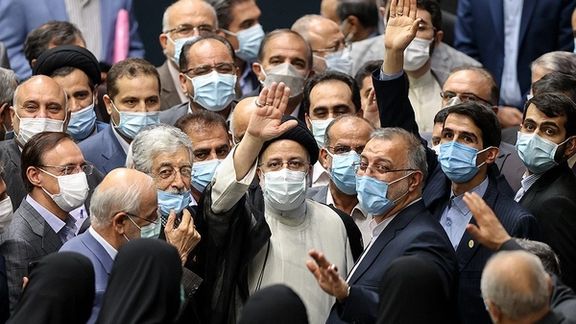
President Ebrahim Raisi and his conservative, hardliner supporters in parliament, August 2021

Criticism of Iran’s governing hardliners fills the pages of some local media for failing to manage the economy and making irrational decisions that hurt the people.

Responding to Iranian hardliners' insistence on employing clerics to supervise government and private institutions in a wide range of areas from banking to medicine, Iranian lawmaker, Massoud Pezeshkian said that no cleric, judge or government minister would put his life at risk by going to a doctor who is a devout Muslim but does not have the medical qualifications.

He said, on the contrary, many of those officials would go abroad to seek medical assistance for a simple surgical operation but when it comes to taking care of the people, they advise that religious virtues, without the right qualifications, comes over and above their academic credentials.

Pezeshkian, a member of the Iranian parliament's medical committee suggested that in the interest of the people's welfare, the government should prioritize professional abilities in various professions instead of employing zealot Muslims with little qualifications and skills. The lawmaker who is a medical doctor criticized government plans to place clerics in all bank branches as Islamic supervisors.

Member of the Iranian parliament Massoud Pezeshkian
100%
Member of the Iranian parliament Massoud Pezeshkian

Criticism of the government in Iran during these days is not limited to lay officials and politicians. Grand Ayatollah Hossein Nouri Hamadani, a source of emulation, one off the highest ranks in the Shiite clerical system, has also called on President Ebrahim Raisi (Raeesi) on September 2, to be serious in tackling inflation.

Didban Iran website quoted Noori Hamadani as saying "It is undeniable that sanctions imposed by the enemies have affected the country's economic situation, but the government should not take advantage of this to justify its failure in controlling the prices and harnessing inflation."

Saying this during a meeting on Friday with the Minister of Industry Reza Fatemi Amin, the grand ayatollah suggested that the government should do its best to provide what the people need by boosting production. He added that "the only sign of the officials' success is the people's happiness. But we see that people find it difficult to buy even a kilogram of fruit."

Grand Ayatollah Hossein Noori Hamadani
100%
Grand Ayatollah Hossein Noori Hamadani

In another development, lawmaker Behrouz Mohebbi of the Iranian parliament's planning and budget committee, told reporters in Tehran on Friday that government’s decision in early May to cancel import subsidies for food, medicine and animal feed has led to unprecedented inflation.

Meanwhile, he attributed part of the problems people face to the fact that the government always talks about long-term plans and has no short-term planning to solve the country's economic issues. Mohebbi further called on President Ebrahim Raisi to take serious measures to help the underprivileged part of the Iranian society.He criticized Raisi and his ministers for pretending during cabinet meetings that the people's financial situation is improving. Mohebbi reiterated that people find it difficult to make ends meet. They are under immense economic pressure.

Meanwhile, conservative commentator Mohammad Mohajeri, a former editor of hardline daily Kayhan, wrote on his Telegram channel that it appears the government has reduced the individual quota for purchasing gasoline at the subsidized price from 250 to 150 liters per month in what appears to be a prelude to raising fuel prices in Iran.

He added that gasoline rationing cards are likely to be made obsolete soon. According to Iranian media, Iranians consume some 120 to 130 million liters of gasoline every day.


Most Viewed

Ghalibaf defends Iran-US talks amid hardline backlash
1
INSIGHT

Ghalibaf defends Iran-US talks amid hardline backlash

2
VOICES FROM IRAN

Bread shortages, soaring prices strain households in Iran, residents say

3
INSIGHT

Iran diplomacy wobbles as factions compete to avoid looking soft on US

4
ANALYSIS

The politics of pink: how Iran uses cuteness to rebrand violence

5
ANALYSIS

From instability to influence: Pakistan’s pivotal role in US-Iran diplomacy

Banner
Banner

Spotlight

  • Is Iran entering its Gorbachev moment?
    INSIGHT

    Is Iran entering its Gorbachev moment?

  • Iran crackdown reaches cemeteries as graves of slain protesters defaced
    EXCLUSIVE

    Iran crackdown reaches cemeteries as graves of slain protesters defaced

  • Iran diplomacy wobbles as factions compete to avoid looking soft on US
    INSIGHT

    Iran diplomacy wobbles as factions compete to avoid looking soft on US

  • The politics of pink: how Iran uses cuteness to rebrand violence
    ANALYSIS

    The politics of pink: how Iran uses cuteness to rebrand violence

  • Bread shortages, soaring prices strain households in Iran, residents say
    VOICES FROM IRAN

    Bread shortages, soaring prices strain households in Iran, residents say

  • Ghalibaf defends Iran-US talks amid hardline backlash
    INSIGHT

    Ghalibaf defends Iran-US talks amid hardline backlash

•
•
•

More Stories

Medicine Crisis Worsens In Iran With Lack Of Foreign Currency

Sep 2, 2022, 14:59 GMT+1
•
Maryam Sinaiee

An Iranian lawmaker has warned about the failure of the government’s Medicine Assistance Plan to make prices affordable amid high inflation and rising poverty.

“Patients, particularly those with rare diseases, have been facing problems since the removal of medicine import subsidies,” Mohammad-Taghi Naghdali, a member of the parliament's judicial and legal committee, told the Iranian Students' News Agency (ISNA) Thursday, adding that lawmakers have warned that without allocation of cheap foreign currency to pharmaceutical imports the government's Medicine Assistance Plan is bound to fail.

Social media users say the cost of medicine has sharply risen in the past few months and some vital drugs for treatment of rare diseases are very hard to find except on the black market.

Pharmacies and insurance companies have also been complaining about the An Iranian lawmaker has warned about the failure of the government’s Medicine Assistance Plan to make prices affordable amid high inflation and rising poverty.

President Ebrahim Raisi announced in early May that his government had begun the process of removing up to $15 billion import subsidies for basic foods, medicine, and animal feed despite warnings of more inflation and hardship. Raisi also said the government would be paying cash assistance to most Iranians as compensation.

The removal of import subsidies meant that manufacturers would no longer receive cheap dollars from the government to import raw materials to produce medicine.

While the compensation for bread is directly paid to individuals, compensation for medicine is supposed to be made through the healthcare insurance companies which will then pay it to pharmacies.

Dr Ali Fatemi, deputy chairman of Iran Pharmacists Association, who is a critic of the government’s plan, said Friday that currently there is a serious shortage of antibiotics including antibiotic syrups for children as well as medication required for treatment of rare diseases and psychiatric drugs. He warned that some companies may cease production of antibiotics if demand drops due to unaffordable prices.

Lawmakers have summoned health minister Bahram Einollahi twice in the past month for explanations regarding the ambiguities in the government plan anda parliamentary committee has given the government two weeks to resolve these issues.

Some critics believe that the government’s healthcare policies are influenced by insider groups and state affiliated entities.

“It is now obvious for everybody that pharmaceuticals are controlled by mafia-like groups with ties to the government, the Execution of Imam Khomeini's Order Headquarters (EIKO), and the Supreme Leader's office,” Mohammad-Kazem Attari, US based physician and public health researcher, told Iran International.

EIKO, which is known in Persian simply as Setad is controlled by the Supreme Leader and his office. Another state entity, Barakat Foundation which is also under Supreme Leader's control, was put in charge of developing a homegrown COVID vaccine. The program ended in failure after squandering tens of millions of dollars and precious time that could have prevented around 40,000 deaths in July-September 2021.

Dr Attari said this influential group comes up with ad hoc and unconsidered plans, including the Medicine Assistance Plan, to secure its own interests whenever foreign currency for importing medicine and pharmaceutical products becomes scarce.

According to Dr Attari, this group has control over 60 to 80 percent of all pharmaceutical imports and production. “That’s why the Medicine Assistance Plan was hastily introduced in the system immediately after the removal of cheap import dollars without any pilot studies.

Blast Rocks Iran’s Oldest Oil Refinery Near Persian Gulf

Sep 2, 2022, 13:26 GMT+1

An explosion rocked Iran’s and Middle East’s oldest oil refinery in southwestern city of Abadan in the oil-rich Khuzestan province overnight, state media reported on Friday.

According to the government’s official news website, IRNA, the blast was caused by the bursting of one of the furnaces of the sulphur production unit of phase three of Abadan Oil Refinery during the start-up operation, causing a huge explosion.

The blast apparently had no casualties, and IRNA claims that production at the refinery continues as usual.

This is the second incident at the Abadan refinery, which supplies around 25 percent of the country’s fuel needs, this year. In April, a section of the refinery caught fire but the blaze was contained with no fatalities or injuries. 

Abadan, near the Persian Gulf coast, is Iran’s largest refinery with a daily capacity of 430,000 barrels of crude, producing liquefied petroleum gas, gasoline, kerosene, gas oil, jet fuel, furnace oil, bitumen, petroleum solvents, sulfur, and naphtha. Abadan refinery, opened in 1912 by the Anglo-Persian Oil Company originally as a pipeline terminus, quickly became one of the world's largest refineries and was an important supplier to the British military.

Several explosions and fires in Iranian military and industrial sites − including pipelines and refineries − since mid-2020 have not been fully explained by authorities. However, they have blamed Israel for a series of spectacular sabotage attacks on nuclear facilities, including two explosions at Natanz uranium enrichment center. Israel has not taken responsibility for any incident.

Iran Morality Official Calls For Gender Segregation In Universities

Sep 1, 2022, 22:26 GMT+1
•
Maryam Sinaiee

A top official in charge of Islamic morals in Iran has defended gender segregation in higher education, claiming that families will welcome its introduction.

In a video interview earlier this week, Mohammad-Saleh Hashemi-Golpaygani, in charge of a government organization called Enjoining Good and Forbidding Evil Headquarters, claimed that gender segregation in higher education institutions will contribute to the progress of science and knowledge.

“I don't have an answer when I'm asked why students are kept separate before they reach adulthood but are mixed when they go to university,” he said.

Boys and girls are strictly separated from primary school, but most universities are mixed gender.

“Families will welcome gender segregation [in higher education]. They want a safe environment [for their children],” he said wildly claiming that there are twenty-one universities and colleges in the world that segregate including some in the United States. He also claimed that the average grade point rose by 1.5 in these universities after separating men and women.

Hashemi-Golpaygani’s remarks have outraged many on social media and websites and newspapers have criticized him for his controversial remarks.

In an editorial Tuesday, the moderate conservative Asriran told Hashem-Golpaygani that with his “imprudent and incorrect statements” -- including the undocumented claim that many of the world's top universities have implemented gender segregation and achieved better academic results as well as existence of facial recognition software that can help identify women with insufficient hijab -- he obliterates the Islamic concept of ‘enjoining good and forbidding evil’ and provides sensational stories for foreign-based Persian language media.

University students in Tehran protesting harassment by campus morality police. April 24, 2022
100%
University students in Tehran protesting harassment by campus morality police. April 24, 2022

Some social media users have pointed out that Hashemi-Golpaygani’s own daughter has been studying in a mixed-gender university in Belgium.

In the same interview, Hashem-Golpaygani said that public CCTV cameras, including those in metro stations, are programmed to use facial recognition technology to take photos of unveiled women and to compare against photos in a national database to identify those who break the hijab rules. He suggested that the rule breakers be fined in the same way that people are fined for violating traffic regulations.

Hashem-Golpaygani said recently that about half of Iranian women do not abide by the mandatory hijab rules.

In its editorial entitled “Watch Fewer Sci-Fi Movies”, Asriran also told the offical that he should present himself to Iran’s state-run Cinema Organization if he is interested in the science fiction genre. His suggestion that fining hijab-rule-breakers by using blurry CCTV images will help convert them to hijab “would only be possible in sci-fi or comic films,” Asriran wrote.

The website also suggested that such technology, if it were available in the country, would better be used to find dangerous criminals. The police have numerous burglaries, car thefts, and mugging cases on their hands with footage of the culprits who they cannot identify.

In recent months government and security agencies have intensified their efforts to pressure women into abiding by the hijab laws and several rounds of anti-hijab civil disobedience campaigns have followed.

The patrols by the ‘morality police’ have increased on the streets and videos of violent arrests of women and girls as well as confrontations between people and hijab enforcers, including a recent incident in Shiraz which resulted in the closure of the shopping center where it happened, are becoming too common on social media.

Minister’s Boast About Radars Irks Iranians Fuming Over Downed Plane

Sep 1, 2022, 14:13 GMT+1

Remarks by the interior minister boasting about Iran's advanced radars have irked Iranians, who still demand justice over the downing of a Ukrainian plane.

During a Thursday ceremony to commemorate the occasion of Iran’s Air Defense Day, Ahmad Vahidi -- himself a Revolutionary Guard (IRGC) general -- said the Islamic Republic is among the top countries in the world in terms of its air defense capabilities.

He said Iran is so advanced in radar systems that can detect and destroy all the enemies’ flying objects, and that in the missile sector, the country is again in the top tier in long, medium and short-range missiles, noting that “all these equipment are indigenous and domestically produced."

Similar remarks about the country’s air defense systems were made by the top brass of the military, including Chief of Staff Mohammad Bagheri, the Army’s Commander-in-Chief Abdolrahim Mousavi, and IRGC’s chief commander Hossein Salami, as well as Ghader Rahimzadeh, the commander of the joint air defenses headquarters of the Army and IRGC.

Salami said some top powers in the world have purchased military and defense equipment from Iran and are now using them.

The remarks came as Russia has faced "numerous failures" with Iranian-made drones acquired from Tehran last month for use in Ukraine, and many people are still irate about the downing of Flight PS752 in 2020.

The airliner was shot down by two air-defense missiles fired by the IRGC as it took off from Tehran’s Imam Khomeini International Airport. All 176 passengers and crew, including 63 Canadians and 10 from Sweden, as well as 82 Iranian citizens died in the disaster.

Iran’s Khamenei, Raisi Criticized For 'Fabricated' Statistics

Sep 1, 2022, 11:18 GMT+1
•
Iran International Newsroom

Iran’s Supreme Leader has come under fire for disputed and boastful economic figures President Ebrahim Raisi has recently showcased amid economic crises.

Raisi offered debatable statistics in a meeting with Ali Khamenei on Tuesday to prove his achievements after one year in office. He had presented the same statistics in a press conference a day earlier.

Among other things, Raisi, who was handpicked by Khamenei to become president last year, was harshly criticized for fabricating inflation figures. He told Khamenei on Tuesday that his government brought down the 60 percent inflation rate in 2021 to 35 percent after one year.

While Raisi was criticized by traditional media including national newspapers, criticism of Khamenei was limited to social media as challenging the Supreme Leader is a no-go area for the press in Iran.

Iranian cleric Mohammad Ranani quoted Khamenei in an tweet August 31 as saying: "The most important success of this government is reviving the people's hope and trust in the government." Ranani added: "With skyrocketing prices and the difficulties the people have in making ends meet, I rule out that claim. The Supreme Leader is probably fed wrong statistics. God knows the truth."

Khamenei in turn praised the government for not complaining about lack of power, the same way former presidents often did.

Fereshteh Sadeghi, a former producer who has worked for international media, wrote in an August 31 tweet: "It is obvious why he has not heard that because…all of its members come from offices under Khamenei's supervision. What should they say?"

Wednesday's newspapers lashed out at Raisi for the figures he gave to the public and Khamenei. Reformist daily Arman Emrooz wrote in a commentary that the figures were in sharp contrast with the realities on the ground. These included his comments about reducing the rate of inflation, the realization of his promise about building four million homes, the improvement in the livelihood of teachers and nurses, the boost in fuel production and other forms of energy and so on.

Arman Emrooz also pointed out that Raisi's claim of sorting out the hefty budget deficit last year as well as his claim about not borrowing from the Central Bank were not true either. The daily quoted Raisi’s own officials as having said that it owes some 3,590 trillion rials to the bank, or at least $15 billion depending what currency exchange rate is used to calculate the astronomical number.

Referring to Raisi's boast about providing COVID vaccines for the nation, the daily reminded that key individuals [meaning Khamenei] and organizations [meaning offices under Khamenei's supervision] prevented the importing of vaccines by the previous government.

The daily also pointed out that Raisi's claims about the abundance of essential commodities, ending power cuts, and supplying water to underprivileged areas were not true.

Some newspapers such as Ebteklar highlighted parts of Khamenei's speech during the meeting with Raisi and his cabinet ministers that in fact showed Raisi's failure. The main headline on Ebtekar on Wednesday quoted Khamenei as saying: "The high cost of housing has made life difficult for the people."

Although Khamenei reminded Raisi and his government during the meeting on Tuesday to be realistic in terms of what they promise to the people, Entekhab quoted a senior foreign ministry official as saying on Wednesday: "We are very close to becoming a superpower."