• العربية
  • فارسی
Brand
  • Iran Insight
  • Politics
  • Economy
  • Analysis
  • Special Report
  • Opinion
  • Podcast
  • Iran Insight
  • Politics
  • Economy
  • Analysis
  • Special Report
  • Opinion
  • Podcast
  • Theme
  • Language
    • العربية
    • فارسی
  • Iran Insight
  • Politics
  • Economy
  • Analysis
  • Special Report
  • Opinion
  • Podcast
All rights reserved for Volant Media UK Limited
volant media logo

Iran's Khamenei Praises Raisi Government, Silent On Nuclear Talks
Iran International Newsroom
Aug 30, 2022, 11:59 GMT+1Updated: 17:43 GMT+1
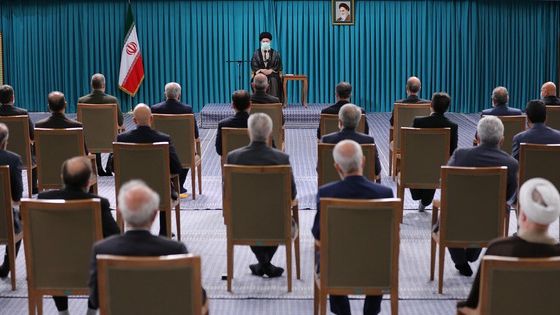
Iran's Supreme Leader Ali Khamenei meeting with members of the government, August 30, 2022

The government has brought renewed hope to Iranians, Supreme Leader Ali Khamenei said Tuesday to defend President Ebrahim Raisi against mounting criticism.

In a meeting that takes place with the president and his ministers every year at the end of August, Khamenei found few concrete accomplishments to praise – something he usually does on this occasion.

Many politicians, social media activists and even allied hardliners have been criticizing Raisi for his economic performance, as inflation has risen, and he has been unable to deliver on his election promises.

Reports in the Iranian media about Khamenei’s remarks did not mention any comment on the ongoing nuclear negotiations that can lift sanctions and ease the mounting economic problems.

Khamenei told members of the government that “In my opinion your most important success has been to reawaken hope among the people.”

This is exactly what has been the subject of countless articles and interviews, even in Iran’s censored media, which began just weeks after Raisi took office a year ago. Many politicians and pundits have warned in the past months that people are losing hope and there is a high danger of a social explosion.

Since the United States withdrew from the JCPOA nuclear agreement and imposed sanction in 2018, Iran’s economic indicators of falling real wages, high inflation and increasing poverty have gotten worse by every passing quarter.

President Raisi chatting with participants in the meeting with Khamenei, August 30, 2022
100%
President Raisi chatting with participants in the meeting with Khamenei, August 30, 2022

Raisi inherited the last one year of this difficult equation, but his domestic critics also insist that he did not have the experience to be chief executive. Similarly, they criticize his top aides and ministers for being second and third-rate functionaries, incapable of operating in the difficult financial environment.

Khamenei advised the government to pay close attention to inflation, economic growth, investments, employment, per capita income and the financial gap among social classes. While he prioritized these issues, he did not say how the government can deal with them amid sanction on oil exports and Iran’s international banking ties.

Khamenei also went on to praise Raisi’s frequent visits to provinces, also criticized by politicians as an ineffective exercise when the president has few tools to improve conditions around the country.

Riaisi in these visits often hears complaints and is faced with requests that he usually promises to address, while critics say most of these pledges remain on paper.

Khamenei also praised Raisi’s for not complaining or indirectly criticizing him. The previous president Hassan Rouhani and his supporters occasionally hinted that they did not have enough freedom of action, meaning that key decisions had to be approved by Khamenei.

Apart from numerous personnel and economically significant issues, the Rouhani government was not allowed to hold talks with the United States to find a solution for the nuclear issue and remove the crippling American sanctions.


Most Viewed

Ghalibaf defends Iran-US talks amid hardline backlash
1
INSIGHT

Ghalibaf defends Iran-US talks amid hardline backlash

2
VOICES FROM IRAN

Bread shortages, soaring prices strain households in Iran, residents say

3
ANALYSIS

From instability to influence: Pakistan’s pivotal role in US-Iran diplomacy

4
ANALYSIS

100 days on: why Iran’s January protests spread across social classes

5

War-hit homeowners feel abandoned as Iran’s reconstruction aid fades

Banner
Banner

Spotlight

  • Is Iran entering its Gorbachev moment?
    INSIGHT

    Is Iran entering its Gorbachev moment?

  • Iran crackdown reaches cemeteries as graves of slain protesters defaced
    EXCLUSIVE

    Iran crackdown reaches cemeteries as graves of slain protesters defaced

  • Iran diplomacy wobbles as factions compete to avoid looking soft on US
    INSIGHT

    Iran diplomacy wobbles as factions compete to avoid looking soft on US

  • The politics of pink: how Iran uses cuteness to rebrand violence
    ANALYSIS

    The politics of pink: how Iran uses cuteness to rebrand violence

  • Bread shortages, soaring prices strain households in Iran, residents say
    VOICES FROM IRAN

    Bread shortages, soaring prices strain households in Iran, residents say

  • Ghalibaf defends Iran-US talks amid hardline backlash
    INSIGHT

    Ghalibaf defends Iran-US talks amid hardline backlash

•
•
•

More Stories

The Economic ‘Black Hole’ That Threatens Iran's Future

Aug 29, 2022, 15:56 GMT+1
•
Behrouz Turani

Iran’s government-controlled economy closely intertwined with a closed political system represents a “black hole” according to a prominent journalist in Tehran.

Foroozan Asef Nakhaei says the Iranian Constitutional Law recognizes three forms for the economy, namely the government sector, private sector and cooperatives. But four decades after the 1979 Islamic Revolution, the economy is plagued by what many have dubbed as “Khosulati” [a combination of the words private and public in Persian] that could be vaguely translated as Private-Government sector.

These are enterprises nominally “privatized” by the government but owned or managed by political insiders. The sector devours the three legitimate forms of the economy like a “black hole.”

"This horrendous black hole can prevent even trusted elements of the regime, men such as Majles Speaker Mohammad Bagher Ghalibaf and President Ebrahim Raisi from advancing their economic plans," Asef Nakhaei said in an article on the moderate conservative Khabar Online website , adding that "the black hole can challenge and paralyze the entire system."

According to the journalist, this is an outcome of lack of transparency in the Iranian political system which confuses Iranian and foreign observers who try to understand the decision-making process in Iran.

A recent example of the ‘Khosulati’ economic black hole is a $3 billion corruption case at a major steel plant that appears as a publicly traded company but in fact is controlled by government entities and run by their appointees.

Foroozan Asef Nakhaei, well-known Iranian journalist
100%
Foroozan Asef Nakhaei, well-known Iranian journalist

Meanwhile, the existence of rival power centers and the prominence of unofficial networks in the political system make the situation even more ambiguous. There is no political power center that would be able to criticize the regime, without dangerously challenging it from a safe distance.

Political powers who identified themselves as "reformists" and usually aligned themselves with the "moderates" within the system could never come up with a rhetoric that would build confidence within the core of the system, which is headed by Supreme Leader Ali Khamenei for the past 33 years.

Although the so called ‘Reformist’ faction tried to embark on some changes in the system of governance, the conservatives gradually pushed them aside.

The two groups differed on the idea of development, as Reformists had slightly a more liberal approach, the conservatives continued to fatten the state-controlled economy and specially the quasi-private sector.

These and the fact that the hardliner advocates of "Islamic Government" as opposed to the "Islamic Republic" created parallel, but otherwise similar institutions, did not allow economic development to take center stage. As a result, economic plans in Iran live in a world different from real needs. Power centers exercise their own policies rather than answering to public demands in domestic and even foreign policy. Asef Nakhaei said that the continuation of this paradoxical duality is destructive and dangerous for the country's survival.

If Iran's hardline conservatives and their currently consolidated government can lend some sort of legal safeguards to everyone before the law, they will in fact be implementing the ideas of the country's reformists and moderates and pushing an immature government to behave maturely. This will lead to a government based on national interests, the journalist opined.

He added that the future of Iran depends on democratic reforms regardless of who runs the system and getting rid of the parallel institutions that give way to black holes such as the quasi-government-private economy which is devouring the other sectors and precious resources.

Iran’s Ex-President Khatami Implicated In Fatwa Against Rushdie

Aug 29, 2022, 15:31 GMT+1

A new report has revealed that Iran’s former President Mohammad Khatami had a role in issuing the fatwa by Islamic Republic’s founder Rouhollah Khomeini against author Salman Rushdie. 

According to a report by BBC, Khatami – then a minister -- held a meeting with two Pakistani-British Islamic scholars, Kalim Siddiqui and Ghayasuddin Siddiqui, just hours before Khomeini issued the fatwa, a formal proclamation that called for the murder of Rushdie. Before the February 1989 decree, Iran had largely ignored the Satanic Verses, the controversial book that brought about 30 years of death threats for the novelist. 

The two Sunni clerics had arrived at Tehran’s Mehrabad Airport to get home to the UK after attending a conference in the Iranian capital to mark a decade since the country's Islamic Revolution. Inside the airport, they bumped into Khatami -- who asked to have a private word with Kalim. "They went to a corner and chatted," Ghayasuddin later explained in the BBC's 2009 documentary, recounting that "He (Khatami) was asking my view about Salman Rushdie - and I told him, 'You know, something drastic has to happen.'"

Khatami then met with Khomeini, and a few hours later the fatwa was issued, not only against Rushdie but also its publishers, editors and translators, reportedly without Khomeini even reading the novel. "I call on all valiant Muslims wherever they may be in the world to kill them without delay" it read. 

Kalim later said he believed he may have been "partially responsible" for the fatwa. In 2019, Ed Husain, a writer on religion and extremism, said that Khomeini had not been minded to do anything about Rushdie; it had been the British imam who had urged the autocratic political and religious leader that he "must do something for the Muslims".

Nothing Will Be Left Of Israel If It Acts Against Iran – President Raisi

Aug 29, 2022, 10:56 GMT+1

Iranian President Ebrahim Raisi says if Israel makes a decision to act against the Islamic Republic, it will not have enough time to implement it before anything is left of the country.

During a press conference on Monday, Raisi noted that Israel did not want Iran to acquire nuclear technology in the first place, “but this knowledge has become native to our country and it cannot take it away from us.”

Referring to Israeli efforts to sway the West from returning to the 2015 nuclear deal, he said that their efforts will ultimately turn out to be in vain, adding that “the assassination of nuclear scientists was to stop the nuclear program, many sabotage operations were also meant to stop us but we did not stop; They will not stop us and they cannot stop us from getting this absolute right.”

Reiterating threats against Israel, Raisi said that “the Zionist regime should see that it cannot even protect itself from the resistance groups in Palestine with its threats.” Israel used to face “the Palestinians' stones” but now they have to deal with “their precision-guided rocket launchers,” he noted. “Can they keep themselves safe? Can the Zionists defend themselves against Gaza despite the fact that its oppressed people are under blockade?”

Iran, which uses the term ‘resistance groups’ to refer to its proxy forces in the region, finances and arms Palestinian and other militants against Israel and Western interests.

Israel has stepped up efforts to dissuade the US from reviving the landmark nuclear pact, officially known as the Joint Comprehensive Plan of Action, or JCPOA. The director of Israel’s intelligence agency Mossad is set to travel to Washington DCnext week following trips by National Security Adviser Eyal Hulata and Defense Minister Benny Gantz.

After 73 Years Of Development Plans, Iran Still Struggles

Aug 28, 2022, 22:26 GMT+1
•
Iran International Newsroom

The Islamic Republic will soon start its 7th national developmental plan, but an expert who worked in previous government economic plans doubts it can succeed.

Since 1940s Iran has launched 11 plans to build infrastructure, establish key industries, expand public services and education. Five plans were launched under the monarchy until 1979, and six during the Islamic Republic. Nevertheless, Iran is still considered a developing country.

There are a few reasons for this. The revolutionary chaos of the early 1980s, immediately followed by the 8-year Iran-Iraq war that caused hundreds of thousands of casualties derailed Iran from its modernization trajectory.

Also, the Islamic government, built on an anti-Western ideology engaged in hostage taking and supporting militant groups from its very inception. This kept Iran isolated from advanced economies. Inefficiency of successive clerical governments during the past four decades, and many years of international sanctions that have crippled the country's economy, were added to the adverse factors.

Reza Shah on the inauguration of Iran's railways in 1938, with the crown prince next to him
100%
Reza Shah on the inauguration of Iran's railways in 1938, with the crown prince next to him

For longer than a decade, governments have not been able to carry out any meaningful development plans as sanctions and growing corruption kept the economic growth rate at around zero.

Economic development until the 1979 revolution

In an interview, Fathollah Aghasizadeh, the author of the book Seventy Years of Planning for Development in Iran, told Khabar Online website in Tehran on Saturday offered his expert views about the failures of developmental plans.

Interestingly, he had words of praise for the pre-revolution plan during the reign of Mohammad Reza Shah Pahlavi.

Fathollah Aghasizadeh, economist and expert on Iran's development plans
100%
Fathollah Aghasizadeh, economist and expert on Iran's development plans

Aghasizadeh said in the interview that Iran's initial development plans which started in 1949 were successful partly because the country's -then- newly established Planning Organization was genuinely interested in furthering development plans.The powerful organization operated independent of the prime ministerial bureaucracy and was directly accountable to the Shah.

With focused governance and rising oil prices in the 1970s Iran was perhaps the best placed country in the region to take the next leap, just as South Korea did in the following two decades. Economic development was taking place and per capita income was rising until the 1979 revolution.

Success with development plans

The outcome of the first two development plans included major projects such as several dams, fertilizer production companies, the construction of some 11,000 kilometers of railways, the Mehrabad Airport as well as several garment factories, sugar mills and cement production companies. At that time, Iran was not a rich oil exporter. It was still a poor country, getting a small share of the oil income from the British who controlled the industry.

Abolhassan Ebtehaj (L), head of Iran's Planning Organization in 1950s
100%
Abolhassan Ebtehaj (L), head of Iran's Planning Organization in 1950s

Another reason for the success, according to Aghasizadeh, was the authority and independence of the organization and its chairmen, particularly Abolhassan Ebtehaj who was chairman after 1954. Ebtehaj left the post in 1958 when his powers were curtailed by the Prime Minister's Office. Later Ebtehaj wrote in his memoires that he got his mandate from the Shah and his mission was to make sure that no one other than himself would have access to the oil income set aside of infrastructural development.

Aghasizadeh says that evidence supports the fact that Ebtehaj was directly backed by the Shah. Even the Islamic Majles acknowledged in a 2010 report that "The Shah personally backed the development efforts."

The expert said that as the organization lost its authority, its success began to diminish, and development plans were changed into comprehensive plans that lacked focus. However, Aghasizadeh said he is not sure whether the current development plans could be effective. "They have very little if any achievement and the country can do without them," he added.

Post-revolution developmental plans

He agreed with Khabar Online that post-revolution development plans reflect Iranian politicians wishful thinking rather than the country's needs. "Plans are no longer written to be executed," he said, adding that institution such as the parliament and the Expediency Council also try to reflect the country's general [ideological] orientation in the new development plans. Meanwhile, he added that governments in the Islamic Republic are more interested in long-term plans that cannot be effective in Iran.

Ayatollah Hashemi Rafsanjani, the post-war president who tried to relaunch Iran's development in the early 1990s
100%
Ayatollah Hashemi Rafsanjani, the post-war president who tried to relaunch Iran's development in the early 1990s

He did not say why, but it appears that politicians' short-sightedness, and the transitional nature of presidential governments, each representing a different faction in the Islamic system, derail their own long-term plans. On the other hand, it appears that the plans with ill-defined objectives provide a better situation for corrupt politicians who block inspections and spend the money for unrelated projects where their allies can enrich themselves.

Aghasizadeh said that Iranians cannot expect much from the 7th development plan for similar reasons as the government is barely taking care of the nation's day to day business amid sanctions and a perpetual economic crisis.

Like India, Iran should turn to one-year developmental plans, Aghasizadeh believes, or plans for a maximum of four years. This gives officials a better chance to follow up on the successful parts of their plans. At the same time, their expectations from each plan is well defined and objective.

Heads Of Iran’s Government Branches Meet Over Large Corruption Case

Aug 28, 2022, 15:05 GMT+1

The heads of the three branches of the Iranian government have held a meeting as a major corruption case at Iran's Mobarakeh Steel Plant implicated dozens of state entities.

Following their meeting on Saturday afternoon, President Ebrahim Raisi, Parliament Speaker Mohammad-Bagher Ghalibaf, and Chief Justice Gholam-Hossein Mohseni-Ejei warned against "media speculations" until the review of the case is completed by the judiciary.

Only the judiciary should review and assess the reports of the parliament’s investigation, and it is necessary to refrain from media speculations until these reports are scrutinized in judicial courts, they announced. 

Last week, a scathing report about an alleged $3 billion corruption case revealed massive irregularities and mismanagement in government-controlled Mobarakeh Steel Company, the largest steel producer in the Middle East and Northern Africa, which is located near the city of Mobarakeh, Esfahan Province. 

The over 250-page report says the company paid astronomical sums of money to various government entities including the Revolutionary Guard (IRGC), ministry of intelligence, police, state broadcaster (IRIB), Friday prayer imam’s offices, religious seminaries, and bribed others such as certain media outlets, individuals, and social media influencers.

The company, which has a share of around 1% in Iran's GDP, employs around 350,000 people directly and indirectly and feeds over 2,800 other large and small enterprises.





