• العربية
  • فارسی
Brand
  • Iran Insight
  • Politics
  • Economy
  • Analysis
  • Special Report
  • Opinion
  • Podcast
  • Iran Insight
  • Politics
  • Economy
  • Analysis
  • Special Report
  • Opinion
  • Podcast
  • Theme
  • Language
    • العربية
    • فارسی
  • Iran Insight
  • Politics
  • Economy
  • Analysis
  • Special Report
  • Opinion
  • Podcast
All rights reserved for Volant Media UK Limited
volant media logo

Iran’s Khamenei, Raisi Criticized For 'Fabricated' Statistics
Iran International Newsroom
Sep 1, 2022, 11:18 GMT+1Updated: 17:22 GMT+1
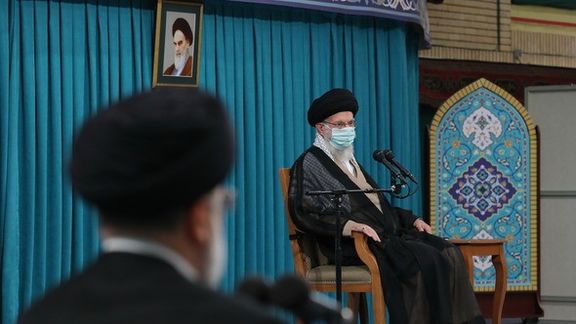
President Ebrahim Raisi listening to Supreme Leader Ali Khamenei on August 30, 2022

Iran’s Supreme Leader has come under fire for disputed and boastful economic figures President Ebrahim Raisi has recently showcased amid economic crises.

Raisi offered debatable statistics in a meeting with Ali Khamenei on Tuesday to prove his achievements after one year in office. He had presented the same statistics in a press conference a day earlier.

Among other things, Raisi, who was handpicked by Khamenei to become president last year, was harshly criticized for fabricating inflation figures. He told Khamenei on Tuesday that his government brought down the 60 percent inflation rate in 2021 to 35 percent after one year.

While Raisi was criticized by traditional media including national newspapers, criticism of Khamenei was limited to social media as challenging the Supreme Leader is a no-go area for the press in Iran.

Iranian cleric Mohammad Ranani quoted Khamenei in an tweet August 31 as saying: "The most important success of this government is reviving the people's hope and trust in the government." Ranani added: "With skyrocketing prices and the difficulties the people have in making ends meet, I rule out that claim. The Supreme Leader is probably fed wrong statistics. God knows the truth."

Khamenei in turn praised the government for not complaining about lack of power, the same way former presidents often did.

Fereshteh Sadeghi, a former producer who has worked for international media, wrote in an August 31 tweet: "It is obvious why he has not heard that because…all of its members come from offices under Khamenei's supervision. What should they say?"

Wednesday's newspapers lashed out at Raisi for the figures he gave to the public and Khamenei. Reformist daily Arman Emrooz wrote in a commentary that the figures were in sharp contrast with the realities on the ground. These included his comments about reducing the rate of inflation, the realization of his promise about building four million homes, the improvement in the livelihood of teachers and nurses, the boost in fuel production and other forms of energy and so on.

Arman Emrooz also pointed out that Raisi's claim of sorting out the hefty budget deficit last year as well as his claim about not borrowing from the Central Bank were not true either. The daily quoted Raisi’s own officials as having said that it owes some 3,590 trillion rials to the bank, or at least $15 billion depending what currency exchange rate is used to calculate the astronomical number.

Referring to Raisi's boast about providing COVID vaccines for the nation, the daily reminded that key individuals [meaning Khamenei] and organizations [meaning offices under Khamenei's supervision] prevented the importing of vaccines by the previous government.

The daily also pointed out that Raisi's claims about the abundance of essential commodities, ending power cuts, and supplying water to underprivileged areas were not true.

Some newspapers such as Ebteklar highlighted parts of Khamenei's speech during the meeting with Raisi and his cabinet ministers that in fact showed Raisi's failure. The main headline on Ebtekar on Wednesday quoted Khamenei as saying: "The high cost of housing has made life difficult for the people."

Although Khamenei reminded Raisi and his government during the meeting on Tuesday to be realistic in terms of what they promise to the people, Entekhab quoted a senior foreign ministry official as saying on Wednesday: "We are very close to becoming a superpower."


Most Viewed

Ghalibaf defends Iran-US talks amid hardline backlash
1
INSIGHT

Ghalibaf defends Iran-US talks amid hardline backlash

2
VOICES FROM IRAN

Bread shortages, soaring prices strain households in Iran, residents say

3
ANALYSIS

From instability to influence: Pakistan’s pivotal role in US-Iran diplomacy

4
ANALYSIS

100 days on: why Iran’s January protests spread across social classes

5

War-hit homeowners feel abandoned as Iran’s reconstruction aid fades

Banner
Banner

Spotlight

  • Is Iran entering its Gorbachev moment?
    INSIGHT

    Is Iran entering its Gorbachev moment?

  • Iran crackdown reaches cemeteries as graves of slain protesters defaced
    EXCLUSIVE

    Iran crackdown reaches cemeteries as graves of slain protesters defaced

  • Iran diplomacy wobbles as factions compete to avoid looking soft on US
    INSIGHT

    Iran diplomacy wobbles as factions compete to avoid looking soft on US

  • The politics of pink: how Iran uses cuteness to rebrand violence
    ANALYSIS

    The politics of pink: how Iran uses cuteness to rebrand violence

  • Bread shortages, soaring prices strain households in Iran, residents say
    VOICES FROM IRAN

    Bread shortages, soaring prices strain households in Iran, residents say

  • Ghalibaf defends Iran-US talks amid hardline backlash
    INSIGHT

    Ghalibaf defends Iran-US talks amid hardline backlash

•
•
•

More Stories

Two Iranian Clerics Beaten Up In Religious City Of Qom

Aug 31, 2022, 22:24 GMT+1

Two unidentified men beat up two clerics in the religious city of Qom on Wednesday, leaving one of them with severe bruises and the other in the hospital waiting for a surgery.

One of them said that he saw two people beating up a cleric he knew with metal pipes and when the attackers saw him looking from his car they started beating him too and broke his cars windows. The clerics are prayer imams at two mosques

The second cleric who has lighter injuries criticized the city’s police for showing up very late -- after about 40 minutes – and for not arresting the perpetrators despite the fact that they knew where they were hiding. 

It is not clear if the attackers knew the first victim and if they attacked him for a personal reason.

Several Iranian clerics have come under attack by angry Iranians recently as rising prices and constant protests have led to a tense environment in the country.

Late in July, a cleric named Mojtaba Hosseini was stabbed several times in his back during his sermon in the city of Karaj in Western Tehran. And earlier in July, a congregational prayer imam was injured in an assassination attempt by an assailant on a motorcycle in the city of Esfahan.

In early June, the representative of Iran’s Supreme Leader in the central city of Esfahan was also attacked by a young man carrying a knife. And in April, a man stabbed three clerics in Iran's largest Shiite shrine in Mashhad, killing two.

Iranians Lost Trust In Government, Two Opposing Politicians Say

Aug 31, 2022, 20:21 GMT+1
•
Iran International Newsroom

A prominent conservative figure has told the IRGC-linked Tasnim news that "Not all reformists are seditionists," while criticizing the current government.

The calibre of the political figure and the media outlet that has interviewed him may be taken as a green light for Iran's embattled reformists to actively take part in the 2024 parliamentary elections.

Conservatives loyal to Supreme Leaser Ali Khamenei coined the ‘seditionist’ label for those who protested Mahmoud Ahmadinejad’s controversial re-election in 2009.

The comment by Expediency Council member Mohammad Javad Bahonar came one day after friends and foes lashed out at President Ebrahim Raisi for giving a misleading report at a news conference about his success in tackling inflation. He had said that his economic policy reduced last year's 60 percent inflation rate to 35 percent.

Many critics, including government supporters reminded that same time last year the official annual inflation rate was around 42 percent, which remains almost the same despite claims of economic improvement.

Khamenei's advice to Raisi this week to follow a better and more convincing propaganda method was obliquely referring to the President's whitewashing of the failure of his economic team, after conservatives consolidated their power by taking over all three government branches and pushing aside ‘reformist’ politicians by barring them from elections.

Prominent conservative politician Mohammad Javad Bahonar. Undated
100%
Prominent conservative politician Mohammad Javad Bahonar

Some reformists including former official and current political activist Ali Soufi were so disappointed by the situation marked by political barriers that they gave up running for any election. He said in his latest interview that "reformists no longer think of taking part in elections.”

Soufi complained that watchdogs including the conservative dominated Guardian Council that vets election candidates, tend to disqualify reformist figures and in such a situation competition is meaningless.

Pointing out the discriminatory situation Soufi said that while former president Hassan Rouhani had to submit the 2015 nuclear agreement for parliament’s approval, hardliners now say that their comrade, President Raisi does not need to do the same with the new nuclear deal. He pointed out that "the core of the Iranian pollical system simply does not trust anyone who is not a hardliner."

Ali Soufi, 'reformist' politician in Iran. Undated
100%
Ali Soufi, 'reformist' politician in Iran who says he will not run in any election

"The system even did not tolerate Iranian and US foreign ministers walking together during the negotiations," in 2015 he said. He also pointed out that many hardliners believe reformists are traitors only because they believe in dialogue and diplomatic relations. "Meanwhile, the Supreme Leader has said over and over that the West is not trustworthy," Soufi noted, adding that some hardliners characterize reformists as pro-Western elements.

He also noted that Iran's problem at the time being is that most Iranians, whether conservative, moderate or reformist, no longer trust the government and many evade the polls.

Nonetheless, the conservative figure Bahonar also criticized the current ultraconservative government "because many of their officials are not familiar with the way big jobs should be done." He added that the government makes ad-hoc problematic decisions such as announcing pay raise for workers that they cannot afford.

Assessing Iran's current political situation, Bahonar said that only less than 10 percent of Iranians are religious, revolutionary and follow the regime’s guidelines in every respect. He added that a lot of Iranians understand national interests and national security, but they are not interested in politics. They simply want to live. "I know many reformists who respect the Islamic revolution, the Islamic Republic and the Supreme Leader. Not all reformists are seditionists," he reiterated.

Iran To Revise 200 Schoolbooks In Line With Khamenei’s Views

Aug 31, 2022, 17:55 GMT+1

Iranian Education Minister Yousef Nouri said Wednesday that 200 schoolbooks of the country’s education system will be revised as ordered by the Supreme Leader. 

Nouri said that the revision of textbooks and educational content will be carried out for the next academic year in 2023 because the books were being printed when the order was issued.

About 200 titles of books from all grades of elementary to high school have been sent for revision, he said, adding that some of them will be revised by the professors at the Farhangian teacher training university and some by the country's educational research and planning organization. 

Earlier in the year, Ali Khamenei said that the content of some schoolbooks that is not practical and does not benefit the students should be removed. 

In the last few years, some changes and edits in students’ textbooks, including removal of an illustration of some girls from the cover of the third-grade math book and adding anti-American and pro-Russia materials, led to controversy among Iranians. 

A conscious ‘Islamization’ of primary, middle and high school books started soon after the 1979 Islamic Revolution. The process has applied to literature, art and all illustrations in the teaching of history. Last year textbooks were revised to play down historical rivalry between Iran and Russia, particularly in the 18th and early 19th century, reflecting Tehran’s current desire for closer relations with Moscow.

President Ebrahim Raisi has also permanently cancelled the implementation of UNESCO 2030, a United Nations document calling for gender equality in education that Khamenei had suspended in 2017. Former President Hassan Rouhani’s administration had adopted the document as a UN member state and was planning its implementation when hardliners lobbied Khamenei to suspend it.

Prisoner Swap With US Must Be Via Diplomatic Channels - Iran’s Prosecutor

Aug 31, 2022, 12:15 GMT+1

Iran’s prosecutor-general Mohammad-Jafar Montazeri says since Tehran and Washington have no treaty on the expatriation of prisoners, such exchanges should be done through diplomatic channels. 

In response to a question about earlier remarks by the country’s foreign ministry spokesman, who had expressed Iran’s readiness for prisoner swaps as part of the agreement to revive the 2015 nuclear deal, he did not rule out such a possibility. 

“We have a duty to follow up on the problems of our citizens anywhere in the world and support them, but relations between countries can be very effective in this field. The level of relationships and the quality of relationships are effective in this field,” he said.

He noted that such exchanges work much more easily with Islamic countries and neighboring countries, especially with countries with whom Tehran has agreements in this regard, but “these relations and contracts do not exist with a country like the United States, and things must be done diplomatically.”

Earlier in the month, foreign ministry spokesman Nasser Kanaani said Iran is ready for swift agreements for prisoner swaps with the US, regardless of the result of talks to restore the JCPOA.

A few days earlier, the spokesman for the Iranian parliament's National Security and Foreign Relations Committee Mahmoud Abbaszadeh Meshkini said, "I don't know specifically whether there is going to be an exchange of prisoners between Iran and the United States, but in international relations this is customary and it is not unusual for some prisoners to be exchanged between the two countries.”

Iran Cuts Consumer Gasoline Quota As Possible Move To Raise Prices

Aug 30, 2022, 20:07 GMT+1

Iran has reduced 100 liters of monthly gasoline quota in personal fuel cards from 250 liters to 150 liters, a deputy oil minister has announced. 

On the sidelines of a ceremony for a national project to export liquefied gas via sea on Tuesday, the head of National Iranian Oil Refining and Distribution Company (NIORDC), Jalil Salari, said that the quota of 250 liters was "a very high number" considering that fact that most Iranians do not consume that much petrol per month. 

All Iranians who own a car have a 60-liter quota of gasoline at the heavily subsidized rate of about five US cents a liter, but were also allowed to buy 250 liters more at about 10 cents, which is again heavily subsidized, at about 37 cents a US gallon. 

According to Jalili the new quota system will be implemented throughout the country soon. 

Some people in social media have described the move as a prelude by the administration of Ebrahim Raisi to increase the price of gasoline, despite repeated announcements by the government that the price of gasoline would not increase in the current Iranian year, which started on March 21. Such a plan had been earlier piloted in Sistan and Baluchistan province, leading to a whopping rise of gasoline prices to about 150,000 rials – or about 50 cent a liter – in the black market.