• العربية
  • فارسی
Brand
  • Iran Insight
  • Politics
  • Economy
  • Analysis
  • Special Report
  • Opinion
  • Podcast
  • Iran Insight
  • Politics
  • Economy
  • Analysis
  • Special Report
  • Opinion
  • Podcast
  • Theme
  • Language
    • العربية
    • فارسی
  • Iran Insight
  • Politics
  • Economy
  • Analysis
  • Special Report
  • Opinion
  • Podcast
All rights reserved for Volant Media UK Limited
volant media logo

Iran Morality Official Calls For Gender Segregation In Universities

Maryam Sinaiee
Maryam Sinaiee

Iran International

Sep 1, 2022, 22:26 GMT+1Updated: 17:37 GMT+1
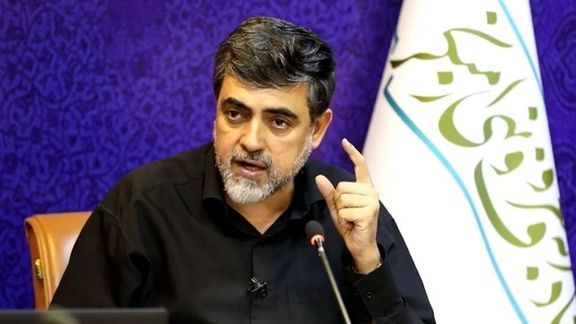
Hashemi-Golpaygani, the top official in a government office overseeing compliance with Islamic morality

A top official in charge of Islamic morals in Iran has defended gender segregation in higher education, claiming that families will welcome its introduction.

In a video interview earlier this week, Mohammad-Saleh Hashemi-Golpaygani, in charge of a government organization called Enjoining Good and Forbidding Evil Headquarters, claimed that gender segregation in higher education institutions will contribute to the progress of science and knowledge.

“I don't have an answer when I'm asked why students are kept separate before they reach adulthood but are mixed when they go to university,” he said.

Boys and girls are strictly separated from primary school, but most universities are mixed gender.

“Families will welcome gender segregation [in higher education]. They want a safe environment [for their children],” he said wildly claiming that there are twenty-one universities and colleges in the world that segregate including some in the United States. He also claimed that the average grade point rose by 1.5 in these universities after separating men and women.

Hashemi-Golpaygani’s remarks have outraged many on social media and websites and newspapers have criticized him for his controversial remarks.

In an editorial Tuesday, the moderate conservative Asriran told Hashem-Golpaygani that with his “imprudent and incorrect statements” -- including the undocumented claim that many of the world's top universities have implemented gender segregation and achieved better academic results as well as existence of facial recognition software that can help identify women with insufficient hijab -- he obliterates the Islamic concept of ‘enjoining good and forbidding evil’ and provides sensational stories for foreign-based Persian language media.

University students in Tehran protesting harassment by campus morality police. April 24, 2022
100%
University students in Tehran protesting harassment by campus morality police. April 24, 2022

Some social media users have pointed out that Hashemi-Golpaygani’s own daughter has been studying in a mixed-gender university in Belgium.

In the same interview, Hashem-Golpaygani said that public CCTV cameras, including those in metro stations, are programmed to use facial recognition technology to take photos of unveiled women and to compare against photos in a national database to identify those who break the hijab rules. He suggested that the rule breakers be fined in the same way that people are fined for violating traffic regulations.

Hashem-Golpaygani said recently that about half of Iranian women do not abide by the mandatory hijab rules.

In its editorial entitled “Watch Fewer Sci-Fi Movies”, Asriran also told the offical that he should present himself to Iran’s state-run Cinema Organization if he is interested in the science fiction genre. His suggestion that fining hijab-rule-breakers by using blurry CCTV images will help convert them to hijab “would only be possible in sci-fi or comic films,” Asriran wrote.

The website also suggested that such technology, if it were available in the country, would better be used to find dangerous criminals. The police have numerous burglaries, car thefts, and mugging cases on their hands with footage of the culprits who they cannot identify.

In recent months government and security agencies have intensified their efforts to pressure women into abiding by the hijab laws and several rounds of anti-hijab civil disobedience campaigns have followed.

The patrols by the ‘morality police’ have increased on the streets and videos of violent arrests of women and girls as well as confrontations between people and hijab enforcers, including a recent incident in Shiraz which resulted in the closure of the shopping center where it happened, are becoming too common on social media.

Most Viewed

Ghalibaf defends Iran-US talks amid hardline backlash
1
INSIGHT

Ghalibaf defends Iran-US talks amid hardline backlash

2
VOICES FROM IRAN

Bread shortages, soaring prices strain households in Iran, residents say

3
ANALYSIS

From instability to influence: Pakistan’s pivotal role in US-Iran diplomacy

4
ANALYSIS

100 days on: why Iran’s January protests spread across social classes

5

War-hit homeowners feel abandoned as Iran’s reconstruction aid fades

Banner
Banner

Spotlight

  • Is Iran entering its Gorbachev moment?
    INSIGHT

    Is Iran entering its Gorbachev moment?

  • Iran crackdown reaches cemeteries as graves of slain protesters defaced
    EXCLUSIVE

    Iran crackdown reaches cemeteries as graves of slain protesters defaced

  • Iran diplomacy wobbles as factions compete to avoid looking soft on US
    INSIGHT

    Iran diplomacy wobbles as factions compete to avoid looking soft on US

  • The politics of pink: how Iran uses cuteness to rebrand violence
    ANALYSIS

    The politics of pink: how Iran uses cuteness to rebrand violence

  • Bread shortages, soaring prices strain households in Iran, residents say
    VOICES FROM IRAN

    Bread shortages, soaring prices strain households in Iran, residents say

  • Ghalibaf defends Iran-US talks amid hardline backlash
    INSIGHT

    Ghalibaf defends Iran-US talks amid hardline backlash

•
•
•

More Stories

Israel Buying 4 Boeing Aerial Refuelers Needed For Attacking Iran

Sep 1, 2022, 19:57 GMT+1

The United States will sell four Boeing KC-46 refueling planes to Israel till 2025, which can facilitate strikes against targets in Iran, some 2,000 kilometers (1,200 miles) from Israel. 

Aircraft manufacturer Boeing signed a contract with the US Department of Defense to supply Israel with the Boeing KC-46 Pegasus planes needed for strikes far outside the regular flight range of Israeli jets, the company said in a statement on Wednesday.

They are scheduled to arrive in 2025 at the earliest, so that the Israeli air force can replace its aging fleet of 707 refueling tankers. 

Israel has asked that this date be moved up — which would require the US to give up its spot in line to receive the planes from Boeing — but Washington has not accepted the request yet. The potential sale of eight KC-46s to Israel for some $2.4 billion was approved by the State Department back in March 2020. 

The announcement came the same day that President Joe Biden had a 45-minute-long phone call with Israeli Prime Minister Yair Lapid, in which the two discussed “global and regional security challenges, including threats posed by Iran.” "The President underscored US commitment to never allow Iran to acquire a nuclear weapon," the White House said in a statement.

“This contract further strengthens the US-Israel alliance and continues the decades-long relationship between Boeing and the Israeli Air Force,” said Ido Nehushtan, president of Boeing Israel. “The KC-46A will benefit Israel’s efforts to ensure national security and regional stability.”

Israel Will Pay For Attacks On Damascus, Aleppo – Syria

Sep 1, 2022, 19:18 GMT+1

Following Israeli airstrikes on targets around Aleppo and Damascus in Syria, the country’s foreign minister said on Thursday that Israel was "playing with fire."

Israel conducted several airstrikes against the Aleppo International Airport in northwestern Syria, hours before its missiles struck targets southeast of capital Damascus Wednesday night.

According to Syria’s state news agency (SANA), Faisal Mekdad said such attacks by Israel threaten the security of the region, noting that "Israel is playing with fire and is putting the regional military and security situations at risk of an explosion."

"Syria will not remain silent regarding the repeated Israeli attacks and the Israelis will pay the price sooner or later," he warned. 

Israel has carried out hundreds of strikes in Syria in recent years, mainly targeting alleged weapons convoys or arms depots belonging to Iran-allied fighters. Iran-backed militias established a foothold in Syria while fighting in support of President Bashar al-Assad during Syria's civil war.

The Wednesday attacks were the first alleged Israeli airstrikes to target the Aleppo airport since 2019 and the second time Israel targeted a Syrian airport this year. On June 10, Israel bombed the Damascus International Airport, causing the airport to go completely out of service for a period of two weeks.

The airstrikes come less than a week after similar airstrikes targeted the Syrian Scientific Studies and Research Center (SSRC) in Masyaf, located southwest of Aleppo, reportedly destroying more than 1,000 Iranian-made missiles. 

Iranian-Canadians Hold Gathering In Solidarity With Political Prisoners

Sep 1, 2022, 18:07 GMT+1

Dozens of Iranian-Canadians held a gathering to mark September 1, the day of solidarity with Iranian political prisoners as per a resolution by the Canadian Parliament.

Many Iranian-Canadians whose family members were killed in a wave of prison executions in 1988, gathered on Wednesday at Queen's Park in Downtown Toronto, Ontario. In 2013, the Canadian parliament condemned the killing of about 5,000 dissidents, and proclaimed September 1 as Solidarity with Political Prisoners in Iran Day in remembrance of the victims.

The participants called on the international community to hold the Islamic Republic accountable for its crimes against humanity as well as its crackdown on dissent. 

Demanding justice for the victims of the 1988 mass executions and an end to impunity for Iranian leaders, including President Ebrahim Raisi, they echoed calls by several US politicians that have urged President Joe Biden to deny a visa to the Iranian president, who plans to travel to the UN in New York in September. Raisi is accused of being a member of a death commission that ordered the summary executions.

Raisi’s election as president last June sparked interest in his role in the executions. Agnes Callamard, the secretary general of Amnesty International, immediately demanded that the United Nations Human Rights Council investigate him for crimes against humanity.

Most of the approximately 5,000 prisoners executed in 1988 were members or sympathizers of the Albania-based exiled opposition group Mujahedin-e Khalq (MEK) serving their sentences, with a lower number of executions of leftists. The MEK has claimed 30,000 members died, and in 2019 launched a booklet Crimes Against Humanity naming 5,000.

Iran Arrests 14 More Members Of Baha’i Religious Minority

Sep 1, 2022, 12:42 GMT+1

Amid the heightened persecution of members of the Baha’i faith by the Islamic Republic, 14 Baha'i citizens were arrested in Qaemshahr in the northern Mazandaran province Wednesday.

According to the US-based Human Rights Activists News Agency (HRANA), security forces stormed a small gathering at the home of one of the Baha’i families in the city and detained them. 

Late in August, UN experts and Amnesty International expressed deep concern over Iran’s persecution of Baha’is and urged an end to pressure on religious and other minorities.

The Shia clergy consider the Baha’i faith as a heretical sect. Supreme Leader Ali Khamenei has on several occasions called the Baha'i faith a cult and in a religious fatwa in 2018 forbade contact, including business dealings, with followers of the faith.

Bahai’s, who number around 300,000 in Iran, cannot hold jobs in the public sector and are sometimes sacked from their jobs in the private sector under pressure from authorities. They are also deprived of higher education.

Informed sources told Iran International earlier in August that at least 90 Baha'i students have been barred from universities this year due to a secret government policy.

In early August, security forces laid siege to Roshankouh, a village in Mazandaran province, and started demolishing houses and farms belonging to members of the persecuted Baha’i faith.

Several countries including Canada, the United States, and Britain have expressed concern over the Islamic Republic’s systematic prosecution, harassment, and discrimination against the Baha'i minority.

Israel Hits Damascus, Aleppo Airports In Iran-Related Attacks

Aug 31, 2022, 22:58 GMT+1
•
Iran International Newsroom

Israel conducted several airstrikes against the Aleppo International Airport in northwestern Syria, hours before its missiles struck targets southeast of Capital Damascus Wednesday night. 

Syria’s state news agency (SANA) reported material damage at the airport, saying, "At around 20:00 hours (17:00 GMT), the Israeli enemy targeted Aleppo International Airport with missile fire, causing material damage at the heart of the facility.” 

The UK-based war monitor, Syrian Observatory for Human Rights, said that four Israeli missiles had targeted the runway and depots at the airport.

According to Syrian military sources, air defense systems near Latakia, located southwest of Aleppo, were activated in an attempt to intercept the missiles headed towards Aleppo. Shortly after the strike in Aleppo, Israeli airstrikes targeted sites near Damascus International Airport and other targets south of Damascus, with Syrian air defenses downing “a number of missiles.”

Sabereen News, a channel close to Iran-backed forces in Syria reported that Israel targeted Aleppo airport to prevent a US sanctioned Iranian plane – belonging to the Yas Air cargo airline -- from landing as it appeared to be descending, adding that the plane changed course to Damascus so the Israeli aircraft returned and bombed Damascus airport. 

Pouya Air – also known as Yas Air – is an Iranian cargo airline that has been owned by Pars Aviation Services Company (PASC), which the UN Security Council has identified as an entity affiliated with Iran's Revolutionary Guard (IRGC). According to the US Department of the Treasury, it has transported illicit cargo to Iranian proxies in the region on behalf of the IRGC Quds Force (IRGC-QF).

The Wednesday attack was the first alleged Israeli airstrike to target the Aleppo airport since 2019 and the second time Israel targeted a Syrian airport this year. On June 10, Israel bombed the Damascus International Airport, causing the airport to go completely out of service for a period of two weeks.

The airstrikes come less than a week after similar airstrikes targeted the Syrian Scientific Studies and Research Center (SSRC) in Masyaf, located southwest of Aleppo, reportedly destroying more than 1,000 Iranian-made missiles. The Observatory for Human Rights said the attack targeted a missile warehouse in the SSRC complex that stored thousands of medium-range, surface-to-surface missiles assembled under the supervision of Iran’s Revolutionary Guard’s “expert officers.”

The observatory added that 14 Syrian civilians sustained injuries with varying levels of severity during the Masyaf airstrike, in addition to casualties reported among Iranian-backed militias guarding the research center– which was heavily damaged during the attack.

In addition to the strikes attributed to Israel, the United States also engaged in a string of tit-for-tat attacks last week against Iranian militias in northern Syria who had targeted US forces with rockets and drones.

Iran-backed militias established a foothold in Syria while fighting in support of President Bashar al-Assad during Syria's civil war.

The airstrikes came just hours after Israeli Prime Minister Yair Lapid spoke with US President Joe Biden about the continuing efforts by the US, EU and Iran to revive the 2015 nuclear deal. During the conversation, Lapid also welcomed recent US strikes on Iran-backed militias in eastern Syria.