• العربية
  • فارسی
Brand
  • Iran Insight
  • Politics
  • Economy
  • Analysis
  • Special Report
  • Opinion
  • Podcast
  • Iran Insight
  • Politics
  • Economy
  • Analysis
  • Special Report
  • Opinion
  • Podcast
  • Theme
  • Language
    • العربية
    • فارسی
  • Iran Insight
  • Politics
  • Economy
  • Analysis
  • Special Report
  • Opinion
  • Podcast
All rights reserved for Volant Media UK Limited
volant media logo

Medicine Crisis Worsens In Iran With Lack Of Foreign Currency

Maryam Sinaiee
Maryam Sinaiee

Iran International

Sep 2, 2022, 14:59 GMT+1Updated: 17:38 GMT+1
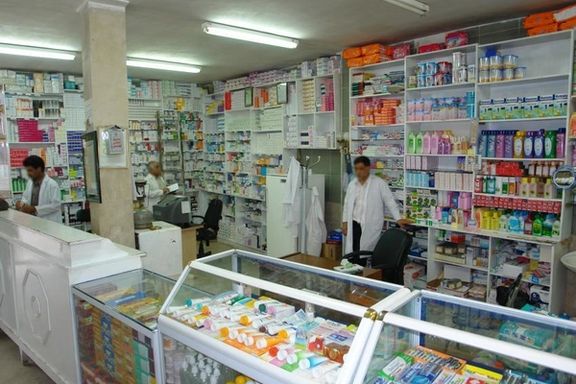
A pharmacy in the Iranian capital Tehran

An Iranian lawmaker has warned about the failure of the government’s Medicine Assistance Plan to make prices affordable amid high inflation and rising poverty.

“Patients, particularly those with rare diseases, have been facing problems since the removal of medicine import subsidies,” Mohammad-Taghi Naghdali, a member of the parliament's judicial and legal committee, told the Iranian Students' News Agency (ISNA) Thursday, adding that lawmakers have warned that without allocation of cheap foreign currency to pharmaceutical imports the government's Medicine Assistance Plan is bound to fail.

Social media users say the cost of medicine has sharply risen in the past few months and some vital drugs for treatment of rare diseases are very hard to find except on the black market.

Pharmacies and insurance companies have also been complaining about the An Iranian lawmaker has warned about the failure of the government’s Medicine Assistance Plan to make prices affordable amid high inflation and rising poverty.

President Ebrahim Raisi announced in early May that his government had begun the process of removing up to $15 billion import subsidies for basic foods, medicine, and animal feed despite warnings of more inflation and hardship. Raisi also said the government would be paying cash assistance to most Iranians as compensation.

The removal of import subsidies meant that manufacturers would no longer receive cheap dollars from the government to import raw materials to produce medicine.

While the compensation for bread is directly paid to individuals, compensation for medicine is supposed to be made through the healthcare insurance companies which will then pay it to pharmacies.

Dr Ali Fatemi, deputy chairman of Iran Pharmacists Association, who is a critic of the government’s plan, said Friday that currently there is a serious shortage of antibiotics including antibiotic syrups for children as well as medication required for treatment of rare diseases and psychiatric drugs. He warned that some companies may cease production of antibiotics if demand drops due to unaffordable prices.

Lawmakers have summoned health minister Bahram Einollahi twice in the past month for explanations regarding the ambiguities in the government plan anda parliamentary committee has given the government two weeks to resolve these issues.

Some critics believe that the government’s healthcare policies are influenced by insider groups and state affiliated entities.

“It is now obvious for everybody that pharmaceuticals are controlled by mafia-like groups with ties to the government, the Execution of Imam Khomeini's Order Headquarters (EIKO), and the Supreme Leader's office,” Mohammad-Kazem Attari, US based physician and public health researcher, told Iran International.

EIKO, which is known in Persian simply as Setad is controlled by the Supreme Leader and his office. Another state entity, Barakat Foundation which is also under Supreme Leader's control, was put in charge of developing a homegrown COVID vaccine. The program ended in failure after squandering tens of millions of dollars and precious time that could have prevented around 40,000 deaths in July-September 2021.

Dr Attari said this influential group comes up with ad hoc and unconsidered plans, including the Medicine Assistance Plan, to secure its own interests whenever foreign currency for importing medicine and pharmaceutical products becomes scarce.

According to Dr Attari, this group has control over 60 to 80 percent of all pharmaceutical imports and production. “That’s why the Medicine Assistance Plan was hastily introduced in the system immediately after the removal of cheap import dollars without any pilot studies.

Most Viewed

Ghalibaf defends Iran-US talks amid hardline backlash
1
INSIGHT

Ghalibaf defends Iran-US talks amid hardline backlash

2
ANALYSIS

From instability to influence: Pakistan’s pivotal role in US-Iran diplomacy

3
ANALYSIS

100 days on: why Iran’s January protests spread across social classes

4

War-hit homeowners feel abandoned as Iran’s reconstruction aid fades

5

Iran says no decision yet on talks as Pakistan prepares to host US team

Banner
Banner

Spotlight

  • The politics of pink: how Iran uses cuteness to rebrand violence
    ANALYSIS

    The politics of pink: how Iran uses cuteness to rebrand violence

  • Bread shortages, soaring prices strain households in Iran, residents say
    VOICES FROM IRAN

    Bread shortages, soaring prices strain households in Iran, residents say

  • War-hit homeowners feel abandoned as Iran’s reconstruction aid fades

    War-hit homeowners feel abandoned as Iran’s reconstruction aid fades

  • 100 days on: the anatomy of Iran’s January crackdown
    INSIGHT

    100 days on: the anatomy of Iran’s January crackdown

  • Ghalibaf defends Iran-US talks amid hardline backlash
    INSIGHT

    Ghalibaf defends Iran-US talks amid hardline backlash

  • From instability to influence: Pakistan’s pivotal role in US-Iran diplomacy
    ANALYSIS

    From instability to influence: Pakistan’s pivotal role in US-Iran diplomacy

•
•
•

More Stories

Blast Rocks Iran’s Oldest Oil Refinery Near Persian Gulf

Sep 2, 2022, 13:26 GMT+1

An explosion rocked Iran’s and Middle East’s oldest oil refinery in southwestern city of Abadan in the oil-rich Khuzestan province overnight, state media reported on Friday.

According to the government’s official news website, IRNA, the blast was caused by the bursting of one of the furnaces of the sulphur production unit of phase three of Abadan Oil Refinery during the start-up operation, causing a huge explosion.

The blast apparently had no casualties, and IRNA claims that production at the refinery continues as usual.

This is the second incident at the Abadan refinery, which supplies around 25 percent of the country’s fuel needs, this year. In April, a section of the refinery caught fire but the blaze was contained with no fatalities or injuries. 

Abadan, near the Persian Gulf coast, is Iran’s largest refinery with a daily capacity of 430,000 barrels of crude, producing liquefied petroleum gas, gasoline, kerosene, gas oil, jet fuel, furnace oil, bitumen, petroleum solvents, sulfur, and naphtha. Abadan refinery, opened in 1912 by the Anglo-Persian Oil Company originally as a pipeline terminus, quickly became one of the world's largest refineries and was an important supplier to the British military.

Several explosions and fires in Iranian military and industrial sites − including pipelines and refineries − since mid-2020 have not been fully explained by authorities. However, they have blamed Israel for a series of spectacular sabotage attacks on nuclear facilities, including two explosions at Natanz uranium enrichment center. Israel has not taken responsibility for any incident.

Minister’s Boast About Radars Irks Iranians Fuming Over Downed Plane

Sep 1, 2022, 14:13 GMT+1

Remarks by the interior minister boasting about Iran's advanced radars have irked Iranians, who still demand justice over the downing of a Ukrainian plane.

During a Thursday ceremony to commemorate the occasion of Iran’s Air Defense Day, Ahmad Vahidi -- himself a Revolutionary Guard (IRGC) general -- said the Islamic Republic is among the top countries in the world in terms of its air defense capabilities.

He said Iran is so advanced in radar systems that can detect and destroy all the enemies’ flying objects, and that in the missile sector, the country is again in the top tier in long, medium and short-range missiles, noting that “all these equipment are indigenous and domestically produced."

Similar remarks about the country’s air defense systems were made by the top brass of the military, including Chief of Staff Mohammad Bagheri, the Army’s Commander-in-Chief Abdolrahim Mousavi, and IRGC’s chief commander Hossein Salami, as well as Ghader Rahimzadeh, the commander of the joint air defenses headquarters of the Army and IRGC.

Salami said some top powers in the world have purchased military and defense equipment from Iran and are now using them.

The remarks came as Russia has faced "numerous failures" with Iranian-made drones acquired from Tehran last month for use in Ukraine, and many people are still irate about the downing of Flight PS752 in 2020.

The airliner was shot down by two air-defense missiles fired by the IRGC as it took off from Tehran’s Imam Khomeini International Airport. All 176 passengers and crew, including 63 Canadians and 10 from Sweden, as well as 82 Iranian citizens died in the disaster.

Iran’s Khamenei, Raisi Criticized For 'Fabricated' Statistics

Sep 1, 2022, 11:18 GMT+1
•
Iran International Newsroom

Iran’s Supreme Leader has come under fire for disputed and boastful economic figures President Ebrahim Raisi has recently showcased amid economic crises.

Raisi offered debatable statistics in a meeting with Ali Khamenei on Tuesday to prove his achievements after one year in office. He had presented the same statistics in a press conference a day earlier.

Among other things, Raisi, who was handpicked by Khamenei to become president last year, was harshly criticized for fabricating inflation figures. He told Khamenei on Tuesday that his government brought down the 60 percent inflation rate in 2021 to 35 percent after one year.

While Raisi was criticized by traditional media including national newspapers, criticism of Khamenei was limited to social media as challenging the Supreme Leader is a no-go area for the press in Iran.

Iranian cleric Mohammad Ranani quoted Khamenei in an tweet August 31 as saying: "The most important success of this government is reviving the people's hope and trust in the government." Ranani added: "With skyrocketing prices and the difficulties the people have in making ends meet, I rule out that claim. The Supreme Leader is probably fed wrong statistics. God knows the truth."

Khamenei in turn praised the government for not complaining about lack of power, the same way former presidents often did.

Fereshteh Sadeghi, a former producer who has worked for international media, wrote in an August 31 tweet: "It is obvious why he has not heard that because…all of its members come from offices under Khamenei's supervision. What should they say?"

Wednesday's newspapers lashed out at Raisi for the figures he gave to the public and Khamenei. Reformist daily Arman Emrooz wrote in a commentary that the figures were in sharp contrast with the realities on the ground. These included his comments about reducing the rate of inflation, the realization of his promise about building four million homes, the improvement in the livelihood of teachers and nurses, the boost in fuel production and other forms of energy and so on.

Arman Emrooz also pointed out that Raisi's claim of sorting out the hefty budget deficit last year as well as his claim about not borrowing from the Central Bank were not true either. The daily quoted Raisi’s own officials as having said that it owes some 3,590 trillion rials to the bank, or at least $15 billion depending what currency exchange rate is used to calculate the astronomical number.

Referring to Raisi's boast about providing COVID vaccines for the nation, the daily reminded that key individuals [meaning Khamenei] and organizations [meaning offices under Khamenei's supervision] prevented the importing of vaccines by the previous government.

The daily also pointed out that Raisi's claims about the abundance of essential commodities, ending power cuts, and supplying water to underprivileged areas were not true.

Some newspapers such as Ebteklar highlighted parts of Khamenei's speech during the meeting with Raisi and his cabinet ministers that in fact showed Raisi's failure. The main headline on Ebtekar on Wednesday quoted Khamenei as saying: "The high cost of housing has made life difficult for the people."

Although Khamenei reminded Raisi and his government during the meeting on Tuesday to be realistic in terms of what they promise to the people, Entekhab quoted a senior foreign ministry official as saying on Wednesday: "We are very close to becoming a superpower."

Two Iranian Clerics Beaten Up In Religious City Of Qom

Aug 31, 2022, 22:24 GMT+1

Two unidentified men beat up two clerics in the religious city of Qom on Wednesday, leaving one of them with severe bruises and the other in the hospital waiting for a surgery.

One of them said that he saw two people beating up a cleric he knew with metal pipes and when the attackers saw him looking from his car they started beating him too and broke his cars windows. The clerics are prayer imams at two mosques

The second cleric who has lighter injuries criticized the city’s police for showing up very late -- after about 40 minutes – and for not arresting the perpetrators despite the fact that they knew where they were hiding. 

It is not clear if the attackers knew the first victim and if they attacked him for a personal reason.

Several Iranian clerics have come under attack by angry Iranians recently as rising prices and constant protests have led to a tense environment in the country.

Late in July, a cleric named Mojtaba Hosseini was stabbed several times in his back during his sermon in the city of Karaj in Western Tehran. And earlier in July, a congregational prayer imam was injured in an assassination attempt by an assailant on a motorcycle in the city of Esfahan.

In early June, the representative of Iran’s Supreme Leader in the central city of Esfahan was also attacked by a young man carrying a knife. And in April, a man stabbed three clerics in Iran's largest Shiite shrine in Mashhad, killing two.

Iranians Lost Trust In Government, Two Opposing Politicians Say

Aug 31, 2022, 20:21 GMT+1
•
Iran International Newsroom

A prominent conservative figure has told the IRGC-linked Tasnim news that "Not all reformists are seditionists," while criticizing the current government.

The calibre of the political figure and the media outlet that has interviewed him may be taken as a green light for Iran's embattled reformists to actively take part in the 2024 parliamentary elections.

Conservatives loyal to Supreme Leaser Ali Khamenei coined the ‘seditionist’ label for those who protested Mahmoud Ahmadinejad’s controversial re-election in 2009.

The comment by Expediency Council member Mohammad Javad Bahonar came one day after friends and foes lashed out at President Ebrahim Raisi for giving a misleading report at a news conference about his success in tackling inflation. He had said that his economic policy reduced last year's 60 percent inflation rate to 35 percent.

Many critics, including government supporters reminded that same time last year the official annual inflation rate was around 42 percent, which remains almost the same despite claims of economic improvement.

Khamenei's advice to Raisi this week to follow a better and more convincing propaganda method was obliquely referring to the President's whitewashing of the failure of his economic team, after conservatives consolidated their power by taking over all three government branches and pushing aside ‘reformist’ politicians by barring them from elections.

Prominent conservative politician Mohammad Javad Bahonar. Undated
100%
Prominent conservative politician Mohammad Javad Bahonar

Some reformists including former official and current political activist Ali Soufi were so disappointed by the situation marked by political barriers that they gave up running for any election. He said in his latest interview that "reformists no longer think of taking part in elections.”

Soufi complained that watchdogs including the conservative dominated Guardian Council that vets election candidates, tend to disqualify reformist figures and in such a situation competition is meaningless.

Pointing out the discriminatory situation Soufi said that while former president Hassan Rouhani had to submit the 2015 nuclear agreement for parliament’s approval, hardliners now say that their comrade, President Raisi does not need to do the same with the new nuclear deal. He pointed out that "the core of the Iranian pollical system simply does not trust anyone who is not a hardliner."

Ali Soufi, 'reformist' politician in Iran. Undated
100%
Ali Soufi, 'reformist' politician in Iran who says he will not run in any election

"The system even did not tolerate Iranian and US foreign ministers walking together during the negotiations," in 2015 he said. He also pointed out that many hardliners believe reformists are traitors only because they believe in dialogue and diplomatic relations. "Meanwhile, the Supreme Leader has said over and over that the West is not trustworthy," Soufi noted, adding that some hardliners characterize reformists as pro-Western elements.

He also noted that Iran's problem at the time being is that most Iranians, whether conservative, moderate or reformist, no longer trust the government and many evade the polls.

Nonetheless, the conservative figure Bahonar also criticized the current ultraconservative government "because many of their officials are not familiar with the way big jobs should be done." He added that the government makes ad-hoc problematic decisions such as announcing pay raise for workers that they cannot afford.

Assessing Iran's current political situation, Bahonar said that only less than 10 percent of Iranians are religious, revolutionary and follow the regime’s guidelines in every respect. He added that a lot of Iranians understand national interests and national security, but they are not interested in politics. They simply want to live. "I know many reformists who respect the Islamic revolution, the Islamic Republic and the Supreme Leader. Not all reformists are seditionists," he reiterated.