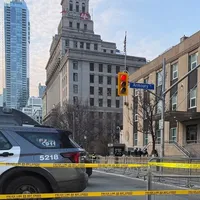
Law enforcement personnel survey the scene outside the U.S. Consulate after shots were fired, in Toronto, Ontario, Canada, March 10, 2026. Picture taken with a mobile phone.
A Toronto police operation targeting suspects linked to the March attack on the US Consulate has uncovered what investigators believe is a far-reaching network connecting a series of shootings across the Greater Toronto Area to actors operating beyond Canada's borders.
According to confidential information obtained by Iran International from police sources, investigators have identified a traceable logistics, supply and equipment pipeline linking suspects in the Toronto shootings to individuals and networks originating in Tehran.
The findings have raised concerns among investigators that criminal groups in Canada may have been used to facilitate operations tied to broader geopolitical objectives.
The revelation comes as Toronto police continue to investigate a network allegedly responsible for dozens of shootings across the GTA.
The investigation intensified following an early-morning raid in which Constable Marc Pinizzotto was killed during an exchange of gunfire. Ballistic testing later linked firearms recovered at the scene to 27 separate shootings, according to Toronto Police.
Police Chief Myron Demkiw said investigators uncovered a recurring pattern in which teenagers and low-level gang members were allegedly recruited through encrypted messaging applications such as Telegram, WhatsApp and Signal to carry out attacks for payment.
In some cases, the recruits were allegedly instructed to film the shootings as proof that the assignments had been completed.
Among those charged is 18-year-old Sheldon Tracy-Stewart, who was wounded and arrested during the raid. Another suspect, 19-year-old Zara Jabbi, remains at large.
The Toronto investigation has unfolded alongside a separate U.S. terrorism case involving Mohammad Baqer Saad Dawood al-Saadi, an Iraqi national charged in New York.
According to U.S. court documents, prosecutors allege that al-Saadi played a role in coordinating attacks linked to Iranian interests abroad.
Federal investigators say he acknowledged in a recorded conversation that associates connected to his network carried out the shooting at the US Consulate in Toronto, allegedly in retaliation for US actions against the Islamic Republic.
The allegations have not been tested in court.
The emerging picture has also renewed attention on an armed attack targeting Iranian-Canadian activist Salar Gholami in Toronto earlier this year.
In the early hours of March 1, gunmen fired at a sports club owned by Gholami, a prominent opposition activist whose facility has served as a gathering place for anti-government events and demonstrations. At least 17 rounds struck the building.
Gholami believes the attack should be examined alongside the broader network now under investigation. Security footage, he said, showed a young masked gunman whose profile resembled the recruits allegedly used in other GTA shootings.
Authorities have not publicly linked the attack on Gholami's club to the wider investigation. But members of Canada's Iranian community argue that threats against dissidents deserve closer scrutiny as investigators work to determine the full extent of the network's operations.
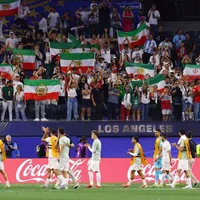
Iran players walk past Iranian fans holding official and pre-revolutionary flags, in Los Angeles, US, June 16, 2026
Iran’s World Cup match with New Zealand was not just a football game but a rare glimpse into the trauma and deep divisions many Iranians carry at home and abroad.
As Iran twice came from behind to draw 2-2 at SoFi Stadium in Inglewood, California, fans cheered different goals for different reasons. Some celebrated every Iranian attack. Others openly rooted against a team they view as inseparable from the Islamic Republic.
The divided reactions reflected a question that has become increasingly fraught since January 8-9, 2026, when the Islamic Republic launched a nationwide crackdown on anti-regime protesters that killed tens of thousands of unarmed civilians: can one support Team Melli without supporting the state it represents?
The trauma of those events continues to reverberate far beyond Iran's borders.
At SoFi Stadium, one fan wore a custom jersey marked "8-9," a reference instantly recognizable to many Iranians as the dates of the deadliest two nights in Iran's modern history.
"I felt proud to be Iranian, but with a mixed bag of emotions, carrying the weight of everything that the regime has done and what the people have suffered," actress and activist Nazanin Nour told Iran International.
Nour said she ultimately decided to attend the game despite her conflicted feelings because the regime has taken so much from Iranians worldwide, and she did not want it to deprive her of the joy of the sport as well.
"I think everybody's feelings are informed by their pain and trauma and everything that we've witnessed over the last not just few months but 47 years," she said. "It makes sense that everybody feels like this is a really weird time but still a time to be proud of who we are and where we come from."
A team added
Since the 2022 Woman, Life, Freedom protests, players have faced scrutiny over whether they sing the national anthem, meet state officials or publicly support protesters.
Supporters and critics alike increasingly view the national team through a political lens because it officially represents the Islamic Republic.
While some players and football federation officials have shown alignment with the state, others have faced pressure for expressing solidarity with anti-government protests or refusing to sing the national anthem.
Former Iranian national team goalkeeper and coach Mohammad Rashid Mazaheri has been held by Iranian authorities since late February 2026 after criticizing the leader in an Instagram post.
For many Iranians, his case is another reminder of how even prominent athletes can face severe repercussions—even death—for expressing dissent.
"We're a world away from past World Cups, when, regardless of politics, Iranians inside the country and across the diaspora were united behind Team Melli," said Holly Dagres, a senior fellow at the Washington Institute.
That unity was perhaps best illustrated in 1998, when Iran's victory over the United States sparked celebrations from Tehran to Los Angeles.
Pride and protest
Before kickoff, hundreds of protesters gathered outside SoFi Stadium waving anti-government signs and the pre-revolution Lion and Sun flag in a city home to one of the world's largest Iranian diasporas.
Despite FIFA's ban on the Lion and Sun flag, videos circulating online showed numerous fans displaying it inside the stadium.
Among those in attendance was activist Mersedeh Shahinkar, who was blinded in one eye after being shot directly in the eye by security forces during the 2022 protests. Shahinkar, who later fled Iran and now lives in the United States, arrived carrying a Lion and Sun flag.
Shahinkar confronted supporters of the Islamic Republic both inside and outside the stadium, where tensions at times spilled into verbal confrontations and some spectators called fans carrying Iran’s current flag "terrorists."
At times, Shahinkar pointed to the empty eye socket left after she was shot during the 2022 protests, a reminder of the price many Iranians have paid in opposing the state.
Iranian-American news anchor Shally Zomorodi later posted a video to Instagram with tears in her eyes, saying two men confronted her husband over his Lion and Sun logo.
"The hardest part of tonight," she wrote. "Two Iranian men saw my husband with the Lion Sun logo on his shirt and started cursing at him and tried to start a fight with Bruce."
But the atmosphere was not uniformly hostile, said Nour, who witnessed fans carrying Lion and Sun flags sitting near supporters displaying Iran’s official flag.
"I just saw people enjoying a game and being respectful of each other's opinions," she said.
Inside the stadium, boos rang out during the national anthem while many fans appeared to cheer individual players rather than the state they represent.
After the match, Iranian goalscorer Ramin Rezaeian pushed back when asked by a US journalist about fans whistling and booing during the national anthem.
"That's none of your business," he said. "What happens between Iranians is our own matter, and we will resolve it ourselves."
The same arguments played out far from California.
In North Vancouver, home to a large Iranian Canadian community, some crowds—even those displaying Iran's pre-revolutionary flag—erupted in cheers when Iran scored against New Zealand.
A sign of just how complicated the issue can be.
"We're here for the players only," Zina Monjazeb of Los Angeles told Reuters. "We're not here supporting the regime, at all."
Others rejected that distinction entirely.
"We believe that this is not the Iranian team. This is the Islamic regime," Naderi Alizadeh, 39, of San Diego, told Reuters.
In one scene captured on social media, Iranian player Mehdi Taremi is seen handing his shirt to a fan displaying the Lion and Sun flag.
For some Iranians, Team Melli remains a source of national pride distinct from the state it represents. For others, the jersey has become inseparable from the government behind it.
Ninety minutes of football did not resolve the argument. But for one night, it revealed just how deeply it now runs.
G7 leaders for a family photo before a cultural performance and concert during the G7 summit, in Evian-les-Bains, France, June 16, 2026.
G7 leaders welcomed on Wednesday the announcement of a deal between the United States and Iran, saying it offered a major opening to prevent Tehran from acquiring a nuclear weapon and address regional and missile-related threats.
“We welcome the announcement of a deal between the United States and Iran, secured under the strong leadership of President Trump, with the support of mediating countries,” the leaders said in a statement on geopolitical issues.
They said the agreement provided “an historic opportunity to prevent Iran from acquiring any nuclear weapon and tackling the threats related to its regional and ballistic activities.”
“We support and are ready to contribute to its implementation,” the statement said.
The Group of Seven also backed further diplomacy after the US-Iran memorandum of understanding, saying any follow-on negotiation should address threats posed by Iran “in the region and beyond” and include relevant partners, including the International Atomic Energy Agency.
“We reaffirm that Iran will never obtain a nuclear weapon,” the leaders said.
On Lebanon, the G7 tied its support to an immediate ceasefire and the disarmament of Iran-backed Hezbollah.
“In Lebanon, we support, through an immediate robust ceasefire, the Lebanese leadership’s efforts to achieve the disarmament of Hezbollah and the monopoly of arms, and to protect Lebanon’s territorial integrity and sovereignty with the appropriate international security guarantees,” the statement said.
The leaders also backed the resumption of traffic through the Strait of Hormuz, saying “the right of transit passage without restrictions or tolls is the bedrock of international trade.”
They said a multinational defensive initiative led by France and the UK could help protect merchant vessels, reassure shipping operators and verify the removal of mines.
The G7 also pledged to reduce global vulnerability to the Strait of Hormuz by accelerating the diversification of energy supply routes and increasing energy stocks.
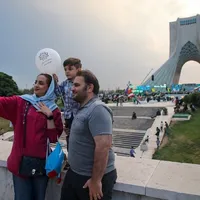
Islamic Republic supporters mourn on the first day of Muharram at Tehran’s Enghelab Square on June 16, 2026.
Iran's hardliners have erupted against the US-Iran MoU with death chants against chief negotiators Abbas Araghchi and M. Bagher Ghalibaf, but experts say the backlash is unlikely to derail a deal the ruling elite sees as essential to the regime's survival.
The public anger from some regime supporters has exposed real divisions within Iran’s political and media establishment. But those divisions appear to be less about whether to preserve the Islamic Republic than about how best to preserve it.
That is the assessment of several Iran experts who spoke to Iran International following the announcement of the US-Iran Memorandum of Understanding.
Hardliners protest the deal
Much of the dissent appears to be coming from the hardline Paydari Front, which sees itself as a guardian of the values of the 1979 revolution that established the Islamic Republic. The faction has long opposed engagement with the West and advocates a more ideological vision of the state rooted in Shia Islamist principles.
Ahead of the signing of the MoU, prominent hardline lawmaker Mahmoud Nabavian warned that accepting the agreement would effectively turn Iran into “a colony of the United States.” He also criticized provisions related to the Strait of Hormuz, arguing they would amount to surrendering one of Iran’s most important strategic levers.
The rhetoric spilled into the streets. At rallies in Tehran over the weekend, protesters called for the resignations of Foreign Minister Abbas Araghchi and Parliamentary Speaker Mohammad Bagher Ghalibaf. Some invoked the memory of the late Supreme Leader, chanting: “Ghalibaf, Araghchi — what about my Leader’s blood?”
Some went even further, calling for their death and execution.
Opponents of the deal have also launched a “we will not accept” campaign.
The question now is whether these internal fractures could eventually weaken a system that, while more resilient than many anticipated, remains under significant strain. For now, experts say the divisions do not appear sufficient to break the system from within.
“The hardliners are loud, but they have a weak case to make,” said Alex Vatanka, a senior fellow at the Middle East Institute.
“This regime has now proven beyond doubt that they’re much more entrenched and resilient than people thought they were. That doesn’t make them nice, just makes them harder adversaries.”
Survival over ideology
Arash Azizi, an Iran analyst and author of What Iranians Want: Women, Life, Freedom, argues that the Islamic Republic is shifting from ideological hardliners toward a more pragmatic — though still authoritarian — collective leadership focused on regime survival.
“They are authoritarian and they’re thugs, to be clear. But they care about keeping their own economic interests, which means social peace as much as they can, and which means deals with the US,” Azizi told Iran International.
In other words, the Islamic Republic is not moderating. It is acting pragmatically — and, as Azizi argues, cynically — to survive.
According to Azizi, the hardliners around Saeed Jalili are important precisely because they have revealed their weakness. They loudly opposed the deal but appear unable to stop it.
Real power, he argues, lies with a collective leadership centered around Ghalibaf, the IRGC leadership and the Supreme National Security Council. That leadership appears to view a deal with Washington as necessary to protect the system.
The deal’s progress, despite Mojtaba Khamenei’s continued absence from public view, has fueled speculation that a new power structure may be consolidating inside the Islamic Republic.
Jason Brodsky, policy director at United Against Nuclear Iran, notes that such divisions are not new.
Similar opposition emerged during the 2013–2015 negotiations that led to the JCPOA, when hardliners attacked then-President Hassan Rouhani and Foreign Minister Mohammad Javad Zarif.
“The Supreme Leader made a decision, and that’s going to carry the day,” Brodsky said.
But Brodsky argues the real struggle may begin if sanctions relief materializes.
“There will be those who want to use resources toward economic rebuilding, but there will be a very hardened IRGC contingent ... who are going to want to rebuild their military, rebuild the nuclear program, and rebuild the terror apparatus.”
Media split reflects political divide
Iran’s media landscape reflects the same tensions.
Hardline newspaper Kayhan has denounced the MoU as surrender to the United States. Khorasan has framed it as a temporary pause rather than peace. Hamshahri has argued that diplomacy was made possible by Iran’s military deterrence.
Meanwhile, reformist and moderate outlets such as Shargh, Etemad and Khabar Online have presented the agreement as a state-backed effort to end the war, ease economic pressure and stabilize the country.
Some supporters of the deal have gone further, arguing that the agreement is superior to the 2015 nuclear accord because Iran has retained strategic leverage, including influence over the Strait of Hormuz.
Government supporters have also pushed back against the Paydari Front, arguing it does not represent ordinary Iranians, many of whom have grown weary of war and economic hardship.
Taken together, the reactions suggest that few inside Iran view the MoU as a peace agreement.
Instead, supporters and critics alike largely see it as a mechanism for preserving the Islamic Republic, though they disagree sharply on what kind of compromise would best serve that goal.
For hardliners, the agreement risks being remembered as a retreat from revolutionary principles. For pragmatists inside the establishment, it is a necessary concession aimed at keeping the system intact.
The domestic battle over the MoU may ultimately prove just as consequential as the negotiations themselves.
New Zealand is actively considering designating Iran’s Revolutionary Guards as a terrorist organization, Deputy Prime Minister David Seymour told Iran International on Monday.
Seymour said Wellington condemned the Islamic Republic’s conduct toward its neighbors, its support for militant groups in the Middle East its activities close to New Zealand as Australia.
“There is no question that we believe this is an evil regime,” Seymour said. “We condemn their actions toward their neighbors, the sponsorship of terrorism throughout the Middle East and as near as Australia, and we especially condemn their behavior toward the Iranian people.”
He said New Zealand had not yet designated the IRGC in part because it still maintained diplomatic relations with Tehran, including an Iranian ambassador in Wellington, while New Zealand’s embassy in Iran was temporarily closed.
“Those connections can be of value,” he said. “There is some value in the connection and that’s why we have maintained our stance despite the fact that we condemn the behavior and actions of the government of Iran.”
Seymour said New Zealand’s police and intelligence agencies were “very aware” of the IRGC’s activities and were monitoring them.
“The New Zealand government and its various agencies, the police, intelligence agencies, have as a priority monitoring and controlling the IRGC and particularly protecting Iranian nationals who have become New Zealanders and make their home here,” he said.
He said he had personally discussed the issue with Prime Minister Christopher Luxon, adding that the government was not currently considering further action beyond the possible terrorist designation.
Seymour also referred to a recent joint statement by New Zealand and 21 other countries condemning the Islamic Republic’s extraterritorial actions.
“We signed that letter because we and the 21 other state parties have a set of values,” he said. “We should trade value for value, voluntarily get stronger together through mutually beneficial voluntary trade rather than use violence to achieve our aims.”
He added: “That is why we condemn this regime, its behavior both inside and outside Iran.”
Seymour called the Islamic Republic’s treatment of protesters “absolutely disgraceful and disgusting,” and said the Iranian government would not endure.
“I believe the time will come when they are no longer sustainable,” he said. “They will no longer be in power because Persia has a beautiful 5,000-year history.”
He added: “The greatness of that place will not be ended by this regime. They will become a footnote in a long history of a great civilization.”
Seymour also paid tribute to the “forty-thousand freedom fighters” killed earlier this year, saying Iranians seeking freedom would ultimately prevail.
“Living freely, with dignity, safe from violence, is the only way that anybody in the world has ever been able to reach their potential,” he said. “Over time, inevitably, you will succeed because you are right and they are wrong.”
Deepening poverty in Iran is driving a rise in child labor, exposing children to sexual exploitation, violence and malnutrition, the head of Iran's Association of Social Workers warned on Sunday.
Hassan Mousavi Chalak told Khabar Online that worsening economic conditions were forcing more families to rely on their children's income to meet basic needs.
"We must accept that poverty in Iran has deepened," Mousavi said. "The more difficult economic conditions become, the more the use of children's labor capacity to cover family expenses increases."
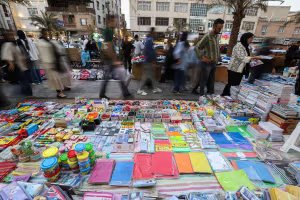
Criticizing what he described as political efforts to downplay the issue, Mousavi said child labor extended far beyond children visible on city streets. He pointed to the use of children in slaughterhouses, livestock farms, underground workshops, orchards, farms and industrial settings, adding that many remained hidden from public view while facing dangerous and damaging working conditions.
There were no reliable statistics on the number of child laborers in Iran but that the phenomenon appeared more widespread in major cities and pilgrimage and tourist destinations, Mousavi said.
Physical and psychological toll
Children who work are deprived of the safety of school environments and normal socialization processes, Mousavi said, forcing them to adapt to harsh street conditions and sometimes engage in risky behavior to survive.
He warned that child laborers face serious health risks, including malnutrition, skin and infectious diseases, gastrointestinal problems and drug use, as well as different forms of violence and sexual exploitation.
"Social comparisons are also harmful," Mousavi said. "When a child compares themselves with others and sees peers enjoying ordinary and happy lives with their families, they experience psychological pressure and emotional suffering."
He cautioned that economic hardship increases the likelihood that children will be exploited, "sometimes even by those closest to them."
Economic strain fuels concerns
In recent weeks, multiple reports have highlighted the worsening economic situation in Iran, with citizens describing rising unemployment, sharp increases in the prices of essential goods and persistent economic stagnation.
Messages sent to Iran International have pointed to mounting pressure on household finances as living costs rise and employment opportunities decline, deepening concerns about livelihoods and the future of the labor market.
Research published in 2025 found that a combination of poverty, migration and marginalization, alongside ineffective support policies, was pushing both Iranian and Afghan migrant children into street work and workshops.
The study argued that child labor should be understood within the framework of profiteering from children in a dysfunctional economic structure, where shortcomings in the welfare system and ineffective social interventions have left the street to serve as a substitute for formal support mechanisms.
Mafia networks target some children
Addressing remarks about organized criminal involvement, Mousavi said the existence of mafia-like networks in the child labor sector could not be entirely dismissed, particularly when it came to homeless children.
However, he said field experience did not support the assumption that all working children were controlled by such groups.
Many children, he said, were sent by their families from poorer provinces to wealthier areas to help cover household expenses.
"Some children, especially those without guardians or effective caregivers, may fall under the control of such networks," Mousavi said. "In these circumstances, they may be forced into illegal or criminal activities."