• العربية
  • فارسی
Brand
  • Iran Insight
  • Politics
  • Economy
  • Analysis
  • Special Report
  • Opinion
  • Podcast
  • Iran Insight
  • Politics
  • Economy
  • Analysis
  • Special Report
  • Opinion
  • Podcast
  • Theme
  • Language
    • العربية
    • فارسی
  • Iran Insight
  • Politics
  • Economy
  • Analysis
  • Special Report
  • Opinion
  • Podcast
All rights reserved for Volant Media UK Limited
volant media logo

Trump's Iran strategy underrates regime's resilience, ex-US diplomat says

Kambiz Tavana
Kambiz Tavana

Iran International

Jun 14, 2026, 03:52 GMT+1
Charles W. Dunne
Charles W. Dunne

A former US diplomat warned that President Donald Trump may be underestimating the Islamic Republic's resilience, arguing that Tehran's leadership has repeatedly demonstrated its ability to withstand military and economic pressure.

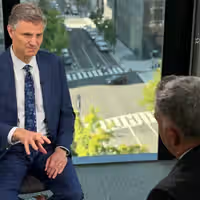
In an interview with Iran International, Charles W. Dunne, a non‑resident fellow at the Arab Center Washington DC and an adjunct lecturer at George Washington University’s Elliott School of International Affairs, said many in the West misread what sanctions, military strikes, and diplomatic isolation can achieve against Tehran.

“From a Western or an American point of view, this pressure that’s been exerted on the regime should have resulted in its collapse already,” he said. “But that’s not how this system works.”

The United States and Israel launched large‑scale attacks on Iran earlier this year, prompting Iranian missile and drone strikes against Israel, US positions, and Persian Gulf Arab states.

While President Donald Trump and Israeli Prime Minister Benjamin Netanyahu raised the possibility of regime change as a result of the airstrikes, the Islamic Republic has remained in place and has grown even more hardline, according to observers.

Dunne said the Trump administration’s shifting narrative points to a lack of strategic clarity at the top of the US government. “We’ve heard at least a dozen different explanations for why this war started in the first place,” he said. “Being completely honest with you, I’m not sure the administration knows to what end it is fighting.”

Dunne said talk of regime collapse and Venezuela‑style oil pressure ignores the Islamic Republic’s record of absorbing far greater punishment. Trump has suggested the US could one day seize Iran’s strategic oil hub of Kharg Island and “run” its energy sector “like we did in Venezuela”, but Dunne said the analogy is fundamentally flawed.

“In Venezuela the United States moved against a much smaller country, removed one leader and worked with a pliant figure inside an old regime that essentially survived,” he said. “That is not at all the scenario we face in Iran.”

Despite Trump’s saying that “regime change” already occurred, Dunne said Iran’s power structure has not collapsed and those now in charge “seem to be even more hardline and determined to prevail” than their predecessors.

Dunne added that the Islamic Republic has already shown far greater resilience, pointing to the 1980–88 Iran‑Iraq war, when the new revolutionary state suffered enormous casualties and damage yet fought Saddam Hussein’s Iraq to a standstill. “That war showed how much pain the regime is willing to accept in order to maintain its grip,” Dunne said. “Sanctions, oil export bans, a collapsing rial – none of that has brought the system to its breaking point yet.”

Dunne said repeated strikes on senior officials have not dismantled the state, but instead produced “more hardline, more aggressive personalities rising to the fore.” Iran’s regular army is backed by the Islamic Revolutionary Guard Corps (IRGC) and Basij paramilitaries, a layered security system designed to withstand both external attack and internal unrest.

“From their point of view, they are still in power, they still control the streets, and that is the main goal,” he said. “They believe they can inflict more political and even military pain than the United States is willing to bear over the next few months.”

Most Viewed

US, Pakistan say Iran deal set for Sunday as Tehran split clouds signing
1

US, Pakistan say Iran deal set for Sunday as Tehran split clouds signing

2

Iran says US MoU may be signed in days as hardliners warn of retreat

3
ANALYSIS

The uneasy mix of diplomacy and pressure in Canada’s Iran policy

4
PODCAST

Lebanon may become first test of emerging Iran-US deal, experts say

5

Trump's Iran strategy underrates regime's resilience, ex-US diplomat says

Banner
Banner

Spotlight

  • The uneasy mix of diplomacy and pressure in Canada’s Iran policy
    ANALYSIS

    The uneasy mix of diplomacy and pressure in Canada’s Iran policy

  • How Nourabad Mamasani became an early flashpoint of Iran’s January bloodshed

    How Nourabad Mamasani became an early flashpoint of Iran’s January bloodshed

  • As prices soar, Iranian diets shrink to survival level
    VOICES FROM IRAN

    As prices soar, Iranian diets shrink to survival level

  • Iranian teens say rising costs turn simple wishes into distant dreams
    VOICES FROM IRAN

    Iranian teens say rising costs turn simple wishes into distant dreams

•
•
•

More Stories

Lebanon may become first test of emerging Iran-US deal, experts say

Jun 13, 2026, 21:42 GMT+1
•
Negar Mojtahedi
Lebanon may become first test of emerging Iran-US deal, experts say
100%
The image shows a gathering in Beirut, Lebanon, on April 22, 2026, where supporters paid tribute to Iran's late Supreme Leader Ali Khamenei and expressed support for his successor, Mojtaba Khamenei.

As Washington and Islamabad push for a preliminary agreement with Iran, experts say the unresolved fight over Lebanon could determine what the region looks like after the war and how much influence Iran retains.

The US and Pakistani officials say a Memorandum of Understanding with Iran will be signed on Sunday, describing it as a step toward ending the wider conflict, but Tehran has cast doubt on the timing.

That uncertainty has kept attention on the issues still capable of derailing or reshaping any deal.

One of them is Lebanon.

Iranian officials and media reports have suggested that any broader understanding with the United States would have to include an end to fighting involving Hezbollah. Israel has rejected any arrangement that would limit its freedom of action, with Defense Minister Israel Katz saying Friday that Israel would continue operating in Lebanon regardless of any agreement with Tehran.

The dispute reflects a larger reality taking shape across the Middle East: even if a preliminary Iran-US agreement moves forward, the struggle over Lebanon may decide what kind of post-war order follows it.

For veteran Middle East negotiator Aaron David Miller, Tehran’s focus on Lebanon is no accident.

“I think they are using Lebanon now to try to push Trump to push Netanyahu and to establish a new equation,” Miller, a senior fellow at the Carnegie Endowment for International Peace, told Eye for Iran.

For decades, Hezbollah served as Iran’s primary deterrent against direct attacks on Iranian territory. Now, Miller argues, Tehran is attempting to reverse that logic by making Hezbollah itself the red line.

Lebanon, he said, has become even more important to Iran after setbacks elsewhere in its regional network. The result is a new dynamic in which military action in Lebanon risks triggering a wider confrontation involving Iran directly.

“The concern about Lebanon and the Persian Gulf is that they provide ample opportunities for miscalculation or kinetic interaction,” Miller said.

The repercussions are already being felt beyond Lebanon.

Mohamed Fahmy, an Egyptian-Canadian journalist and Middle East political analyst who recently returned from reporting in Kuwait, Saudi Arabia and the United Arab Emirates, said the war has altered how Iran is viewed across parts of the Arab world.

“There is a scar that has changed the psyche of people there towards how Iran is viewed,” Fahmy said.

Fahmy said governments across the region are now grappling with questions about deterrence, security and their future relationship with Tehran as missile and drone attacks continue despite diplomatic efforts.

The shifting landscape is also reshaping traditional assumptions about power in the Middle East.

“If you ask me who are the three most powerful players in the region, they’re the three non-Arabs: Israel, Turkey and Iran,” Miller said.

“The three states that dominated Middle Eastern politics for decades, Egypt, Iraq and Syria, are all offline.”

That makes Lebanon more than a side issue in the diplomacy around Iran. It is one of the places where the limits of any agreement may be tested first: whether Iran can preserve the deterrent value of Hezbollah, whether Israel can keep striking without triggering a wider war, and whether Washington can turn a preliminary understanding with Tehran into a more durable regional arrangement.

'The only real end is Iran regime change'

For former US special representative for Iran Elliott Abrams, the debate over Lebanon points to a larger question about the future of the Islamic Republic itself.

“The only real end of this is the end of the regime, which is to say, let the Iranian people govern themselves,” Abrams told Eye for Iran.

Looking beyond the immediate fighting, Abrams argued that the significance of the war may not ultimately be measured by what happens in Lebanon, but by what happens inside Iran.

“If the regime falls in a few years, we’ll all look back on early 2026 and say that’s when it started.”

For now, Lebanon remains one of the clearest tests of the emerging Iran-US track. A preliminary agreement may slow the war, but experts say the unresolved fight over Hezbollah and Israel’s freedom of action could still shape what comes after it.

US probes NIAC founder Trita Parsi for possible deportation - Free Press

Jun 11, 2026, 07:24 GMT+1
US probes NIAC founder Trita Parsi for possible deportation - Free Press
100%
NIAC founder Trita Parsi (File photo)

The US State Department is investigating NIAC founder Trita Parsi and weighing whether to revoke his green card, The Free Press reported, in a case that revives long-running questions over Tehran’s influence in Washington.

The report, by Jay Solomon, said US officials and documents reviewed by The Free Press show Parsi has become a target of the State Department investigation as Secretary of State Marco Rubio seeks to counter Iranian influence inside the United States.

Parsi, 51, was born in Iran, raised in Sweden and has lived in the United States for more than 25 years. He is a green-card holder and co-founder of the Quincy Institute for Responsible Statecraft, a Washington think tank that argues for diplomacy, military restraint and a smaller US military role overseas.

The State Department declined to discuss Parsi’s immigration status, The Free Press said. Parsi and Quincy did not respond to the outlet’s requests for comment.

  • Inside Tehran’s Soft War: How Iran Gained Influence In US Policy Centers

    Inside Tehran’s Soft War: How Iran Gained Influence In US Policy Centers

The investigation places one of the most prominent critics of the US-Israel war against Iran at the center of a broader fight over who shapes Washington’s Iran debate.

Since the war began, Parsi has appeared across left-wing, mainstream and even pro-MAGA platforms arguing that Trump faces a quagmire and that Washington should seek a deal with Tehran.

  • US arrests Iranian national over alleged Basij-linked visa fraud

    US arrests Iranian national over alleged Basij-linked visa fraud

His critics say that position fits a much longer pattern: opposing sanctions and military pressure, amplifying Tehran’s warnings, and presenting policies favorable to the Islamic Republic as anti-war realism. Parsi has denied wrongdoing and has said such criticism is an effort to silence opponents of Trump’s Iran policy.

The Free Press cited a Trump administration official saying the State Department is reviewing people whose work is seen as helping US adversaries. “Anyone who seeks to undermine the US, we’re taking a hard look at,” the official said.

  • US terminates green cards of 3 Iranians tied to Islamic Republic

    US terminates green cards of 3 Iranians tied to Islamic Republic

Parsi has long been a divisive figure among Iranian Americans. In 2002, he founded the National Iranian American Council, or NIAC, which described itself as a voice for Iranian Americans and later became one of the most visible organizations advocating engagement with Tehran.

In 2020, Republican senators Tom Cotton, Mike Braun and Ted Cruz asked the Justice Department to examine whether NIAC should register as a foreign agent, accusing it of amplifying Iranian government propaganda. No investigation or enforcement action was publicly announced.

  • Under fire at home, Pezeshkian misses own VIP dinner send-off at UN

    Under fire at home, Pezeshkian misses own VIP dinner send-off at UN

The Free Press also revisited Parsi’s defamation lawsuit against Iranian American journalist Hassan Daioleslam, who had accused Parsi and NIAC of advancing Tehran’s interests. The lawsuit was dismissed. Emails disclosed in the case showed Parsi had corresponded with Iran’s then-UN ambassador, who later became foreign minister, about meetings with US lawmakers and policy conferences.

The latest report also points to Parsi’s family and professional ecosystem. His brother, Rouzbeh Parsi, helped create the Iran Experts Initiative, a network of Iranian scholars and analysts formed in 2014 as nuclear talks with world powers intensified.

  • Exclusive: Covert Ties Between Iran And The International Crisis Group

    Exclusive: Covert Ties Between Iran And The International Crisis Group

The initiative was first exposed in 2023 by Iran International and Semafor, based on thousands of Iranian Foreign Ministry emails. The documents showed Iranian officials sought to cultivate overseas analysts and academics who could promote Tehran’s positions on the nuclear talks in Western media and policy circles.

The Free Press said Trita Parsi’s name did not appear in the Foreign Ministry emails as a member of the initiative. But it quoted critics who argued that the work of the two brothers should be viewed as part of a broader effort to weaken pressure on Tehran and normalize engagement with the Islamic Republic.

  • Leaked documents tie Iranian-Swedish scholar to Tehran’s influence network

    Leaked documents tie Iranian-Swedish scholar to Tehran’s influence network

Rouzbeh Parsi has denied cooperating with Tehran. A later investigation by the Swedish Institute of International Affairs, his former employer, found no evidence that he was paid by Iran or controlled by it. But it concluded that he had been a principal creator of the initiative and had failed to disclose its work to the institute, Sweden’s foreign ministry or Lund University. The institute ended his employment in May 2025.

The Iran Experts Initiative revelations also drew attention in Washington because one of its founding members, Ariane Tabatabai, later held a senior Defense Department role under the Biden administration.

  • Republican senator seeks FBI, Pentagon probe into Iranian influence

    Republican senator seeks FBI, Pentagon probe into Iranian influence

Republican lawmakers pressed the Pentagon and FBI to ensure members of the initiative were not in positions to influence US policy or access sensitive intelligence. Tabatabai’s current employer has defended her record and said she had passed security reviews under multiple administrations.

The controversy around Parsi has not been limited to Washington. In February, the German Institute for Global and Area Studies canceled a Berlin event featuring him after public backlash from Iranian activists and opponents of the Islamic Republic.

  • Biden White House regularly hosted Pentagon official with ties to Iran

    Biden White House regularly hosted Pentagon official with ties to Iran

The institute cited security concerns, while critics said Western institutions should not offer unchallenged platforms to figures they accuse of echoing Tehran’s policy line.

The Free Press report said Quincy had prepared for a possible legal fight. In an April memo reviewed by the outlet, Quincy CEO Lora Lumpe said the think tank’s chairman had agreed to cover legal costs to prepare for, and if necessary fight, what she called a “deportation attack on Trita.”

The memo said Quincy was retaining an immigration lawyer and preparing a habeas corpus petition in case Parsi was suddenly detained by immigration authorities.

The report also said Parsi’s recent criticism of the Iran war has been noticed in Tehran. Photos circulated last month by Iranian activists showed banners bearing his face on a Tehran overpass and lamppost, alongside a quote attributed to him saying Trump’s “failed war” had destroyed Washington’s ability to make military threats.

  • Iran Influence Network Parallels Soviet Era 'Active Measures'

    Iran Influence Network Parallels Soviet Era 'Active Measures'

For critics, those images captured the central question around Parsi’s career: why a Washington analyst’s arguments are repeatedly useful to Tehran at moments when US pressure on the Islamic Republic is at stake.

For his defenders, the case raises a different concern: whether the Trump administration is using immigration powers to punish lawful political speech and dissent over war policy.

That tension makes the Parsi investigation more than a dispute over one analyst’s status. It is now part of a wider battle over Iranian influence, free speech, immigration power and the long-running struggle to define US policy toward Tehran.

Iran defrocks cleric after challenge to state-backed Shiite narratives

Jun 10, 2026, 14:16 GMT+1
Iran defrocks cleric after challenge to state-backed Shiite narratives
100%
Cleric Abdolrahim Soleimani Ardestani (right) during a youtube debate show with cleric Hamed Kashani (center)

Iran’s Special Clerical Court has sentenced dissident cleric Abdolrahim Soleimani Ardestani to six years in prison, a fine and removal from the clergy, months after his public challenge to state-backed Shiite narratives drew threats and political pressure.

Soleimani Ardestani, a religious scholar, former Mofid University professor and member of a reformist association of Qom seminary teachers and researchers, is being held in Qom’s prison.

According to Mojtaba Lotfi, an official from the office of the late dissident cleric Hossein Ali Montazeri, the court convicted him on all eight charges brought against him.

Lotfi said Soleimani Ardestani does not plan to appeal unless the court agrees to hold a public hearing.

In a letter from prison, Soleimani Ardestani said the charges against him included disturbing public opinion, insulting sacred values, insulting the leadership in relation to Ali Khamenei and his son Mojtaba, taking part in a gathering over the house arrest of Mir-Hossein Mousavi, and assembly and collusion against domestic security.

Mousavi, a former prime minister, has been under house arrest since 2011 after rejecting the official result of Iran’s disputed 2009 presidential election and becoming one of the symbols of the Green Movement protests.

Soleimani Ardestani also listed accusations such as propaganda against the system, spreading falsehoods online, insulting senior religious authorities, damaging the dignity of the clergy and “mind control and psychological suggestion” – a striking charge even by the standards of Iran’s broad political indictments.

He has called the indictment weak and baseless, criticized his arrest and solitary confinement, and said he wrote his defense not to seek acquittal but to leave a record for history.

The case began with remarks in a debate with pro-government cleric Hamed Kashani. Soleimani Ardestani questioned long-promoted Shiite accounts about the death of Fatemeh Zahra, the daughter of the Prophet Muhammed and wife of Ali, the first Shiite Imam.

In Iran, the story of Fatemeh’s martyrdom is not only a religious narrative but part of a vast state-backed culture of mourning, ritual and political identity.

Soleimani Ardestani argued that if Ali had merely watched his wife being attacked and had not intervened, then the traditional account would raise questions about his justice. He later said he had not insulted Fatemeh and was challenging what he called the “stories told by religious singers or eulogists (maddahs).”

  • Q&A: Who are Iran's ‘eulogists’ and what is their role in the Islamic Republic?

    Q&A: Who are Iran's ‘eulogists’ and what is their role in the Islamic Republic?

He also questioned mourning ceremonies for Muhammad Taqi, the ninth Shiite Imam, saying his death was linked to jealousy by his wife after he remarried and that mourning the event 1,300 years later was meaningless.

The backlash was immediate. Pro-government eulogists, who play an influential role in mobilizing religious crowds, attacked him with vulgar and sexist language. Reports also emerged of a group attack on his home.

  • Eulogists Are Khamenei's Favorite Politicians, Mob Influencers

    Eulogists Are Khamenei's Favorite Politicians, Mob Influencers

Hardline figures called for prosecution and defrocking, while some religious voices went further, suggesting that denial of Fatemeh’s martyrdom could amount to leaving Shiite doctrine.

The controversy also split parts of the political middle ground. Reformist figures criticized Soleimani Ardestani’s tone and timing, while others warned that violent threats, home attacks and denunciations violated freedom of belief.

The sentence is significant because it shows how quickly the Islamic Republic can convert a dispute over religious history into a security case.

Soleimani Ardestani was not an outside critic of clerical rule. He was a cleric from inside the seminary world, which makes his challenge more sensitive.

By sentencing him to prison and stripping him of clerical status, the system is not only punishing one man. It is policing the boundaries of who is allowed to interpret religion, how far internal debate can go, and what happens when religious scholarship collides with the political theology of the state.

As prices soar, Iranian diets shrink to survival level

Jun 10, 2026, 01:30 GMT+1
•
Saba Heidarkhani
As prices soar, Iranian diets shrink to survival level
100%
File photo of shoppers browse grocery shelves at a supermarket in Iran as households face rising living costs and inflation. The photo quality was enhanced using AI.

Citizens across Iran say soaring food prices have reduced household diets to the bare minimum needed to stave off hunger, with nutrition and variety increasingly out of reach.

Messages sent to Iran International from cities across the country paint a picture of households slipping steadily down the hierarchy of human needs.

Many say their tables have been reduced to the level of survival, where staying full matters more than quality, variety or nutritional value.

If many families had already removed red meat, fish and even chicken from their diets in recent years, messages received by Iran International suggest that fruit, eggs and dairy products have now also become luxuries for a large share of households.

Instead, they say they rely on filling foods such as pasta, potatoes, onions, bread and plain rice.

One citizen summed up the sense of despair bluntly: "If the Islamic Republic remains, we will be buried in the graveyard of our dreams."

Another said that most days their family eats little beyond potatoes, onions and lentil soup.

The accounts reflect a shift toward the most basic physiological needs required for survival, with little room for long-term health, development or security.

One citizen said that after months of buying food from weekly street vendors because shops had become too expensive, even those purchases are now out of reach.

"I only buy the absolute necessities now, things like potatoes, tomatoes and onions, and even then I buy the lowest-quality produce available," the person said.

File photo of a a woman shopping at a bakery in Tehran, Iran, amid rising food prices and persistent inflation.
100%
File photo of a a woman shopping at a bakery in Tehran, Iran, amid rising food prices and persistent inflation.

A resident of Isfahan said the family's meals now consist largely of potatoes, pasta, or bread and cheese.

Official figures show some food categories rising well into triple digits over the past year while wages have failed to keep pace.

According to Central Bank data for the past month, year-on-year inflation reached 161 percent for milk, cheese and eggs, 267 percent for oils and fats, and 176 percent for meat products.

Citizens reported that lamb currently sells for around 22 million rials ($12.5) per kilogram, while beef costs roughly 15 million rials ($8.5) per kilogram.

Masoud Rasouli, secretary of the Meat Packaging and Protein Industry Association, said in early June that demand for red meat had fallen by about 50 percent compared with the previous year.

Many families told Iran International they had eliminated animal protein entirely from their diets despite warnings from health experts that prolonged protein deficiencies can lead to widespread malnutrition, particularly among children and adolescents.

Doctors have warned that shrinking household food baskets and a shift toward cheaper, lower-quality products could contribute to rising rates of anemia, weakened immune systems and other long-term health problems.

  • Inflation pushes Iranians to buy food in installments

    Inflation pushes Iranians to buy food in installments

'Nothing but bread and cheese'

Several citizens said an ordinary package of breakfast cheese now costs around 2 million rials ($1.1).

"Many days our lunch and dinner consist only of bread and cheese," one person said. "But even if you live only on bread and cheese, you would still need about 150 million rials ($85) a month."

Iran's minimum monthly wage currently stands at around 160 million rials ($90).

Citizens reported prices of around 250,000 rials ($0.14) for a single egg, more than 10 million rials ($5.6) for a liter of cooking oil, and about 5 million rials ($2.8) for a 2.5-kilogram container of yogurt.

Many said that salaries which barely reach 200 million rials ($113) a month have left them struggling to secure even protein-free meals.

  • Millions face poverty as Iran’s economy reels from war and sanctions

    Millions face poverty as Iran’s economy reels from war and sanctions

The messages also point to a more troubling development: the gradual replacement of food with whatever can fill an empty stomach.

A resident of Tabriz said they now buy meat stock instead of meat simply to create the flavor of meat in stews.

A mother from Dehloran in Ilam Province said her children have not eaten meat for months and that even chicken has become unaffordable.

Others described selling household belongings to cover food expenses.

"We have cut costs everywhere possible and there is almost nothing left on our table," one citizen said. "I have not eaten a proper meal in a week. We are reaching a point where we cannot afford three meals a day."

For a growing number of Iranians, the question is no longer how to maintain a standard of living, but how to secure enough food to get through another day.

File photo of a billboard featuring Iran's 10,000-rial banknote is seen behind red traffic lights in Tehran, Iran.
100%
File photo of a billboard featuring Iran's 10,000-rial banknote is seen behind red traffic lights in Tehran, Iran.

Iran eco-tourism operators warn of closures as travel dries up

Jun 9, 2026, 11:35 GMT+1
Iran eco-tourism operators warn of closures as travel dries up
100%
A guest room at a traditional Iranian eco-lodge

Tourism businesses report empty rooms, mounting losses and growing pressure to cut jobs as rising living costs push travel out of reach for many households.

Tourism businesses in Iran are struggling to survive as economic hardship and a sharp decline in travel leave eco-lodges empty, operators facing bankruptcy and workers at risk of losing their jobs, according to a report by Shargh newspaper.

Once promoted as a way to boost local economies and preserve traditional lifestyles, eco-lodges across Iran are now grappling with falling visitor numbers, rising costs and mounting financial pressure.

"The damage caused by the war will take months to repair, and tourism will need a long time to return to previous levels," Yavar Abiri, head of Iran's Association of Eco-Lodge Professional Societies, told Shargh.

  • Iran tourism officials stress reshaping global image after war

    Iran tourism officials stress reshaping global image after war

Abiri said many Iranians have shifted their priorities from travel to basic survival as economic uncertainty deepens.

"People are saving whatever money they have for essential needs in case another war breaks out," he said.

Travel slips down household priorities

Tourism operators say domestic travel had already been weakening before the latest economic shocks.

Official statistics cited by Shargh showed that nearly half of Iranian households did not take a single trip during the spring of 2024. Industry representatives say rising prices have forced many families to either cancel travel altogether or cut costs by camping, avoiding restaurants and reducing leisure spending.

Officials have also questioned whether travel remains a priority for many households.

Traditional Iranian rice dishes served at an eco-lodge restaurant
100%
Traditional Iranian rice dishes served at an eco-lodge restaurant

Hani Rastegaran, secretary of the National Travel Services Coordination Headquarters, previously described declining domestic travel as a warning sign for the tourism sector and called for an assessment of whether economic pressure had pushed travel out of family budgets.

Eco-lodges face closures

Mahlagha Mahdavi, who operates an eco-lodge in Shiraz and has worked in the sector for a decade, said the downturn has intensified over the past year.

"We faced a sharp drop in visitors and had to offer significant discounts because people simply could not afford to travel," Mahdavi told Shargh.

She said many eco-lodge employees are women and heads of households, prompting operators to avoid layoffs despite worsening finances.

"We do not know how long we can continue without reducing staff," she said.

Many former tourism operators, according to Mahdavi, have already left the industry, while the profile of travelers has changed. Visitors who once belonged largely to the middle class have been replaced by wealthier Iranians who can no longer justify foreign trips but continue to travel domestically.

Revenue collapses, costs soar

Operators in other provinces described similar challenges. Abas'ad Sharafkhani, who runs an eco-lodge in Hamedan province, said revenue between January and April amounted to only a fraction of what he had expected.

  • Foreign tourist arrivals to Iran plummet 75% after 12-day war, minister says

    Foreign tourist arrivals to Iran plummet 75% after 12-day war, minister says

"Out of the income I had projected, I earned only about 10 percent, and even that barely covered operating costs," he told Shargh.

Sharafkhani said many eco-lodges are nearing complete bankruptcy and that some properties sustained physical damage during the conflict.

He criticized authorities for failing to provide meaningful support or compensation.

Rising prices force cutbacks

Ahmad Kazemi, an eco-lodge operator in Khorasan Razavi province, said inflation has transformed the economics of the business.

"When we started in 2019, a sack of high-quality Iranian rice cost three million rials ($1.8). Now it costs 64 million rials (about $36)," Kazemi told Shargh.

He said accommodation packages that once cost 4000,000 rials ($2.2) now cost between forty and fifty million rials ($22-28), even after operators reduce their profit margins.

To cope with rising expenses, Kazemi said his lodge has removed lunch and dinner services and now offers only accommodation and breakfast.

A traditional courtyard at an eco-lodge in central Iran
100%
A traditional courtyard at an eco-lodge in central Iran

"People are not traveling for leisure the way they used to," he said. "Many now choose short local trips because they are cheaper."

Iran's minimum monthly wage is currently equivalent to about $90–$110, depending on exchange-rate movements, while labor experts estimate that many workers earn around $150 per month on average.

Industry operators told Shargh that without financial support and an improvement in household purchasing power, many of Iran's eco-lodges may be unable to continue operating, threatening jobs and a sector that was once viewed as a growing part of the country's tourism economy.