• العربية
  • فارسی
Brand
  • Iran Insight
  • Politics
  • Economy
  • Analysis
  • Special Report
  • Opinion
  • Podcast
  • Iran Insight
  • Politics
  • Economy
  • Analysis
  • Special Report
  • Opinion
  • Podcast
  • Theme
  • Language
    • العربية
    • فارسی
  • Iran Insight
  • Politics
  • Economy
  • Analysis
  • Special Report
  • Opinion
  • Podcast
All rights reserved for Volant Media UK Limited
volant media logo

Netanyahu says Iran can reach Europe, calls for global action
Mar 22, 2026, 12:33 GMT+0

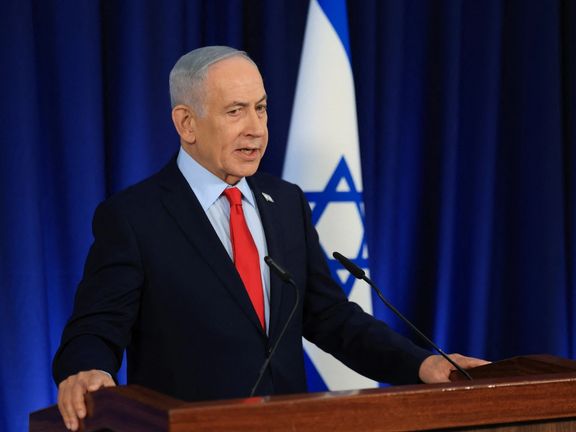
Iran now has the capability to strike deep into Europe, Israeli Prime Minister Benjamin Netanyahu said on Sunday, as he visited the site of a missile strike in the southern city of Arad.

Netanyahu said Iran had fired an intercontinental ballistic missile toward Diego Garcia and warned that its range puts European capitals within reach.

“They fired an intercontinental ballistic missile on Diego Garcia. That's 4,000 kilometers. I've been warning all the time. They have now the capacity to reach deep into Europe. They already have fired on European countries, Cyprus,” he said, adding that Iran is “putting everyone in their sights.”

He accused Iran of targeting civilian areas and religious sites in recent attacks and said the country is also disrupting global energy flows through the Strait of Hormuz.

“They fired on Jerusalem right next to the holy sites of the three monotheistic faiths, the Western Wall, the Church of the Holy Sepulcher, and the Al-Aqsa Mosque. And by dint of a miracle, again, none of them were hurt, but they were targeting the holy sites of the three major monotheistic religions.”

Netanyahu called on world leaders to join the United States and Israel in confronting Iran, saying the threat goes beyond the region and “is for the security of the entire world.”


Most Viewed

Disputes within Iran leadership blocked negotiators’ trip to Islamabad
1
EXCLUSIVE

Disputes within Iran leadership blocked negotiators’ trip to Islamabad

2
ANALYSIS

Internet Pro or Censor Pro? Iran rolls out a new service

3
INSIGHT

As Tehran digs in, ordinary Iranians pay the price

4
INSIGHT

Who backs war now? Tehran flips the script

5
VOICES FROM IRAN

Inflation spikes, basic goods slip out of reach for Iranians, citizens say

Banner
Banner

Spotlight

  • Tehran stocks head for reopening, but it risks triggering a new crisis
    ANALYSIS

    Tehran stocks head for reopening, but it risks triggering a new crisis

  • Power vacuum in Tehran emboldens hardliners
    INSIGHT

    Power vacuum in Tehran emboldens hardliners

  • Inflation spikes, basic goods slip out of reach for Iranians, citizens say
    VOICES FROM IRAN

    Inflation spikes, basic goods slip out of reach for Iranians, citizens say

  • Iran turns to citizenship and assets as tools of pressure beyond its borders

    Iran turns to citizenship and assets as tools of pressure beyond its borders

  • Who backs war now? Tehran flips the script
    INSIGHT

    Who backs war now? Tehran flips the script

  • As Tehran digs in, ordinary Iranians pay the price
    INSIGHT

    As Tehran digs in, ordinary Iranians pay the price

•
•
•

More Stories

Iran VP warns of regional blackout if infrastructure attacked

Mar 22, 2026, 12:28 GMT+0

Iran’s First Vice President Mohammad Reza Aref warned that any attack on the country’s infrastructure would cause a widespread blackout across the region.

Referring to Donald Trump’s warning of strikes on Iranian power plants if the Strait of Hormuz is not reopened, Aref said, “An attack on Iran’s infrastructure will create a widespread blackout in the region.”

He added that Iran’s right to self-defense remains intact and warned that those issuing threats would bear responsibility for the consequences.

Aref said Iran did not start the war but would not hesitate to defend itself, adding that Tehran would decide “when and how” the conflict ends.

Can Iran’s power grid be knocked out?

Mar 22, 2026, 11:39 GMT+0
•
Amirhadi Anvari

A warning by US President Donald Trump that Iran’s power plants could be targeted if disruptions in the Strait of Hormuz continue has drawn attention to a key question: how vulnerable is Iran’s electricity network?

The short answer is that Iran’s power system is large, heavily dependent on thermal generation, and widely dispersed – making it difficult to disable through limited military strikes.

A system built on thermal power

According to Iran’s Ministry of Energy, the country has around 40.6 million electricity subscribers, including 32.3 million residential users.

Although official figures put hydroelectric power at 13.4% of capacity, the actual share is less than 5%, largely due to reservoir conditions.

Instead, Iran relies overwhelmingly on thermal power plants, which generate more than 95% of its electricity.

There are about 130 thermal plants across the country, with a combined capacity of 78,000 megawatts. Among them, around 20 plants exceed 1,000 megawatts, and three exceed 2,000 megawatts.

Where the power is generated

The largest facility is the Damavand power plant, with a capacity of about 2,900 megawatts.

Also known as the Pakdasht plant, it covers roughly 200 hectares and is located 50 kilometers southeast of Tehran on the Khavaran road. Its construction cost was close to 2 billion euros.

The Neka (Behshahr) power plant, also around 200 hectares, is located along the Caspian Sea in Mazandaran province and has a capacity of about 2,200 megawatts.

The Rajaei power plant, along the Karaj-Qazvin road, produces around 2,000 megawatts and spans about 350 hectares.

Around Tehran, five major plants – Damavand, Rajaei, Montazer Ghaem, Roudshour (Rudshur), and Mofatteh – play a central role in supplying electricity.

Within the capital itself, smaller plants – Besat, Rey, Tarasht, and Parand – operate at much lower capacity. The largest among them, Parand, produces about 950 megawatts, while Besat generates around 250 megawatts and Tarasht only 50 megawatts.

Hard targets, limited impact

Large power plants are not easy targets.

A facility like Damavand, with multiple cooling towers and units spread across 200 hectares – roughly 30 times the size of Tehran’s Azadi Square – would require a wide-scale attack to fully disable.

Even then, the impact on the national grid would be limited.

The complete destruction of Damavand would remove only 3.7% of Iran’s total electricity generation capacity. Part of that loss could be offset by halting about 400 megawatts of electricity exports.

A decentralized grid

Iran’s electricity system is not concentrated in a few locations. Its transmission and sub-transmission network extends about 133,000 kilometers, and when urban and rural lines are included, the total exceeds 1.3 million kilometers.

The system is supported by 857,000 transformers and an estimated 2,000 to 5,000 large and medium substations across the country.

Strikes on substations could cause temporary, localized outages, but they can be replaced relatively quickly.

For example, after blue flashes were seen in the skies over western Tehran and Karaj – likely caused by explosions at power substations – electricity in western Tehran was cut temporarily before being restored.

Can Iran be plunged into darkness?

Given this scale and dispersion, targeting one or several power plants is unlikely to cause a nationwide blackout.

Even significant damage would be absorbed by the broader network, limiting the impact to specific areas and short timeframes.

Iran says acting intelligence minister appointed, name to be announced later

Mar 22, 2026, 11:29 GMT+0

An acting intelligence minister was appointed immediately after the killing of Intelligence Minister Esmail Khatib, a communications aide to President Masoud Pezeshkian said on Sunday.

Mehdi Tabatabaei, deputy for communications and information at Pezeshkian’s office, said the appointment order was issued by the president and conveyed to the relevant authorities, but added that the name of the acting minister would be announced at an “appropriate time.”

  • Spymaster Esmail Khatib killed: The man who turned dissent into espionage

    Spymaster Esmail Khatib killed: The man who turned dissent into espionage

From rainbows to tremors: Wartime Nowruz feels surreal, yet hope endures

Mar 22, 2026, 11:18 GMT+0
•
Maryam Sinaiee

Many Iranians say the year 1404 (which ended on March 20) was among the darkest they remember, yet as Nowruz arrives, its rituals offer a fragile but enduring sense of hope in even the most desperate times.

For many Iranians, the holiday is more than a celebration—it is an assertion of life in the face of uncertainty, a reminder that renewal is always possible, even in the darkest of years.

Iranians celebrate Nowruz at the exact moment of the spring equinox, which fell on the afternoon of March 20 this year. In Tehran, the atmosphere on Friday was described as surreal.

As people waited for the official announcement on television, a brief rain gave way to sunlight, and a double rainbow stretched across the sky. Images quickly circulated online, with many calling it a good omen for the country.

But the moment of celebration was short-lived. Just after the New Year was announced and greetings began, air defenses roared to life and explosions echoed across the capital. This marked the first time since the 1980s that Iranians were observing Nowruz during wartime.

For many, the outgoing year was defined by loss and upheaval. Social media has been filled with accounts describing it as a period of “pain and calamities,” marked by two wars, widespread displacement, and the bloodiest crackdown in history. Hundreds of thousands have reportedly fled their homes—twice in a single year—seeking safety elsewhere.

Davoud Heshmati, an Iranian journalist, captured the sentiment in a short post: “In these final hours of the year, it seems to me that what we can all agree on is that the year 1404 was a year of darkness.”

Grief remains fresh. Many mourn those killed in January, victims of the recent strikes and those of the 12-day war in June, and at least five young men executed in the final days of the year for political reasons.

Yet amid the trauma, the rhythms of Nowruz persist, albeit with far less energy and enthusiasm than in the past. In markets and homes, people continue to prepare for the holiday, clinging to rituals that symbolize renewal.

One user wrote: “The city is truly buzzing with the vibrancy of the holiday—shopping for sprouted grains, flowers, and sweets. How fortunate we are that, amid the war and its endless fear, Nowruz still keeps us standing tall.” Another added: “As long as Nowruz is alive we are too.”

Images from Tehran’s Tajrish Bazaar—once packed with shoppers buying new clothes, sweets, and traditional items for the Haft-Seen table—have circulated widely in recent days. The display typically includes symbolic objects such as sabzeh (grain sprouts), wheat pudding, flowers, candles and goldfish. This year, however, the crowds appear thinner.

“Street vendors say in all these years, even during COVID, the place was never this quiet,” one Tehran resident noted online.

For those who did venture out, the experience was shaped by the realities of war. Faezeh, a Tehran resident, described using a brief period of calm to prepare for the holiday. “While laying the Haft-Seen I was thinking about how to place things so they won’t fall by tremors from the strikes. How resilient are humans?” she wrote.

In another post, she recounted how the sound of explosions and air-defense systems has become part of everyday life, along with the unsettling sight of destroyed buildings that had stood only hours earlier.

Yet even amid such scenes, many emphasize the symbolic power of Nowruz. “Above our heads is the roar of fighter jets and the sound of explosions, but here in the heart of the city, the pulse of life beats for Nowruz. Amid such darkness, we buy flowers and lay the Haft-Seen; because this ritual is our fortress. What has remained proud and eternal through the tempests of history... is Iran, Iran, Iran,” another user wrote.

Economic pressures have compounded the sense of crisis. Prices have surged, jobs have been lost, and some businesses—already weakened by the June conflict and the January crackdown—have shut down or failed to pay New Year bonuses. Reports from both media and social platforms suggest layoffs are becoming widespread.

At the same time, a prolonged internet shutdown—now stretching into its third week—has deepened the isolation felt by many Iranians. For families split between Iran and the diaspora, the inability to communicate during the New Year has been especially painful.

In a reflection of this frustration, Vahid Online played on the traditional greeting “May your every day be Nowruz!” by writing: “May your every day be ‘online’!”

UK minister says no evidence Iran can strike European capitals

Mar 22, 2026, 09:32 GMT+0

UK Housing Secretary Steve Reed said there is no assessment supporting claims that Iran plans to strike European capitals or has the capability to do so

The comments came after Israeli officials said Iran had fired a long-range missile toward Diego Garcia and warned that European cities could also be within range.

"We have systems and defenses in place that keep the United Kingdom safe, and that will continue to happen, but the PM has been crystal clear about this war,” Reed told Sky News's Sunday Morning With Trevor Phillips program.

"We didn't join the war, we're not going to be dragged into this war, but we will take necessary defensive action to protect British interests, British people, or our allies across the region.”

Diego Garcia lies about 3,800 km (2,360 miles) from Iran, while the distance between Iran and the United Kingdom is roughly 4,400–5,000 km (2,700–3,100 miles), depending on the reference points used.