• العربية
  • فارسی
Brand
  • Iran Insight
  • Politics
  • Economy
  • Analysis
  • Special Report
  • Opinion
  • Podcast
  • Iran Insight
  • Politics
  • Economy
  • Analysis
  • Special Report
  • Opinion
  • Podcast
  • Theme
  • Language
    • العربية
    • فارسی
  • Iran Insight
  • Politics
  • Economy
  • Analysis
  • Special Report
  • Opinion
  • Podcast
All rights reserved for Volant Media UK Limited
volant media logo
INSIGHT

Spymaster Esmail Khatib killed: The man who turned dissent into espionage

Arash Sohrabi
Arash Sohrabi

Iran International

Mar 18, 2026, 12:38 GMTUpdated: 14:17 GMT

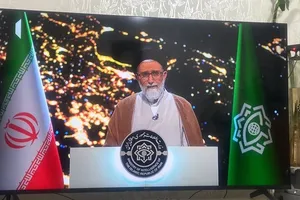
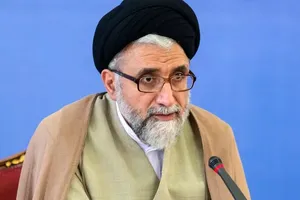
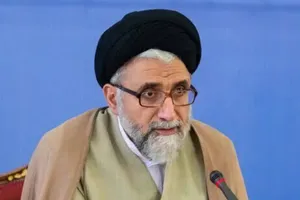
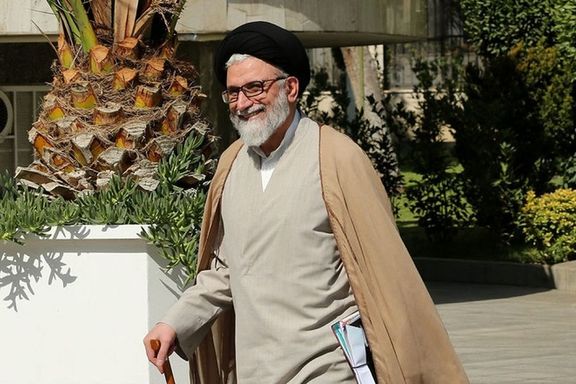
Esmail Khatib, killed in overnight strikes, mattered not because he ran spies but because he helped redraw the line between politics and security, turning dissent into an intelligence battlefield and recasting protest as hybrid war.

That was the frame Khatib laid out in a long interview published on Ali Khamenei’s website during the Woman, Life, Freedom uprising. It became more than rhetoric. It became a governing logic that collapsed protest, foreign media, activism and espionage into one threat map.

Khatib’s career made him unusually suited to that task.

Born in 1961 and trained in Qom, he rose through the Revolutionary Guards’ intelligence world, later ran the intelligence office in Qom, moved into the Supreme Leader’s protection orbit and then headed the judiciary’s protection and intelligence apparatus.

By the time Ebrahim Raisi made him intelligence minister in 2021, Khatib had passed through nearly every institution that mattered in the Islamic Republic’s coercive core: the Guards, the judiciary and the Supreme Leader’s household.

His retention in 2024 confirmed that his authority rested less on party politics than on trust from the system above elected government.

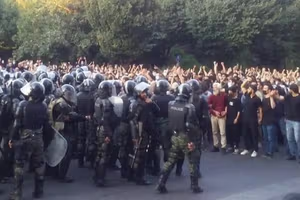
Under Khatib, the state increasingly treated social unrest as proof of foreign infiltration.

Protesters were not simply angry citizens. They were portrayed as nodes in an enemy network. Foreign-based Persian media were not just broadcasters. They were recast as operational arms of hostile states.

That logic also hardened into law.

Under his watch, the state broadened the definition of espionage and hostile collaboration, making it easier to turn contact, information-sharing, media work and loosely defined cooperation with enemy states or affiliated groups into national-security crimes.

The point was not only to punish spies. It was to widen the category of who could be treated like one.

The United States designated Khatib twice in September 2022, reflecting the breadth of his role across both overseas operations and domestic repression.

The Treasury first sanctioned him and the Intelligence Ministry over malicious cyber activity, including the disruption of Albanian government systems.

Later that month, it sanctioned him again, saying the ministry under his leadership had targeted human rights defenders, women’s rights activists, journalists, filmmakers and religious minorities, and had subjected detainees to torture in secret detention centers.

Years of the gallows

The intelligence ministry did not sign every death sentence. But the execution surge is still part of the meaning of Khatib’s tenure, because it formed the climate in which his security doctrine operated.

In the four full calendar years after he took office, Iran carried out at least 4,000 executions: about 580 in 2022, 830 in 2023, 975 in 2024 and 1,900 in 2025.

Those numbers belong formally to the judiciary and the prison system.

Politically, though, they sit inside the same larger story: a state that answered dissent, insecurity and social fracture with a heavier reliance on coercion, exemplary punishment and fear.

Operations beyond Iran

Khatib was also important beyond Iran’s borders. The ministry he led was accused by Western governments of directing cyber operations, targeting dissidents abroad and helping run the wider machinery of transnational repression.

His significance, though, was not that he was publicly tied to every individual plot.

It was that he sat atop a ministry that linked classic espionage, cyber activity, surveillance of exiles and operational cooperation with Iran’s other security arms.

In that sense he was less a field commander than a system manager, overseeing one part of Iran’s long war against opponents at home and abroad.

The glue

That coordinating role may be the most revealing part of his legacy.

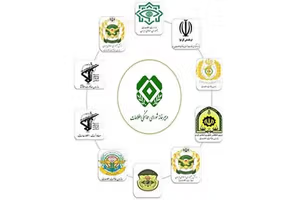
Iran’s intelligence world is fragmented. The Intelligence Ministry, the IRGC Intelligence Organization, the judiciary and the Leader’s office all have their own stakes, rivalries and chains of command.

Khatib’s value was that he could move across those worlds.

He came from the Guards’ intelligence culture, served in the Leader’s protection orbit, worked closely with the judiciary and then ran the ministry that was supposed to give the system a more unified picture of the threat environment.

After the 2022 uprising, that became even more important.

The Islamic Republic needed its rival security organs to act less like competing fiefdoms and more like a single architecture.

Khatib helped provide that common language, one in which protest, activism, foreign media, exile politics, sabotage and espionage could all be placed on the same continuum of danger.

That is why Khatib mattered. He mattered because he helped normalize a broader idea: that almost any challenge to the Islamic Republic could be reclassified as infiltration.

In the end, that was his real achievement for the system he served. He helped make dissent legible as intelligence warfare.

Most Viewed

US terminates green cards of 3 Iranians tied to Islamic Republic
1

US terminates green cards of 3 Iranians tied to Islamic Republic

2
PODCAST

Worst outcome is Islamic Republic’s survival, ex-CIA official says

3
ANALYSIS

Iran brings unusually broad team to US talks to blunt future blame

4
INSIGHT

Tehran sends tough message but keeps diplomacy door open

5

Zoroastrian religious figure arrested in Iran

Banner
Banner

Spotlight

  • Tehran sends tough message but keeps diplomacy door open
    INSIGHT

    Tehran sends tough message but keeps diplomacy door open

  • Worst outcome is Islamic Republic’s survival, ex-CIA official says
    PODCAST

    Worst outcome is Islamic Republic’s survival, ex-CIA official says

  • Why the Iran-US truce is more likely to buy time than peace
    ANALYSIS

    Why the Iran-US truce is more likely to buy time than peace

  • Engaged but uncommitted: China watches Iran and US fight and talk
    ANALYSIS

    Engaged but uncommitted: China watches Iran and US fight and talk

  • A truce for the world, a reckoning for Iran’s economy
    ANALYSIS

    A truce for the world, a reckoning for Iran’s economy

  • Why the world failed to bypass the Strait of Hormuz
    ANALYSIS

    Why the world failed to bypass the Strait of Hormuz

  • Proposed minister of intelligence in Iran: Who is Esmail Khatib?

    Proposed minister of intelligence in Iran: Who is Esmail Khatib?

  • Tehran set to implement law expanding death penalty to online offenses

    Tehran set to implement law expanding death penalty to online offenses

  • Tenfold rise in intelligence ministry's budget raises eyebrows in Iran

    Tenfold rise in intelligence ministry's budget raises eyebrows in Iran

  • Iran’s intelligence mocked by allies and foes over 'secret' Israel files

    Iran’s intelligence mocked by allies and foes over 'secret' Israel files

  • Islamic Republic Creating Yet Another Parallel Intel Agency

    Islamic Republic Creating Yet Another Parallel Intel Agency

  • Iran To Set Up A Fourth Major Intelligence Entity

    Iran To Set Up A Fourth Major Intelligence Entity

•
•
•

More Stories

Iranians defy crackdown at fire festival as Israel signals support

Mar 18, 2026, 11:15 GMT

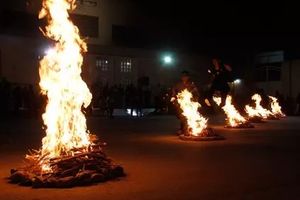
Iranians across many cities took to the streets late Tuesday to celebrate Chaharshanbe Suri, defying warnings and attempted crackdowns by security forces as the country remains under sustained military pressure.

Videos sent to Iran International showed crowds gathering in Tehran, Karaj, Shiraz, Mashhad and other cities, lighting fires, dancing and chanting slogans, including “Javid Shah,” in apparent response to calls by exiled prince Reza Pahlavi to mark the pre-Islamic festival despite restrictions.

In several locations, including Chitgar in western Tehran and parts of Karaj, security forces were seen attempting to disperse gatherings, with footage showing police vehicles approaching crowds.

  • Tehran warns of crackdown ahead of annual fire festival

    Tehran warns of crackdown ahead of annual fire festival

  • Iran braces for fire festival under shadow of war

    Iran braces for fire festival under shadow of war

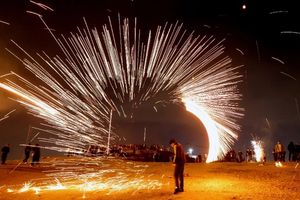
But the celebrations persisted, with people singing patriotic songs such as “Ey Iran” and setting off fireworks in residential neighborhoods and public spaces.

Chaharshanbe Suri, traditionally held on the eve of last Wednesday of the Iranian calendar year, has long been viewed with suspicion by the Islamic Republic.

In recent years it has increasingly become a flashpoint for anti-government expression, particularly during periods of unrest.

This year’s celebrations unfolded against the backdrop of ongoing conflict and heightened security pressure, with reports of surveillance and efforts by authorities to deter gatherings.

Israeli support

“An unprecedented event took place last night, as Israeli drones targeted Basij and police patrols attempting to approach celebration sites,” an Israeli official told Iran International.

“For the first time, the people of Iran benefited from active support that paralyzed the repression apparatus and effectively provided an ‘air umbrella’ for the crowds,” the official said.

Israeli Prime Minister Benjamin Netanyahu had earlier signaled support, saying in a video message that Israeli forces were targeting what he described as “terrorist operatives” to enable Iranians to celebrate.

“Our aircraft are striking terrorist elements in city squares and intersections to allow the brave people of Iran to celebrate the fire festival,” he said. “Celebrate. Happy Nowruz. We are watching from above.”

Iran executes Swedish citizen accused of spying for Israel, judiciary says

Mar 18, 2026, 08:17 GMT

Iran has executed a Swedish-Iranian man identified as Kourosh Keyvani after convicting him of espionage for Israel, according to reports by the judiciary-linked Mizan news agency.

Mizan said Keyvani was executed on Wednesday morning after his death sentence was upheld by the Supreme Court. He had been accused of passing “images and information of sensitive locations” to officers of Israel’s Mossad intelligence agency.

The report said Keyvani was arrested in Savojbolagh on the fourth day of the 12-day war in June. Authorities said the case had gone through legal procedures, but no independent evidence supporting the allegations was made public.

Later in the day, Swedish Foreign Minister Maria Malmer Stenergard said in a statement that a Swedish citizen was executed in Iran without naming him. However, it confirmed that the person was arrested in June.

The legal proceedings leading up to the execution did not meet the standards of due process, she added.

  • Sweden summons Iran envoy amid reports citizen faces death sentence

    Sweden summons Iran envoy amid reports citizen faces death sentence

The semi-official Tasnim news agency said Keyvani had been detained by the Revolutionary Guards’ intelligence arm and was found with cash, vehicles and what it described as advanced communication and surveillance equipment.

Tasnim also reported that he had allegedly been recruited through online contact and trained abroad before returning to Iran, though these claims could not be independently verified.

Keyvani is the latest in a series of executions in Iran involving individuals accused of espionage for Israel, particularly since the outbreak of the June war.

Iran has one of the highest execution rates in the world and has long used the death penalty in national security cases, including allegations of spying. Following the conflict, rights groups and international media have reported a sharp increase in arrests and executions on such charges.

The Telegraph reported that executions in Iran have surged since the June war, citing data from human rights group HRANA indicating that the number of executions has risen significantly, including for those accused of links to Israel. The Sunday Times has also reported that dozens more people could face execution on similar charges.

War and hardship dampen Nowruz mood in Iran

Mar 17, 2026, 21:29 GMT
•
Hooman Abedi

Nowruz is approaching with far less of its usual energy across Iran this year, as many families abandon long-standing New Year preparations while war, economic strain and an atmosphere of uncertainty dampen the festive mood.

Several Iranians told Iran International that familiar rituals that normally fill homes with activity in the weeks before the holiday have stalled.

“This year we did nothing,” Leila, a 38-year-old resident of Tehran, told Iran International. “We didn’t wash carpets and we didn’t do the house cleaning. Every year I would start from early February, but this year we are just looking at the sky, waiting for the fall of this regime.”

Nowruz, the Persian New Year marking the arrival of spring, has been celebrated for more than 3,000 years across Iran and parts of Central Asia and the Middle East.

The holiday usually falls on March 20 or 21 and begins nearly two weeks of family visits, meals and gatherings.

An Iranian person washes a carpet during traditional spring cleaning, known as khaneh-Tekani, ahead of the Nowruz new year celebrations.
100%
An Iranian person washes a carpet during traditional spring cleaning, known as khaneh-Tekani, ahead of the Nowruz new year celebrations.

‘Shaking the house’

In most years, the weeks before Nowruz transform daily life across Iran. Families traditionally begin with Khaneh Tekaani, a deep spring cleaning whose name literally means “shaking the house.” Carpets are washed, cupboards reorganized and homes refreshed to symbolically welcome the new year.

Another essential ritual is planting Sabzeh — dishes of sprouting wheat, lentils or barley that represent renewal and rebirth and are later placed on the Haft-Seen table, the centerpiece of the celebration alongside candles, colored eggs, a mirror and often a red goldfish.

But this year, some residents say even modest traditions feel out of reach.

“Planting Sabzeh is something we Iranians do every year, but this year with all the news about war we completely forgot about it. God damn the Islamic Republic for ruining everything,” Kamran, a 42-year-old office worker in Hamedan, told Iran International.

An Iranian man installs curtains at home as part of preparations ahead of the Nowruz new year celebrations.
100%
An Iranian man installs curtains at home as part of preparations ahead of the Nowruz new year celebrations.

‘No money, no mood’

Markets that normally bustle in the run-up to Nowruz — with families buying sweets for visiting relatives, decorative items for Haft-Seen tables and new clothes for children — have also been quieter this year, residents say.

Some cite the worsening economic situation as a key reason holiday traditions have faded.

“Every year despite inflation we bought at least a few things,” said Golnaz, a 35-year-old shop owner in Karaj. “But this year we had neither the money nor the mood. We are waiting for that final moment.”

Golnaz described how rising prices have weighed heavily on households and small businesses.

“Even if we wanted to prepare and had the energy, prices are so high we simply cannot afford it. Everything has become several times more expensive. I run a small cosmetics shop and this month I have not even earned the rent for the store,” she said.

Her husband, who drives for a ride-hailing service, is working less frequently amid fears of bombings and falling demand as more people stay home.

People look at goldfish displayed for sale at a street market ahead of Nowruz celebrations in Tehran.
100%
People look at goldfish displayed for sale at a street market ahead of Nowruz celebrations in Tehran.

‘No ordinary time’

On social media, many Iranians say the emotional tone of the season has shifted sharply compared with previous years.

“If things were normal, I should be excited for next week and finishing my preparations. The scent of night-blooming flowers would be filling the house and the holiday sweets would already be in the refrigerator,” one user wrote.

Another reflected on the contrast with childhood memories: “What burns me is that it is the New Year season. People should now have the mood of buying for the holiday and welcoming the new year in Iran. I remember how excited I was as a child. But those feelings slowly died inside me.”

For generations, the approach of Nowruz has filled Iranian homes with cleaning, cooking and preparations symbolizing renewal. This year, residents say those rituals — once a nationwide signal of spring’s arrival — have been overshadowed by war, rising prices and uncertainty about what the new year will bring.

A traditional Haft-Seen table is arranged at a home ahead of Nowruz, the Persian New Year.
100%
A traditional Haft-Seen table is arranged at a home ahead of Nowruz, the Persian New Year.

What Larijani’s killing means for Iran’s power structure

Mar 17, 2026, 19:32 GMT
•
Shahram Kholdi

The Israeli killing of Ali Larijani marks another blow to the Islamic Republic’s capacity for coordination, weakening an already fragmented system and raising the risk of miscalculation under pressure.

Iran confirmed on Tuesday that Larijani—Secretary of the Supreme National Security Council and one of the regime’s central security coordinators— was killed in a morning strike on Tehran.

The strike inevitably recalls the killing of Qassem Soleimani in 2020: another precise removal of a figure who linked diplomacy, intelligence and military power.

Soleimani’s death did more than eliminate a commander. It weakened the regime’s ability to calibrate risk. Radical in purpose, cautious in execution, he pushed proxies forward without inviting existential retaliation.

His absence left a gap no successor fully filled. Coordination frayed, misjudgments mounted and responses grew less predictable. The network endured, but its timing became erratic and its restraint thinner.

Larijani’s role must be understood against that backdrop.

According to a source cited by Christiane Amanpour, Larijani had, as recently as September 2025, been viewed in some Western and Israeli assessments as a potentially acceptable transitional figure before becoming a target by early February 2026.

The account attributes the shift to his role in pressing for domestic crackdowns, adopting a more confrontational posture toward the United States and Israel and assuming a central role in shaping IRGC military operations.

The claims remain unverified but highlight how Larijani straddled internal consolidation and external escalation at a moment of acute pressure.

His career began during the Iran-Iraq War, where he rose within the Islamic Revolutionary Guard Corps to brigadier general, later serving as Speaker of Parliament (2008–2020), where he advanced a hard-line agenda aligned with the consolidation of power in the Office of the Supreme Leader.

In the years that followed, he moved from battlefield to bureaucracy, helping consolidate the regime’s coercive and ideological infrastructure.

As head of Islamic Republic of Iran Broadcasting (1994–2004), Larijani oversaw more than a media organization. The state broadcaster worked closely with the intelligence services and the IRGC, shaping narratives that reinforced loyalty and narrowed the space for dissent.

The 1996 Hoviyyat (Identity) series publicly branded intellectuals and professionals as traitors, airing coerced confessions and drawing sharp limits around permissible thought. At the same time, official memory of the Iran-Iraq War was recast into doctrine: martyrdom elevated, endurance framed as victory.

Over time, this messaging helped consolidate a narrower but more disciplined base embedded across Basij and IRGC networks. Its purpose was not persuasion but enforcement: to secure the regime against a broader, often unwilling society.

That framework endured. It underpinned repression during the 2009 Green Movement, resurfaced during the Woman, Life, Freedom protests in 2022 and shaped the violence of January 2026.

Beyond Iran, the same logic informed Hezbollah’s campaign in Syria, Hamas operations culminating in October 7 and the IRGC’s maritime doctrine of asymmetric pressure.

Despite tensions within the political elite, Larijani remained firmly inside the core leadership. Loyal and disciplined, he embodied continuity across institutions.

Following the death of Supreme Leader Ali Khamenei in the February 28 strike that opened the current phase of war, Larijani’s experience and connections positioned him as a potential stabilizing figure.

His 2025 reappointment as Iran’s security chief reinforced that role. From there he coordinated nuclear policy, crisis management and relations among the regime’s core institutions.

Larijani’s removal would introduce immediate disruption: friction in command and pressure for retaliation. The deeper consequence may be fragmentation.

The Islamic Republic now operates less as a unified state than as a dispersed system under sustained pressure from Israel and the United States. Authority increasingly runs through provincial clerical networks, IRGC commanders and Basij structures. Resources are mobilized locally, repression enforced locally and survival managed locally.

Larijani belonged to the shrinking circle still capable of linking these fragments to a central command. His loss risks accelerating the incoherence the system is already struggling to contain.

Soleimani’s precedent is instructive: decapitation weakens coordination and invites miscalculation, even as the structure endures.

Missile infrastructure remains dispersed across hardened and subterranean sites. Fast naval craft and unmanned vessels continue to threaten shipping in the Strait of Hormuz. Proxy militias operate through channels designed to outlast leadership losses.

What appears as resilience may instead reflect dispersal without coordination — a system that survives but no longer acts as one.

Larijani’s killing tests not only the state’s durability but its capacity to function as a coherent force under sustained pressure. The war may not bring immediate collapse. But without figures such as Soleimani and Larijani, adaptation may hasten, rather than forestall, its demise.

Tehran warns of crackdown ahead of annual fire festival

Mar 17, 2026, 15:50 GMT
•
Maryam Sinaiee

Authorities in Tehran have issued sweeping warnings ahead of Iran’s annual fire festival, Chaharshanbeh Suri, framing the centuries-old celebration as a potential flashpoint for unrest during wartime.

The festival has long been a source of friction between the public and the state, but this year officials appear particularly concerned amid U.S.-Israeli strikes and fresh calls for mass participation, including appeals this week from exiled Prince Reza Pahlavi.

Judicial and security bodies have sent text messages directly to citizens. One such message, reportedly from a provincial justice department, warned that any “noise, commotion or unconventional behaviour” that disrupts public order could result in punishments including imprisonment and flogging.

On Tuesday, chief justice Gholam-Hossein Mohseni-Ejei warned dissenters and repeated orders to confiscate the assets of those deemed “collaborators with the enemy,” again raising the possibility of capital punishment.

“We warn all elements who intend to threaten public security that if they act, they will face firm legal action, and there will be no leniency,” he said.

The Revolutionary Guards (IRGC) spokesman, Brigadier General Ali-Mohammad Naeini, used even sharper language, describing the day as a “Charshanbeh of burning enemies.”

He vowed that attacks on Israel and U.S. bases in the region would intensify while “symbols of monarchists, separatist terrorists and mercenaries inside the country” would be set ablaze.

Ahmad-Reza Radan, Iran’s police commander, appeared Monday at a pro-establishment gathering in Tehran and urged supporters “not to leave the arena” to the opposition, calling the night “a decisive night” for the state.

Marked by bonfires, fireworks and rituals rooted in pre-Islamic traditions, Charshanbeh Suri has frequently drawn official scrutiny since the 1979 revolution, with clerical leaders often dismissing it as incompatible with religious norms.

Despite repeated enforcement efforts involving police, paramilitary Basij forces and vigilante groups, the celebration has persisted.

Restrictions have also altered how the festival is observed: traditional practices such as jumping over small fires and spoon-banging at doors have, over time, given way in many areas to the use of homemade explosives, often resulting in injuries and property damage.

In recent years — especially following the 2022–23 “Woman, Life, Freedom” protests — the festival has taken on a more overtly political dimension, with young people chanting slogans and at times confronting security forces with firecrackers and improvised devices.

The wave of warnings followed messages by Iran’s exiled Prince Reza Pahlavi in recent days addressed to Iranians and the “international community and friends of Iran.”

He urged citizens to celebrate Charshanbeh Suri in “alleys and neighborhoods across the country” and called on global observers to keep their eyes on Iran and “not to allow the regime to use violence against the people determined to celebrate life, light and hope in the face of darkness.”

In a separate message, he directly urged Donald Trump and Benjamin Netanyahu to closely monitor developments on the night of the festival.

In a further video message posted Tuesday, he urged Iranians to avoid confrontation with government forces while warning security personnel to leave people in peace.

“These malevolent agents intend to drag your festival of light, purity and life into darkness, filth and death. Do not give them this opportunity,” he said.

Online reactions suggest the calls for participation are resonating with some younger Iranians, who frame the festival as both a national tradition and a symbol of resistance.

One user wrote that holding Charshanbeh Suri this year would mean “turning a national ritual into a symbol of standing against the regime and honoring those who gave their lives for the homeland.”

Another post declared: “Tomorrow night we will witness the largest Charshanbeh Suri in Iran’s history. I dare you to touch even a hair on the heads of our compatriots.”