• العربية
  • فارسی
Brand
  • Iran Insight
  • Politics
  • Economy
  • Analysis
  • Special Report
  • Opinion
  • Podcast
  • Iran Insight
  • Politics
  • Economy
  • Analysis
  • Special Report
  • Opinion
  • Podcast
  • Theme
  • Language
    • العربية
    • فارسی
  • Iran Insight
  • Politics
  • Economy
  • Analysis
  • Special Report
  • Opinion
  • Podcast
All rights reserved for Volant Media UK Limited
volant media logo

Iran turns to citizenship and assets as tools of pressure beyond its borders

Niloufar Goudarzi
Niloufar Goudarzi

Iran International

Apr 23, 2026, 12:14 GMT+1
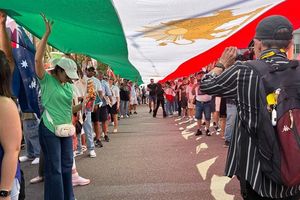
Demonstrators march toward the Iranian embassy in London during a rally supporting nationwide protests in Iran, Jan, 2026.

The Islamic Republic is escalating its campaign against the diaspora, moving beyond domestic seizures to explore the confiscation of assets held by Iranians in foreign countries and possible revocation of their citizenship.

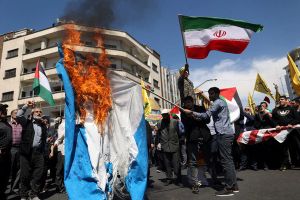
The move follows a period of intense pressure on the establishment. Hundreds of thousands of Iranians took to the streets globally to protest the government following a mass killing of protesters in January.

Tehran, currently facing a severe economic crisis and the rising costs of war, appears to be targeting the financial and legal identities of those it labels as "enemy collaborators."

Pursuing assets across borders

In a significant escalation of rhetoric, the Chief Justice of Ilam Province told the judiciary-linked Mizan news agency on Thursday that officials are examining the legal dimensions of "confiscating the property" of Iranians abroad within their countries of residence.

While the state has already begun identifying and freezing assets within Iran, this official called for international judicial mechanisms to target property held in the West. "Generally, the legal possibility for these actions exists," he said, adding that success would depend on "legal coordination with the country where the assets are located."

This follows a directive from Gholam-Hossein Mohseni-Ejei, the head of the Judiciary, to accelerate the seizure of property belonging to those linked to "overseas services and subversive networks."

By framing political dissent as "material support for hostility," a cash-strapped Tehran is attempting to create a legal pretext to pursue the private wealth of its citizens globally.

Citizenship as a political tool

In addition to financial threats, some officials are calling for the removal of the most basic legal tie between the state and the diaspora: Iranian citizenship.

Hassanali Akhlaghi Amiri, a member of parliament from Mashhad, said earlier this month that cooperation with "hostile countries" should lead to the revocation of a person's national identity.

"The punishment for cooperating with hostile countries against national security and interests begins with the confiscation of property and may even include the revocation of citizenship," Akhlaghi Amiri said.

The suggestion has sparked a heated debate within Iran. The moderate outlet Rouydad24 argued that the constitution treats citizenship as an absolute right that cannot be taken away.

The outlet warned that treating a national identity as a "revocable privilege" to be traded for political loyalty is a dangerous shift that makes the law a matter of "personal taste."

'Stray' citizens: Deprivation of consular services

While the legal debate over formal revocation continues, many Iranians abroad are already experiencing a de facto loss of citizenship through the denial of consular services.

Maryam Ebrahimvand, an independent filmmaker and activist also known as Maryam Taher, recently said that the Iranian consulate in Paris has repeatedly informed her that her "citizenship has issues." Ebrahimvand said that her identity documents were previously seized and have not been returned.

"For the third time, they verbally told me my citizenship is problematic," Ebrahimvand said in a video message. "When they say my citizenship has a problem, it means I have been stripped of it... I have no passport from any country. I am in a state of statelessness."

A globalized crackdown

The escalation comes as the government faces unprecedented opposition from the diaspora. Since the January massacre, massive rallies in cities across Europe and North America have drawn millions of people, marking the largest Iranian opposition movement in decades.

Authorities in Tehran have also alluded to the stance some members of the diaspora have taken regarding the recent military conflict with the US and Israel.

While the topic is delicate, officials have increasingly used "wartime protocols" to justify harsher punishments for those they accuse of siding with foreign adversaries during a time of crisis.

By threatening to seize assets, withholding consular services, and discussing the formal cancellation of passports, the government is attempting to create a climate of fear for protesters who previously felt safe beyond Iran’s borders.

These measures signal a government that no longer sees its people as citizens with rights, but as assets to be seized or enemies to be erased.

Most Viewed

IRGC-linked media hints at threat to Persian Gulf undersea internet cables
1

IRGC-linked media hints at threat to Persian Gulf undersea internet cables

2

Iran Guards say two ships seized in Hormuz after ceasefire extension

3
EXCLUSIVE

Strikes on petrochemical hubs leave Iran short of plastics

4
INSIGHT

War or economic collapse: can Iran withstand the pressure?

5

Iran executes former atomic agency employee over alleged spying for Israel

Banner
Banner

Spotlight

  • Tehran stocks head for reopening, but it risks triggering a new crisis
    ANALYSIS

    Tehran stocks head for reopening, but it risks triggering a new crisis

  • Power vacuum in Tehran emboldens hardliners
    INSIGHT

    Power vacuum in Tehran emboldens hardliners

  • Inflation spikes, basic goods slip out of reach for Iranians, citizens say
    VOICES FROM IRAN

    Inflation spikes, basic goods slip out of reach for Iranians, citizens say

  • Iran turns to citizenship and assets as tools of pressure beyond its borders

    Iran turns to citizenship and assets as tools of pressure beyond its borders

  • Who backs war now? Tehran flips the script
    INSIGHT

    Who backs war now? Tehran flips the script

  • As Tehran digs in, ordinary Iranians pay the price
    INSIGHT

    As Tehran digs in, ordinary Iranians pay the price

  • Over a million people rally worldwide in solidarity with Iran protests

    Over a million people rally worldwide in solidarity with Iran protests

  • Iran watchdog clears tougher espionage law targeting Israel, US cooperation

    Iran watchdog clears tougher espionage law targeting Israel, US cooperation

  • Iran warns it will seize assets of overseas Iranians working against state

    Iran warns it will seize assets of overseas Iranians working against state

•
•
•

More Stories

Exiled prince dismisses Iran negotiators as part of repression system

Apr 23, 2026, 09:57 GMT+1

The Islamic Republic’s negotiators in talks with the US are “different faces of the same machine,” that suppresses the Iranian people, exiled Prince Reza Pahlavi said at a press conference in Berlin on Thursday.

“They are not pragmatists; they are not reformers,” he said, referring to lead negotiator Mohammad Bagher Ghalibaf and Foreign Minister Abbas Araghchi during his speech at the Haus der Bundespressekonferenz. “Neither are the IRGC killers behind the curtains.”

Pahlavi was in Berlin for meetings with German lawmakers and members of the press as part of a European trip focused on Iran’s political future.

The Iranian prince warned that continued rule by the Islamic Republic would lead to further conflict in the region as the authorities will continue to pose threats to the people, the region, and beyond as long as they remain in power.

“For 47 years, the world has known Iran through the actions of a regime that took a great nation hostage,” Pahlavi said. “No deal will solve this. No negotiations will solve this. It is in their DNA.”

‘Choosing free Iran over a dying regime’

Pahlavi further addressed Europe, saying it faces a choice between the current Iranian system and a free Iran that could become a partner for stability.

“The choice before Europe is not between war and peace. It is between a dying regime that endangers us all and a free Iran that can become a partner for stability,” he said.

The Iranian prince urged European authorities to seek “a new course” in dealing with Tehran, or keep facing “constant blackmail” from the Islamic Republic.

“European governments must stop appeasing this regime. Expel regime ambassadors, refuse to legitimize any arrangements that preserve the IRGC-centered power structure and prepare to recognize the transitional government when it is announced,” he said, addressing European powers.

‘Iranians don’t want to see regime legitimized’

Pahlavi referred to nationwide protests in Iran, saying the Iranian people demand world countries refrain from strengthening or legitimizing a government that terrorizes the nation.

“The Iranian people are not asking us to fight their revolution. They are already doing that, and with a courage that should humble all of us,” he said. “They are asking something far more modest: do not legitimize those who oppress them. Do not strengthen those who terrorize them.”

He said it was time for the world to “catch up with their courage,” noting that the international community’s contribution to their struggle could help bring about an end to the government's violence.

“If you stand with us, if you act in honor of those 40,000 innocent protesters, you will save lives, you will stop the flow of blood,” he said.

Pahlavi also touched upon the Iran war, saying the destruction of governmental infrastructure employed in suppressing dissent, could potentially facilitate protests aimed at subverting the government.

“The air cover campaign that included hitting the regime infrastructure and apparatus of repression was a necessary step to equalize the playing field for the Iranians who were getting massacred on the streets defenseless, by a regime that used military weapons to hit them on the streets,” Pahlavi said.

He argued that a democratic transition in Iran could reduce regional tensions and open the way for broader economic cooperation.

“A free Iran would be a stabilizing anchor for the entire Middle East, ending the proxy wars that have ravaged Lebanon, Yemen, Iraq, and Syria, and becoming a partner for regional economic integration,” Pahlavi said.

Internet Pro or Censor Pro? Iran rolls out a new service

Apr 22, 2026, 16:10 GMT+1
•
Negar Mojtahedi

Iran’s new “Internet Pro” rollout may tighten state control in the short term, but experts who spoke to Iran International question whether the Islamic Republic can sustain a class-based internet in one of the Middle East’s most connected societies.

Tens of millions of Iranians have been cut off from the rest of the globe since US-Israeli strikes began on Feb. 28. It has been described as the world’s longest state-imposed internet blackout to date.

Under the new plan, approved by Iran’s Supreme National Security Council, selected businesses and institutions would regain global internet access while much of the public remains restricted.

The rollout would begin with commercial card holders and later expand to sectors tied to production, industry and trade, according to officials, who present the measure as economic management.

Critics see something larger: the formalization of a two-tier digital system. Those fears have intensified after leaked material circulated in recent days suggested authorities were considering more permanent restrictions.

Iran International has not independently verified the documents.

‘War as excuse’

Neda Bolourchi, executive director of the Public Affairs Alliance of Iranian Americans, said the announcement appears less like an emergency wartime measure than the rollout of a long-prepared policy.

“What we can understand is that this has been a multi-year project,” she told Iran International. “That the war has given it the excuse to roll it out.”

She added that she does not expect a quick return even to the limited internet environment that existed before the latest shutdowns.

But Amin Sabeti, the London-based founder of CERTFA, a cybersecurity lab focused on cyberattacks linked to Iran, questioned whether Tehran could maintain such a model for long.

“They are trying to implement it, but the big question mark for me is how long they can carry on,” he told Iran International. “I don’t think they can continue the next six months as it is.”

Sabeti argued that wartime conditions may allow governments to impose extraordinary restrictions, but Iran is not North Korea and cannot easily be transformed into one.”

‘The Gen Z problem’

The economic consequences are already mounting.

For millions of Iranians, Instagram, Telegram and WhatsApp are not luxuries. They are storefronts, classrooms, advertising platforms and lifelines to clients abroad.

Bolourchi warned that while the model may be sustainable for the state, it could be punishing for ordinary households, many of whom make their living online.

Sabeti noted that this would carry political risks for the ruling elite.

“If you offer it to the Iranian people—internet, Instagram, XYZ—and suddenly you want to take it away, that’s the level of the anger. We will see huge protests,” Sabeti said.

Holly Dagres, a senior fellow at The Washington Institute who focuses on Iranian society, Gen Z and social media, said the blackout cannot be separated from the Islamic Republic’s broader information war.

“The reason they are basically not allowing Iranians access to the outside world is because the internet and social media is the only way for their voices to be heard,” Dagres said.

She also stressed that the economic damage has been particularly severe for entrepreneurs, women-led businesses and rural sellers who depend on social media income streams.

Tightening control

The system may also deepen surveillance.

Even if Iran does not become a replica of North Korea, a permission-based internet would still mean more monitoring and greater pressure on citizens to censor themselves.

Dagres argued that the government may be trying to normalize the blackout through small concessions while preserving overall control.

Direct-to-cell technology, which could one day allow ordinary smartphones to connect directly to satellites without dishes or ground terminals, is still not meaningfully available in Iran and remains more promise than practical solution.

For Tehran, “Internet Pro” may solve one immediate problem: how to keep strategic sectors online while limiting the wider public. In doing so, it may create another.

Iran is a country where tens of millions have built livelihoods, relationships and daily routines online. Restricting that access while rewarding approved groups may tighten control today, but deepen resentment tomorrow.

Iran Guards say two ships seized in Hormuz after ceasefire extension

Apr 22, 2026, 10:30 GMT+1

Iran’s Islamic Revolutionary Guard Corps Navy said it had seized two vessels in the Strait of Hormuz and directed them toward Iranian shores, hours after Donald Trump said the United States would extend a ceasefire with Iran.

In a statement, the Guards said the vessels, identified as MSC Francesca and Epaminodes, had violated maritime regulations and endangered navigation by manipulating their tracking systems.

It said the ships were detained and escorted to Iran’s coast, adding that disruption to security in the Strait of Hormuz was a “red line,” referring to the US blockade of Iranian ports.

Vessels under fire

The United Kingdom Maritime Trade Operations (UKMTO) said earlier on Wednesday that two cargo vessels were fired upon in separate incidents in the strait.

It said a container ship northeast of Oman reported being approached by an IRGC gunboat, which opened fire without radio contact, causing heavy damage to the vessel’s bridge. All crew were safe and no fire or environmental impact was reported.

In a separate incident west of Iran, an outbound cargo ship reported being fired upon and had stopped in the water. Its crew were safe and there was no reported damage, UKMTO said.

The IRGC-affiliated Fars News Agency said three vessels — Euphoria, MSC Francesca and Epaminodes — were targeted.

Trump said on Tuesday he would extend a fragile ceasefire with Iran indefinitely, even as plans for new talks stalled.

The incidents come amid heightened tensions in the Strait of Hormuz, a key global shipping route that previously handled about one-fifth of the world’s oil and gas flows.

Iran executes former atomic agency employee over alleged spying for Israel

Apr 22, 2026, 08:21 GMT+1

Iran executed a man early on Wednesday after convicting him of spying for Israel, with the judiciary identifying him as Mehdi Farid and saying he had worked at a “sensitive organization” and maintained online contact with Mossad officers.

It said Farid headed a non-military defense management committee at one of the country’s sensitive organizations, without naming it, and had shared information including organizational structures, security arrangements and infrastructure.

Rights groups had earlier said Farid was arrested in 2023 and had been working at the Atomic Energy Organization of Iran. They said he was first held in Tehran’s Greater Tehran prison before being transferred to Evin prison.

Iran Human Rights had reported last year that he was “initially sentenced to 10 years in prison” and, after a retrial, “sentenced to death on charges of spying for Israel.”

The judiciary said Farid had connected internal servers to infected files on instructions from a Mossad officer and enabled outside access to systems using USB devices.

It added that Farid confessed during the case process to transferring information and had been promised payment and help to leave the country.

Rights groups have raised concerns about the use of forced confessions and due process in Iran.

  • Iran family says executed nuclear scientist confessed after threats to mother

    Iran family says executed nuclear scientist confessed after threats to mother

  • Iran executes nuclear engineer accused of spying for Israel - rights group

    Iran executes nuclear engineer accused of spying for Israel - rights group

Atomic-linked executions

Iran has carried out several executions in recent months in cases tied to its nuclear sector and alleged links to Israel.

In October, rights group Hengaw said Iran executed Javad Naeimi, described as a nuclear engineer working at the Natanz facility, after convicting him of spying for Israel.

The group said he was hanged in Qom Central Prison and that the execution was carried out in secrecy. Iranian state media reported the execution of a man on espionage charges at the time but did not identify him.

Hengaw said Naeimi had been arrested in February 2024 and sentenced to death after what it described as an opaque judicial process, adding that he was subjected to torture and coerced confessions during interrogation.

In August, Iran executed nuclear scientist Rouzbeh Vadi on similar charges. The judiciary said he had been recruited by Mossad and transferred classified information.

A relative told Iran International that Vadi confessed only after severe torture and threats against his mother, and said the case relied on a televised confession. Rights groups have long raised concerns about the use of forced confessions in such cases.

Following heightened tensions with Israel and the US, Iranian authorities have stepped up arrests, trials and executions in espionage cases, drawing criticism from rights groups and UN experts over due process.

Family told missing teen was alive, then received his body 60 days later

Apr 21, 2026, 12:33 GMT+1
•
Farnoosh Faraji

A 14-year-old student disappeared during protests near Tehran on January 8, only for his family to receive his body 60 days later with a gunshot wound to the temple, Iran International has learned.

Amir-Mohammad Shahkarami, an eighth-grade student, vanished as security forces suppressed demonstrations in Shahre Qods, located west of Tehran. For two months, his family faced a series of conflicting reports from Iranian authorities regarding his safety.

On January 10, two days after he went missing, the boy's mobile phone was turned on. Government agents used the device to contact the family and tell them he was alive. Officials at the local judiciary later supported this account, telling the parents that the teenager was in custody and that a court had already issued a sentence against him.

The family also tried to find information through the Department of Education, but officials there labeled his file as "confidential" and refused to speak.

A 'finish-off' shot

After 60 days of silence, forensic officials finally called the family to identify a body. The body of the 14-year-old was delivered to the family.

When the family examined the body, they found a gunshot wound to the temple, a type of injury often described by rights groups as a "finish-off" shot. Large bruises also covered his chest and side.

Patterns of deception

The teenager’s death highlights the uncertainty facing many families of young detainees who disappeared during the January protests. Despite the assurances given to his parents in the weeks following his disappearance, the physical evidence on his body pointed to a violent death.

Rights groups have documented cases where Iranian authorities provide families with false information about the health or legal status of detained relatives to delay public reporting or to manage the fallout of deaths in custody.

The Iranian government has not explained why various state agencies told the family the boy was alive and sentenced while he was either already dead or facing terminal abuse in custody.