• العربية
  • فارسی
Brand
  • Iran Insight
  • Politics
  • Economy
  • Analysis
  • Special Report
  • Opinion
  • Podcast
  • Iran Insight
  • Politics
  • Economy
  • Analysis
  • Special Report
  • Opinion
  • Podcast
  • Theme
  • Language
    • العربية
    • فارسی
  • Iran Insight
  • Politics
  • Economy
  • Analysis
  • Special Report
  • Opinion
  • Podcast
All rights reserved for Volant Media UK Limited
volant media logo

Hope for US–Iran talks shaken by drones, gunboats and new demands

Feb 3, 2026, 21:16 GMT+0
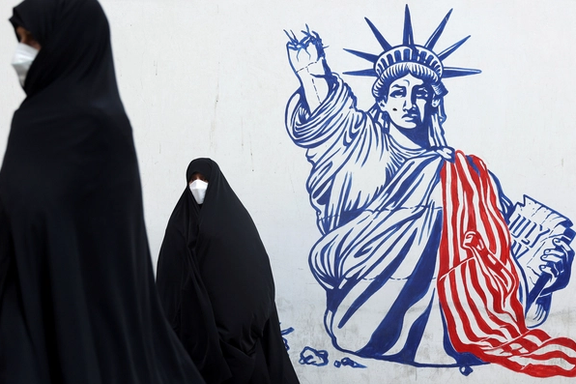
A mural on the former US embassy building in Tehran

Monday’s cautious optimism about renewed US–Iran diplomacy took several blows on Tuesday, as Tehran reportedly signaled fresh conditions for talks and Iranian and American forces clashed at sea.

US officials said American forces shot down an Iranian drone after it approached a US Navy aircraft carrier in the Arabian Sea, and later intervened when armed Iranian boats harassed a US-flagged merchant vessel transiting the Strait of Hormuz.

The incidents underscored the fragility of a diplomatic process that Washington and Tehran had suggested was back on track only a day earlier.

Iran’s foreign ministry sought to downplay growing uncertainty around talks expected later this week, saying discussions over the venue and timing were ongoing and should not be “turned into a media issue.”

Esmail Baghaei, the ministry’s spokesman, said Turkey, Oman and other regional countries had offered to host the talks, and thanked “friendly countries” for helping create conditions for diplomacy.

“In principle, the venue and timing of talks are not complicated issues and should not be used as a pretext for media games,” Baghaei said, adding that details would be announced once finalized.

Behind the scenes, however, Iranian officials appeared to be revisiting earlier understandings. Reuters and Axios reported that Tehran was seeking to move the talks from Istanbul to Oman and to limit discussions strictly to the nuclear file, excluding missiles and support for regional armed groups—issues that Washington and regional allies have said must be addressed.

Axios cited informed sources saying Iran was “walking back” agreements reached in recent days after other countries had already been invited to participate.

The Wall Street Journal reported that Iranian officials had also threatened to pull out of talks altogether, though it was not immediately clear what prompted the warning.

At sea, the confrontations continued. US Central Command said Iranian Revolutionary Guard forces harassed a US-flagged, US-crewed merchant vessel in the Strait of Hormuz, while a US fighter jet downed an Iranian drone that had approached a carrier strike group.

Iranian state-linked media said the drone was conducting a “routine and lawful mission” in international waters and that data had been transmitted successfully before contact was lost.

White House press secretary Karoline Leavitt said talks with US envoy Steve Witkoff were still scheduled, but stressed that military options remained on the table. “For diplomacy to work, of course, it takes two to tango,” she said.

Israeli Prime Minister Benjamin Netanyahu struck a harsher note, saying Iran “has repeatedly proven it cannot be trusted to keep its promises.”

Most Viewed

100 days after carnage: Iran economy reels from war, inflation, unemployment
1
INSIGHT

100 days after carnage: Iran economy reels from war, inflation, unemployment

2
INSIGHT

Ghalibaf defends Iran-US talks amid hardline backlash

3
INSIGHT

A nation in limbo: 100 days after the massacre, has the world moved on?

4
ANALYSIS

From instability to influence: Pakistan’s pivotal role in US-Iran diplomacy

5
ANALYSIS

100 days on: why Iran’s January protests spread across social classes

Banner
Banner

Spotlight

  • War-hit homeowners feel abandoned as Iran’s reconstruction aid fades

    War-hit homeowners feel abandoned as Iran’s reconstruction aid fades

  • 100 days on: the anatomy of Iran’s January crackdown
    INSIGHT

    100 days on: the anatomy of Iran’s January crackdown

  • Ghalibaf defends Iran-US talks amid hardline backlash
    INSIGHT

    Ghalibaf defends Iran-US talks amid hardline backlash

  • 100 days on: why Iran’s January protests spread across social classes
    ANALYSIS

    100 days on: why Iran’s January protests spread across social classes

  • From instability to influence: Pakistan’s pivotal role in US-Iran diplomacy
    ANALYSIS

    From instability to influence: Pakistan’s pivotal role in US-Iran diplomacy

  • A nation in limbo: 100 days after the massacre, has the world moved on?
    INSIGHT

    A nation in limbo: 100 days after the massacre, has the world moved on?

•
•
•

More Stories

Tehran and Washington test the limits of talks without trust

Feb 3, 2026, 20:04 GMT+0
•
Shahram Kholdi

The reappearance of diplomacy between Washington and Tehran is being shadowed by limited but dangerous military showdowns, revealing how narrow the space for negotiation has become in the absence of trust.

As talks expected later this week faltered over venue and format,tensions in the Persian Gulf continued to rise.

On Tuesday, US forces shot down an Iranian Shahed-139 drone approaching a US aircraft carrier in the Arabian Sea, while armed Iranian boats attempted to stop a US-flagged oil tanker in the Strait of Hormuz.

White House spokeswoman Karoline Leavitt said hours later that talks between US envoy Steve Witkoff and Iran’s foreign minister Abbas Araghchi were “still scheduled” despite the escalatory events. “For diplomacy to work, of course, it takes two to tango,” she added, warning that a military option remained on the table.

Together, these developments capture the defining contradiction of the moment: diplomacy is being pursued, but the conditions that might allow it to succeed remain elusive.

Familiar pattern

Iran’s leadership enters this phase struggling with military setbacks, economic collapse and mass protest that have narrowed its strategic options. The Islamic Republic’s capacity to absorb pressure—long central to its survival—has markedly diminished.

It is against this backdrop that diplomacy has resurfaced, haltingly. The pattern is familiar: engagement paired with coercive signalling, compromise floated even as escalation continues.

The analytical question, then, is not whether a negotiated outcome is possible. It is whether any agreement reached under such conditions can resolve the underlying conflict without accelerating regime destabilisation.

Washington’s publicly articulated demands extend well beyond nuclear fuel cycles. They include eliminating domestic enrichment, constraining Iran’s ballistic missile programme, and ending support for armed groups across the region.

Tehran’s dilemma

Taken together, these demands strike at the institutional and ideological foundations of the Islamic Republic, while implicitly challenging its reliance on internal repression to maintain control.

Compliance would generate a strategic paradox. Nuclear rollback would weaken deterrence; missile constraints would erode Iran’s asymmetric posture; proxy disengagement would dismantle its regional influence architecture; and ideological retreat would hollow out the revolutionary legitimacy that sustains clerical authority.

No historical precedent suggests the Islamic Republic can survive such cumulative disarmament intact. The more fully Tehran complies, the less viable the regime becomes.

The protests of late 2025 and early 2026—unfolding as the rial fell to historic lows—rapidly evolved into demonstrations rejecting clerical rule and calling for systemic change.

Wary neighbours

Regional reactions, particularly among Persian Gulf states, remain ambivalent. Some governments privately fear that an Iranian transition could introduce instability or renewed competition.

Yet history suggests a more complex picture. During the 1970s, within the Cold War security framework of the period, Iran functioned as a stabilising pillar of regional order rather than a source of disruption—an approach sharply at odds with the Islamic Republic’s subsequent reliance on proxy warfare.

For the United States, the strategic dilemma is increasingly constrained. Sustaining a large forward military posture—carrier strike groups, advanced air assets, missile defence systems, and logistics—carries steep financial and opportunity costs.

Conservative estimates place the monthly expense well above one billion dollars, at a time when Washington faces mounting pressures in East Asia, renewed instability in the Western Hemisphere, and competing domestic priorities.

Interactable problem?

These constraints are sharpened by signals from the White House, where. President Donald Trump has repeatedly asserted that the United States would come to the aid of Iranian demonstrators if violent repression continued.

Such statements are not cost-free. Repeated often, they risk transforming intervention from a contingency into an expectation, narrowing Washington’s room for manoeuvre should events move faster than policy can adapt.

A negotiated settlement that leaves Iran’s coercive capabilities partially intact risks repeating earlier cycles of temporary de-escalation followed by strategic relapse. Yet comprehensive Iranian compliance would likely accelerate regime fragmentation by stripping away the pillars that sustain clerical authority. Indefinite military pressure, meanwhile, is fiscally and strategically unsustainable.

President Trump therefore confronts not a binary choice, but a narrowing decision space shaped by volatility and exhaustion. Each available pathway carries consequences that extend beyond Iran itself, affecting US credibility, regional security, and the broader balance of power.

What distinguishes the present moment is not diplomatic momentum but strategic fatigue.

Negotiation still holds the possibility of de-escalation, but it no longer offers an obvious route to durable equilibrium. Instead, it points toward competing trajectories of erosion or escalation. How Washington manages this unstable phase will shape not only Iran’s future, but the strategic contours of the Middle East for years to come.

Strategy or paralysis? Tehran sends mixed signals on war and diplomacy

Feb 3, 2026, 16:40 GMT+0
•
Behrouz Turani

Conflicting voices in Tehran on the competing prospects of war and diplomacy with Washington may be deliberate, but they more likely reflect an absence of consensus at the top.

A quick look at the main headlines on the IRGC-linked Tasnim News Agency on Monday captured the mood in Tehran: “Possibility of Iran–US Negotiations Confirmed,” “Implications for America if War Spreads Across the Region,” and “With Trump’s Conditions, There Will Be No Negotiations.”

Together, they betray a system simultaneously preparing for talks, threatening escalation, and insisting negotiations are impossible.

Despite the government’s efforts to project calm beneath Tehran’s smog-covered skyline, a speech on Sunday by Supreme Leader Ali Khamenei only deepened the sense of foreboding.

Khamenei recounted a joke from his native province of Khorasan about a man boasting of how close he was to marrying the woman he loved. “Only two steps remain,” the man says. “I ask her father for her hand, and he replies: ‘How dare you!’”

Those seated around Khamenei, including his financial confidant Mohammad Mokhber, smiled uncertainly—perhaps only gradually realizing that, in Khamenei’s telling, the hopeful suitor was US President Donald Trump, and the disapproving father was Khamenei himself.

‘American graveyard’

For opportunistic politicians and commentators in Tehran, the message was unmistakable: recent claims by Foreign Minister Abbas Araghchi and security chief Ali Larijani about ongoing negotiations with Washington mattered far less than the Supreme Leader’s evident reluctance to engage.

On the central question—whether Iran is prepared to make concessions—Khamenei remains firmly unwilling to yield.

Hardliners, who had briefly lowered their volume in anticipation of a possible diplomatic opening, appeared to have received the memo and quickly returned to form.

In parliament, the cleric Mohammad Taghi Naghdali declared that Iran should not only close the Strait of Hormuz but also disrupt Europe’s shipping routes and gas export networks, while calling for reduced cooperation with the International Atomic Energy Agency.

The rhetoric soon veered into the absurd. The managing director of Tehran’s main cemetery, Behesht-e Zahra, claimed he had prepared 5,000 graves for US soldiers he believed would be killed on the first day of a war with Iran.

The statement was swiftly refuted by Tehran city councillor Jafar Tashakori, who warned that reckless remarks could trigger crises “far beyond domestic politics.”

Vested interests

Even seasoned analysts struggled to impose coherence on the moment. Political commentator Ali Bigdeli said no one could say with certainty whether war was coming, arguing that Iran’s only viable path forward lay in direct talks with the United States.

While Iran’s official position, articulated by Araghchi, is that any talks must be confined to the nuclear file, Bigdeli cautioned that Washington’s ambitions extend to Tehran’s missile program and its regional allies.

“Trump is not interested in a direct war with Iran,” Bigdeli told the moderate outlet Khabar Online. “But he is unlikely to leave the region with his armada without achieving something.”

Ebrahim Rezai, spokesperson for parliament’s National Security Committee, cited a briefing by IRGC Aerospace Force commanders to assert that any US attack would trap American forces in a regional war.

Yet another conservative figure, Hossein Naghavi Hosseini, cautioned that those beating the drums of war in Tehran were playing into Israel’s hands.

Taken together, the cacophony points less to confidence than to paralysis: a system torn between waiting for a signal from the top and being pulled in opposing directions by vested interests, each pressing for the outcome it prefers.

Iran, US set for Istanbul talks as region scrambles to stave off war

Feb 3, 2026, 12:54 GMT+0

Regional powers including Saudi Arabia, Qatar, Egypt and Oman are trying to bring Iran and the United States to talks in Istanbul on Friday, officials say, to stave off war – starting with Tehran’s nuclear file despite a wide gap over US demands on missiles and allied militias.

What is new this week is not simply another round of nuclear diplomacy, but the intensity of the regional effort behind it.

Officials say the priority of the Istanbul meeting is to prevent conflict, with countries including Saudi Arabia, Qatar, Egypt, Oman, Pakistan and the UAE invited at foreign-minister level as part of a broader attempt to start dialogue before tensions spiral.

The meeting is expected to bring US special envoy Steve Witkoff and Iran’s Foreign Minister Abbas Araghchi together, with regional mediators hoping the presence of Arab and Turkish ministers can help bridge gaps that have widened since talks collapsed last summer after Israeli and US strikes on Iranian nuclear facilities.

One regional official, speaking on condition of anonymity, said that US President Donald Trump’s son-in-law Jared Kushner will also attend alongside Witkoff if the meeting goes ahead.

According to Qatar's Foreign Ministry spokesperson, Majed Al-Ansari, on Tuesday, there is regional collaboration and ongoing efforts aimed at ensuring the de-escalation.

The UAE president's adviser Anwar Gargash told a panel at the World Governments Summit in Dubai on Tuesday, "I think that the region has gone through various calamitous confrontations. I don't think we need another one, but I would like to see direct Iranian-American negotiations leading to understandings so that we don't have these issues every other day."

Public rhetoric on both sides remains extreme, making it harder to judge where compromise lies.

Trump warned this week that with big US warships heading to Iran, "bad things" would likely happen without an agreement, while Iran’s leadership continues to insist it will not negotiate under threats.

Iranian President Masoud Pezeshkian said on Tuesday that he had instructed foreign minister to prepare the ground for talks with the United States.

“Given requests from friendly governments in the region for a response to the US president’s proposal for talks, I instructed the foreign minister to, if conditions are suitable – free of threats and unrealistic expectations – create the groundwork for fair and equitable negotiations, guided by the principle of dignity, wisdom, and expediency, within the framework of the national interest,” Pezeshkian said.

The existence of an Istanbul channel – and the involvement of multiple regional capitals – suggests both sides are still testing whether a deal is possible.

Where talks could bog down

The central diplomatic battle is over scope. Regional officials involved in the effort say mediators are trying to limit the talks to Iran’s nuclear program as the most realistic path to getting Tehran to “yes,” with one official describing the strategy as addressing Washington’s non-nuclear demands only later through innovative ways.

“If the talks happen, they will stay focused on Iran’s nuclear program. And then we will try to find innovative ways to address Washington’s nonnuclear demands,” the Washington Post cited a US official as saying.

The Trump administration, however, has been explicit that it wants more than nuclear limits – including constraints on Iran’s missile development and its support for allied militia groups across Iraq, Lebanon, Yemen and elsewhere.

That mismatch is likely to define the talks: Iran wants the file narrow, Washington wants it comprehensive.

Uranium stockpile and enrichment: the urgent nuclear core

At the heart of the talks is Iran’s uranium stockpile and enrichment capability.

The Trump administration has demanded that Tehran remove or transfer 400 kilograms (more than 900 pounds) of uranium enriched to 60% purity and curb enrichment activity it says is edging toward weapons capability.

Iran denies it intends to weaponize its program, but the question of what happens to existing stockpiles – whether moved abroad, frozen, or placed under tighter monitoring – remains one of the most immediate pressure points.

Analysts say one possible compromise could be suspending further enrichment without Iran explicitly renouncing what it claims as a right to enrich under the Non-Proliferation Treaty.

Missile program: Tehran’s red line

Iran has consistently signaled that its missile program is not up for negotiation.

That creates an early ceiling on what can be achieved if Washington insists on missile curbs as part of any package, reinforcing the mediator strategy of keeping the first phase focused tightly on the nuclear file.

Regional militias: the hardest unresolved layer

The US has also demanded that Iran reduce support for allied non-state groups across the region.

Iran is unlikely to publicly abandon those relationships, but experts suggest the sides could explore narrower understandings – such as a nonaggression framework that extends to both countries’ respective partners – rather than an explicit proxy rollback.

This is where the talks could either expand into a broader security negotiation or fracture under maximalist expectations.

What happens next

Officials caution that details of the Istanbul format remain unclear, but the “main meeting” is expected on Friday.

The immediate goal may be modest: establish a channel, prevent escalation, and see whether nuclear-focused diplomacy can restart – with missiles and regional militias left as the more difficult second-stage questions.

In that sense, Istanbul seems less about a final agreement than about whether the sides can still find a negotiating floor before confrontation becomes the default.

According to an Iranian diplomatic source cited by Reuters on Tuesday, Iran is "neither optimistic nor pessimistic" over the talks.
Trump pairs deal talk with war threats ahead of Iran negotiations

Feb 2, 2026, 23:05 GMT+0

President Donald Trump on Thursday delivered a characteristically ambiguous message on Iran, pairing talk of overwhelming military force with renewed signals that he may still favor a negotiated deal.

“I can’t tell you what I’m going to do right now,” Trump told reporters in the Oval Office when asked about Iran. “We have a tremendous force going in there, just like we did in Venezuela — even bigger.”

Still, he stressed that the administration was already in contact with Tehran.

“Right now, we’re talking to them. We’re talking to Iran,” he said. “If we could work something out, that’d be great. And if we can’t, probably bad things would happen.”

The remarks underscored a familiar dual-track approach: escalating deterrence while keeping the door open to diplomacy.

That uncertainty comes as US and Iranian officials prepare for what could be their first face-to-face engagement in the current crisis, with US envoy Steve Witkoff and Iran’s Foreign Minister Abbas Araghchi set to meet in Istanbul on Friday.

The meeting, if it goes ahead as expected, would mark a significant step after weeks of indirect messaging, military posturing and sharply escalatory rhetoric.

Conflicting reports

Various reports emerged on Friday about the details and potential format of the planned negotiations.

Reuters cited an unnamed Iranian official as saying Tehran was “ready to show flexibility on uranium enrichment,” including the possible transfer of 400 kilograms of highly enriched uranium and acceptance of zero enrichment under a consortium arrangement.

The report was swiftly denied by Ali Shamkhani, a senior adviser to Iran’s Supreme Leader Ali Khamenei, who stressed that any transfer of enriched uranium abroad was off the table.

“We are prepared for a possible war,” Shamkhani said in an interview with Hezbollah-affiliated broadcaster Al Mayadeen. “If the US attacks, we will certainly strike Israel.”

Separately, the Financial Times cited unnamed diplomats as saying the initial talks in Turkey are expected to focus primarily on Iran’s nuclear program, rather than its missile arsenal or support for regional militant groups.

Iran says Turkey could host US talks in coming days, expects results soon

Feb 2, 2026, 11:24 GMT+0

Iran’s Foreign Minister Abbas Araghchi said on Monday that Tehran was ready for diplomacy and said he hoped there would be results soon, as Iran weighs possible talks with the United States.

Araghchi said Iran had never abandoned diplomacy based on mutual respect and mutual interests.

“The people of Iran must be spoken to with respect,” Araghchi said, adding that Iran would respond respectfully to anyone who did so.

Iran’s President Masoud Pezeshkian, meanwhile, ordered the start of negotiations with the United States, Fars news agency quoted a source in the administration as saying, adding that negotiations would take place within the framework of the nuclear issue.

Fars later changed the wording of the report and said nothing is final about the status of the negotiations.

The report followed remarks earlier in the day by foreign ministry spokesperson Esmaeil Baghaei, who said talks between Iran and the US would probably be held in Turkey in the coming days.

At his weekly news conference, Baghaei said any Tehran-Washington negotiations would proceed step by step.

He said alongside “the issue of threats,” the priority for the Islamic Republic would be sanctions relief, which he called “a fundamental and non-negotiable priority.” He also thanked Turkey for its role in helping reduce regional tensions.

Tasnim news agency, which is affiliated with the Revolutionary Guard, confirmed the possibility of talks but said the time and place were not final. It said talks would likely be held between the Iranian foreign minister, and Steve Witkoff, the US special envoy.

A senior Iranian official and a Western diplomat told Reuters on Monday that Witkoff and Araghchi could meet in Turkey in the coming days.

A Turkish ruling party official told Reuters that Tehran and Washington had agreed that talks would focus on diplomacy, seen as a possible reprieve from potential US strikes.

Qatar and Egypt were also being considered as possible hosts for talks, Iran’s ISNA news agency reported.