• العربية
  • فارسی
Brand
  • Iran Insight
  • Politics
  • Economy
  • Analysis
  • Special Report
  • Opinion
  • Podcast
  • Iran Insight
  • Politics
  • Economy
  • Analysis
  • Special Report
  • Opinion
  • Podcast
  • Theme
  • Language
    • العربية
    • فارسی
  • Iran Insight
  • Politics
  • Economy
  • Analysis
  • Special Report
  • Opinion
  • Podcast
All rights reserved for Volant Media UK Limited
volant media logo

Iran says Turkey could host US talks in coming days, expects results soon

Feb 2, 2026, 11:24 GMT+0Updated: 12:58 GMT+0
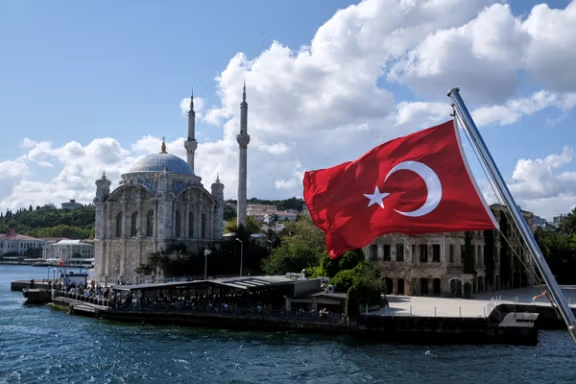
A Turkish flag is pictured on a boat with the Ortakoy Mosque in the background in Istanbul, Turkey September 5, 2021.

Iran’s Foreign Minister Abbas Araghchi said on Monday that Tehran was ready for diplomacy and said he hoped there would be results soon, as Iran weighs possible talks with the United States.

Araghchi said Iran had never abandoned diplomacy based on mutual respect and mutual interests.

“The people of Iran must be spoken to with respect,” Araghchi said, adding that Iran would respond respectfully to anyone who did so.

Iran’s President Masoud Pezeshkian, meanwhile, ordered the start of negotiations with the United States, Fars news agency quoted a source in the administration as saying, adding that negotiations would take place within the framework of the nuclear issue.

Fars later changed the wording of the report and said nothing is final about the status of the negotiations.

The report followed remarks earlier in the day by foreign ministry spokesperson Esmaeil Baghaei, who said talks between Iran and the US would probably be held in Turkey in the coming days.

At his weekly news conference, Baghaei said any Tehran-Washington negotiations would proceed step by step.

He said alongside “the issue of threats,” the priority for the Islamic Republic would be sanctions relief, which he called “a fundamental and non-negotiable priority.” He also thanked Turkey for its role in helping reduce regional tensions.

Tasnim news agency, which is affiliated with the Revolutionary Guard, confirmed the possibility of talks but said the time and place were not final. It said talks would likely be held between the Iranian foreign minister, and Steve Witkoff, the US special envoy.

A senior Iranian official and a Western diplomat told Reuters on Monday that Witkoff and Araghchi could meet in Turkey in the coming days.

A Turkish ruling party official told Reuters that Tehran and Washington had agreed that talks would focus on diplomacy, seen as a possible reprieve from potential US strikes.

Qatar and Egypt were also being considered as possible hosts for talks, Iran’s ISNA news agency reported.

Most Viewed

Ghalibaf defends Iran-US talks amid hardline backlash
1
INSIGHT

Ghalibaf defends Iran-US talks amid hardline backlash

2
VOICES FROM IRAN

Bread shortages, soaring prices strain households in Iran, residents say

3
INSIGHT

Iran diplomacy wobbles as factions compete to avoid looking soft on US

4
ANALYSIS

The politics of pink: how Iran uses cuteness to rebrand violence

5

War-hit homeowners feel abandoned as Iran’s reconstruction aid fades

Banner
Banner

Spotlight

  • Is Iran entering its Gorbachev moment?
    INSIGHT

    Is Iran entering its Gorbachev moment?

  • Iran crackdown reaches cemeteries as graves of slain protesters defaced
    EXCLUSIVE

    Iran crackdown reaches cemeteries as graves of slain protesters defaced

  • Iran diplomacy wobbles as factions compete to avoid looking soft on US
    INSIGHT

    Iran diplomacy wobbles as factions compete to avoid looking soft on US

  • The politics of pink: how Iran uses cuteness to rebrand violence
    ANALYSIS

    The politics of pink: how Iran uses cuteness to rebrand violence

  • Bread shortages, soaring prices strain households in Iran, residents say
    VOICES FROM IRAN

    Bread shortages, soaring prices strain households in Iran, residents say

  • Ghalibaf defends Iran-US talks amid hardline backlash
    INSIGHT

    Ghalibaf defends Iran-US talks amid hardline backlash

•
•
•

More Stories

Forces given ‘blank check’ to kill protesters in Iran, senior official says

Jan 31, 2026, 16:30 GMT+0

Security forces were given free rein to use lethal force during the January 8–9 crackdown to spread fear and deter further protests in Iran, a senior government official said in a closed-door meeting, according to a source familiar with the talks.

The closed-door meeting was held to brief senior government officials and local governors on the brutal crackdown on protesters, the source told Iran International.

The senior official said security forces were given “full authority and a blank check to attack, with the aim of creating maximum fear to deter the resurgence of protests," the source said.

The order, he added, made no distinction between civilians and others.

The senior official speaking at the meeting was presenting assessments by security bodies that sharply contradict the government’s official figures on the killings.

While the official death toll stands at nearly 3,000, classified documents and eyewitness reports reviewed by Iran International’s editorial board show that more than 36,500 people were killed during the targeted suppression of Iran’s national uprising on the orders of Supreme Leader Ali Khamenei.

Following Khamenei’s speech on January 9, briefing sessions and internal discussions among senior Islamic Revolutionary Guard Corps (IRGC) commanders used phrases such as “victory through terror” and “fight them until there is no more sedition," according to sources familiar with the discussions.

The same language later appeared on Telegram channels linked to pro-government groups.

Use of foreign forces

During the closed-door meeting, the senior government official confirmed earlier reports about the use of foreign forces in suppressing the protests, saying the Revolutionary Guards, its Basij militia, as well as Quds Force-linked units trained in Chechnya, Iraq, Pakistan, and Sudan were involved.

Iran International reported earlier this month that Iranian-backed Iraqi militias had begun recruiting and deploying fighters to assist Iranian forces in cracking down on protests.

That report said hundreds of Shiite militiamen from groups including Kataib Hezbollah, Harakat al-Nujaba, Kataib Sayyid al-Shuhada and the Badr Organization had been sent into Iran through multiple border crossings.

The fighters were transferred under the guise of pilgrimage trips and gathered at a base in Ahvaz before being dispatched to various regions, Iran International reported.

Afghan migrants among those killed in Iran protests

Jan 30, 2026, 20:42 GMT+0

Several Afghan migrants were killed during Iran’s recent nationwide protests, with some taking part alongside Iranian demonstrators and others shot despite having no direct involvement, a source confirmed to Afghanistan International.

The protests began in Tehran and several other cities in late December, initially driven by public anger over the sharp fall in Iran’s national currency, soaring inflation and worsening economic conditions.

A series of messages circulated in Afghan migrant WhatsApp and Telegram groups during the early days of the protests, urging migrants not to participate, a source told Afghanistan International.

The messages warned that sharing photos or videos could have serious consequences, reflecting widespread fear of arrest, deportation or forced expulsion.

An Afghan migrant living in Mashhad told Afghanistan International that many Afghans in Iran deliberately avoid political activity because of their precarious legal status, particularly protesting the government.

He added that some migrants joined the demonstrations nonetheless due to severe economic hardship.

Sources also said that amid an increase in security checkpoints, some Afghan migrants began using images of senior Islamic Republic figures as phone wallpapers, fearing inspections of their mobile phones by security forces.

Afghanistan International confirmed the identities of several Afghan nationals killed during the protests, including 16-year-old Amirhossein Moradi, who was shot in Mashhad and later died in hospital.

The human rights organization Hengaw also confirmed the deaths of three other Afghan nationals in the city. Sources say families were warned against speaking to the media before being allowed to bury their relatives.

Additional cases have been reported in Tehran, Karaj and Isfahan, including Afghan migrants and children killed by direct or indiscriminate fire, some while not participating in protests. Internet restrictions and pressure on families have made it difficult to establish accurate figures.

Afghan migrants have previously been killed during protests in Iran. During the 2022 nationwide unrest, Amnesty International reported that at least two Afghan teenagers were killed by Iranian security forces, with their families later threatened into silence.

Iran’s consul general in Herat has denied Afghan involvement in the recent protests, claiming some actors are attempting to damage relations between Iran and Afghanistan.

More than 36,500 Iranians were killed by security forces during the January 8-9 crackdown on nationwide protests, making it the deadliest two-day protest massacre in history, according to documents reviewed by Iran International's Editorial Board.
Iran shows no shift on US talks as Turkey engages Washington

Jan 30, 2026, 12:38 GMT+0

Iran showed no sign of shifting its stance toward the United States at a joint press conference with Turkey on Friday, with Foreign Minister Abbas Araghchi saying Tehran had no plan to meet US officials and would not negotiate under threats or preconditions.

“We do not have any plan or programme to meet or discuss with any US officials,” Araghchi told a joint news conference with Turkish Foreign Minister Hakan Fidan.

“Negotiation cannot be dictated,” he said. “If one party is threatening and setting preconditions, that is no longer a negotiation.”

“While they are threatening us, they say they want to negotiate,” Araghchi added.

Araghchi said Iran would only consider what he described as “just, fair and equitable” talks, but said the basic framework for such negotiations had not been established.

“We need to see the preconditions and the agenda first,” he said.

He warned that Iran was prepared for escalation if attacked. “We are ready for negotiations, but we are also ready for warfare,” Araghchi said. “We are even more ready than in June last year.”

He said any direct US intervention would change the situation fundamentally and could push the conflict beyond a bilateral confrontation, with wider regional consequences.

Araghchi described his talks with Fidan in Istanbul as “good and useful,” saying they covered bilateral, regional and international issues.

Fidan said Turkey was in contact with both Tehran and Washington as tensions rise, adding that he had held talks with US special envoy for the Middle East Steve Witkoff.

“Yesterday I had long talks with Steve Witkoff,” Fidan said, adding that Ankara would continue contacts with the United States and other regional actors.

Turkey opposes any new conflict in the region and views continued fighting as a driver of instability, terrorism and migration, Fidan said.

Iran bank branches face cash shortages as demand spikes

Jan 29, 2026, 09:39 GMT+0

Iranian bank branches are facing growing shortages of cash as demand for banknotes rises sharply, prompting informal daily withdrawal caps of 30 million to 50 million rials per customer (about $18 to $30), Iranian media reported.

Didban Iran website said branches in several banks were running out of banknotes on a daily basis, with customers arriving later in the working day sometimes unable to withdraw cash.

The report comes as inflation continues to erode purchasing power, and analysts have long said Iran’s chronic price rises have increased pressure for larger-denomination banknotes.

According to the Central Bank of Iran’s latest data, banknotes and coins held by the public rose by more than 23% in the first eight months of the current Iranian year, which began on March 21, 2025, compared with 0.8% growth over the same period a year earlier.

Iran’s largest widely circulating note is the 2,000,000-rial “Iran cheque” (about $1.22), which has steadily lost value in real terms.

The report added that the maximum daily cash withdrawal from ATMs has recently been set at 3,000,000 rials (about $1.83), a limit that has pushed more customers to visit branches in person to access larger sums.

The Central Bank has not publicly commented on the reported shortages or whether additional currency issuance is planned.

Gold, hoarding, fear: War fever deepens Iran’s economic anxiety

Jan 29, 2026, 07:44 GMT+0
•
Behrouz Turani

The possibility of US military action against Iran is eroding Iranians’ purchasing power and deepening their sense of insecurity, according to Iranian economic news outlets which provide a rare window into economic behavior amid an internet blackout.

Financial woes helped spark anti-government protests late last which which were crushed with deadly force, in a bloody crackdown in which security forces killed thousands.

The political uncertainty and a threat of attack by the United States has only deepened

Several economic publications, including Donya‑ye Eghtesad, the state‑run ISNA, and Tejarat News, published guidance on Tuesday advising citizens on how to protect their assets from devaluation, how to plan purchases to minimize the impact of price hikes and when to buy essential goods amid market volatility.

Reports indicate that many people are stockpiling non‑perishable items, viewing goods as safer than cash amid relentless inflation.

Those with savings, they noted, have increasingly turn to gold in any form, seeing it as a hedge against currency devaluation and a liquid asset that can be converted into cash at any time.

At the same time, households are keeping only small amounts of cash on hand, enough to cover basic needs in the event of internet outages that could disrupt ATMs and banking services.

The outlets warned that persistent inflation was fuelling panic buying of basic necessities that was distorting normal spending habits.

Economic malaise has festered as the Iranian rial currency again hit a new low this week and the internal crackdown suggests no near resolution to deep US and international sanctions along with persistent corruption and mismanagement.

US President Donald Trump on Tuesday suggested Iran would face a harsh attack if it did not accede to demands by Washington over its nuclear program and military posture.Iranian foreign minister Abbas Araghchi responded that Tehran was ready with “fingers on the trigger.”

The Shargh newspaper wrote that foreign policy news and not economic it is not economic fundamentals were driving market behavior and fears assets would devalue further.

The Economic dailies predicted that the impact on food and essential goods prices would be sharp and unavoidable.

As Donya‑ye Eghtesad observed, Iran’s economy is effectively in a state of suspended animation, with the key to stability lying in the hands of diplomats.

This prolonged uncertainty, the paper argued, is creating chronic anxiety among the public: a volatile mix of fear, despair, and anger that increasingly blames authorities deemed responsible for managing the crisis.