• العربية
  • فارسی
Brand
  • Iran Insight
  • Politics
  • Economy
  • Analysis
  • Special Report
  • Opinion
  • Podcast
  • Iran Insight
  • Politics
  • Economy
  • Analysis
  • Special Report
  • Opinion
  • Podcast
  • Theme
  • Language
    • العربية
    • فارسی
  • Iran Insight
  • Politics
  • Economy
  • Analysis
  • Special Report
  • Opinion
  • Podcast
All rights reserved for Volant Media UK Limited
volant media logo
INSIGHT

Strategy or paralysis? Tehran sends mixed signals on war and diplomacy

Behrouz Turani
Behrouz Turani

Iran International

Feb 3, 2026, 16:40 GMT+0
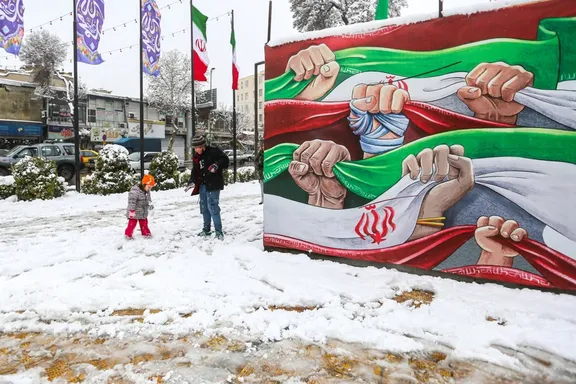
A toddler and a young boy play in the snow next to a state-sponsored billboard depicting Iranian fists and flags, in northern city of Qazvin, January 20, 2026

Conflicting voices in Tehran on the competing prospects of war and diplomacy with Washington may be deliberate, but they more likely reflect an absence of consensus at the top.

A quick look at the main headlines on the IRGC-linked Tasnim News Agency on Monday captured the mood in Tehran: “Possibility of Iran–US Negotiations Confirmed,” “Implications for America if War Spreads Across the Region,” and “With Trump’s Conditions, There Will Be No Negotiations.”

Together, they betray a system simultaneously preparing for talks, threatening escalation, and insisting negotiations are impossible.

Despite the government’s efforts to project calm beneath Tehran’s smog-covered skyline, a speech on Sunday by Supreme Leader Ali Khamenei only deepened the sense of foreboding.

Khamenei recounted a joke from his native province of Khorasan about a man boasting of how close he was to marrying the woman he loved. “Only two steps remain,” the man says. “I ask her father for her hand, and he replies: ‘How dare you!’”

Those seated around Khamenei, including his financial confidant Mohammad Mokhber, smiled uncertainly—perhaps only gradually realizing that, in Khamenei’s telling, the hopeful suitor was US President Donald Trump, and the disapproving father was Khamenei himself.

‘American graveyard’

For opportunistic politicians and commentators in Tehran, the message was unmistakable: recent claims by Foreign Minister Abbas Araghchi and security chief Ali Larijani about ongoing negotiations with Washington mattered far less than the Supreme Leader’s evident reluctance to engage.

On the central question—whether Iran is prepared to make concessions—Khamenei remains firmly unwilling to yield.

Hardliners, who had briefly lowered their volume in anticipation of a possible diplomatic opening, appeared to have received the memo and quickly returned to form.

In parliament, the cleric Mohammad Taghi Naghdali declared that Iran should not only close the Strait of Hormuz but also disrupt Europe’s shipping routes and gas export networks, while calling for reduced cooperation with the International Atomic Energy Agency.

The rhetoric soon veered into the absurd. The managing director of Tehran’s main cemetery, Behesht-e Zahra, claimed he had prepared 5,000 graves for US soldiers he believed would be killed on the first day of a war with Iran.

The statement was swiftly refuted by Tehran city councillor Jafar Tashakori, who warned that reckless remarks could trigger crises “far beyond domestic politics.”

Vested interests

Even seasoned analysts struggled to impose coherence on the moment. Political commentator Ali Bigdeli said no one could say with certainty whether war was coming, arguing that Iran’s only viable path forward lay in direct talks with the United States.

While Iran’s official position, articulated by Araghchi, is that any talks must be confined to the nuclear file, Bigdeli cautioned that Washington’s ambitions extend to Tehran’s missile program and its regional allies.

“Trump is not interested in a direct war with Iran,” Bigdeli told the moderate outlet Khabar Online. “But he is unlikely to leave the region with his armada without achieving something.”

Ebrahim Rezai, spokesperson for parliament’s National Security Committee, cited a briefing by IRGC Aerospace Force commanders to assert that any US attack would trap American forces in a regional war.

Yet another conservative figure, Hossein Naghavi Hosseini, cautioned that those beating the drums of war in Tehran were playing into Israel’s hands.

Taken together, the cacophony points less to confidence than to paralysis: a system torn between waiting for a signal from the top and being pulled in opposing directions by vested interests, each pressing for the outcome it prefers.

Most Viewed

State media slam Araghchi's Hormuz tweet, say it let Trump claim victory
1

State media slam Araghchi's Hormuz tweet, say it let Trump claim victory

2
OPINION

The Hormuz get out of jail card turned to a grave

3

Iran International says it won’t be silenced after London arson attack

4
INSIGHT

How Tehran bends its own red lines to boost state rallies

5

Iran halts petrochemical exports to supply domestic market

Banner
Banner

Spotlight

  • Too early to tell who is winning Iran war, experts say
    PODCAST

    Too early to tell who is winning Iran war, experts say

  • How Tehran bends its own red lines to boost state rallies
    INSIGHT

    How Tehran bends its own red lines to boost state rallies

  • Iran blackout cripples freelancer, small business incomes
    VOICES FROM IRAN

    Iran blackout cripples freelancer, small business incomes

  • Ideology may be fading in Iran, but not in Kashmir's ‘Mini Iran'
    INSIGHT

    Ideology may be fading in Iran, but not in Kashmir's ‘Mini Iran'

  • US blockade enters murky phase as tankers spoof signals and buyers hesitate
    ANALYSIS

    US blockade enters murky phase as tankers spoof signals and buyers hesitate

  • Why the $100 billion Hormuz toll revenue is a myth
    ANALYSIS

    Why the $100 billion Hormuz toll revenue is a myth

•
•
•

More Stories

Iran, US set for Istanbul talks as region scrambles to stave off war

Feb 3, 2026, 12:54 GMT+0

Regional powers including Saudi Arabia, Qatar, Egypt and Oman are trying to bring Iran and the United States to talks in Istanbul on Friday, officials say, to stave off war – starting with Tehran’s nuclear file despite a wide gap over US demands on missiles and allied militias.

What is new this week is not simply another round of nuclear diplomacy, but the intensity of the regional effort behind it.

Officials say the priority of the Istanbul meeting is to prevent conflict, with countries including Saudi Arabia, Qatar, Egypt, Oman, Pakistan and the UAE invited at foreign-minister level as part of a broader attempt to start dialogue before tensions spiral.

The meeting is expected to bring US special envoy Steve Witkoff and Iran’s Foreign Minister Abbas Araghchi together, with regional mediators hoping the presence of Arab and Turkish ministers can help bridge gaps that have widened since talks collapsed last summer after Israeli and US strikes on Iranian nuclear facilities.

One regional official, speaking on condition of anonymity, said that US President Donald Trump’s son-in-law Jared Kushner will also attend alongside Witkoff if the meeting goes ahead.

According to Qatar's Foreign Ministry spokesperson, Majed Al-Ansari, on Tuesday, there is regional collaboration and ongoing efforts aimed at ensuring the de-escalation.

The UAE president's adviser Anwar Gargash told a panel at the World Governments Summit in Dubai on Tuesday, "I think that the region has gone through various calamitous confrontations. I don't think we need another one, but I would like to see direct Iranian-American negotiations leading to understandings so that we don't have these issues every other day."

Public rhetoric on both sides remains extreme, making it harder to judge where compromise lies.

Trump warned this week that with big US warships heading to Iran, "bad things" would likely happen without an agreement, while Iran’s leadership continues to insist it will not negotiate under threats.

Iranian President Masoud Pezeshkian said on Tuesday that he had instructed foreign minister to prepare the ground for talks with the United States.

“Given requests from friendly governments in the region for a response to the US president’s proposal for talks, I instructed the foreign minister to, if conditions are suitable – free of threats and unrealistic expectations – create the groundwork for fair and equitable negotiations, guided by the principle of dignity, wisdom, and expediency, within the framework of the national interest,” Pezeshkian said.

The existence of an Istanbul channel – and the involvement of multiple regional capitals – suggests both sides are still testing whether a deal is possible.

Where talks could bog down

The central diplomatic battle is over scope. Regional officials involved in the effort say mediators are trying to limit the talks to Iran’s nuclear program as the most realistic path to getting Tehran to “yes,” with one official describing the strategy as addressing Washington’s non-nuclear demands only later through innovative ways.

“If the talks happen, they will stay focused on Iran’s nuclear program. And then we will try to find innovative ways to address Washington’s nonnuclear demands,” the Washington Post cited a US official as saying.

The Trump administration, however, has been explicit that it wants more than nuclear limits – including constraints on Iran’s missile development and its support for allied militia groups across Iraq, Lebanon, Yemen and elsewhere.

That mismatch is likely to define the talks: Iran wants the file narrow, Washington wants it comprehensive.

Uranium stockpile and enrichment: the urgent nuclear core

At the heart of the talks is Iran’s uranium stockpile and enrichment capability.

The Trump administration has demanded that Tehran remove or transfer 400 kilograms (more than 900 pounds) of uranium enriched to 60% purity and curb enrichment activity it says is edging toward weapons capability.

Iran denies it intends to weaponize its program, but the question of what happens to existing stockpiles – whether moved abroad, frozen, or placed under tighter monitoring – remains one of the most immediate pressure points.

Analysts say one possible compromise could be suspending further enrichment without Iran explicitly renouncing what it claims as a right to enrich under the Non-Proliferation Treaty.

Missile program: Tehran’s red line

Iran has consistently signaled that its missile program is not up for negotiation.

That creates an early ceiling on what can be achieved if Washington insists on missile curbs as part of any package, reinforcing the mediator strategy of keeping the first phase focused tightly on the nuclear file.

Regional militias: the hardest unresolved layer

The US has also demanded that Iran reduce support for allied non-state groups across the region.

Iran is unlikely to publicly abandon those relationships, but experts suggest the sides could explore narrower understandings – such as a nonaggression framework that extends to both countries’ respective partners – rather than an explicit proxy rollback.

This is where the talks could either expand into a broader security negotiation or fracture under maximalist expectations.

What happens next

Officials caution that details of the Istanbul format remain unclear, but the “main meeting” is expected on Friday.

The immediate goal may be modest: establish a channel, prevent escalation, and see whether nuclear-focused diplomacy can restart – with missiles and regional militias left as the more difficult second-stage questions.

In that sense, Istanbul seems less about a final agreement than about whether the sides can still find a negotiating floor before confrontation becomes the default.

According to an Iranian diplomatic source cited by Reuters on Tuesday, Iran is "neither optimistic nor pessimistic" over the talks.

What Iranians taught me while I spoke to them from Israel

Feb 3, 2026, 08:35 GMT+0
•
Tamar Schwarzbard

Israelis and Iranians have been cast as enemies for so long, but during Iran’s uprisings their voices tell a different story as Iranians drew a line between themselves and the Islamic Republic.

In late September 2022, when a young Iranian woman named Mahsa Amini was killed for showing her hair, Iran erupted. Millions of brave Iranians, women and men, young and old, took to the streets.

What followed was not just a protest against compulsory hijab laws, but one of the clearest rejections of the Islamic Republic since 1979: Woman. Life. Freedom.

At the time, I was head of digital operations at the Israel ministry of foreign affairs, leading Israel’s public diplomacy online in six languages, including Persian.

From the start, we distinguished between the Islamic Republic and the Iranian people. That distinction guided everything we did. We launched one of the only official digital campaigns anywhere in direct solidarity with Mahsa Amini and the protesters, including a filter viewed more than a million times.

Our Israel in Persian accounts exploded. Posts expressing support reached millions. Every day, we received thousands of messages from inside Iran: “Thank you for seeing us,” they said, “be our voice.”

In January 2026, they did the same.

For more than four decades, the Islamic Republic has insisted that hatred of Israel is central to Iranian identity. But millions of Iranians have told us otherwise.

A GAMAAN survey published in 2025 found that roughly two thirds of Iranians said the government should stop its “destroy Israel” rhetoric, and a similar majority viewed the recent 12 day conflict as between the Iranian regime and Israel, not between Israel and ordinary Iranians.

Loyal supporters of Iran's theocratic rule, the same voices that celebrated October 7, want you to believe Iranians hate Israel and that the protests are foreign engineered fantasies.

They flood social media with trolls, lies, and fake AI videos. But the people have already spoken. Across ideology and geography, they are saying the same thing: Not death to Israel. Not death to America. Death to the Islamic Republic.

Hundreds of thousands of Iranian Jews live around the world today, many still speaking Persian, cooking Iranian food, and aching for the country they were forced to leave.

People hold a banner, as Israelis rally in support of the nationwide protests happening in Iran, in Holon, Israel, January 14, 2026.
100%
People hold a banner, as Israelis rally in support of the nationwide protests happening in Iran, in Holon, Israel, January 14, 2026.

Israel is home to about 200,000 Iranian Jews. Long before modern politics, Cyrus the Great liberated the Jews from exile and allowed them to return to Jerusalem, an event recorded in both Jewish and Persian history.

That shared past still lives between our peoples. And it lives in everyday encounters.

Every Iranian I have ever met has responded to me as a Jewish Israeli with warmth, curiosity, and respect. Never hatred.

Israelis are taught that Iran wants them wiped off the map. Iranians are taught that Israel is satanic and responsible for their suffering. But we both know the truth. It is the Islamic Republic that threatens both of us.

The rulers in Tehran have destroyed Iran’s economy, murdered teenagers for defying religious rule, and crushed dissent. They send money to their armed allies in the region while ordinary Iranians struggle to afford food and medicine.

Inside Iran, protesters chant, “Not Gaza, not Lebanon, my life for Iran.”

For Israelis, the danger is existential. The same regime that brutalizes its citizens openly calls for Israel’s destruction and races toward nuclear capability.

Israelis and Iranians do not need permission to recognize each other. Beneath decades of forced slogans lies something older and stronger than propaganda.

When Iranians rose up, Israelis didn’t see enemies in the streets of Tehran. We saw courage. And just as Iranians amplified Israeli voices after October 7, we understand that now it is our turn to speak for them.

This is not a Zionist conspiracy. It is human beings standing up for human beings.

The Islamic Republic fears that if Israelis and Iranians ever meet as people rather than caricatures, its mythology would collapse. So we stand with our Iranian brothers and sisters as allies, determined to answer their call for help.

For Jews, “Next year in Jerusalem” is a prayer for freedom. Today, that prayer has an echo: Next year in Tehran.

Trump pairs deal talk with war threats ahead of Iran negotiations

Feb 2, 2026, 23:05 GMT+0

President Donald Trump on Thursday delivered a characteristically ambiguous message on Iran, pairing talk of overwhelming military force with renewed signals that he may still favor a negotiated deal.

“I can’t tell you what I’m going to do right now,” Trump told reporters in the Oval Office when asked about Iran. “We have a tremendous force going in there, just like we did in Venezuela — even bigger.”

Still, he stressed that the administration was already in contact with Tehran.

“Right now, we’re talking to them. We’re talking to Iran,” he said. “If we could work something out, that’d be great. And if we can’t, probably bad things would happen.”

The remarks underscored a familiar dual-track approach: escalating deterrence while keeping the door open to diplomacy.

That uncertainty comes as US and Iranian officials prepare for what could be their first face-to-face engagement in the current crisis, with US envoy Steve Witkoff and Iran’s Foreign Minister Abbas Araghchi set to meet in Istanbul on Friday.

The meeting, if it goes ahead as expected, would mark a significant step after weeks of indirect messaging, military posturing and sharply escalatory rhetoric.

Conflicting reports

Various reports emerged on Friday about the details and potential format of the planned negotiations.

Reuters cited an unnamed Iranian official as saying Tehran was “ready to show flexibility on uranium enrichment,” including the possible transfer of 400 kilograms of highly enriched uranium and acceptance of zero enrichment under a consortium arrangement.

The report was swiftly denied by Ali Shamkhani, a senior adviser to Iran’s Supreme Leader Ali Khamenei, who stressed that any transfer of enriched uranium abroad was off the table.

“We are prepared for a possible war,” Shamkhani said in an interview with Hezbollah-affiliated broadcaster Al Mayadeen. “If the US attacks, we will certainly strike Israel.”

Separately, the Financial Times cited unnamed diplomats as saying the initial talks in Turkey are expected to focus primarily on Iran’s nuclear program, rather than its missile arsenal or support for regional militant groups.

Alarm grows over detention of doctors who treated Iran protesters

Feb 2, 2026, 20:08 GMT+0
•
Maryam Sinaiee

Rights groups and activists are sounding the alarm over what they describe as a widening campaign of pressure, arrests and intimidation against Iranian doctors and nurses who treated injured protesters.

Iran International has reviewed information from multiple sources inside Iran suggesting that at least 32 members of the country’s medical staff have been detained, with no public information available about the status of their cases.

Doctors who treated wounded protesters in cities including Qazvin, Rasht, Tabriz, Mashhad and Gorgan have been arrested or have gone missing, according to the reports.

Most of the reported arrests are said to have taken place after January 8, following the escalation of protests and the ensuing security crackdown.

‘Normalization of arrests’

Iran Medical Council chief Mohammad Raiszadeh confirmed that 17 of its members had faced judicial or security cases linked to the recent unrest, but insisted that none had been prosecuted for providing medical treatment and that no verdicts had been issued.

The Medical Council is formally a civil body but operates under heavy state oversight.

Raiszadeh, who is close to conservative political circles and previously led the establishment-aligned Basij Doctors Organization, said the council had followed up the cases with security and judicial authorities and had been told that none of the individuals were arrested solely for treating patients.

His remarks prompted criticism within the medical community.

Mahdiar Saeedian, editor-in-chief of a medical science magazine in Iran, wrote on X that the council’s position amounted to normalizing state pressure on healthcare workers.

“More unpleasant than silence is the normalization of arrests and pressure on medical staff by the Medical Council,” he wrote. “This is the result of fully turning a professional organization into a state-controlled body.”

Reported cases

UK-based outlet Kayhan London reported that doctors Masoud Ebadi-Fard Azari and his wife, Parisa Porkar, were arrested in Qazvin for allegedly treating injured protesters, adding that their whereabouts remain unknown.

Another reported case involves Golnaz Naraqi, a 41-year-old emergency medicine specialist at Hasheminejad and Shohada-ye Tajrish hospitals in Tehran, who was reportedly arrested at her home more than ten days ago.

Social media users have also reported growing pressure on medical staff accused of helping protesters anonymously.

In one account, a viewer message sent to Iran International said Farshid Pourreza, head of Golsar Hospital in Rasht, was dismissed and expelled from the hospital for supporting protesters and treating the wounded.

Health Minister Mohammad Reza Zafarghandi wrote on X that providing “the best possible medical services to every patient in a safe healthcare environment,” regardless of “any external factors,” was the health system’s top priority.

The remarks drew swift criticism online.

“As a colleague, I am waiting to see whether you remain loyal to your oath, or whether an ‘external factor’ stands in the way of it,” Nakisa Serafinincho, an Iranian doctor based in Romania, wrote on X.

Another user responded: “You can’t even protect medical staff. How can you talk about patient safety?”

How Tehran recasts protest killings as ‘holy duty’

Feb 2, 2026, 18:52 GMT+0
•
Arash Sohrabi

As Iranians mourn those killed in the nationwide crackdown, state-aligned voices are falling back on familiar defenses: downplaying the toll, casting the protests as a foreign plot, and stripping victims of civic status by branding them religious enemies.

Variations of this message have surfaced across pro-government platforms, from seminarians presenting bloodshed as “righteous” to well-connected insiders arguing that killing protesters in the street is cheaper than arresting and executing them one by one.

A week after Iran killed more than 36,500 people, a state-affiliated analyst, Hesamoddin Haerizadeh, framed the protests not as civic dissent but as a divinely charged war, wrapping state violence in religious and moral language.

Opening his remarks, Haerizadeh cast the uprising as an externally orchestrated assault, describing the unrest as foreign backed riots and part of a broader confrontation between the Islamic Republic and the "non-believers front."

From there, he moved beyond political framing into a religious logic that treats street protests as a battlefield where killing is not a crime but an inevitable feature of a sacred struggle.

Haerizadeh branded the protests as “armed rebellion,” insisting that what had taken place was not peaceful protest but organized violence.

  • 36,500 deaths in context: How Iran’s toll compares with wars and crackdowns

    36,500 deaths in context: How Iran’s toll compares with wars and crackdowns

  • Over 36,500 killed in Iran's deadliest massacre, documents reveal

    Over 36,500 killed in Iran's deadliest massacre, documents reveal

Haerizadeh then introduced an explicitly theological lens, portraying the crackdown as part of what he described as a divine process of purification.

“These events are meant to separate the impure from the pure,” he said, adding that turmoil is necessary so that “the impure are distinguished from the pure.”

In one of the starkest passages, he cited a Quranic verse often used to legitimize violence against perceived enemies: “And fight them until there is no more fitna,” he said, quoting scripture, “until religion is entirely for God.”

Critics say the effect of this framing is to turn the killing of protesters into something sacred: not a state decision, but a divine sorting mechanism—a form of moral cleansing.

Haerizadeh’s rhetoric relied heavily on dehumanization, dividing society into moral categories rather than citizens with rights.

“Kill, but with a ‘pure heart,’” activist Ahmad Batebi wrote, arguing that the lecture was designed to allow perpetrators to believe: “I didn’t kill; God sifted.”

The civic technology group TavaanaTech described the session as “workshops for killing and murder,” warning that such religious framing lowers the moral barrier to atrocity.

“This language is the language of genocide,” the group wrote, “a language that first makes the victim worthless so killing becomes easier.”

Killing as bureaucratic efficiency

A separate set of remarks, contained in an audio file attributed to Ahmad Ghadiri Abyaneh – the son of a former senior Iranian diplomat – moves beyond ideology into blunt cost-benefit logic.

In an online session on Thursday, January 29, he argued that killing protesters in the street could spare the Islamic Republic the international pressure that follows formal executions.

He minimized the scale of the deaths, reducing reported killings from tens of thousands to just over 3,000, and said the cost of killing protesters on the streets was far lower than arresting and executing them one by one.

“Why didn’t you kill them on the streets?” he asked, addressing the authorities. “You know that if they had been eliminated on the spot, the cost to the system would have been far, far lower than if you tried to execute them one by one.”

“Each one becomes a case file and a source of pressure on the Islamic Republic,” he continued. “By any logic—by any religious reasoning—it would have been right to show an iron fist with a decisive strike and wipe them out on the scene.”

  • Mockery of protest victims on state TV sparks fury in Iran

    Mockery of protest victims on state TV sparks fury in Iran

  • 'Finish the job': accounts point to Iran's executions of injured protesters

    'Finish the job': accounts point to Iran's executions of injured protesters

  • Forces given ‘blank check’ to kill protesters in Iran, senior official says

    Forces given ‘blank check’ to kill protesters in Iran, senior official says

Mockery on state television

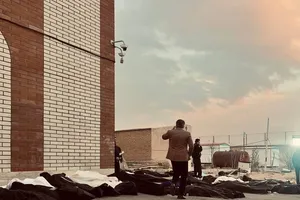
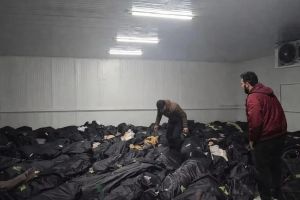
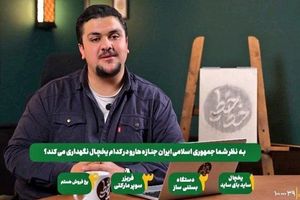
The narrative hardened further when a host on Ofogh TV, an IRIB channel affiliated with the Revolutionary Guards, mocked reports that thousands of bodies had been transported in refrigerated trailers.

“What type of refrigerator do you think the Islamic Republic keeps the bodies in?” he asked sarcastically, offering joking options including an “ice cream machine” and a “supermarket freezer.”

The remarks sparked outrage across Iran’s political spectrum. IRIB later removed Ofogh TV’s director, Sadegh Yazdani, and pulled the program, though many critics said deeper accountability was unlikely.

'Enemies of God'

The same logic resurfaced on Sunday, when Tehran City Council head Mehdi Chamran denied protest deaths while labeling victims with one of the Islamic Republic’s harshest religious-legal categories.

“In these protests we had no deaths, and only moharebs were present with guns and knives,” Chamran said.

The term mohareb –used for those accused of waging war against God – has long been associated with the harshest punishments, including execution. Critics say it functions as a rhetorical weapon, transforming civilians into divine enemies.

Taken together, these remarks point to a single through-line: Tehran's effort to frame violence as either sacred duty or bureaucratic convenience.