• العربية
  • فارسی
Brand
  • Iran Insight
  • Politics
  • Economy
  • Analysis
  • Special Report
  • Opinion
  • Podcast
  • Iran Insight
  • Politics
  • Economy
  • Analysis
  • Special Report
  • Opinion
  • Podcast
  • Theme
  • Language
    • العربية
    • فارسی
  • Iran Insight
  • Politics
  • Economy
  • Analysis
  • Special Report
  • Opinion
  • Podcast
All rights reserved for Volant Media UK Limited
volant media logo

Britain sanctions Iran’s security apparatus over deadly crackdowns

Feb 2, 2026, 15:09 GMT+0
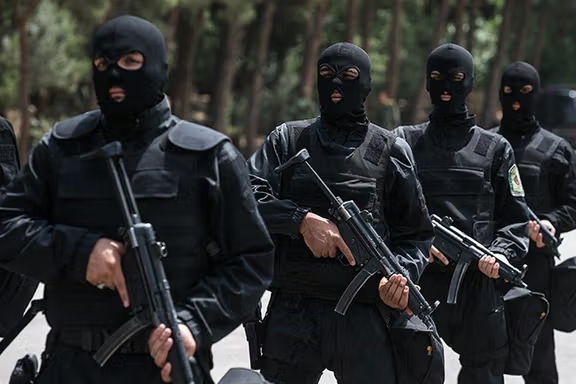
Iran's Special Unite police

Britain on Monday imposed a new round of sanctions on Iranian officials and a state security body, targeting those it said were responsible for violent crackdowns on peaceful protests.

The British Foreign Office said it had sanctioned 10 individuals and the Law Enforcement Forces of the Islamic Republic for what it described as serious human rights violations, including the killing of protesters, torture, sexual violence, and sweeping restrictions on freedom of expression and peaceful assembly.

The measures include asset freezes, travel bans and director disqualification sanctions, which prevent those listed from holding senior positions in British companies.

Among those designated was Eskandar Momeni, who oversees Iran’s domestic security apparatus, provincial police chiefs Mohammad Reza Hashemifar and Ahmed Amini, senior IRGC commander Mohammad Zamani, judges Ahmad Darvish Goftar and Mehdi Rasakhi, and the businessman Babak Zanjani.

“The Iranian people have shown extreme courage in the face of brutality and repression over recent weeks simply for exercising their right to peaceful protest,” Foreign Secretary Yvette Cooper said in a statement. “

The reports and shocking scenes of violence that have been seen around the world are horrific,” she added.

British officials said the action followed similar measures imposed by the European Union and the United States as part of a coordinated effort to hold Iranian authorities accountable.

Last week, EU foreign ministers formally designated the Islamic Revolutionary Guard Corps as a terrorist organization, a move that prompted sharp retaliation from Tehran.

Iranian officials have routinely dismissed Western sanctions as politically motivated and deny responsibility for abuses.

On Sunday, Iran’s parliament speaker said the country would now consider the armies of EU member states “terrorist groups,” escalating an already tense standoff between Iran and Western governments.

The sanctions were announced as signs emerged that diplomatic contacts between Iran and the United States could resume.

An Iranian foreign ministry official said on Monday that Tehran was weighing terms for renewed nuclear talks, even as Washington has increased its naval presence in the region following last month’s deadly protest crackdown.

Most Viewed

100 days after carnage: Iran economy reels from war, inflation, unemployment
1
INSIGHT

100 days after carnage: Iran economy reels from war, inflation, unemployment

2
INSIGHT

Ghalibaf defends Iran-US talks amid hardline backlash

3
INSIGHT

A nation in limbo: 100 days after the massacre, has the world moved on?

4
ANALYSIS

From instability to influence: Pakistan’s pivotal role in US-Iran diplomacy

5
ANALYSIS

100 days on: why Iran’s January protests spread across social classes

Banner
Banner

Spotlight

  • War-hit homeowners feel abandoned as Iran’s reconstruction aid fades

    War-hit homeowners feel abandoned as Iran’s reconstruction aid fades

  • 100 days on: the anatomy of Iran’s January crackdown
    INSIGHT

    100 days on: the anatomy of Iran’s January crackdown

  • Ghalibaf defends Iran-US talks amid hardline backlash
    INSIGHT

    Ghalibaf defends Iran-US talks amid hardline backlash

  • 100 days on: why Iran’s January protests spread across social classes
    ANALYSIS

    100 days on: why Iran’s January protests spread across social classes

  • From instability to influence: Pakistan’s pivotal role in US-Iran diplomacy
    ANALYSIS

    From instability to influence: Pakistan’s pivotal role in US-Iran diplomacy

  • A nation in limbo: 100 days after the massacre, has the world moved on?
    INSIGHT

    A nation in limbo: 100 days after the massacre, has the world moved on?

•
•
•

More Stories

Leaked memo shows Iran Guards media plan to undermine exiled prince

Feb 2, 2026, 11:01 GMT+0

A leaked Tasnim memo seen by Iran International shows the IRGC media apparatus sought to manipulate narratives around the protests and crackdown, undermine exiled Prince Reza Pahlavi, and frame the uprising as foreign-driven – not rooted in public anger at the Islamic Republic.

The document, issued by the Strategic Center of Tasnim News Agency – an outlet linked to the Islamic Revolutionary Guard Corps (IRGC), instructs that audiences should be led to view Pahlavi not as a political alternative, but as a Western-backed media instrument. It outlines three main lines of messaging.

First, it denies that Pahlavi has any meaningful social base inside Iran, saying recent protests were not the result of his calls but were planned on the ground by the United States and Israel. His statements, it argues, serve only as media coverage of unrest rather than leadership.

Second, the strategy seeks to separate broad social anger from support for Pahlavi, saying that many protesters were expressing accumulated frustration with the Islamic Republic rather than endorsing his political qualifications. Supportive slogans, it adds, reflect opposition to the system more than approval of Pahlavi himself.

Third, the document focuses on undermining Pahlavi’s political and personal credibility, portraying him as inconsistent, unwilling to take responsibility, lacking courage, and ultimately depicted as a “puppet” rather than a serious political actor.

Commenting on the document, political analyst Rouhollah Rahimpour, a freelance journalist, told Iran International that within the Islamic Republic’s broader media machinery, “nothing is random – neither words, nor terminology, nor narratives, nor timing.”

He described the approach as a classic narrative war designed to separate the public from political alternatives, allow anger to be released without enabling leadership to form, and keep society in a state of resentment.

“They tried to show that Crown Prince Reza Pahlavi is not a political actor but a tool,” Rahimpour said.

He added that the strategy also aims to prevent any perceived identity link between protesters inside Iran and Pahlavi, ensuring that “no identity connection is established between protesters inside Iran and Pahlavi.”

Suspicious in-custody injections feared linked to deaths of Iran protesters

Feb 1, 2026, 23:35 GMT+0
•
Negar Mojtahedi, Hooman Abedi

Detainees in Iran are being forcibly injected with unknown substances inside detention facilities, according to eyewitness testimonies, informed sources and human rights monitors who warn of a growing pattern of deaths among current and former prisoners.

Shiva Mahbobi, a former political prisoner and a spokesperson for the Campaign to Free Political Prisoners in Iran, said her organization has been collecting accounts suggesting that detainees—particularly those wounded during recent protests—are being denied medical care and, in some cases, subjected to injections of unknown substances.

“One massacre happened on the street,” Mahbobi said in an interview with Iran International. “Another may be happening quietly in prisons and detention centers.”

Iranian authorities tightly restrict access to detention facilities, families are often warned against speaking publicly, and there is no mechanism for independent medical or forensic investigation.

Still, Mahbobi and other activists say the reports they are receiving show a troubling pattern rather than isolated incidents.

According to Mahbobi, injured protesters are frequently taken directly into custody rather than to hospitals, where some are left without treatment.

In several cases reported to her organization, detainees were allegedly injected during detention and later experienced rapid medical deterioration.

'Teenage girl in a coma'

In one recent case described by an informed source, a 16-year-old girl detained last week fell into a coma after what the source said was an injection administered in custody.

Medical tests later indicated signs of poisoning, though doctors have not determined the cause. 

The teenager, who was released only after her family paid heavy bail, was transferred to intensive care and remains hospitalized, the source said.

Mahbobi also cited a case in Isfahan in which a young woman was detained, released on bail, and died the following day.

In another reported incident, in Shahinshahr, near Isfahan, Mahbobi said the family of a detained man was told he would be released only after posting bail and receiving what officials described as a “vaccine.” 

According to Mahbobi, the man resisted the injection, was beaten, and later found it difficult to obtain medical care after his release, as doctors feared repercussions.

'Voices calling for help in morgue'

Eyewitness accounts received by Iran International describe similarly disturbing scenes beyond detention centers. 

One witness said voices calling for help could be heard inside a morgue as bodies were being processed, alleging that they were resisting injections. 

Mahbobi said documenting abuses inside prisons remains particularly difficult.

“What people don’t see on television is the most frightening part,” she said. “There is no footage from inside prisons.”

The allegations echo reports from the 2022 Woman, Life, Freedom protests, when several detainees died shortly after their release following unexplained medical treatment in custody. 

In some cases, families and rights groups raised concerns about injections or drug administration, but no independent investigations were carried out.

At the time, medical experts warned that the forced use of sedatives or psychiatric drugs in detention—and their abrupt withdrawal—could cause severe complications, including cardiac failure. 

'Lethal injections in jails'

The exact substances allegedly being used in current cases remain unknown.“We don’t know what they are injecting,” Mahbobi said.

“What we know is that people are being injected in custody, and some of them are dying.”

Mahbobi also said her organization has received reports of injured protesters taken away by ambulance who later returned to their families as bodies, as well as accounts from Kermanshah of residents being summoned to identify corpses which locals believed belonged to detainees.

She warned that executions may increasingly be carried out away from public view. “The executions won’t look like before,” she said. "They will be hidden.”

Iranian officials have not commented on the allegations.

Mahbobi called on the international community to pressure Iranian authorities to disclose the identities and locations of detainees and allow independent monitoring of detention facilities.

“Our fear,” she said, “is that if this continues in silence, many people will never come out alive.”
'Finish the job': accounts point to Iran's executions of injured protesters

Feb 1, 2026, 17:13 GMT+0

Accounts from grieving families, medics and rights groups point to a grim pattern in Iran’s crackdown: wounded protesters were not just denied care but deliberately shot again in hospitals or removed alive and later killed.

For families searching for wounded protesters in Iran’s latest crackdown, hospitals have offered no refuge—only dead ends.

One such case was described by the Wall Street Journal in a report on Sunday, which recounted the final hours of a teenage protester identified as Sam, shot and then taken away while still alive.

According to the paper, a medic told Sam’s family that he was “in critical condition being treated for a single gunshot wound in the back of his head,” before security forces arrived and removed him along with other patients.

The medic urged the family to look elsewhere. “The medic advised them to check the morgues,” Sam’s father, Parviz, said, according to the report.

They found him days later. “They found him inside a body bag on Jan. 11 with a second bullet wound that tore through half of his face and made him almost unrecognizable,” Parviz told the Journal.

The second shot—delivered after medical care had begun—was not an act of mercy. It was finalization.

Similar accounts have emerged from Karaj, west of Tehran, where witnesses told Iran International that armed forces surrounded hospitals following days of mass killings and resistance.

Witnesses speaking to Iran International on the condition of anonymity report the abduction of wounded protesters from hospitals and the execution of injured people who were unable to move.

A Karaj taxi driver, who said he witnessed the violence firsthand, described security forces loading both dead and wounded protesters into trucks without distinction.

“Even the wounded were not separated from the dead. They piled everyone together. Someone injured like that will die anyway,” he said.

A photo received by Iran International showed the body of a deceased protester at Kahrizak morgue south of Tehran with his hands bound.

In the image, the man’s body is seen inside a black body bag typically used for those killed, with his hands tied and placed on his abdomen.

The image appeared to show that the citizen was in the custody of security forces at the time of his death and that he died while in detention.

100%

Other witnesses said the killings continued inside medical facilities. One source told Iran International that agents used suppressed weapons. “That person was crying and saying they were shooting the wounded with silenced guns,” the witness said, describing what was explicitly referred to as a finishing shot.

Hospitals including Ghasem Soleimani, Kasra and Takht-e Jamshid were placed under armed lockdown, according to eyewitness reports, with families barred from entry and medical staff working under threat.

One healthcare worker said more than 400 people killed during January 8-9 were brought to Karaj hospitals alone.

The practice has been documented elsewhere. The Iran Human Rights Documentation Center previously reported that one wounded protester, terrified of being executed in hospital, remained motionless for three days inside a plastic body bag used for transporting corpses. His family eventually located him alive in Kahrizak.

In Karaj, fear of those final shots drove families to keep bodies hidden at home rather than risk official channels. According to reports and accounts obtained by Iran International, authorities halted burials, closed morgues, and restricted funerals to a single family member, firing shots into the air to disperse mourners.

What emerges from these accounts is not chaos but method.

Wounded protesters—those who survived initial gunfire—appear to have been treated as liabilities. Removing them from hospitals, or killing them outright, ensured that testimony would not survive.

Sam’s father said his son had dreamed of studying information technology in Germany, where he planned to reunite with him. Instead, he was shot once, treated, and then shot again.

The second bullet did what the first did not.

Disconnected and afraid: Iran’s internet blackouts leave lasting scars

Feb 1, 2026, 13:09 GMT+0
•
Maryam Sinaiee

When Iran cuts off internet access, millions are plunged into more than digital silence. Mental health experts say the blackouts intensify anxiety, isolation, and trauma in a society already under extreme strain.

The Iranian outlet Khabar Online has argued that the fear of being digitally cut off from unfolding events can resemble a form of mass FOMO, anxiety driven not by social media envy, but by enforced disconnection.

Beyond personal stress

The article says that the consequences extend far beyond individual stress. “Cutting the internet is not just a trauma at the individual level; it severely destroys interpersonal bonds and trust,” it said.

It also warned of what it called “anticipatory anxiety.” Even after access is partially restored, society remains on edge.

“Every slight drop in internet speed triggers waves of stress and panic over another shutdown,” the article added.

US-based psychotherapist Azadeh Afsahi said the effects mirror enforced isolation. “Clinically, shutting down the internet is equivalent to enforced isolation and the sudden loss of multiple coping mechanisms at once,” Afsahi told Iran International.

“Isolation is a well-established driver of anxiety and depression and significantly increases the risk of suicidal ideation and suicide attempts.”

She added that Iran’s psychological baseline is already fragile.

Decades of repression, violence, economic instability, and chronic uncertainty have severely compromised mental health, she said, and internet shutdowns “compound the existing trauma” and can “push already vulnerable individuals closer to psychological collapse.”

From isolation to overload

Afsahi said prolonged digital silence creates a dangerous psychological cycle: after days or weeks of isolation, people are suddenly exposed to graphic images and devastating news once access is partially restored.

The abrupt flood of information, she said, can overwhelm the nervous system, triggering panic attacks, dissociation, intrusive thoughts, trauma-related symptoms resembling PTSD, and an increased risk of suicide.

“This cycle – isolation followed by psychological overload – creates cumulative, long-term harm,” Afsahi said.

The effects are not confined to those inside Iran. Families, journalists, activists, and content creators abroad are also affected, as their mental wellbeing depends on connection and community.

Shutdown as a tool of control

Internet disruptions have become a familiar reality for Iranians in recent years. Sometimes nationwide, sometimes regional or temporary, shutdowns have emerged as a central tool used by authorities to control protests, slow the spread of information, and suppress evidence of repression.

During crises, restricted access heightens public anxiety while crippling digital businesses and essential online services.

The most recent shutdown followed the 12-day war with Israel in June, when internet access was disrupted for roughly six days. This time, however, several days of complete blackout were followed by only limited access to a heavily censored domestic intranet.

Nearly 25 days later, the restrictions persist, with only a trickle of tightly restricted access returning. Many people and businesses still lack access.

  • Volunteers abroad deploy tech to pierce Iran's internet iron curtain

    Volunteers abroad deploy tech to pierce Iran's internet iron curtain

  • After 20-day outage, Iran internet flickers back but restrictions persist

    After 20-day outage, Iran internet flickers back but restrictions persist

  • No clicks, no revenue: Iran's blackout wipes out online businesses

    No clicks, no revenue: Iran's blackout wipes out online businesses

Coping at the margins

Some Iranians have traveled to border regions or neighboring countries to send business files, upload videos documenting the January 8-9 crackdown, or contact family members.

Meanwhile, informal volunteer networks abroad have attempted to provide access through anti-censorship tools such as Psiphon and its Conduit feature, offering slow and unstable connections to the outside world.

The government says the shutdown is necessary to protect national security and citizens’ lives. Concerns over potential cyberattacks may also play a role.

Technology researcher Mohammad Rahbari warned in Khabar Online that prolonged communication blackouts can undermine society’s psychological stability.

“The continuation of communication shutdowns, even if intended to protect citizens’ physical safety, can seriously damage psychological security – which is a core component of overall security,” he said.

Forces given ‘blank check’ to kill protesters in Iran, senior official says

Jan 31, 2026, 16:30 GMT+0

Security forces were given free rein to use lethal force during the January 8–9 crackdown to spread fear and deter further protests in Iran, a senior government official said in a closed-door meeting, according to a source familiar with the talks.

The closed-door meeting was held to brief senior government officials and local governors on the brutal crackdown on protesters, the source told Iran International.

The senior official said security forces were given “full authority and a blank check to attack, with the aim of creating maximum fear to deter the resurgence of protests," the source said.

The order, he added, made no distinction between civilians and others.

The senior official speaking at the meeting was presenting assessments by security bodies that sharply contradict the government’s official figures on the killings.

While the official death toll stands at nearly 3,000, classified documents and eyewitness reports reviewed by Iran International’s editorial board show that more than 36,500 people were killed during the targeted suppression of Iran’s national uprising on the orders of Supreme Leader Ali Khamenei.

Following Khamenei’s speech on January 9, briefing sessions and internal discussions among senior Islamic Revolutionary Guard Corps (IRGC) commanders used phrases such as “victory through terror” and “fight them until there is no more sedition," according to sources familiar with the discussions.

The same language later appeared on Telegram channels linked to pro-government groups.

Use of foreign forces

During the closed-door meeting, the senior government official confirmed earlier reports about the use of foreign forces in suppressing the protests, saying the Revolutionary Guards, its Basij militia, as well as Quds Force-linked units trained in Chechnya, Iraq, Pakistan, and Sudan were involved.

Iran International reported earlier this month that Iranian-backed Iraqi militias had begun recruiting and deploying fighters to assist Iranian forces in cracking down on protests.

That report said hundreds of Shiite militiamen from groups including Kataib Hezbollah, Harakat al-Nujaba, Kataib Sayyid al-Shuhada and the Badr Organization had been sent into Iran through multiple border crossings.

The fighters were transferred under the guise of pilgrimage trips and gathered at a base in Ahvaz before being dispatched to various regions, Iran International reported.