• العربية
  • فارسی
Brand
  • Iran Insight
  • Politics
  • Economy
  • Analysis
  • Special Report
  • Opinion
  • Podcast
  • Iran Insight
  • Politics
  • Economy
  • Analysis
  • Special Report
  • Opinion
  • Podcast
  • Theme
  • Language
    • العربية
    • فارسی
  • Iran Insight
  • Politics
  • Economy
  • Analysis
  • Special Report
  • Opinion
  • Podcast
All rights reserved for Volant Media UK Limited
volant media logo

Suspicious in-custody injections feared linked to deaths of Iran protesters

Negar MojtahediHooman Abedi
Negar Mojtahedi,
Hooman Abedi
Feb 1, 2026, 23:35 GMT+0
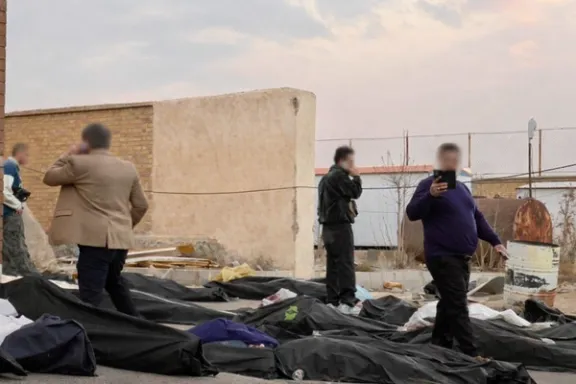
Dead bodies lie in a morgue in Iran, January 2026.

Detainees in Iran are being forcibly injected with unknown substances inside detention facilities, according to eyewitness testimonies, informed sources and human rights monitors who warn of a growing pattern of deaths among current and former prisoners.

Shiva Mahbobi, a former political prisoner and a spokesperson for the Campaign to Free Political Prisoners in Iran, said her organization has been collecting accounts suggesting that detainees—particularly those wounded during recent protests—are being denied medical care and, in some cases, subjected to injections of unknown substances.

“One massacre happened on the street,” Mahbobi said in an interview with Iran International. “Another may be happening quietly in prisons and detention centers.”

Iranian authorities tightly restrict access to detention facilities, families are often warned against speaking publicly, and there is no mechanism for independent medical or forensic investigation.

Still, Mahbobi and other activists say the reports they are receiving show a troubling pattern rather than isolated incidents.

According to Mahbobi, injured protesters are frequently taken directly into custody rather than to hospitals, where some are left without treatment.

In several cases reported to her organization, detainees were allegedly injected during detention and later experienced rapid medical deterioration.

'Teenage girl in a coma'

In one recent case described by an informed source, a 16-year-old girl detained last week fell into a coma after what the source said was an injection administered in custody.

Medical tests later indicated signs of poisoning, though doctors have not determined the cause. 

The teenager, who was released only after her family paid heavy bail, was transferred to intensive care and remains hospitalized, the source said.

Mahbobi also cited a case in Isfahan in which a young woman was detained, released on bail, and died the following day.

In another reported incident, in Shahinshahr, near Isfahan, Mahbobi said the family of a detained man was told he would be released only after posting bail and receiving what officials described as a “vaccine.” 

According to Mahbobi, the man resisted the injection, was beaten, and later found it difficult to obtain medical care after his release, as doctors feared repercussions.

'Voices calling for help in morgue'

Eyewitness accounts received by Iran International describe similarly disturbing scenes beyond detention centers. 

One witness said voices calling for help could be heard inside a morgue as bodies were being processed, alleging that they were resisting injections. 

Mahbobi said documenting abuses inside prisons remains particularly difficult.

“What people don’t see on television is the most frightening part,” she said. “There is no footage from inside prisons.”

The allegations echo reports from the 2022 Woman, Life, Freedom protests, when several detainees died shortly after their release following unexplained medical treatment in custody. 

In some cases, families and rights groups raised concerns about injections or drug administration, but no independent investigations were carried out.

At the time, medical experts warned that the forced use of sedatives or psychiatric drugs in detention—and their abrupt withdrawal—could cause severe complications, including cardiac failure. 

'Lethal injections in jails'

The exact substances allegedly being used in current cases remain unknown.“We don’t know what they are injecting,” Mahbobi said.

“What we know is that people are being injected in custody, and some of them are dying.”

Mahbobi also said her organization has received reports of injured protesters taken away by ambulance who later returned to their families as bodies, as well as accounts from Kermanshah of residents being summoned to identify corpses which locals believed belonged to detainees.

She warned that executions may increasingly be carried out away from public view. “The executions won’t look like before,” she said. "They will be hidden.”

Iranian officials have not commented on the allegations.

Mahbobi called on the international community to pressure Iranian authorities to disclose the identities and locations of detainees and allow independent monitoring of detention facilities.

“Our fear,” she said, “is that if this continues in silence, many people will never come out alive.”

Most Viewed

Iran diplomacy wobbles as factions compete to avoid looking soft on US
1
INSIGHT

Iran diplomacy wobbles as factions compete to avoid looking soft on US

2
ANALYSIS

The politics of pink: how Iran uses cuteness to rebrand violence

3

Scam messages seek crypto for ships’ safe passage through Hormuz, firm warns

4
EXCLUSIVE

Family told missing teen was alive, then received his body 60 days later

5
TEHRAN INSIDER

The future has been switched off here

Banner
Banner

Spotlight

  • Diplomacy tolls at Hormuz as conflict returns to its doorstep
    OPINION

    Diplomacy tolls at Hormuz as conflict returns to its doorstep

  • Opposition to US talks grows in Tehran as ceasefire deadline nears
    INSIGHT

    Opposition to US talks grows in Tehran as ceasefire deadline nears

  • Tehran moderates see ‘no deal–no war’ limbo as worst outcome
    INSIGHT

    Tehran moderates see ‘no deal–no war’ limbo as worst outcome

  • The future has been switched off here
    TEHRAN INSIDER

    The future has been switched off here

  • Lights out, then gunfire: Witnesses recount Mashhad protest crackdown
    VOICES FROM IRAN

    Lights out, then gunfire: Witnesses recount Mashhad protest crackdown

  • Is Iran entering its Gorbachev moment?
    INSIGHT

    Is Iran entering its Gorbachev moment?

•
•
•

More Stories

'Finish the job': accounts point to Iran's executions of injured protesters

Feb 1, 2026, 17:13 GMT+0

Accounts from grieving families, medics and rights groups point to a grim pattern in Iran’s crackdown: wounded protesters were not just denied care but deliberately shot again in hospitals or removed alive and later killed.

For families searching for wounded protesters in Iran’s latest crackdown, hospitals have offered no refuge—only dead ends.

One such case was described by the Wall Street Journal in a report on Sunday, which recounted the final hours of a teenage protester identified as Sam, shot and then taken away while still alive.

According to the paper, a medic told Sam’s family that he was “in critical condition being treated for a single gunshot wound in the back of his head,” before security forces arrived and removed him along with other patients.

The medic urged the family to look elsewhere. “The medic advised them to check the morgues,” Sam’s father, Parviz, said, according to the report.

They found him days later. “They found him inside a body bag on Jan. 11 with a second bullet wound that tore through half of his face and made him almost unrecognizable,” Parviz told the Journal.

The second shot—delivered after medical care had begun—was not an act of mercy. It was finalization.

Similar accounts have emerged from Karaj, west of Tehran, where witnesses told Iran International that armed forces surrounded hospitals following days of mass killings and resistance.

Witnesses speaking to Iran International on the condition of anonymity report the abduction of wounded protesters from hospitals and the execution of injured people who were unable to move.

A Karaj taxi driver, who said he witnessed the violence firsthand, described security forces loading both dead and wounded protesters into trucks without distinction.

“Even the wounded were not separated from the dead. They piled everyone together. Someone injured like that will die anyway,” he said.

A photo received by Iran International showed the body of a deceased protester at Kahrizak morgue south of Tehran with his hands bound.

In the image, the man’s body is seen inside a black body bag typically used for those killed, with his hands tied and placed on his abdomen.

The image appeared to show that the citizen was in the custody of security forces at the time of his death and that he died while in detention.

100%

Other witnesses said the killings continued inside medical facilities. One source told Iran International that agents used suppressed weapons. “That person was crying and saying they were shooting the wounded with silenced guns,” the witness said, describing what was explicitly referred to as a finishing shot.

Hospitals including Ghasem Soleimani, Kasra and Takht-e Jamshid were placed under armed lockdown, according to eyewitness reports, with families barred from entry and medical staff working under threat.

One healthcare worker said more than 400 people killed during January 8-9 were brought to Karaj hospitals alone.

The practice has been documented elsewhere. The Iran Human Rights Documentation Center previously reported that one wounded protester, terrified of being executed in hospital, remained motionless for three days inside a plastic body bag used for transporting corpses. His family eventually located him alive in Kahrizak.

In Karaj, fear of those final shots drove families to keep bodies hidden at home rather than risk official channels. According to reports and accounts obtained by Iran International, authorities halted burials, closed morgues, and restricted funerals to a single family member, firing shots into the air to disperse mourners.

What emerges from these accounts is not chaos but method.

Wounded protesters—those who survived initial gunfire—appear to have been treated as liabilities. Removing them from hospitals, or killing them outright, ensured that testimony would not survive.

Sam’s father said his son had dreamed of studying information technology in Germany, where he planned to reunite with him. Instead, he was shot once, treated, and then shot again.

The second bullet did what the first did not.

Disconnected and afraid: Iran’s internet blackouts leave lasting scars

Feb 1, 2026, 13:09 GMT+0
•
Maryam Sinaiee

When Iran cuts off internet access, millions are plunged into more than digital silence. Mental health experts say the blackouts intensify anxiety, isolation, and trauma in a society already under extreme strain.

The Iranian outlet Khabar Online has argued that the fear of being digitally cut off from unfolding events can resemble a form of mass FOMO, anxiety driven not by social media envy, but by enforced disconnection.

Beyond personal stress

The article says that the consequences extend far beyond individual stress. “Cutting the internet is not just a trauma at the individual level; it severely destroys interpersonal bonds and trust,” it said.

It also warned of what it called “anticipatory anxiety.” Even after access is partially restored, society remains on edge.

“Every slight drop in internet speed triggers waves of stress and panic over another shutdown,” the article added.

US-based psychotherapist Azadeh Afsahi said the effects mirror enforced isolation. “Clinically, shutting down the internet is equivalent to enforced isolation and the sudden loss of multiple coping mechanisms at once,” Afsahi told Iran International.

“Isolation is a well-established driver of anxiety and depression and significantly increases the risk of suicidal ideation and suicide attempts.”

She added that Iran’s psychological baseline is already fragile.

Decades of repression, violence, economic instability, and chronic uncertainty have severely compromised mental health, she said, and internet shutdowns “compound the existing trauma” and can “push already vulnerable individuals closer to psychological collapse.”

From isolation to overload

Afsahi said prolonged digital silence creates a dangerous psychological cycle: after days or weeks of isolation, people are suddenly exposed to graphic images and devastating news once access is partially restored.

The abrupt flood of information, she said, can overwhelm the nervous system, triggering panic attacks, dissociation, intrusive thoughts, trauma-related symptoms resembling PTSD, and an increased risk of suicide.

“This cycle – isolation followed by psychological overload – creates cumulative, long-term harm,” Afsahi said.

The effects are not confined to those inside Iran. Families, journalists, activists, and content creators abroad are also affected, as their mental wellbeing depends on connection and community.

Shutdown as a tool of control

Internet disruptions have become a familiar reality for Iranians in recent years. Sometimes nationwide, sometimes regional or temporary, shutdowns have emerged as a central tool used by authorities to control protests, slow the spread of information, and suppress evidence of repression.

During crises, restricted access heightens public anxiety while crippling digital businesses and essential online services.

The most recent shutdown followed the 12-day war with Israel in June, when internet access was disrupted for roughly six days. This time, however, several days of complete blackout were followed by only limited access to a heavily censored domestic intranet.

Nearly 25 days later, the restrictions persist, with only a trickle of tightly restricted access returning. Many people and businesses still lack access.

  • Volunteers abroad deploy tech to pierce Iran's internet iron curtain

    Volunteers abroad deploy tech to pierce Iran's internet iron curtain

  • After 20-day outage, Iran internet flickers back but restrictions persist

    After 20-day outage, Iran internet flickers back but restrictions persist

  • No clicks, no revenue: Iran's blackout wipes out online businesses

    No clicks, no revenue: Iran's blackout wipes out online businesses

Coping at the margins

Some Iranians have traveled to border regions or neighboring countries to send business files, upload videos documenting the January 8-9 crackdown, or contact family members.

Meanwhile, informal volunteer networks abroad have attempted to provide access through anti-censorship tools such as Psiphon and its Conduit feature, offering slow and unstable connections to the outside world.

The government says the shutdown is necessary to protect national security and citizens’ lives. Concerns over potential cyberattacks may also play a role.

Technology researcher Mohammad Rahbari warned in Khabar Online that prolonged communication blackouts can undermine society’s psychological stability.

“The continuation of communication shutdowns, even if intended to protect citizens’ physical safety, can seriously damage psychological security – which is a core component of overall security,” he said.

Forces given ‘blank check’ to kill protesters in Iran, senior official says

Jan 31, 2026, 16:30 GMT+0

Security forces were given free rein to use lethal force during the January 8–9 crackdown to spread fear and deter further protests in Iran, a senior government official said in a closed-door meeting, according to a source familiar with the talks.

The closed-door meeting was held to brief senior government officials and local governors on the brutal crackdown on protesters, the source told Iran International.

The senior official said security forces were given “full authority and a blank check to attack, with the aim of creating maximum fear to deter the resurgence of protests," the source said.

The order, he added, made no distinction between civilians and others.

The senior official speaking at the meeting was presenting assessments by security bodies that sharply contradict the government’s official figures on the killings.

While the official death toll stands at nearly 3,000, classified documents and eyewitness reports reviewed by Iran International’s editorial board show that more than 36,500 people were killed during the targeted suppression of Iran’s national uprising on the orders of Supreme Leader Ali Khamenei.

Following Khamenei’s speech on January 9, briefing sessions and internal discussions among senior Islamic Revolutionary Guard Corps (IRGC) commanders used phrases such as “victory through terror” and “fight them until there is no more sedition," according to sources familiar with the discussions.

The same language later appeared on Telegram channels linked to pro-government groups.

Use of foreign forces

During the closed-door meeting, the senior government official confirmed earlier reports about the use of foreign forces in suppressing the protests, saying the Revolutionary Guards, its Basij militia, as well as Quds Force-linked units trained in Chechnya, Iraq, Pakistan, and Sudan were involved.

Iran International reported earlier this month that Iranian-backed Iraqi militias had begun recruiting and deploying fighters to assist Iranian forces in cracking down on protests.

That report said hundreds of Shiite militiamen from groups including Kataib Hezbollah, Harakat al-Nujaba, Kataib Sayyid al-Shuhada and the Badr Organization had been sent into Iran through multiple border crossings.

The fighters were transferred under the guise of pilgrimage trips and gathered at a base in Ahvaz before being dispatched to various regions, Iran International reported.

Afghan migrants among those killed in Iran protests

Jan 30, 2026, 20:42 GMT+0

Several Afghan migrants were killed during Iran’s recent nationwide protests, with some taking part alongside Iranian demonstrators and others shot despite having no direct involvement, a source confirmed to Afghanistan International.

The protests began in Tehran and several other cities in late December, initially driven by public anger over the sharp fall in Iran’s national currency, soaring inflation and worsening economic conditions.

A series of messages circulated in Afghan migrant WhatsApp and Telegram groups during the early days of the protests, urging migrants not to participate, a source told Afghanistan International.

The messages warned that sharing photos or videos could have serious consequences, reflecting widespread fear of arrest, deportation or forced expulsion.

An Afghan migrant living in Mashhad told Afghanistan International that many Afghans in Iran deliberately avoid political activity because of their precarious legal status, particularly protesting the government.

He added that some migrants joined the demonstrations nonetheless due to severe economic hardship.

Sources also said that amid an increase in security checkpoints, some Afghan migrants began using images of senior Islamic Republic figures as phone wallpapers, fearing inspections of their mobile phones by security forces.

Afghanistan International confirmed the identities of several Afghan nationals killed during the protests, including 16-year-old Amirhossein Moradi, who was shot in Mashhad and later died in hospital.

The human rights organization Hengaw also confirmed the deaths of three other Afghan nationals in the city. Sources say families were warned against speaking to the media before being allowed to bury their relatives.

Additional cases have been reported in Tehran, Karaj and Isfahan, including Afghan migrants and children killed by direct or indiscriminate fire, some while not participating in protests. Internet restrictions and pressure on families have made it difficult to establish accurate figures.

Afghan migrants have previously been killed during protests in Iran. During the 2022 nationwide unrest, Amnesty International reported that at least two Afghan teenagers were killed by Iranian security forces, with their families later threatened into silence.

Iran’s consul general in Herat has denied Afghan involvement in the recent protests, claiming some actors are attempting to damage relations between Iran and Afghanistan.

More than 36,500 Iranians were killed by security forces during the January 8-9 crackdown on nationwide protests, making it the deadliest two-day protest massacre in history, according to documents reviewed by Iran International's Editorial Board.

Huda Beauty faces boycott campaign over founder’s Iran protest video

Jan 30, 2026, 19:21 GMT+0

Global beauty brand Huda Beauty has become the focus of a viral backlash after its founder, Huda Kattan, shared a social media post that many Iranians said echoed Tehran’s narrative about the deadly crackdown on nationwide protests.

The controversy began earlier this week when Kattan, who has more than five million Instagram followers, reposted a video related to the unrest in Iran.

The footage showed supporters of the Islamic Republic burning images of exiled Crown Prince Reza Pahlavi and U.S. President Donald Trump—content critics said closely resembled state propaganda.

Many Iranians, both inside the country and in the diaspora, reacted with anger. Videos soon began circulating online showing users smashing, burning, or discarding Huda Beauty products in protest.

Some clips took a more satirical or graphic approach, depicting Kattan covering killed protesters with makeup, applying cosmetics to Iran’s supreme leader, Ali Khamenei, or appearing dressed as a cleric.

Others showed palettes and lipsticks dumped into garbage bins, gestures meant to signal rejection of the brand and what critics saw as Kattan’s misstep.

Kattan deleted the original Instagram story within hours, but the backlash continued and soon extended to prominent figures in the beauty community.

Nicknames such as “Mullah Beauty” and “Ayatollah Huda” quickly spread online, underscoring the belief among critics that the post amplified regime talking points rather than the voices of protesters.

Naz Golrokh, a US-based Iranian influencer with more than nine million Instagram followers, was among the first high-profile figures to call for a boycott. “If you can’t stand with innocent people, at the very least, don’t spread lies against them,” she wrote, urging her followers to stop purchasing Huda Beauty products.

Her post—showing a pile of destroyed cosmetics—received more than one million likes, becoming a rallying image for the campaign.

Iranian-American celebrity hairstylist Henry Zador also joined the boycott, posting videos of himself discarding Huda Beauty products and urging others not to underestimate their collective commercial influence.

“If Iran’s revolution succeeds and all major cosmetics companies enter the market, Huda Beauty will have no place in that large market,” Zador told Iran International.

Calls for accountability soon reached major retailers, with some users urging chains such as Sephora to reconsider carrying the brand unless Kattan addressed the criticism publicly.

Even Kattan’s sister and longtime collaborator, Mona Kattan, unfollowed her on social media amid the backlash. Mona, who has 3.8 million followers, has been more openly supportive of Iranian protesters, highlighting divisions within the beauty community over how to respond to the unrest.

Jehan Hashem, an Iraqi influencer with 15.5 million followers, also posted stories of unfollowing Kattan and expressing solidarity with Iranians.

Kattan later posted a series of messages denying support for the Islamic Republic and saying she did not feel qualified to take a public position on what she described as a complex internal political situation.

She also cited past US military interventions, including in Iraq, as shaping her reluctance to endorse foreign involvement.

For many critics, that framing deepened the backlash. They argued that labeling the uprising an “internal issue” minimized the scale of state violence and echoed language long used by Iranian officials to deflect international scrutiny. Others said that if she felt insufficiently informed, she should not have posted at all.

The episode follows earlier controversies involving Kattan over social media commentary on geopolitical issues, a history that has made critics quicker to scrutinize her public statements.

Huda Beauty is widely considered one of the largest cosmetics brands in the Middle East.

While no official data exists on its market share in Iran, the scale of engagement with the boycott—including visible participation by Instagram users inside the country—suggests it could have a tangible impact on the brand’s standing there.