• العربية
  • فارسی
Brand
  • Iran Insight
  • Politics
  • Economy
  • Analysis
  • Special Report
  • Opinion
  • Podcast
  • Iran Insight
  • Politics
  • Economy
  • Analysis
  • Special Report
  • Opinion
  • Podcast
  • Theme
  • Language
    • العربية
    • فارسی
  • Iran Insight
  • Politics
  • Economy
  • Analysis
  • Special Report
  • Opinion
  • Podcast
All rights reserved for Volant Media UK Limited
volant media logo

How a month of protests and threats brought Trump to Iran strike decision point

Jan 29, 2026, 13:17 GMT+0
USS Abraham Lincoln
USS Abraham Lincoln

A month of protests inside Iran, a widening crackdown and repeated warnings from President Donald Trump have brought Washington to a decision point on whether to use force, as senior Israeli and Saudi officials arrive in the US capital this week for talks on possible next steps.

Israeli military intelligence chief Maj. Gen. Shlomi Binder met senior officials at the Pentagon, the CIA and the White House on Tuesday and Wednesday, according to US officials and other sources familiar with the discussions, as Israel shared intelligence it says could inform potential targets inside Iran, Axios reported on Thursday.

Saudi Defense Minister Prince Khalid bin Salman was expected in Washington on Thursday and Friday for meetings at the Pentagon, the State Department and the White House, including with Secretary of State Marco Rubio and US special envoy Steve Witkoff, sources said.

Saudi officials have been urging de-escalation and have passed messages between Washington and Tehran in recent days, according to the same accounts.

The visits came as Reuters reported on Thursday that President Donald Trump is considering military options against Iran that range from targeted strikes on commanders and security forces blamed by Washington for a violent crackdown on protests, to broader attacks against Iran’s missile and nuclear infrastructure.

Trump has not made a final decision, Reuters reported, citing multiple sources, including US officials familiar with the deliberations.

Trump on Wednesday again warned Iran about possible strikes while also urging Tehran to “come to the table” on a nuclear deal, saying any future attack would be “far worse” than a June bombing campaign against Iranian nuclear sites.

He described US naval forces in the region as an “armada,” language he has used repeatedly in recent days.

Washington’s military posture has been shifting at the same time.

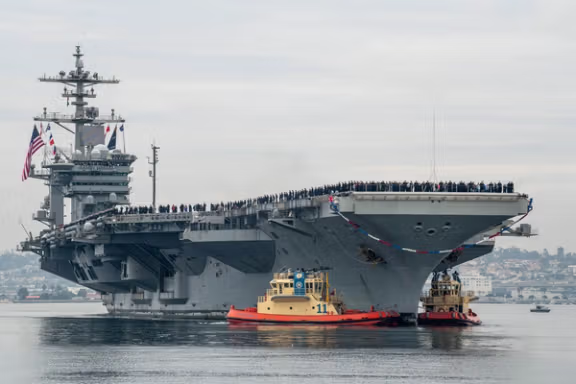
The arrival of the USS Abraham Lincoln aircraft carrier and supporting warships in the region this week broadened Trump’s options.

Open-source tracking and public statements over the past two weeks have pointed to a wider buildup of air, sea and air-defense assets, including deployments designed to support sustained air operations and defend US forces and regional partners against retaliation.

The question of whether a second major naval force could follow has added to the sense of escalation.

A separate carrier strike group, the USS George H.W. Bush, departed Norfolk on January 13, though its destination has not been publicly confirmed.

Analysts tracking force movements have said the Bush’s movements could determine whether the United States intends to maintain one carrier in the region as a deterrent, or assemble a larger package capable of prolonged operations.

Behind the high-level diplomacy and military deployments is a rapidly deteriorating crisis inside Iran that has reshaped Washington’s calculations over the past month.

Protests erupted on December 28 after strikes and demonstrations began in Tehran’s bazaars and spread nationwide, driven initially by economic pressures and rapidly escalating into wider political demands.

Iran’s authorities responded with mass killings and arrests as well as communications restrictions, while the Trump administration warned Tehran against lethal repression.

Trump publicly threatened military action if Iran carried out large-scale executions of protesters, and in mid-January said – without providing evidence – that killings had paused.

The situation then worsened sharply. More than 36,500 Iranians were killed by security forces during the January 8-9 crackdown on nationwide protests, making it the deadliest two-day protest massacre in history, according to documents reviewed by Iran International

Iranian authorities have not released a comprehensive breakdown of protest-related deaths. They have, however, acknowledged several thousand fatalities.

In Tehran, Iranian officials have warned the United States and regional states against military action. Ali Shamkhani, a senior adviser to Iran’s top leadership, said on X that any US military action would be treated as an act of war and would prompt immediate retaliation, including against Israel and what he called those supporting an attack. Iranian officials have also said US bases in the region could be targeted in response.

At the same time, Iranian officials have signaled that indirect diplomacy remains possible even as they reject Washington’s terms.

Trump has not publicly laid out his terms. Past U.S. negotiating demands have included a ban on Iran enriching uranium, limits on long-range ballistic missiles and curbs on Tehran’s network of allied armed groups in the region. Iran has rejected preconditions and says it will negotiate only on equal footing.

A senior Iranian official told Reuters that Iran was preparing for a potential military confrontation while also using diplomatic channels, but said Washington was not showing openness to diplomacy.

Regional reactions

Regional governments are split between fear of Iranian retaliation and concern about Iran’s internal trajectory.

Persian Gulf states that host US forces have pressed Washington against strikes, wary that they would be the first targets in any escalation, according to Reuters.

Saudi Crown Prince Mohammed bin Salman told Iran’s President Masoud Pezeshkian that Riyadh would not allow its airspace to be used for an attack, according to state news agency SPA. Qatar, Oman and Egypt have also lobbied for restraint, Reuters reported.

Israeli officials, while sharing intelligence and planning closely with Washington, have also cautioned that air power alone is unlikely to produce political change in Iran, Reuters reported, and that any transition would depend on internal fractures and organized domestic forces.

“If you're going to topple the regime, you have to put boots on the ground,” a senior Israeli official told Reuters, adding that even if the United States killed Supreme Leader Ali Khamenei, Iran would "have a new leader that will replace him."

For now, US officials say the military buildup is nearing completion and Trump has not closed the door to diplomacy.

But the convergence of high-level visits, an expanded US force posture and the White House’s increasingly explicit linkage between military options and Iran’s internal crackdown has turned a once-remote contingency into an imminent choice for Washington.
Most Viewed

Ghalibaf defends Iran-US talks amid hardline backlash
1
INSIGHT

Ghalibaf defends Iran-US talks amid hardline backlash

2
ANALYSIS

From instability to influence: Pakistan’s pivotal role in US-Iran diplomacy

3
ANALYSIS

100 days on: why Iran’s January protests spread across social classes

4

War-hit homeowners feel abandoned as Iran’s reconstruction aid fades

5
INSIGHT

100 days on: the anatomy of Iran’s January crackdown

Banner
Banner

Spotlight

  • Bread shortages, soaring prices strain households in Iran, residents say
    VOICES FROM IRAN

    Bread shortages, soaring prices strain households in Iran, residents say

  • War-hit homeowners feel abandoned as Iran’s reconstruction aid fades

    War-hit homeowners feel abandoned as Iran’s reconstruction aid fades

  • 100 days on: the anatomy of Iran’s January crackdown
    INSIGHT

    100 days on: the anatomy of Iran’s January crackdown

  • Ghalibaf defends Iran-US talks amid hardline backlash
    INSIGHT

    Ghalibaf defends Iran-US talks amid hardline backlash

  • 100 days on: why Iran’s January protests spread across social classes
    ANALYSIS

    100 days on: why Iran’s January protests spread across social classes

  • From instability to influence: Pakistan’s pivotal role in US-Iran diplomacy
    ANALYSIS

    From instability to influence: Pakistan’s pivotal role in US-Iran diplomacy

  • 36,500 deaths in context: How Iran’s toll compares with wars and crackdowns

    36,500 deaths in context: How Iran’s toll compares with wars and crackdowns

  • Over 36,500 killed in Iran's deadliest massacre, documents reveal

    Over 36,500 killed in Iran's deadliest massacre, documents reveal

•
•
•

More Stories

Trump in Tehran? Former Iranian envoy floats Hail Mary talks to avoid war

Jan 28, 2026, 19:48 GMT+0
•
Behrouz Turani

As the threat of attack by the United States looms, Iranian commentators are sounding the alarm on the existential danger they see to Tehran, with one former envoy even saying US President Donald Trump should be hosted for talks.

Iran’s US- based former ambassador to Germany Hossein Mousavian said that the Iranian President Masoud Pezeshkian should invite Trump to Tehran as a step toward de-escalating tensions which could crescendo into an attack that threatens the Islamic Republic’s rule.

“Trump genuinely wants direct talks with Iran,” he told outlet Ensaf News in an interview.

“Pick up the phone and speak to him. Do not waste time as the situation is critically dangerous … I repeat: if you do not act immediately, Iran may face military confrontation with the United States, Israel, and NATO.”

In a more sober assessment, Iranian political commentator Reza Nasri warned “unlike his predecessors, Trump can wage a swift and clean war against Iran without imposing additional costs on US taxpayers or repeating past mistakes.”

Nasri warned against complacency about some Trump’s more conciliatory messaging, saying “any premature optimism about de-escalation can lead to dangerous miscalculations by lowering the state of alert and imposing heavy costs on Iran’s security.”

The US threat comes after Trump vowed to come to the defense of protestors before authorities unleashed one of the deadliest crackdowns on unrest in modern history, killing thousands.

Nasri, cleaving to the theocracy’s official discourse, described the demonstrations as “one of the most difficult and complex threats in Iran’s recent history and a project aimed at disintegrating the country and collapsing its political system.”

“This project has failed for now,” he added. “But a combination of domestic crisis, foreign threats and economic and psychological warfare still looms.”

Meanwhile, hardline Tehran commentator and social media personality Ali-Akbar Raefipour raised the alarm to an even louder pitch, saying without providing evidence that foreign preparations for a complex armed attack were already underway.

“Mutiny and targeted assassination cells may be activated if Iran is attacked. Their goals include killing prominent individuals and seizing sensitive centers,” he wrote on X.

“In recent days, we have seen equipment flowing into Iran for these groups.”

Iran re-arrests digital security expert once accused of spying for US

Jan 28, 2026, 18:34 GMT+0

Amirhossein (Iman) Seyrafi, a former political prisoner and digital security expert previously accused of spying for the United States, has been arrested amid Iran’s sweeping crackdown on dissent, sources familiar with the matter told Iran International.

Seyrafi was detained on January 26 outside his home in Tehran, they said. Authorities have not issued any statement on his arrest.

An informed source told Iran International he has been accused of cooperating with Israel's foreign intelligence agency Mossad.

Seyrafi had previously been imprisoned on national security-related charges and was released in October 2020 after serving seven years in prison.

Iran’s judiciary had accused him of spying for the United States and “collaboration with a hostile government,” charges frequently used against political detainees, activists and individuals working in sensitive fields like IT.

Human rights organizations have identified Seyrafi as one of dozens of prisoners previously held in Ward 7 of Tehran’s Evin Prison, where detainees facing national security accusations are commonly imprisoned.

A 2019 report by the Human Rights Activists News Agency (HRANA) listed Seyrafi among prisoners charged under Iran’s penal code provisions related to espionage and alleged ties to “enemy states.”

But Seyrafi has also been referenced in international cybersecurity research examining Iran’s early hacker networks.

A report published in 2013 by the ICT Cyber Desk at the Interdisciplinary Center (IDC) Herzliya in Israel identified Seyrafi — also known online as “Iman” or “iM4n” — as the first leader of a hacker group known as the “Emperor Team.”

The report credited him with involvement in the defacement of websites and subdomains belonging to major international platforms, including MSN and Yahoo.

Seyrafi and other members, it added, initially formed the group to gather information before later shifting into what he described in past interviews as “security activities,” including the development of basic cyber tools.

Some of the assertions cited in the report could not be independently verified.

Seyrafi’s rearrest comes amid increasing concern from rights advocates that Iranian authorities are treating digital expertise itself as a national security threat.

Why Turkey fears Iran’s unrest more than its repression

Jan 28, 2026, 17:13 GMT+0
•
Ata Mohamed Tabriz

Iranians’ chants against the Islamic Republic—muted for now by brute force—are viewed in Turkey not as a struggle for freedom but as a geopolitical risk from migration and militancy.

Iran, in this view, is a buffer—a state whose continued cohesion has helped secure Turkey’s eastern borders for decades, whatever its internal circumstances.

The prospect of that buffer weakening alarms Ankara far more than the nature of the demands driving Iran’s unrest.

That approach was underscored on Thursday, when President Recep Tayyip Erdoğan told Iran’s President Masoud Pezeshkian in a phone call that Turkey opposed any foreign intervention in Iran and valued peace and stability in the country.

The message echoed a broader pattern in Ankara’s response: caution, restraint, and a clear preference for preserving the status quo over endorsing political change.

Since the protests began, Turkish officials have framed developments in Iran as the erosion of central authority driven by outside forces.

Senior figures, including Erdoğan and Foreign Minister Hakan Fidan, have described the unrest as a “scripted scenario” and warned against what they portray as foreign efforts to push the region toward chaos.

At the core of this stance lies a long-standing fear that instability in Iran could open space for militant groups along Turkey’s eastern and southern frontiers, even as a peace process with Kurdish militants has made historic progress after decades of combat.

The Syrian precedent

This security-first reading of events reflects a fear expressed from corners of Turkey’s media and academic establishment that if the Islamic Republic were to collapse, Turkey could be next.

As a result, Iran’s protests are often explained away through the language of conspiracy—foreign plots rather than expressions of domestic discontent—making meaningful democratic solidarity between the two societies more difficult at a moment of profound crisis.

Years of economic strain at home and unresolved entanglements in Syria have further heightened Ankara’s sensitivity to instability beyond its borders.

Few Turkish policymakers are eager to risk a scenario that could trigger new refugee flows after the epic out-migration of Syrians fleeing that country's civil war strained Turkey's domestic cohesion and stoked bitter arguments with Europe.

Support for armed insurgents in that war did not render the hosting of millions of Syrian people on Turkish soil any easier, and Turkey has shown no such fondness for any anti-state elements in Iran.

Ankara’s caution has also been shaped by its regional calculations since the war in Gaza. Turkish officials are acutely wary of being seen as aligned with Israel, particularly as Israeli leaders have spoken openly in favor of regime change in Iran.

In Ankara’s reading, Western rhetoric about democracy masks a broader realignment that would ultimately strengthen Israel’s regional position at Turkey’s expense. Weakening Iran, they fear, could expand Israeli influence in ways that leave Turkey strategically exposed.

Some Turkish analysts have warned in recent days that the government should be less concerned about Iran losing a conventional conflict than about what might follow. A weakened Iranian state, they argue, could rely on proxy forces and non-state actors to drag the region into a prolonged, asymmetric struggle.

Fear of what may come next

From this perspective, preventing war in Iran is a strategic necessity. A collapse of authority inside Iran could empower Kurdish groups such as the PKK or its Iranian affiliate, PJAK, and test Turkey’s security more severely than the Syrian civil war ever did.

The fragmentation of Syria remains a vivid reference point: a power vacuum, the emergence of armed enclaves, and a long-term security burden that Ankara is still struggling to manage.

These fears help explain why the refrain “if Iran falls, Turkey is next” has gained traction in Turkish media.

Turkey’s main opposition party, the Republican People’s Party, has largely aligned with the government’s cautious approach. Even media outlets critical of Erdoğan have, at times, reinforced narratives that external actors are driving the violence in Iran.

The relative absence of support from Turkey’s secular movements for protesters in Iran also reflects the limited reach of Iranian opposition groups in neighboring countries.

Turkish officials often say they would prefer an Iran that is more developed and better integrated into the international system. But the uncertainty surrounding Iran’s political trajectory—and the perceived costs of a turbulent transition—continue to outweigh that aspiration.

For now, Ankara’s overriding objective remains stability: not because it approves of Iran’s system, but because it fears what might come after it.

'Rat-Ali': Iran’s protest nickname targets Ali Khamenei’s time underground

Jan 28, 2026, 10:04 GMT+0
•
Arash Sohrabi

Many Iranians on social media have been referring to Supreme Leader Ali Khamenei as ‘Moush-Ali’ (Rat-Ali), a nickname rooted in reports that he has repeatedly gone into underground seclusion and now echoed at rallies inside Iran and in diaspora protests.

The expression gained traction during the 12-day war with Israel in June, when Khamenei largely disappeared from public view amid reports that he had moved into a fortified underground shelter.

While Iranian officials did not confirm his location at the time, state media limited his presence to a pair of prerecorded video statements, which appeared to be filmed from a bunker rather than his office.

Since then, new reports have reinforced the perception of prolonged seclusion.

According to sources who spoke to Iran International on condition of anonymity, Khamenei has again taken refuge in an underground facility in Tehran amid heightened concerns about a potential US strike amid the recent wave of nationwide protests.

The site is described as a fortified complex with interconnected tunnels, with his son, Masoud Khamenei, overseeing day-to-day operations and serving as the main conduit between the leader’s office and the government.

Protesters hold a rat’s head wearing a turban during a rally in support of protests in Iran
100%
Protesters hold a rat’s head wearing a turban during a rally in support of protests in Iran

In Persian, “moush” (rat) is a common metaphor for timidity or avoidance, particularly when someone is perceived as retreating from danger rather than confronting it. By pairing the word with Khamenei’s name, critics draw a sharp contrast between the image he has long cultivated – of a steadfast leader and commander-in-chief – and his physical absence during moments of acute national crisis.

The nickname has also taken on a visual dimension. Protest imagery circulating online depicts rats in clerical robes or emerging from underground tunnels, reinforcing the association between concealment and political weakness.

One chant that includes the term – “Cry out, Moush-Ali, Pahlavi is coming” (Zajjeh Bezan Moush-Ali, Dareh Miad Pahlavi) – links the insult to broader political demands and signals a rejection not only of Khamenei personally, but of the authority structure he represents.

For analysts, the spread of the phrase points to something deeper than mockery. Khamenei’s extended absence during the war, followed by reports that senior officials struggled to reach him directly, has raised questions about leadership visibility and continuity.

While political slogans in Iran have evolved before, the rapid adoption of “Moush-Ali” shows how language becomes a vehicle for social judgment – compressing complex grievances about power, accountability, and legitimacy into a single, resonant word.

In that sense, the term is less about insult than about perception: a reflection of how authority is being re-imagined, contested, and, increasingly, stripped of its aura.

100%
A protester holds a rat doll wearing a turban and bearing the word “Moush-Ali” during a rally in Brussels in support of protests in Iran, January 2026.
100%
A protester holds a rat doll wearing a turban and bearing the word “Moush-Ali” during a rally in Brussels in support of protests in Iran, January 2026.

Wealthy Iranian brothers chose protest and were killed

Jan 28, 2026, 01:53 GMT+0

Brothers Hamid and Vahid Arzanlou were two well-known entrepreneurs in Iran’s furniture industry who despite their wealth still chose to raise their voices in anti-government protests this month and paid with their lives.

During mass killings by security forces in the Tehranpars area east of Tehran on January 9, Hamid Arzanlou was shot in the head and Vahid was shot twice in the neck while trying to save him, according to sources close to the family.

Both brothers later died from their wounds.

At their funeral, a third brother Kiomars Arzanlou asked mourners to clap if they believed his brothers had chosen the right path, and the mourners responded by applauding the two Arzanlou brothers.

According to the sources, security agencies demanded more than one billion tomans (about $6,670) from the relatives in exchange for handing over the bodies.

Hamid and Vahid, the sources added, actively supported and helped organize walkouts during the early days of strikes in Tehran’s central bazaar beginning late last year.

The large‑scale strike on January 7 at the furniture market in the Delavaran district was organized partly through their efforts and became one of the biggest strikes in eastern Tehran.

Sources close to the family say the two brothers were also among the first on the streets on the night of January 8, standing alongside other protesters for hours before security forces unleased a two-day crackdown which killed them along with thousands of other demonstrators.

Hamid and Vahid were owners and managers of the Aysa Mobl Kian furniture company which is one of the best‑known brands in Iran’s furniture industry.

At its peak, this group created jobs for at least one thousand people directly and indirectly and employed about 200 workers directly.

The two brothers hailed from a working‑class family and grew up in Tehran’s Khak‑e Sefid neighborhood and had built up wealth through their hard work and thrift, the sources added.

Vahid was the father of three children while Hamid is leaves behind two young children. Their mother, 68, survives them.