An Iranian protester holds an effigy depicting Supreme Leader Ali Khamenei with a rat’s head during a rally in Adelaide, Australia, in support of protests in Iran, January 2026.
Many Iranians on social media have been referring to Supreme Leader Ali Khamenei as ‘Moush-Ali’ (Rat-Ali), a nickname rooted in reports that he has repeatedly gone into underground seclusion and now echoed at rallies inside Iran and in diaspora protests.
The expression gained traction during the 12-day war with Israel in June, when Khamenei largely disappeared from public view amid reports that he had moved into a fortified underground shelter.
While Iranian officials did not confirm his location at the time, state media limited his presence to a pair of prerecorded video statements, which appeared to be filmed from a bunker rather than his office.
Since then, new reports have reinforced the perception of prolonged seclusion.
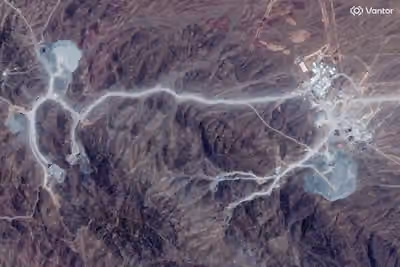
According to sources who spoke to Iran International on condition of anonymity, Khamenei has again taken refuge in an underground facility in Tehran amid heightened concerns about a potential US strike amid the recent wave of nationwide protests.
The site is described as a fortified complex with interconnected tunnels, with his son, Masoud Khamenei, overseeing day-to-day operations and serving as the main conduit between the leader’s office and the government.
Protesters hold a rat’s head wearing a turban during a rally in support of protests in Iran
In Persian, “moush” (rat) is a common metaphor for timidity or avoidance, particularly when someone is perceived as retreating from danger rather than confronting it. By pairing the word with Khamenei’s name, critics draw a sharp contrast between the image he has long cultivated – of a steadfast leader and commander-in-chief – and his physical absence during moments of acute national crisis.
The nickname has also taken on a visual dimension. Protest imagery circulating online depicts rats in clerical robes or emerging from underground tunnels, reinforcing the association between concealment and political weakness.
One chant that includes the term – “Cry out, Moush-Ali, Pahlavi is coming” (Zajjeh Bezan Moush-Ali, Dareh Miad Pahlavi) – links the insult to broader political demands and signals a rejection not only of Khamenei personally, but of the authority structure he represents.
For analysts, the spread of the phrase points to something deeper than mockery. Khamenei’s extended absence during the war, followed by reports that senior officials struggled to reach him directly, has raised questions about leadership visibility and continuity.
While political slogans in Iran have evolved before, the rapid adoption of “Moush-Ali” shows how language becomes a vehicle for social judgment – compressing complex grievances about power, accountability, and legitimacy into a single, resonant word.
In that sense, the term is less about insult than about perception: a reflection of how authority is being re-imagined, contested, and, increasingly, stripped of its aura.
A protester holds a rat doll wearing a turban and bearing the word “Moush-Ali” during a rally in Brussels in support of protests in Iran, January 2026.