• العربية
  • فارسی
Brand
  • Iran Insight
  • Politics
  • Economy
  • Analysis
  • Special Report
  • Opinion
  • Podcast
  • Iran Insight
  • Politics
  • Economy
  • Analysis
  • Special Report
  • Opinion
  • Podcast
  • Theme
  • Language
    • العربية
    • فارسی
  • Iran Insight
  • Politics
  • Economy
  • Analysis
  • Special Report
  • Opinion
  • Podcast
All rights reserved for Volant Media UK Limited
volant media logo

Trump in Tehran? Former Iranian envoy floats Hail Mary talks to avoid war

Behrouz Turani
Behrouz Turani

Iran International

Jan 28, 2026, 19:48 GMT+0
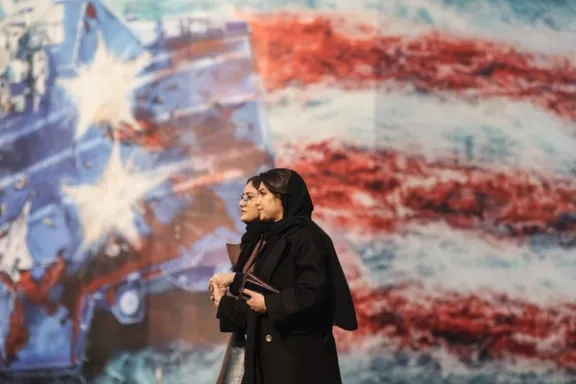
Two women walk past a banner posted by authorities in a main Tehran square depicting an Iranian attack on a US aircraft carrier

As the threat of attack by the United States looms, Iranian commentators are sounding the alarm on the existential danger they see to Tehran, with one former envoy even saying US President Donald Trump should be hosted for talks.

Iran’s US- based former ambassador to Germany Hossein Mousavian said that the Iranian President Masoud Pezeshkian should invite Trump to Tehran as a step toward de-escalating tensions which could crescendo into an attack that threatens the Islamic Republic’s rule.

“Trump genuinely wants direct talks with Iran,” he told outlet Ensaf News in an interview.

“Pick up the phone and speak to him. Do not waste time as the situation is critically dangerous … I repeat: if you do not act immediately, Iran may face military confrontation with the United States, Israel, and NATO.”

In a more sober assessment, Iranian political commentator Reza Nasri warned “unlike his predecessors, Trump can wage a swift and clean war against Iran without imposing additional costs on US taxpayers or repeating past mistakes.”

Nasri warned against complacency about some Trump’s more conciliatory messaging, saying “any premature optimism about de-escalation can lead to dangerous miscalculations by lowering the state of alert and imposing heavy costs on Iran’s security.”

The US threat comes after Trump vowed to come to the defense of protestors before authorities unleashed one of the deadliest crackdowns on unrest in modern history, killing thousands.

Nasri, cleaving to the theocracy’s official discourse, described the demonstrations as “one of the most difficult and complex threats in Iran’s recent history and a project aimed at disintegrating the country and collapsing its political system.”

“This project has failed for now,” he added. “But a combination of domestic crisis, foreign threats and economic and psychological warfare still looms.”

Meanwhile, hardline Tehran commentator and social media personality Ali-Akbar Raefipour raised the alarm to an even louder pitch, saying without providing evidence that foreign preparations for a complex armed attack were already underway.

“Mutiny and targeted assassination cells may be activated if Iran is attacked. Their goals include killing prominent individuals and seizing sensitive centers,” he wrote on X.

“In recent days, we have seen equipment flowing into Iran for these groups.”

Most Viewed

100 days after carnage: Iran economy reels from war, inflation, unemployment
1
INSIGHT

100 days after carnage: Iran economy reels from war, inflation, unemployment

2
INSIGHT

Ghalibaf defends Iran-US talks amid hardline backlash

3
EXCLUSIVE

Iranian assaulted in London amid concern over threats to regime critics

4

IRGC fires at Indian vessel in Hormuz

5
INSIGHT

A nation in limbo: 100 days after the massacre, has the world moved on?

Banner
Banner

Spotlight

  • War-hit homeowners feel abandoned as Iran’s reconstruction aid fades

    War-hit homeowners feel abandoned as Iran’s reconstruction aid fades

  • 100 days on: the anatomy of Iran’s January crackdown
    INSIGHT

    100 days on: the anatomy of Iran’s January crackdown

  • Ghalibaf defends Iran-US talks amid hardline backlash
    INSIGHT

    Ghalibaf defends Iran-US talks amid hardline backlash

  • 100 days on: why Iran’s January protests spread across social classes
    ANALYSIS

    100 days on: why Iran’s January protests spread across social classes

  • From instability to influence: Pakistan’s pivotal role in US-Iran diplomacy
    ANALYSIS

    From instability to influence: Pakistan’s pivotal role in US-Iran diplomacy

  • A nation in limbo: 100 days after the massacre, has the world moved on?
    INSIGHT

    A nation in limbo: 100 days after the massacre, has the world moved on?

•
•
•

More Stories

Iran re-arrests digital security expert once accused of spying for US

Jan 28, 2026, 18:34 GMT+0

Amirhossein (Iman) Seyrafi, a former political prisoner and digital security expert previously accused of spying for the United States, has been arrested amid Iran’s sweeping crackdown on dissent, sources familiar with the matter told Iran International.

Seyrafi was detained on January 26 outside his home in Tehran, they said. Authorities have not issued any statement on his arrest.

An informed source told Iran International he has been accused of cooperating with Israel's foreign intelligence agency Mossad.

Seyrafi had previously been imprisoned on national security-related charges and was released in October 2020 after serving seven years in prison.

Iran’s judiciary had accused him of spying for the United States and “collaboration with a hostile government,” charges frequently used against political detainees, activists and individuals working in sensitive fields like IT.

Human rights organizations have identified Seyrafi as one of dozens of prisoners previously held in Ward 7 of Tehran’s Evin Prison, where detainees facing national security accusations are commonly imprisoned.

A 2019 report by the Human Rights Activists News Agency (HRANA) listed Seyrafi among prisoners charged under Iran’s penal code provisions related to espionage and alleged ties to “enemy states.”

But Seyrafi has also been referenced in international cybersecurity research examining Iran’s early hacker networks.

A report published in 2013 by the ICT Cyber Desk at the Interdisciplinary Center (IDC) Herzliya in Israel identified Seyrafi — also known online as “Iman” or “iM4n” — as the first leader of a hacker group known as the “Emperor Team.”

The report credited him with involvement in the defacement of websites and subdomains belonging to major international platforms, including MSN and Yahoo.

Seyrafi and other members, it added, initially formed the group to gather information before later shifting into what he described in past interviews as “security activities,” including the development of basic cyber tools.

Some of the assertions cited in the report could not be independently verified.

Seyrafi’s rearrest comes amid increasing concern from rights advocates that Iranian authorities are treating digital expertise itself as a national security threat.

Why Turkey fears Iran’s unrest more than its repression

Jan 28, 2026, 17:13 GMT+0
•
Ata Mohamed Tabriz

Iranians’ chants against the Islamic Republic—muted for now by brute force—are viewed in Turkey not as a struggle for freedom but as a geopolitical risk from migration and militancy.

Iran, in this view, is a buffer—a state whose continued cohesion has helped secure Turkey’s eastern borders for decades, whatever its internal circumstances.

The prospect of that buffer weakening alarms Ankara far more than the nature of the demands driving Iran’s unrest.

That approach was underscored on Thursday, when President Recep Tayyip Erdoğan told Iran’s President Masoud Pezeshkian in a phone call that Turkey opposed any foreign intervention in Iran and valued peace and stability in the country.

The message echoed a broader pattern in Ankara’s response: caution, restraint, and a clear preference for preserving the status quo over endorsing political change.

Since the protests began, Turkish officials have framed developments in Iran as the erosion of central authority driven by outside forces.

Senior figures, including Erdoğan and Foreign Minister Hakan Fidan, have described the unrest as a “scripted scenario” and warned against what they portray as foreign efforts to push the region toward chaos.

At the core of this stance lies a long-standing fear that instability in Iran could open space for militant groups along Turkey’s eastern and southern frontiers, even as a peace process with Kurdish militants has made historic progress after decades of combat.

The Syrian precedent

This security-first reading of events reflects a fear expressed from corners of Turkey’s media and academic establishment that if the Islamic Republic were to collapse, Turkey could be next.

As a result, Iran’s protests are often explained away through the language of conspiracy—foreign plots rather than expressions of domestic discontent—making meaningful democratic solidarity between the two societies more difficult at a moment of profound crisis.

Years of economic strain at home and unresolved entanglements in Syria have further heightened Ankara’s sensitivity to instability beyond its borders.

Few Turkish policymakers are eager to risk a scenario that could trigger new refugee flows after the epic out-migration of Syrians fleeing that country's civil war strained Turkey's domestic cohesion and stoked bitter arguments with Europe.

Support for armed insurgents in that war did not render the hosting of millions of Syrian people on Turkish soil any easier, and Turkey has shown no such fondness for any anti-state elements in Iran.

Ankara’s caution has also been shaped by its regional calculations since the war in Gaza. Turkish officials are acutely wary of being seen as aligned with Israel, particularly as Israeli leaders have spoken openly in favor of regime change in Iran.

In Ankara’s reading, Western rhetoric about democracy masks a broader realignment that would ultimately strengthen Israel’s regional position at Turkey’s expense. Weakening Iran, they fear, could expand Israeli influence in ways that leave Turkey strategically exposed.

Some Turkish analysts have warned in recent days that the government should be less concerned about Iran losing a conventional conflict than about what might follow. A weakened Iranian state, they argue, could rely on proxy forces and non-state actors to drag the region into a prolonged, asymmetric struggle.

Fear of what may come next

From this perspective, preventing war in Iran is a strategic necessity. A collapse of authority inside Iran could empower Kurdish groups such as the PKK or its Iranian affiliate, PJAK, and test Turkey’s security more severely than the Syrian civil war ever did.

The fragmentation of Syria remains a vivid reference point: a power vacuum, the emergence of armed enclaves, and a long-term security burden that Ankara is still struggling to manage.

These fears help explain why the refrain “if Iran falls, Turkey is next” has gained traction in Turkish media.

Turkey’s main opposition party, the Republican People’s Party, has largely aligned with the government’s cautious approach. Even media outlets critical of Erdoğan have, at times, reinforced narratives that external actors are driving the violence in Iran.

The relative absence of support from Turkey’s secular movements for protesters in Iran also reflects the limited reach of Iranian opposition groups in neighboring countries.

Turkish officials often say they would prefer an Iran that is more developed and better integrated into the international system. But the uncertainty surrounding Iran’s political trajectory—and the perceived costs of a turbulent transition—continue to outweigh that aspiration.

For now, Ankara’s overriding objective remains stability: not because it approves of Iran’s system, but because it fears what might come after it.

Turkey arrests six over Iran-linked spying, drone plans

Jan 28, 2026, 12:12 GMT+0

Turkish intelligence arrested six people over a suspected Iran-linked espionage cell accused of gathering sensitive military and security information, the Daily Sabah newspaper reported on Wednesday.

The cell carried out reconnaissance around the Incirlik air base in southern Turkey and used commercial activity as cover, the paper said.

Investigators said the network was directed by Iranian intelligence officers Najaf Rostami, known as “Haji,” and Mahdi Yekeh Dehghan, referred to as “Doctor,” according to Daily Sabah.

The investigation found that one of the suspects, Iranian national Ashkan Jalali, based in Ankara, planned the transfer of armed unmanned aerial vehicles from Turkey to the Turkish Republic of Northern Cyprus and the Greek Cypriot administration through companies he owned, Bulaq Robotics and Arete Industries, it said.

Jalali and another suspect, Alican Koç, attended specialized drone training sessions in Iran in August and September 2025, according to the report.

Police detained defense industry company owners Erhan Ergelen and Taner Özcan, textile businessperson Cemal Beyaz, Remzi Beyaz, Koç and Jalali in Istanbul-centered raids. An Istanbul court later arrested all six on charges of “obtaining confidential state information for political or military espionage,” Daily Sabah said.

The paper said Ergelen and Özcan traveled to Iran in October 2025 and played roles in drone shipment plans to Greek Cyprus. In testimony, Remzi Beyaz said he was offered money to take part in assassination plots targeting Iranian dissidents.

The network used encrypted messaging under the code name “Güvercin” and financed its activities by disguising operations as commercial drone trade, the paper added.

US deports three former IRGC members, ICE says

Jan 28, 2026, 07:53 GMT+0

The United States has deported three former members of Iran’s Islamic Revolutionary Guard Corps (IRGC), US Immigration and Customs Enforcement (ICE) said in a post on X.

“Foreign terrorist organizers are NOT welcome in our country,” ICE wrote, announcing that Ehsan Khaledi, Mohammad Mehrani and Morteza Nasirikakolaki were returned to Iran over the weekend.

The Department of Homeland Security (DHS) identified the three men as former IRGC members and said they were among 14 Iranian nationals on a deportation flight to Tehran, the first such flight since widespread anti-government protests in Iran were met with a deadly crackdown.

According to DHS, Mehrani and Khaledi entered the United States illegally in Southern California in 2024, while Nasirikakolaki entered illegally in November 2024 and was apprehended by Border Patrol near San Luis, Arizona. The White House said all individuals deported had final removal orders issued by a federal judge.

The IRGC is Iran’s elite military force, separate from the regular army and reporting directly to Supreme Leader Ali Khamenei. The United States designated the IRGC as a foreign terrorist organization in 2019, citing its role in supporting militant groups and carrying out operations targeting US interests and allies.

The deportations come amid sharply rising tensions between Washington and Tehran, as the Trump administration has signaled it is prepared to use military force if Iran continues executions and violent repression linked to nationwide protests. The United States has also stepped up its military presence in the region in recent weeks.

Iran judiciary says man convicted of spying for Israel’s Mossad was executed

Jan 28, 2026, 07:22 GMT+0

Iran’s judiciary said on Wednesday it executed a man it identified as Hamidreza Sabet Esmailipour, whom it accused of spying for Israel’s intelligence service, Mossad, after his death sentence was upheld by the Supreme Court.

The judiciary identified him as Hamidreza Sabet Esmailipour and said he was arrested on April 29, 2025. It said he was convicted of “espionage and intelligence cooperation,” alleging he communicated with an intelligence officer and handed over documents and classified information.

In a detailed account published by Mizan, the judiciary’s official media outlet, authorities said Sabet Esmailipour had carried out logistical and support tasks for what they described as Israeli intelligence operations, including moving vehicles between provinces and transferring funds. The report alleged some of the vehicles contained explosives intended for sabotage operations, claims that could not be independently verified.

Mizan said the man acknowledged cooperating with Mossad during interrogations and court proceedings, and that his death sentence was upheld by Iran’s Supreme Court before being carried out by hanging.

  • Iran hangs man accused of spying for Mossad

    Iran hangs man accused of spying for Mossad

  • Iran publicly executes man on alleged murder charges

    Iran publicly executes man on alleged murder charges

Iran has executed more than a dozen people in recent months on charges of spying for Israel, cases that human rights groups say often involve opaque legal proceedings.

Iranian authorities have said more than 700 people were detained on suspicion of espionage or collaboration with Israel following the conflict in June.

US-based rights group HRANA said in a report earlier this month that at least 313 prisoners were executed by hanging during a period of nationwide protests between late December and late January, adding that executions surged alongside mass arrests and a security crackdown as unrest spread and internet access was widely restricted.






