• العربية
  • فارسی
Brand
  • Iran Insight
  • Politics
  • Economy
  • Analysis
  • Special Report
  • Opinion
  • Podcast
  • Iran Insight
  • Politics
  • Economy
  • Analysis
  • Special Report
  • Opinion
  • Podcast
  • Theme
  • Language
    • العربية
    • فارسی
  • Iran Insight
  • Politics
  • Economy
  • Analysis
  • Special Report
  • Opinion
  • Podcast
All rights reserved for Volant Media UK Limited
volant media logo
ANALYSIS

Why Turkey fears Iran’s unrest more than its repression

Ata Mohamed Tabriz
Ata Mohamed Tabriz

Iran analyst

Jan 28, 2026, 17:13 GMT+0
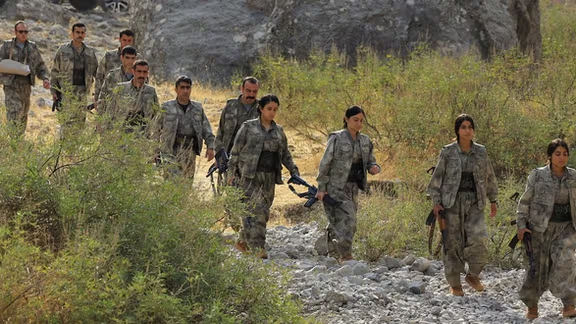
Fighters with the Kurdistan Workers' Party (PKK) walk for a disarmament ceremony marking a significant step toward ending the decades-long conflict between Turkey and the outlawed group, in the Qandil mountains, Iraq October 26, 2025.

Iranians’ chants against the Islamic Republic—muted for now by brute force—are viewed in Turkey not as a struggle for freedom but as a geopolitical risk from migration and militancy.

Iran, in this view, is a buffer—a state whose continued cohesion has helped secure Turkey’s eastern borders for decades, whatever its internal circumstances.

The prospect of that buffer weakening alarms Ankara far more than the nature of the demands driving Iran’s unrest.

That approach was underscored on Thursday, when President Recep Tayyip Erdoğan told Iran’s President Masoud Pezeshkian in a phone call that Turkey opposed any foreign intervention in Iran and valued peace and stability in the country.

The message echoed a broader pattern in Ankara’s response: caution, restraint, and a clear preference for preserving the status quo over endorsing political change.

Since the protests began, Turkish officials have framed developments in Iran as the erosion of central authority driven by outside forces.

Senior figures, including Erdoğan and Foreign Minister Hakan Fidan, have described the unrest as a “scripted scenario” and warned against what they portray as foreign efforts to push the region toward chaos.

At the core of this stance lies a long-standing fear that instability in Iran could open space for militant groups along Turkey’s eastern and southern frontiers, even as a peace process with Kurdish militants has made historic progress after decades of combat.

The Syrian precedent

This security-first reading of events reflects a fear expressed from corners of Turkey’s media and academic establishment that if the Islamic Republic were to collapse, Turkey could be next.

As a result, Iran’s protests are often explained away through the language of conspiracy—foreign plots rather than expressions of domestic discontent—making meaningful democratic solidarity between the two societies more difficult at a moment of profound crisis.

Years of economic strain at home and unresolved entanglements in Syria have further heightened Ankara’s sensitivity to instability beyond its borders.

Few Turkish policymakers are eager to risk a scenario that could trigger new refugee flows after the epic out-migration of Syrians fleeing that country's civil war strained Turkey's domestic cohesion and stoked bitter arguments with Europe.

Support for armed insurgents in that war did not render the hosting of millions of Syrian people on Turkish soil any easier, and Turkey has shown no such fondness for any anti-state elements in Iran.

Ankara’s caution has also been shaped by its regional calculations since the war in Gaza. Turkish officials are acutely wary of being seen as aligned with Israel, particularly as Israeli leaders have spoken openly in favor of regime change in Iran.

In Ankara’s reading, Western rhetoric about democracy masks a broader realignment that would ultimately strengthen Israel’s regional position at Turkey’s expense. Weakening Iran, they fear, could expand Israeli influence in ways that leave Turkey strategically exposed.

Some Turkish analysts have warned in recent days that the government should be less concerned about Iran losing a conventional conflict than about what might follow. A weakened Iranian state, they argue, could rely on proxy forces and non-state actors to drag the region into a prolonged, asymmetric struggle.

Fear of what may come next

From this perspective, preventing war in Iran is a strategic necessity. A collapse of authority inside Iran could empower Kurdish groups such as the PKK or its Iranian affiliate, PJAK, and test Turkey’s security more severely than the Syrian civil war ever did.

The fragmentation of Syria remains a vivid reference point: a power vacuum, the emergence of armed enclaves, and a long-term security burden that Ankara is still struggling to manage.

These fears help explain why the refrain “if Iran falls, Turkey is next” has gained traction in Turkish media.

Turkey’s main opposition party, the Republican People’s Party, has largely aligned with the government’s cautious approach. Even media outlets critical of Erdoğan have, at times, reinforced narratives that external actors are driving the violence in Iran.

The relative absence of support from Turkey’s secular movements for protesters in Iran also reflects the limited reach of Iranian opposition groups in neighboring countries.

Turkish officials often say they would prefer an Iran that is more developed and better integrated into the international system. But the uncertainty surrounding Iran’s political trajectory—and the perceived costs of a turbulent transition—continue to outweigh that aspiration.

For now, Ankara’s overriding objective remains stability: not because it approves of Iran’s system, but because it fears what might come after it.

Most Viewed

Iran diplomacy wobbles as factions compete to avoid looking soft on US
1
INSIGHT

Iran diplomacy wobbles as factions compete to avoid looking soft on US

2

IRGC-linked media hints at threat to Persian Gulf undersea internet cables

3
ANALYSIS

The politics of pink: how Iran uses cuteness to rebrand violence

4

Iran Guards say two ships seized in Hormuz after ceasefire extension

5
EXCLUSIVE

Strikes on petrochemical hubs leave Iran short of plastics

Banner
Banner

Spotlight

  • As Tehran digs in, ordinary Iranians pay the price
    INSIGHT

    As Tehran digs in, ordinary Iranians pay the price

  • Internet Pro or Censor Pro? Iran rolls out a new service
    ANALYSIS

    Internet Pro or Censor Pro? Iran rolls out a new service

  • Strikes on petrochemical hubs leave Iran short of plastics
    EXCLUSIVE

    Strikes on petrochemical hubs leave Iran short of plastics

  • Diplomacy tolls at Hormuz as conflict returns to its doorstep
    OPINION

    Diplomacy tolls at Hormuz as conflict returns to its doorstep

  • Opposition to US talks grows in Tehran as ceasefire deadline nears
    INSIGHT

    Opposition to US talks grows in Tehran as ceasefire deadline nears

  • The future has been switched off here
    TEHRAN INSIDER

    The future has been switched off here

•
•
•

More Stories

Turkey arrests six over Iran-linked spying, drone plans

Jan 28, 2026, 12:12 GMT+0

Turkish intelligence arrested six people over a suspected Iran-linked espionage cell accused of gathering sensitive military and security information, the Daily Sabah newspaper reported on Wednesday.

The cell carried out reconnaissance around the Incirlik air base in southern Turkey and used commercial activity as cover, the paper said.

Investigators said the network was directed by Iranian intelligence officers Najaf Rostami, known as “Haji,” and Mahdi Yekeh Dehghan, referred to as “Doctor,” according to Daily Sabah.

The investigation found that one of the suspects, Iranian national Ashkan Jalali, based in Ankara, planned the transfer of armed unmanned aerial vehicles from Turkey to the Turkish Republic of Northern Cyprus and the Greek Cypriot administration through companies he owned, Bulaq Robotics and Arete Industries, it said.

Jalali and another suspect, Alican Koç, attended specialized drone training sessions in Iran in August and September 2025, according to the report.

Police detained defense industry company owners Erhan Ergelen and Taner Özcan, textile businessperson Cemal Beyaz, Remzi Beyaz, Koç and Jalali in Istanbul-centered raids. An Istanbul court later arrested all six on charges of “obtaining confidential state information for political or military espionage,” Daily Sabah said.

The paper said Ergelen and Özcan traveled to Iran in October 2025 and played roles in drone shipment plans to Greek Cyprus. In testimony, Remzi Beyaz said he was offered money to take part in assassination plots targeting Iranian dissidents.

The network used encrypted messaging under the code name “Güvercin” and financed its activities by disguising operations as commercial drone trade, the paper added.

'Rat-Ali': Iran’s protest nickname targets Ali Khamenei’s time underground

Jan 28, 2026, 10:04 GMT+0
•
Arash Sohrabi

Many Iranians on social media have been referring to Supreme Leader Ali Khamenei as ‘Moush-Ali’ (Rat-Ali), a nickname rooted in reports that he has repeatedly gone into underground seclusion and now echoed at rallies inside Iran and in diaspora protests.

The expression gained traction during the 12-day war with Israel in June, when Khamenei largely disappeared from public view amid reports that he had moved into a fortified underground shelter.

While Iranian officials did not confirm his location at the time, state media limited his presence to a pair of prerecorded video statements, which appeared to be filmed from a bunker rather than his office.

Since then, new reports have reinforced the perception of prolonged seclusion.

According to sources who spoke to Iran International on condition of anonymity, Khamenei has again taken refuge in an underground facility in Tehran amid heightened concerns about a potential US strike amid the recent wave of nationwide protests.

The site is described as a fortified complex with interconnected tunnels, with his son, Masoud Khamenei, overseeing day-to-day operations and serving as the main conduit between the leader’s office and the government.

Protesters hold a rat’s head wearing a turban during a rally in support of protests in Iran
100%
Protesters hold a rat’s head wearing a turban during a rally in support of protests in Iran

In Persian, “moush” (rat) is a common metaphor for timidity or avoidance, particularly when someone is perceived as retreating from danger rather than confronting it. By pairing the word with Khamenei’s name, critics draw a sharp contrast between the image he has long cultivated – of a steadfast leader and commander-in-chief – and his physical absence during moments of acute national crisis.

The nickname has also taken on a visual dimension. Protest imagery circulating online depicts rats in clerical robes or emerging from underground tunnels, reinforcing the association between concealment and political weakness.

One chant that includes the term – “Cry out, Moush-Ali, Pahlavi is coming” (Zajjeh Bezan Moush-Ali, Dareh Miad Pahlavi) – links the insult to broader political demands and signals a rejection not only of Khamenei personally, but of the authority structure he represents.

For analysts, the spread of the phrase points to something deeper than mockery. Khamenei’s extended absence during the war, followed by reports that senior officials struggled to reach him directly, has raised questions about leadership visibility and continuity.

While political slogans in Iran have evolved before, the rapid adoption of “Moush-Ali” shows how language becomes a vehicle for social judgment – compressing complex grievances about power, accountability, and legitimacy into a single, resonant word.

In that sense, the term is less about insult than about perception: a reflection of how authority is being re-imagined, contested, and, increasingly, stripped of its aura.

100%
A protester holds a rat doll wearing a turban and bearing the word “Moush-Ali” during a rally in Brussels in support of protests in Iran, January 2026.
100%
A protester holds a rat doll wearing a turban and bearing the word “Moush-Ali” during a rally in Brussels in support of protests in Iran, January 2026.

US deports three former IRGC members, ICE says

Jan 28, 2026, 07:53 GMT+0

The United States has deported three former members of Iran’s Islamic Revolutionary Guard Corps (IRGC), US Immigration and Customs Enforcement (ICE) said in a post on X.

“Foreign terrorist organizers are NOT welcome in our country,” ICE wrote, announcing that Ehsan Khaledi, Mohammad Mehrani and Morteza Nasirikakolaki were returned to Iran over the weekend.

The Department of Homeland Security (DHS) identified the three men as former IRGC members and said they were among 14 Iranian nationals on a deportation flight to Tehran, the first such flight since widespread anti-government protests in Iran were met with a deadly crackdown.

According to DHS, Mehrani and Khaledi entered the United States illegally in Southern California in 2024, while Nasirikakolaki entered illegally in November 2024 and was apprehended by Border Patrol near San Luis, Arizona. The White House said all individuals deported had final removal orders issued by a federal judge.

The IRGC is Iran’s elite military force, separate from the regular army and reporting directly to Supreme Leader Ali Khamenei. The United States designated the IRGC as a foreign terrorist organization in 2019, citing its role in supporting militant groups and carrying out operations targeting US interests and allies.

The deportations come amid sharply rising tensions between Washington and Tehran, as the Trump administration has signaled it is prepared to use military force if Iran continues executions and violent repression linked to nationwide protests. The United States has also stepped up its military presence in the region in recent weeks.

Wealthy Iranian brothers chose protest and were killed

Jan 28, 2026, 01:53 GMT+0

Brothers Hamid and Vahid Arzanlou were two well-known entrepreneurs in Iran’s furniture industry who despite their wealth still chose to raise their voices in anti-government protests this month and paid with their lives.

During mass killings by security forces in the Tehranpars area east of Tehran on January 9, Hamid Arzanlou was shot in the head and Vahid was shot twice in the neck while trying to save him, according to sources close to the family.

Both brothers later died from their wounds.

At their funeral, a third brother Kiomars Arzanlou asked mourners to clap if they believed his brothers had chosen the right path, and the mourners responded by applauding the two Arzanlou brothers.

According to the sources, security agencies demanded more than one billion tomans (about $6,670) from the relatives in exchange for handing over the bodies.

Hamid and Vahid, the sources added, actively supported and helped organize walkouts during the early days of strikes in Tehran’s central bazaar beginning late last year.

The large‑scale strike on January 7 at the furniture market in the Delavaran district was organized partly through their efforts and became one of the biggest strikes in eastern Tehran.

Sources close to the family say the two brothers were also among the first on the streets on the night of January 8, standing alongside other protesters for hours before security forces unleased a two-day crackdown which killed them along with thousands of other demonstrators.

Hamid and Vahid were owners and managers of the Aysa Mobl Kian furniture company which is one of the best‑known brands in Iran’s furniture industry.

At its peak, this group created jobs for at least one thousand people directly and indirectly and employed about 200 workers directly.

The two brothers hailed from a working‑class family and grew up in Tehran’s Khak‑e Sefid neighborhood and had built up wealth through their hard work and thrift, the sources added.

Vahid was the father of three children while Hamid is leaves behind two young children. Their mother, 68, survives them.

A protester’s final wish: 'Bury me wrapped in the lion and sun flag'

Jan 27, 2026, 21:17 GMT+0
•
Azadeh Akbari

Mojtaba (Shahmorad) Shahpari, a protester from the southwestern Iranian city of Izeh who was injured during the nationwide protests and later found dead in a cold storage warehouse in Isfahan, was laid to rest wrapped in the lion and sun flag, fulfilling his final wish.

Shahpari was shot by security forces on January 8, 2026, during protests in Baharestan, Isfahan province, people familiar with the matter told Iran International.

The sources, who asked not to be named for fear of retaliation, said security forces opened fire indiscriminately on protesters that night.

“They opened fire on everyone that night, men and women, young and old,” the source said.

Videos sent to Iran International show gunshots being heard as protesters chant “long live the King” in Baharestan on January 8.

Security forces shot Shahpari in the leg on Isar Street in Baharestan sometime between 8:30 p.m. and 9 p.m. local time, causing him to fall to the ground, a source said.

Wounded but alive, he was taken by ambulance to Al-Zahra Hospital in Isfahan.

“He was not dead when he was taken to hospital,” the source added.

For days afterward, Shahpari’s family searched hospitals across Isfahan. Authorities repeatedly told them he was wounded and alive but refused to say where he was, the source said.

“Then there was nothing. No answers.”

Three days later, the family’s search ended near Bagh-e Rezvan cemetery, Isfahan’s main burial ground.

With the cemetery morgue full, bodies were being kept in a storage warehouse used for fruit and vegetables near Bagh-e Rezvan cemetery, the source said.

“There was no space ... They had put the bodies in a warehouse. As far as the eye could see, there were bodies,” putting the total at a minimum of 500.

When the body was found, a gunshot wound was visible on the side of his head, which the source said was not present when he was taken to hospital.

The source said they believed it was a gunshot to execute him and that he had been operated upon on his abdomen without his family's knowledge and later stitched back up.

About 18 miles southeast of Baharestan, also in Isfahan province, in the provincial capital, another source told Iran International that at the height of protests, “several containers of bodies” were brought to Bagh-e Rezvan in the middle of the night and unloaded into warehouses.

According to the source, some of the bodies were still alive and semi-conscious.

100%

Shahpari, 32, was originally from Izeh in Khuzestan province in southwestern Iran, but had moved to Baharestan in search of work.

To support himself, he worked nights as a building security guard and spent his days unloading cargo as a laborer.

“He was a freedom-seeker,” a source said. “He opposed religion and supported the monarchy.”

Shahpari was buried on January 18, 2026, in the village of Nashil-e Do near Izeh.

“He was buried wrapped in the lion and sun flag, just as he wished...just as we all do.”