• العربية
  • فارسی
Brand
  • Iran Insight
  • Politics
  • Economy
  • Analysis
  • Special Report
  • Opinion
  • Podcast
  • Iran Insight
  • Politics
  • Economy
  • Analysis
  • Special Report
  • Opinion
  • Podcast
  • Theme
  • Language
    • العربية
    • فارسی
  • Iran Insight
  • Politics
  • Economy
  • Analysis
  • Special Report
  • Opinion
  • Podcast
All rights reserved for Volant Media UK Limited
volant media logo

Dozens arrested as Iran truckers’ strike enters third week

Jun 6, 2025, 09:25 GMT+1Updated: 11:55 GMT+1
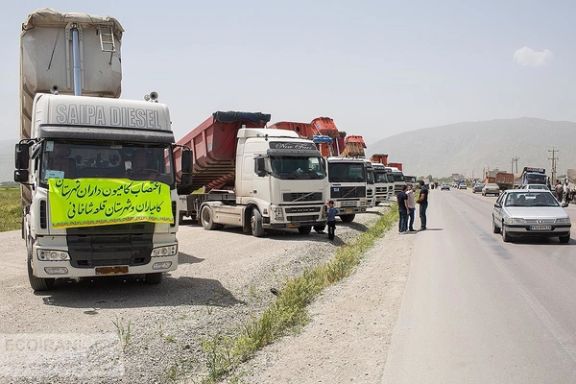
A row of parked trucks lines the side of a highway in Iran, with a banner on one vehicle declaring participation in the nationwide truckers’ strike.

Iranian authorities have arrested more than 40 people, including truck drivers and supporters of a growing nationwide truckers’ strike, according to the Human Rights Activists News Agency (HRANA).

The detentions span several provinces, including Kurdistan, Gilan, Fars, Qazvin, and Kermanshah, and involve both striking drivers and citizens accused of promoting the protests online or documenting blockades.

The strike began on May 22 in the southern port city of Bandar Abbas, triggered by mounting frustrations over rising costs, falling freight rates, fuel restrictions, and lack of state support. The movement quickly spread, and the Alliance of Iran Truckers and Truck Drivers’ Unions (AITTD) now says drivers in at least 155 cities and towns are participating.

Those arrested include named individuals such as Farzad Rezaei, Zanko Rostami, Rezgar Moradi, Sediq Mohammadi, Ata Aziri, Alireza Faghfoori, and Shahab Darabi—who has reportedly been released. Authorities in Qazvin said nine people were detained for allegedly disrupting traffic and posting videos on social media. In some cases, state media aired what appeared to be forced confessions.

The Center for Human Rights in Iran (CHRI) has called the strike “the largest labor protest in recent years,” citing it as evidence of growing discontent over the country’s deepening economic crisis.

Most Viewed

US blockade enters murky phase as tankers spoof signals and buyers hesitate
1
ANALYSIS

US blockade enters murky phase as tankers spoof signals and buyers hesitate

2

US tightens financial squeeze on Iran, warns banks over oil money flows

3
INSIGHT

Ideology may be fading in Iran, but not in Kashmir's ‘Mini Iran'

4
INSIGHT

Hardliners push Hormuz ‘red line’ as US blockade tests Iran’s leverage

5
VOICES FROM IRAN

Hope and anger in Iran as fragile ceasefire persists

Banner
Banner

Spotlight

  • Hardliners push Hormuz ‘red line’ as US blockade tests Iran’s leverage
    INSIGHT

    Hardliners push Hormuz ‘red line’ as US blockade tests Iran’s leverage

  • Ideology may be fading in Iran, but not in Kashmir's ‘Mini Iran'
    INSIGHT

    Ideology may be fading in Iran, but not in Kashmir's ‘Mini Iran'

  • War damage amounts to $3,000 per Iranian, with blockade set to add to losses
    INSIGHT

    War damage amounts to $3,000 per Iranian, with blockade set to add to losses

  • Why the $100 billion Hormuz toll revenue is a myth
    ANALYSIS

    Why the $100 billion Hormuz toll revenue is a myth

  • US blockade targets Iran oil boom amid regional disruption
    ANALYSIS

    US blockade targets Iran oil boom amid regional disruption

  • Iran's digital economy battered by prolonged blackout
    INSIGHT

    Iran's digital economy battered by prolonged blackout

•
•
•

More Stories

Pakistani man convicted in US for smuggling Iranian weapons to Houthis

Jun 6, 2025, 07:21 GMT+1

A US federal jury has convicted a Pakistani national of smuggling Iranian-made advanced weaponry to Yemen’s Houthis and threatening witnesses, the Justice Department announced Thursday.

Muhammad Pahlawan, 49, was arrested in January last year after US Navy forces boarded an unflagged dhow in the Arabian Sea and discovered ballistic missile parts, cruise missile components, and a warhead. The weapons were consistent with those used by the Houthis in attacks on commercial and military vessels.

Prosecutors said Pahlawan worked with two Iranian nationals linked to the Islamic Revolutionary Guard Corps (IRGC) to move arms from Iran to Yemen via ship-to-ship transfers off the Somali coast. He was convicted on multiple charges, including providing material support to terrorists and Iran’s weapons of mass destruction program.

Pahlawan is scheduled to be sentenced on September 22.

Iran orders thousands of tons of ballistic-missile material from China – WSJ

Jun 6, 2025, 06:49 GMT+1

Iran has ordered thousands of tons of ammonium perchlorate, a key ingredient for ballistic missile fuel, from China in a move to expand its missile arsenal while nuclear negotiations with the United States continue, the Wall Street Journal reported on Thursday.

The shipments, expected to arrive in the coming months, could be used to produce hundreds of missiles, with some material likely to be transferred to Iranian-aligned groups such as the Houthis in Yemen, the report said, citing people familiar with the matter.

The order was placed by an Iranian company through a Hong Kong-based firm. US officials estimate the material could support the production of up to 800 missiles. Iran has one of the region’s largest ballistic missile programs and has rejected any limits on its missile capabilities as part of nuclear talks.

US sanctions and growing concerns

The US has recently sanctioned multiple individuals and entities in Iran and China linked to missile propellant procurement. A State Department official told the Journal that Chinese support for Iran’s missile program and its regional allies remains a concern.

The shipments, expected to arrive in the coming months, could be used to produce hundreds of missiles, with some material likely to be transferred to Iranian-aligned groups such as the Houthis in Yemen, the report said.

The order was placed by an Iranian company through a Hong Kong-based firm. US officials estimate the material could support the production of up to 800 missiles. Iran has one of the region’s largest ballistic missile programs and has rejected any limits on its missile capabilities as part of nuclear talks.

The US has recently sanctioned multiple individuals and entities in Iran and China linked to missile propellant procurement. A State Department official told the Journal that Chinese support for Iran’s missile program and its regional allies remains a concern.

Previous shipments linked to missile fuel

The move follows earlier shipments of sodium perchlorate—used to manufacture ammonium perchlorate—also sent from China to Iran earlier this year, aboard two Iranian cargo vessels. According to Western officials cited by CNN, Financial Times, and the Associated Press, these shipments were bound for the Islamic Revolutionary Guard Corps and could fuel hundreds of mid-range missiles.

Explosion at Shahid Rajaei port still unexplained

In April, a deadly explosion occurred at Iran’s Shahid Rajaei port, where some of the imported materials were reportedly delivered. Iranian authorities have not confirmed the cause of the blast.

However, according to the private security firm Ambrey, the explosion was “reportedly the result of improper handling of a shipment of solid fuel intended for use in Iranian ballistic missiles.” Months later, officials have not publicly provided a detailed explanation.

Desperate odds: inside Iran’s quiet gambling boom

Jun 5, 2025, 21:41 GMT+1
•
Mehdi Jedinia

Despite legal and religious prohibitions, online gambling is quietly on the rise in Iran, offering an illusory hope of gain to many worn out by economic hardship.

The phenomenon is steeped in contradiction, with many platforms operating in plain sight despite the Islamic prohibition of gambling.

While supreme leader Ali Khamenei recently ruled that predicting sports outcomes for prizes is not inherently forbidden (haram), Iran’s judiciary continues to treat gambling as a criminal offense—punishable by lashes and imprisonment.

Still, with the national currency, the rial, in free fall and opportunities dwindling, many see gambling as one of the few remaining ways to beat inflation—or to reclaim a fleeting sense of freedom.

Bet to breathe

For Maryam, 49, a former schoolteacher, online poker began as a form of relief from daily suffocation.

"In Iran, we are prisoners—not just of the regime, but of our own despair," she says from her Tehran apartment. "The leaders want to drag us back to rules from 1,400 years ago, while the world moves forward. These games … they let me breathe."

She’s lost several months’ wages in a single night but insists the emotional release is worth it. "When I win, I feel like I’ve beaten the system. When I lose, at least I was free for a moment."

Mohammad, 35, a software engineer, sees gambling less as a thrill than as a necessity. "Look at our currency," he says. "You save 100 million rials today, and in six months, it buys half as much."

Using VPNs to access offshore sportsbooks, he trades in dollars or cryptocurrency to hedge against both inflation and sanctions. "Gambling isn’t a game here—it’s a financial tactic."

Loopholes, laundering, and lashes

The rise in betting has exposed a divide at the highest levels of authority.

While Khamenei’s office has carved out a religious loophole for prize-based predictions, senior Shi’a jurists like Ayatollah Makarem Shirazi maintain that all forms of monetary betting are haram.

Due to this inconsistency, perhaps, enforcement remains patchy and ineffective.

Although Iran’s Cyber Police (FATA) have shuttered over 1,500 gambling websites since 2021 and frozen 72 billion tomans in suspected gambling funds, many platforms operate freely, using registered banking gateways that suggest official indifference—or even complicity.

Tehran MP Mojtaba Tavangar recently called on Iran’s Central Bank to impose tighter controls on the country’s 3.8 million unregistered point-of-sale (POS) systems, which he says are conduits for illicit cash flows.

He blamed anonymous banking transactions for fueling the online gambling surge, asserting that $1 billion in gambling profits exited the country last year.

The warning was echoed by senior FATA official Ali Niknafs, who accused payment processors of enabling a “black-market economy” and faulted the Central Bank for what he called lax oversight.

A symptom, not a vice

Gambling is a rising concern in many societies, but in Iran, it thrives in the shadows—fueled by economic despair, filtered through VPNs, and punished with lashes.

What elsewhere may be a regulated vice has here become an act of defiance and desperation, shaped by repression and the absence of lawful outlets for risk or relief.

Experts say Iran’s gambling boom reflects a deeper breakdown.

"When people lose faith in banks and jobs, they turn to risky alternatives," says Stockholm-based economist Ahmad Alavi. "The regime blames Western decadence, but the real problem is their own mismanagement."

The growing habit is now affecting workplaces too.

"Employees gamble during work hours—some even stealing to cover losses," says an IT supervisor at a Tehran bank who asked not to be named. "We fire them, but new ones do the same thing."

Saman, another IT manager, says he has deployed firewalls and screen monitoring systems, only to see workers bypass them using secret Telegram channels and disguised apps.

With VPN usage at record highs and underground betting networks expanding, crackdowns—by officials or employers—appear increasingly futile. More and more people chase the dream in desperation, many aware it’s an illusion but not seeing any alternative.

"We’re trapped in a broken system," Maryam says. "So we roll the dice."
Iranian pilgrims chant ‘death to America’ and ‘death to Israel’ at hajj ceremony

Jun 5, 2025, 12:19 GMT+1

Iranian pilgrims chanted “Death to America” and “Death to Israel” during the annual “Disavowal of Polytheists” ceremony held on Thursday in the plain of Arafat in Saudi Arabia, Iranian media reported.

The event, organized as part of Iran’s official Hajj program, took place in tents allocated to Iranian pilgrims and was attended by senior officials, including Iran’s ambassador to Saudi Arabia and the country’s top Hajj representative.

Participants carried placards with slogans such as “Al-Quds is ours” and “Israel is absolute evil.”

The Islamic Republic of Iran has long regarded the “Disavowal of Polytheists” as a politically symbolic ritual, tying religious observance to opposition to perceived global oppressors. The chant “Death to America” has been a staple of the ceremony since it was first introduced after the 1979 revolution.

In 1987, the event led to a deadly confrontation between Iranian pilgrims and Saudi security forces, resulting in more than 400 deaths. Following that incident, the ceremony was suspended for several years and resumed in 2001 in a more restricted format. It is now conducted inside enclosed tents under Iranian supervision and coordinated with Saudi authorities.

Trump says travel ban countries like Iran 'don't have things under control'

Jun 5, 2025, 10:00 GMT+1

US President Donald Trump on Wednesday signed a new executive order barring entry to nationals from 12 countries, including Iran, in what the White House described as an effort to prevent terrorism and safeguard national security.

“Iran is a state sponsor of terrorism. Iran regularly fails to cooperate with the United States Government in identifying security risks, is the source of significant terrorism around the world, and has historically failed to accept back its removable nationals,” the announcement said late on Wednesday.

"The countries that we have (on the travel ban list) don't have things under control," Trump told reporters in the White House on Thursday.

"And why now? I can say that it can't come soon enough frankly. We want to keep bad people out of our country."

The US State Department designated the Islamic Republic a state-sponsor of terrorism in 1984. However, the latest statement against Iran comes amid sensitive nuclear negotiations between Washington and Tehran.

Effective June 9, the directive prohibits most travelers from Afghanistan, Myanmar, Chad, Congo, Equatorial Guinea, Eritrea, Haiti, Iran, Libya, Somalia, Sudan, and Yemen from entering the United States. Partial travel restrictions have also been imposed on citizens from seven additional countries: Burundi, Cuba, Laos, Sierra Leone, Togo, Turkmenistan, and Venezuela.

“We cannot have open migration from countries where we cannot safely and reliably vet individuals,” Trump said in a video address. “The recent terror attack in Boulder, Colorado, showed the danger of allowing unvetted foreign nationals to enter our country and overstay their visas.”

  • Iranian migrants moved to remote Panama jungle camp

    Iranian migrants moved to remote Panama jungle camp

  • Deported by US, Iranian Christian convert stranded in Panama jungle camp

    Deported by US, Iranian Christian convert stranded in Panama jungle camp

The announcement comes days after an Egyptian national was charged with throwing a Molotov cocktail at a pro-Israel rally in Colorado. Officials say the suspect had overstayed his tourist visa and was working illegally in the US. Egypt is not among the countries affected by the ban.

It is also just days after two staff members from the Israeli embassy were gunned down in Washington's Jewish Museum by a man who, according to court papers, said he did it "for Palestine".

The White House said the latest decision follows a State Department-led review, coordinated with national security agencies, which identified persistent security failures, such as inadequate identity verification systems, poor criminal record keeping, high visa overstay rates and lack of cooperation on counterterrorism.

Exceptions to the ban include US lawful permanent residents, holders of valid visas, dual nationals using a non-restricted passport, certain US government employees, Olympic athletes and individuals whose entry is deemed in the national interest.

“The suspension of and limitation on entry... shall not apply to immigrant visas for ethnic and religious minorities facing persecution in Iran,” the statement added.

The new order builds on Trump’s first-term travel bans, which were upheld by the Supreme Court. The White House said the policy may be revised based on improvements in cooperation or emerging threats.

“Our priority is to keep America safe,” Trump said. “We will not admit those who wish to do us harm.”