• العربية
  • فارسی
Brand
  • Iran Insight
  • Politics
  • Economy
  • Analysis
  • Special Report
  • Opinion
  • Podcast
  • Iran Insight
  • Politics
  • Economy
  • Analysis
  • Special Report
  • Opinion
  • Podcast
  • Theme
  • Language
    • العربية
    • فارسی
  • Iran Insight
  • Politics
  • Economy
  • Analysis
  • Special Report
  • Opinion
  • Podcast
All rights reserved for Volant Media UK Limited
volant media logo

Desperate odds: inside Iran’s quiet gambling boom

Mehdi Jedinia
Mehdi Jedinia

Iran International

Jun 5, 2025, 21:41 GMT+1Updated: 08:06 GMT+0
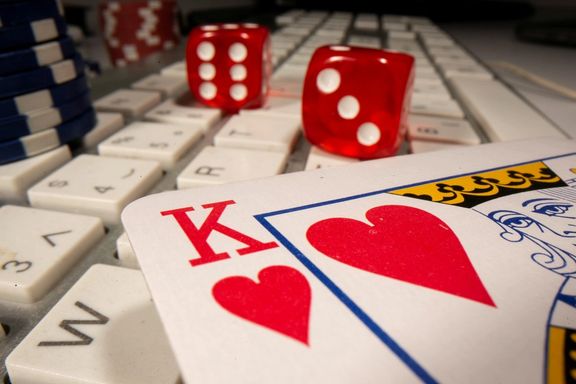
A playing card and two dices on a keyboard

Despite legal and religious prohibitions, online gambling is quietly on the rise in Iran, offering an illusory hope of gain to many worn out by economic hardship.

The phenomenon is steeped in contradiction, with many platforms operating in plain sight despite the Islamic prohibition of gambling.

While supreme leader Ali Khamenei recently ruled that predicting sports outcomes for prizes is not inherently forbidden (haram), Iran’s judiciary continues to treat gambling as a criminal offense—punishable by lashes and imprisonment.

Still, with the national currency, the rial, in free fall and opportunities dwindling, many see gambling as one of the few remaining ways to beat inflation—or to reclaim a fleeting sense of freedom.

Bet to breathe

For Maryam, 49, a former schoolteacher, online poker began as a form of relief from daily suffocation.

"In Iran, we are prisoners—not just of the regime, but of our own despair," she says from her Tehran apartment. "The leaders want to drag us back to rules from 1,400 years ago, while the world moves forward. These games … they let me breathe."

She’s lost several months’ wages in a single night but insists the emotional release is worth it. "When I win, I feel like I’ve beaten the system. When I lose, at least I was free for a moment."

Mohammad, 35, a software engineer, sees gambling less as a thrill than as a necessity. "Look at our currency," he says. "You save 100 million rials today, and in six months, it buys half as much."

Using VPNs to access offshore sportsbooks, he trades in dollars or cryptocurrency to hedge against both inflation and sanctions. "Gambling isn’t a game here—it’s a financial tactic."

Loopholes, laundering, and lashes

The rise in betting has exposed a divide at the highest levels of authority.

While Khamenei’s office has carved out a religious loophole for prize-based predictions, senior Shi’a jurists like Ayatollah Makarem Shirazi maintain that all forms of monetary betting are haram.

Due to this inconsistency, perhaps, enforcement remains patchy and ineffective.

Although Iran’s Cyber Police (FATA) have shuttered over 1,500 gambling websites since 2021 and frozen 72 billion tomans in suspected gambling funds, many platforms operate freely, using registered banking gateways that suggest official indifference—or even complicity.

Tehran MP Mojtaba Tavangar recently called on Iran’s Central Bank to impose tighter controls on the country’s 3.8 million unregistered point-of-sale (POS) systems, which he says are conduits for illicit cash flows.

He blamed anonymous banking transactions for fueling the online gambling surge, asserting that $1 billion in gambling profits exited the country last year.

The warning was echoed by senior FATA official Ali Niknafs, who accused payment processors of enabling a “black-market economy” and faulted the Central Bank for what he called lax oversight.

A symptom, not a vice

Gambling is a rising concern in many societies, but in Iran, it thrives in the shadows—fueled by economic despair, filtered through VPNs, and punished with lashes.

What elsewhere may be a regulated vice has here become an act of defiance and desperation, shaped by repression and the absence of lawful outlets for risk or relief.

Experts say Iran’s gambling boom reflects a deeper breakdown.

"When people lose faith in banks and jobs, they turn to risky alternatives," says Stockholm-based economist Ahmad Alavi. "The regime blames Western decadence, but the real problem is their own mismanagement."

The growing habit is now affecting workplaces too.

"Employees gamble during work hours—some even stealing to cover losses," says an IT supervisor at a Tehran bank who asked not to be named. "We fire them, but new ones do the same thing."

Saman, another IT manager, says he has deployed firewalls and screen monitoring systems, only to see workers bypass them using secret Telegram channels and disguised apps.

With VPN usage at record highs and underground betting networks expanding, crackdowns—by officials or employers—appear increasingly futile. More and more people chase the dream in desperation, many aware it’s an illusion but not seeing any alternative.

"We’re trapped in a broken system," Maryam says. "So we roll the dice."

Most Viewed

Ghalibaf defends Iran-US talks amid hardline backlash
1
INSIGHT

Ghalibaf defends Iran-US talks amid hardline backlash

2
VOICES FROM IRAN

Bread shortages, soaring prices strain households in Iran, residents say

3
INSIGHT

Iran diplomacy wobbles as factions compete to avoid looking soft on US

4
ANALYSIS

The politics of pink: how Iran uses cuteness to rebrand violence

5

War-hit homeowners feel abandoned as Iran’s reconstruction aid fades

Banner
Banner

Spotlight

  • Is Iran entering its Gorbachev moment?
    INSIGHT

    Is Iran entering its Gorbachev moment?

  • Iran crackdown reaches cemeteries as graves of slain protesters defaced
    EXCLUSIVE

    Iran crackdown reaches cemeteries as graves of slain protesters defaced

  • Iran diplomacy wobbles as factions compete to avoid looking soft on US
    INSIGHT

    Iran diplomacy wobbles as factions compete to avoid looking soft on US

  • The politics of pink: how Iran uses cuteness to rebrand violence
    ANALYSIS

    The politics of pink: how Iran uses cuteness to rebrand violence

  • Bread shortages, soaring prices strain households in Iran, residents say
    VOICES FROM IRAN

    Bread shortages, soaring prices strain households in Iran, residents say

  • Ghalibaf defends Iran-US talks amid hardline backlash
    INSIGHT

    Ghalibaf defends Iran-US talks amid hardline backlash

•
•
•

More Stories

Iran's regional energy clout wanes as buyers turn elsewhere

Jun 4, 2025, 21:52 GMT+1
•
Dalga Khatinoglu

Iran’s ambition to serve as a regional energy hub is faltering, with key neighbors losing confidence in Tehran’s ability to fulfil its commitments and shifting to alternative suppliers.

Turkey, long a major customer, imported over 5 billion cubic meters of liquefied natural gas (LNG) from the United States in the first quarter of 2025, according to Turkey’s Energy Market Regulatory Authority (EMRA).

That’s nearly the same volume as in all of 2024—which itself marked a 38% jump from 2023. The United States is now Turkey’s second-largest gas supplier after Russia, displacing Iran.

Meanwhile, Iran is grappling with year-round gas deficits. Last winter, domestic shortages roughly equaled Turkey’s daily seasonal demand.

EMRA data shows that Iran’s winter deliveries to Turkey have halved over the past two years, failing to meet the agreed quota in every month of the cold season.

A 25-year agreement between Tehran and Ankara expires next year. Despite repeated offers to renew, Turkey has shown little interest, bolstering its energy ties with Russia, Azerbaijan, and the US.

In March, Ankara began importing gas from Turkmenistan through swap deals via Iran—further reducing direct reliance on Iranian supply.

Iraq and Syria: shrinking markets

Iraq, Iran’s only remaining major gas customer, has also reported a sharp drop in supply.

Reduced deliveries from Iran have cut electricity production by 3,000 megawatts, according to Iraqi officials, just as summer demand peaks. Iran now supplies only 3% of Iraq’s electricity needs, down from 10% just a few years ago.

Turkey has stepped into the void, doubling its electricity exports to Iraq in 2025 and now supplying more than twice the volume Iran provides.

Tehran earns an estimated $5.5 billion annually from electricity and gas exports. Yet the strategy of converting regional political leverage into economic gains appears to be unraveling.

For years, Iran spent tens of billions of dollars supporting armed groups in Iraq, Syria and Lebanon, hoping to convert influence into energy contracts and infrastructure projects. But the hard-gained influence all but vaporised with Israeli strikes and the fall of Bashar al-Assad in Syria.

Syria, once a central partner in Tehran’s ambitions, has effectively cut ties. Iraq plans to end reliance on Iranian gas within two years.

Lost Ground

From 2012 to 2023, Iran sent more than 300 million barrels of free crude oil to Syria—worth $23 billion, according to energy analytics firm Kpler— in hopes of securing energy and industrial dominance in postwar reconstruction.

Last week, Syria’s interim government signed a $7 billion deal with Qatari, Turkish and US firms to build 6,000 megawatts of new generation capacity.

Turkey will supply 2 billion cubic meters of gas annually, while Qatar began gas shipments via Jordan in March, bypassing Iran entirely.

Even before Assad’s fall, Iran lagged behind. Turkey exported 15 times more goods to Syria than Iran. Today, Iran’s trade has all but stopped, while Turkish exports to Syria topped $1 billion in the first four months of 2025 — a 32% increase over the same period last year.

Iran closes beauty brand’s Instagram account over female rappers promo

Jun 4, 2025, 21:00 GMT+1

Iranian authorities have shut down the Instagram page of a popular beauty brand after it released a promotional rap music video featuring young female hip hop artists, in the latest official move against the creative advertising industry.

Khanoumi Shop, an online cosmetics and personal care retailer, had posted the promotional video as part of a new campaign to market its brand.

The video showcased young women performing a rap song — a move that violated the Islamic Republic’s ban on female public singing.


Following the video’s release, Khanoumi’s Instagram page — which had 1.5 million followers — was taken offline by judicial order.

This is not the first time the brand has used methods frowned upon by the clerical establishment to promote its products. Two years ago, it released another rap video featuring female animated puppets to advertise its wares.

The company has also engaged in sharp messaging which could be construed as an oblique critique of officialdom. It promoted a moisturizing cream by referencing the dryness of Isfahan's Zayandeh Rood river, which has suffered from mismanagement and water shortages.

Khanoumi is among a handful of Iranian brands that have tried to distinguish themselves through bold advertising, but such efforts have increasingly drawn the ire of the country's theocratic authorities.

In recent years, several similar campaigns have faced backlash from the judiciary. The feminine hygiene brand MyLady, whose Instagram page was blocked after it ran a campaign for International Women’s Day on March 8, raising awareness about the restrictions imposed by the Islamic Republic against Iranian women.

In February, the Instagram page of Cenan, one of Iran's largest bakery companies, was shut down by the Islamic Republic's police after it released a promotional video featuring female employees without the mandatory hijab.

In March, Iranian authorities blocked the Instagram accounts belonging to multiple female artists under judiciary orders, ramping up an effort to limit the visibility of women vocalists, whose performances have been banned in public settings since the 1979 Islamic Revolution.

The restrictions on female artists have escalated since the protests following Mahsa Amini’s death in custody in 2022 over hijab, as many female performers supported the demonstrations. Several have been arrested or barred from professional activities.

Artistic defiance has become a hallmark of Iran’s protest movements, with musicians such as Shervin Hajipour, Mehdi Yarrahi, Saman Yasin and Toomaj Salehi facing arrest for their roles in encouraging dissent.

Tehran hardliners bash US-educated nominee for economy minister

Jun 4, 2025, 19:08 GMT+1
•
Behrouz Turani

Iran has been without an economy minister since March—and may remain so even longer—as President Massoud Pezeshkian’s nominee faces mounting opposition from hardliners inside and outside parliament.

The moderate president has struggled for nearly three months to name a replacement after his previous minister was impeached, drawing criticism from rivals for indecision.

Now, his choice Ali Madanizadeh, a prominent academic with degrees from Stanford and the University of Chicago—is under intense scrutiny, with opponents questioning his qualifications and ideological loyalties.

“I am not saying he is an infiltrator, but he received a scholarship from a Western influence network that recruits elite students, indoctrinating them before placing them in key positions in Iran to serve Western interests,” MP Hossein Samsami told parliament.

Another lawmaker, Sara Fallahi, argued that Madanizadeh is unfit for office because his child was born in the United States.

Madanizadeh, 43, currently serves as dean of the Faculty of Economics at Iran’s top technical school, Sharif University of Technology, where he obtained his first degree before going to the U.S. for advanced studies.

He has also advised Iran’s Central Bank and the Planning and Budget Organization.

Ultraconservatives, particularly the Paydari Party, have led the charge against Madanizadeh—just as they did in the impeachment of the former economy minister and the push to oust Pezeshkian’s transport minister over the port blast in southern Iran in late April.

MP Amir Hossein Sabeti claimed—without naming Madanizadeh—that the nominee “lacks managerial experience” and is no different from the minister they removed.

The moderate news site Khabar Online on Tuesday framed the criticisms as political revenge for Pezeshkian’s defeat of Paydari’s preferred candidate, Saeed Jalili, in the 2024 election.

Moderates push back

Although parliament initially approved all of Pezeshkian’s cabinet picks, that backing has eroded.

Pezeshkian’s allies have defended the nomination.

Moderate MP Alireza Novin called the criticisms “unethical behavior” that denies Madanizadeh a chance to prove his qualifications.

Renowned sociologist Mohammad Fazeli said hardliners “routinely brand political and academic elites as infiltrators to deprive the system of capable individuals.”

Shadow of supreme power

In the debates surrounding the impeachment of former economy minister Abdolnasser Hemmati, his supporters argued that Iran’s economic failings are structural and often rooted in decisions not made by the administration.

What most mean by that—but do not say—is that the one ultimately responsible is Supreme Leader Ali Khamenei.

Khamenei has long promoted his concept of a “resistance economy,” a loosely defined model grounded in anti-Americanism, self-sufficiency and ideological discipline.

While he frequently calls for higher productivity, critics argue that Tehran’s foreign policy—set and directed by Khamenei—has led to sanctions and international isolation that make such goals unachievable.

Iran’s ‘hell’ exhibit goes cold on final night after technical glitch

Jun 4, 2025, 09:26 GMT+1

A theatrical “hell” installation staged by Iran’s Revolutionary Guards failed to deliver its fiery finale after technical issues left the exhibit cold on its final night, the online newspaper Faraz reported.

The immersive experience, part of the Heaven Time project in Gilan Province, aimed to depict scenes from the Islamic afterlife using real flames, costumed actors, and dramatized punishments. But on the final night, hell failed to ignite—at least on Earth.

Civil rights lawyer Hassan Younesi wrote on X that several women were denied entry to the “hell” exhibit for not wearing the mandatory hijab—sparking widespread irony online, where users said that those supposedly destined for hell were barred from even visiting it.

Images and reports from the event had already sparked ridicule online for what many called a crude and unsettling parody of faith.


Iran crude oil flows to China drop as sanctions bite - Bloomberg

Jun 4, 2025, 08:42 GMT+1

Iran’s crude oil shipments to China fell sharply in May as tighter US sanctions and seasonal refinery maintenance weighed on flows, Bloomberg reported on Wednesday, citing preliminary ship-tracking data and market analysts.

According to data from Vortexa Ltd., Iran exported just over 1.1 million barrels per day (bpd) of crude and condensate to China last month, marking a drop of roughly 20% compared to the same period a year earlier.

The figures, based on shipping movements, remain subject to revision due to a growing number of tankers switching off their tracking systems in an effort to avoid detection.

“The tightening US sanctions are straining the supply chain and raising concerns about the reliability of shipments,” said Emma Li, senior market analyst at Vortexa. “At the same time, refinery demand in China has weakened, largely due to delayed seasonal maintenance, which now appears likely to extend through July.”

Independent Chinese refiners, known as teapots, are Iran’s primary customers, drawn by steep discounts on sanctioned barrels. But the facilities—mostly concentrated in Shandong province—are currently operating near record-low rates, Li noted. Many refiners had already stockpiled Iranian oil earlier this year, reducing the need for additional purchases in May.

Lower prices of competing crude from Russia, including Sokol and Novy Port grades, have also edged out Iranian supplies in the Chinese spot market.

Impact of sanctions and port restrictions

The decline follows months of escalating US pressure on Iran’s oil exports. Since early 2025, Washington has sanctioned dozens of tankers and companies involved in the trade, particularly targeting Iran’s so-called “shadow fleet.”

The latest round of sanctions, imposed in May, included Hebei Xinhai Chemical Group Co.—a Chinese independent refiner alleged to have received hundreds of millions of dollars’ worth of Iranian crude—as well as several port operators in Shandong and seven vessels used to disguise Iranian shipments.

“The United States remains resolved to intensify pressure on all elements of Iran’s oil supply chain,” said Treasury Secretary Scott Bessent in a statement at the time.

The sanctions have disrupted, but not halted, Iran’s crude flows to China. According to Bloomberg, many shipments now occur in “dark mode,” with vessels turning off their transponders and conducting ship-to-ship transfers off Malaysia to obscure the oil’s origin.

However, sanctions have pushed freight costs sharply higher, with chartering rates for non-sanctioned supertankers reaching up to $6 million—an increase of 50% over the past year.

Shandong Port Group has reportedly advised local operators to avoid dealings with blacklisted tankers, further complicating logistics for Iranian crude.

Earlier cracks in the trade

China’s imports of Iranian oil began declining steeply in January after authorities barred sanctioned tankers from entering Shandong ports, which handle around 90% of Iranian cargoes.

According to Kpler data, Iranian oil deliveries to China dropped below 850,000 bpd in January, compared to over 1.8 million bpd in October 2024.

At the same time, Iran’s floating oil reserves have surged to 35 million barrels, underscoring the widening gap between official shipment figures and actual deliveries.

Despite sporadic rebounds—such as a brief rise in April driven by a backlog of delayed cargoes—the overall trend has been downward.

As US sanctions intensify and China takes further precautions, Iran’s reliance on its shrinking pool of buyers could deepen, while Tehran says its energy exports remain stable.
  • Panama removes 650 ships from registry amid scrutiny over Iran sanctions

    Panama removes 650 ships from registry amid scrutiny over Iran sanctions

  • Iran wastes as much gas as Spain uses in a year

    Iran wastes as much gas as Spain uses in a year

  • Iran's energy exports rise as domestic grid falters

    Iran's energy exports rise as domestic grid falters

  • Oil prices fall on hopes of US-Iran nuclear deal

    Oil prices fall on hopes of US-Iran nuclear deal

  • US sanctions Iranian military front companies selling oil to China

    US sanctions Iranian military front companies selling oil to China

  • US sanctions Chinese refinery, operators for handling Iranian oil

    US sanctions Chinese refinery, operators for handling Iranian oil