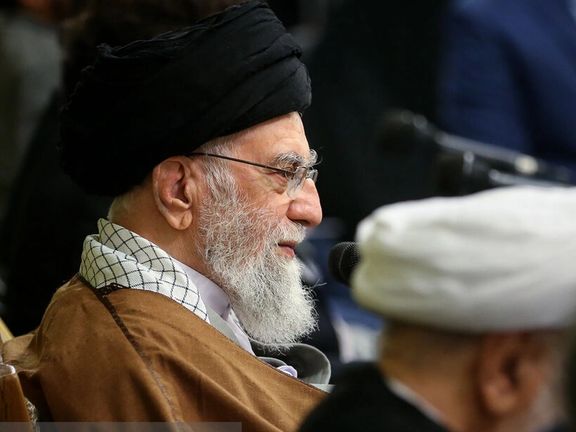
Iran's supreme leader Ali Khamenei, Tehran, March 15, 2025
The threat of war looming over Iran by President Trump’s ultimatum to make a nuclear deal or face attack may be a blessing in disguise for rulers in Tehran as they seek to manage growing popular discontent.
Iranian officials have repeatedly rejected negotiations with the United States under terms set by Donald Trump, doubling down on Supreme Leader Ali Khamenei's hardline stance.
Questioning the point of talks with a "deal-breaking" US president, Khamenei on Monday nonchalantly dismissed the consequences of shunning Washington.
"The United States is threatening militarization,” Khamenei said on the day his foreign ministry finally confirmed receiving a personal letter from Trump to Khamenei. “War is not a one-sided blow. Iran is capable of retaliating and will certainly do so,” he added.
War, once a distant threat, now looks a distinct possibility. It should concern those in power Tehran—and it perhaps does. But it may serve them as an instrument to deter adversaries and to enforce control at home.
War as a mechanism for control
Looking at Iran’s official outlets, the refrain of war is omnipresent. Military figures dominate state media and security-focused language overshadows other narratives.
This change of tone and substance—transmitted mainly inside Iran—appears to be not just a response to foreign threats, but a calculated strategy to unify and subdue the populace, forcing societal alignment by amplifying fears of conflict.
And this approach is driven by insecurity as much as intent.
Behzad Nabavi, a former minister and veteran lawmaker of the Reform camp, said recently that a wartime atmosphere could foster national solidarity, suggesting that even moderates long-shunned from power circles see fear as a unifying force.
Meanwhile, those in power have intensified the crackdown on the internet, branding the free flow of information a “cognitive war.” The sentiment was best summed up recently by Iran’s national police chief Ahmadreza Radan.
“Back then, we were encircled in the Komeil trench,” he said, invoking memories of the eight-year war with Iraq in the 1980s. “Today, we are surrounded in virtual trenches. If we’re not fighters now, we’ll surely retreat and surrender the homeland."
War as a gambit for survival
The Islamic Republic faces multiple challenges of significant severity: an ailing economy, environmental collapse, budget shortfalls, and entrenched corruption. Public trust has eroded, with sporadic protests signaling discontent.
Fearing another “sedition”—a term used to label past protests and justify their brutal suppression—officials now see war’s shadow as a lifeline.
The theocracy has a proven record of internet blackouts, arbitrary arrests and harsher suppression of dissent in general. It can be expected to do more in a state of inflated external threats, dishing out labels of “subversion” and “enemy collaboration.”
This isn’t mere opportunism—it’s a high-stakes gamble.
Iranians did rally during the war with Iraq, especially the early years. But that was forty-odd years ago. And Khamenei is no Khomeini, the first supreme leader who had all but universal following when he called for Iran’s monarchy to be replaced by an Islamic Republic.
Today, the system, as Khamenei likes to call it, is all but universally loathed. While he clings to power by keeping loyal forces primed and its critics silenced, millions of ordinary Iranians face an unrelenting battle of survival.
Stoking war fears and siege mentality to stifle unrest may work for the supreme leader. Or it could backfire spectacularly and save Trump a war he clearly does not want.
War as a lever for defense and deterrence
The Islamic Republic frames conflict as both a defensive necessity and a means to intimidate foes. Israel and Arab states astride the Persian Gulf have often borne the brunt of this rhetoric.
A senior commander of the Revolutionary Guards (IRGC) warned recently that an attack on Iran’s nuclear facilities would spark “a fire in the region that cannot be contained.” Another senior IRGC figure made it clearer: "True Promise 3 will take place at the right moment, destroying Israel and leveling Tel Aviv and Haifa.”
These threats are backed by action. Iran has nearly doubled its military exercises since October 2024, according to the Financial Times, with drills concentrated near the Natanz nuclear facility and the Strait of Hormuz.
This posturing may not be as effective in deterring the US or Israel but does help shape domestic perceptions amid worsening economic and social crises.
Iran's then-presidential candidate Mehdi Karroubi (3rd right) joins a crowd of supporters in Tehran June 17, 2009.
Mehdi Karroubi, a presidential candidate at the center of deadly 2009 protests, is set to be released from house arrest after 14 years, his son said on Monday.
"Security officers met my father and said his arrest would be lifted today on orders of the head of the judiciary," Karroubi's son Hossein Karroubi told Jamaran, a semi-official newspaper linked to Iran's Reformist political faction.
Karroubi's political ally, former Prime Minister Mirhossein Mousavi, would also be released from house arrest in the coming months, he added.
In the 2009 presidential election, which resulted in the controversial re-election of Mahmoud Ahmadinejad, Karroubi, now 87, and Mousavi, 83, ran on a reformist platform. The outcome sparked mass protests, known as the Green Movement, with demonstrators alleging widespread electoral fraud."
Both were detained in 2011 after taking a leading role in the protests, though they were not put on trial or publicly charged.
Karroubi’s son, however, added that his father had been told that security officers would be present at his home until April 8 to ensure his protection.
Iran's official news agency IRNA also reported on Karroubi's release, but did not refer to Mousavi's case.
Last year, Hossein Karroubi told Ensaf News that his father would refuse release from house arrest while Mousavi remained detained.
Iran's current president, Masoud Pezeshkian, promised during his election campaign to release both politicians.
Iranian President Masoud Pezeshkian (center-left) talking to lawmaker Mahmoud Nabavian (2nd right) at the parliament (March 2025)
A significant rift has emerged within Iran's ultra-hardliner faction following a prominent lawmaker’s unprecedented criticism of protests by radicals to pressure authorities into enforcing a tough hijab law.
The decision of the Supreme National Security Council (SNSC) not to enforce the controversial law could not have been made without the approval of Supreme Leader Ali Khamenei, who has avoided discussing the issue in his speeches for months.
Enforcing the morality legislation—which imposes severe penalties, including heavy fines and prison sentences on women who violate strict hijab rules, as well as businesses that fail to comply—could be highly provocative under current conditions, potentially sparking widespread anti-government protests.
Internal clash over the enforcement of the hijab law
Mahmoud Nabavian, a senior member of the hardline Paydari (Steadfastness) Party and the Parliament’s National Security and Foreign Policy Committee, is facing backlash from his allies after condemning recent protests led by radical elements. His remarks have surprised many within his faction, where he was long regarded as a key figure and a strict enforcer of their agenda.
Despite playing a key role in drafting the hijab legislation, Nabavian now argues that preserving the Islamic Republic must take precedence over enforcing the law—implicitly acknowledging the risk of unrest. “If implementing the hijab law creates tensions and weakens the system, it should automatically be set aside,” he said last week.
According to the Islamic Republic’s founder, Ruhollah Khomeini, preserving the system must take “utmost priority,” even if it requires temporarily setting aside religious obligations like prayer and fasting. By that logic, hijab would be no exception—a stance authorities now seem compelled to accept, much to the frustration of the hardline political and religious establishment.
Ultra-hardliners protesting outside the Iranian Parliament against delay in enforcing hijab law
Concerns over national stability
Nabavian justified the security council’s suspension of the hijab law by pointing to major geopolitical developments—the fall of Bashar al-Assad in Syria and Israel’s assassination of Hezbollah chief Hassan Nasrallah. He argued that enforcing the law at this time could provide foreign adversaries with an opportunity to destabilize Iran.
“Given the country’s and the region’s current conditions, especially the situation in Yemen, and the need for national unity, we must all support the implementation of the law but polarizing the society, calling for illegal gatherings, and staging street protests—no matter the faction—are against the country’s interests,” Nabavian warned in an X post on Sunday. His remarks came after the US military launched massive airstrikes against Iran-aligned Houthi rebels in Yemen on Saturday.
Hasan Soleimani, editor-in-chief of the hardline Mashregh News, a publication believed to be linked to the Revolutionary Guards Intelligence Organization (SAS), defended Nabavian’s position. In an X post, he accused radical hardliners of using the hijab issue as a pretext to disrupt the country’s stability. He went further, comparing them to the Forqan group—an Islamist faction that carried out assassinations against officials of the newly established Islamic Republic, including a failed attempt on Khamenei’s life in 1981.
Highlighting defiance of Khamenei’s decisions
Nabavian also accused ultra-hardliners—whom he refers to as “super-revolutionaries” or “radicals”—of openly defying Khamenei, citing their opposition to Covid vaccination. “I won’t even mention the disgraceful remarks they made [about Khamenei’s own vaccination],” he said last week. He also linked their defiance to more recent criticism over Iran’s two-month delay in 2024 before retaliating against Israel’s attack on Iranian military facilities—a decision ultimately made by Khamenei.
Similarly, if Khamenei decides to permit direct talks with the Trump administration in the coming weeks or months, ultra-hardliners’ reaction could pose a significant challenge. He ruled out the possibility of such talks in a recent speech and has so far not acknowledged the US President’s letter to him. Former President Hassan Rouhani suggested a few days ago that Khamenei’s stance could change depending on circumstances, as it did in 2013 when he allowed secret talks with the US.
Warnings of a fragile political climate
Citing the hardliners' protests in Mashhad against moderate conservative Hassan Rouhani’s government on December 28, 2017, some media outlets and analysts have warned that demonstrations organized by “super-revolutionaries” could similarly spiral out of control.
The Mashhad protests quickly spread nationwide, with demonstrators in several cities chanting against Khamenei. The weeklong unrest resulted in at least 25 deaths and thousands of arrests.
However, the current situation is fundamentally different from 2017, an article in the reformist Etemad daily warned on Sunday. It pointed to Trump's presence in the White House and heightened regional tensions, citing a statement from the Supreme National Security Council Secretariat that cautioned any provocation or political polarization could cause irreparable damage to the country.
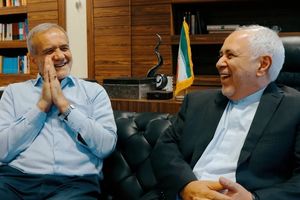
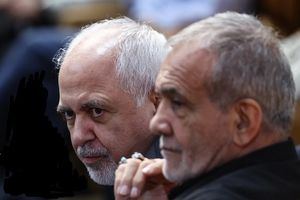
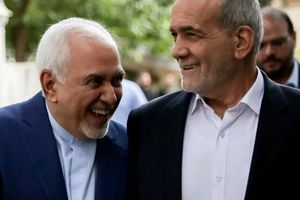
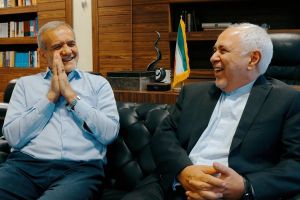
Iranian President Masoud Pezeshkian (right) and Mohammad Javad Zarif (center), the vice-president for strategic affairs
Veteran nuclear negotiator and top reformist Javad Zarif remains at his senior post despite resigning, a spokesperson said, signaling that the beleaguered president is loath to lose him.
Government Spokeswoman Fatemeh Mohajerani said on Sunday that Zarif's resignation, announced amid controversy over his children's US citizenship, has not been officially accepted, emphasizing that his appointment has not been revoked, nor has a replacement been named.
"From the government's perspective, Zarif remains the Strategic Affairs Vice-President," Mohajerani said. "Dr. Zarif's vice presidency remains valid, though he is absent from government meetings."
Zarif announced his resignation earlier this month, citing pressure from the Judiciary and a desire to "prevent further pressure on the government" after criticism from hardliners who cited a 2022 law banning officials with dual citizenship or close relatives with dual citizenship from holding sensitive positions.
Mohajerani also addressed concerns about other officials with dual citizenship. "If the law is to be enforced, it must apply uniformly across all branches of government," she added.
Mohajerani revealed that Zarif had met with President Masoud Pezeshkian after submitting his resignation, where she said they discussed "Zarif's capabilities, impact, and unique experiences".
Though she said "the text he released indicated a kind of resignation", she went on to say: “The Vice-President for Strategic Affairs resigned from his position to prevent harm to the President, the government, and the country."
Zarif's resignation sparked sharp political reactions in Iran, with hardliners celebrating his exit and reformists warning of its broader implications.
His departure came less than four weeks after Supreme Leader Ali Khamenei reaffirmed his opposition to negotiations with the United States, a stance that undermined Zarif’s role in the government.
It was widely perceived that Zarif joined the Pezeshkian administration to help negotiate another nuclear deal with world powers similar to the Joint Comprehensive Plan of Action (JCPOA), which was scrapped by Donald Trump during his first term in office.
However, Khamenei, the country's ultimate decision-maker, rejected the idea of talks with Trump last month.
Reformist commentators have warned that Zarif’s resignation, coming shortly after the impeachment of Economy Minister Abdolnaser Hemmati, signals growing instability within Pezeshkian’s administration.
US President Donald Trump speaks to reporters, watched by National Security Advisor Mike Waltz, aboard Air Force One on his return to Washington, DC, March 16, 2025.
Tehran will respond privately to US President Donald Trump's letter and will not make public its contents, according to Iran's foreign ministry.
"We currently do not intend to release the contents of Trump's message to the media," said Spokesperson Esmail Baghaei during a press conference on Monday.
Last week, an Emirati official brought a letter from the US president proposing nuclear talks with Tehran, which Supreme Leader Ali Khamenei rejected, saying such a proposal was deception from Washington amid crippling sanctions on Iran.
"Our response to this correspondence will be provided through appropriate channels after the completion of the reviews. What has been published in the media is mostly speculation and lacks a precise basis."
Baghaei noted that the letter's content "is not significantly different from Trump's speeches and is structured based on those elements."
The spokesman described US messages as contradictory signals, noting that while expressing readiness for talks, the US continues to impose sanctions.
He specifically criticized the US for sanctioning Iran's oil minister, whose "only crime is performing his official, legal, and national duties."
"Diplomatic negotiations have etiquette in that each side must recognize the other's interests and, more importantly, believe in fulfilling their commitments," he added during the televised press conference.
"The US does not respect that and uses the possibility of negotiations as a propaganda and political tool."
During his first term, President Trump withdrew the US from the 2015 Joint Comprehensive Plan of Action (JCPOA), an agreement between Iran and major powers that limited Iran's nuclear activities in exchange for sanctions relief. Following the 2018 US withdrawal and reimposition of sanctions, Iran exceeded the JCPOA's nuclear activity limits.
Western powers express concern that Iran's uranium enrichment, reaching up to 60% purity, indicates a potential pursuit of nuclear weapons, an allegation Iran denies, asserting its program is for peaceful purposes and compliant with international law.
Baghaei also highlighted recent diplomatic activities, including a trip by Foreign Minister Abbas Araghchi to Oman on Sunday, a trilateral meeting in Beijing with Russia and China, and a visit by the Deputy for Legal and International Affairs to Vienna for talks with the International Atomic Energy Agency (IAEA).
He stressed that Araghchi's Oman trip was unrelated to Trump's letter and had been scheduled beforehand.
In response to questions about US military strikes against the Iran-backed Houthis in Yemen, Baghaei condemned the attacks as a crime and a violation of international law.
"The US has unfortunately mistaken the victim for the criminal," he said, calling on the international community to take urgent action.
He also rejected US claims that Iran was behind the Houthi's blockade of commercial shipping in the Red Sea, saying the Yemeni people make their own decisions.
The denials came on the back of claims made on Sunday by Revolutionary Guard Corps (IRGC) Commander Hossein Salami who categorically denied US accusations of Iranian control over the Houthis', in spite of the blockade being ordered by Iran's Supreme Leader in allegiance with Iran-backed Hamas amid the Gaza war, back in 2023.
"We have always declared, and we declare today, that the Yemenis are an independent and free nation in their own land and have an independent national policy," Salami said.
"Ansarullah, as the representative of the Yemenis, makes its own strategic decisions, and the Islamic Republic of Iran has no role in setting the national or operational policies of any movement in the resistance front, including Ansarullah in Yemen."
A B-52 Stratofortress flies over Afghanistan in this undated handout photo. U.S. Air Force
The Trump administration wants Iran to abandon all aspects of its nuclear program, the US national security advisor said on Sunday, warning that all options are on the table should Tehran refuse.
"Iran cannot have a nuclear weapon. All options are on the table to ensure it does not have one," Michael Waltz told ABC News on Sunday.
"And that’s all aspects of Iran's program. That’s the missiles, the weaponization, the enrichment. They can either hand it over and give it up in a way that is verifiable, or they can face a whole series of other consequences," he warned.
In 2015, Iran signed a nuclear deal with the United States and other world powers that imposed restrictions on its uranium enrichment capacity but effectively allowed it to maintain its nuclear program. It also did not directly address Tehran's ballistic missile program, focusing instead on nuclear-related issues.
While Iran is now signaling a willingness to accept similar restrictions on its nuclear program in exchange for sanctions relief, the Trump administration appears determined to put an end to Tehran's atomic ambitions.
The United Nations' nuclear watchdog warned on Saturday that the Islamic Republic is very close to developing a nuclear weapon.
"Iran has an extremely ambitious and extensive nuclear program, under which it is enriching uranium to nearly weapons-grade levels," Rafael Grossi, the director general of the International Atomic Energy Agency (IAEA) said.
Trump's national security advisor said on Sunday that "we cannot have a world with the ayatollahs with their finger on the nuclear button. And President Trump is determined (to prevent that), one way or another."
"Iran has been offered a way out of this to make sure that we don’t have a world that can be threatened by a radical regime," Waltz said, referring to Trump's direct letter to Iran's Supreme Leader.
Trump announced the overture at the same time he warned Iran to agree to a new nuclear deal or face military action.
While Supreme Leader Ali Khamenei has publicly ruled out talks, Iran’s foreign minister on Thursday signaled Tehran's willingness to engage in indirect negotiations with the United States through Oman.
On Sunday, Araghchi travelled to Muscat "to review bilateral and regional issues of mutual interest and concern."
"Our commitment is to diplomacy in defense of peace and stability, and I am always delighted to engage with my Omani counterpart in pursuit of these aims," he said, without explaining whether the issue of Omani mediation between Tehran and Washington had been discussed.
US may target Iranian assets in Red Sea
Araghchi's trip to Oman came hours after the US military started a series of large-scale airstrikes against Yemen's Houthis in what US officials described as a warning signal to their sponsors in Tehran.
US Defense Secretary Pete Hegseth said on Sunday the ongoing US airstrikes against Houthis serve as a warning to Iran to stop backing the group.
Washington would conduct "unrelenting" strikes against Yemen's Houthis until the Tehran-backed group ceases their military actions targeting US assets and global shipping, Hegseth told Fox News.
Secretary of State Marco Rubio also told CBS News that there was "no way" Yemen's Houthis would have the ability to attack global shipping without support from Iran.
In his Sunday interview with Fox News, Michael Waltz said the Trump administration "will hold not only the Houthis accountable, but we’re going to hold Iran, their backers, accountable as well.”
"And if that means they’re targeting ships that they have put in to – to help their Iranian trainers, IRGC and others, that intelligence, other things that they have put in to help the Houthis attack the global economy, those – those targets will be on the table too," he warned.
Iran allegedly operates reconnaissance ships in the Red Sea, including the commercial cargo ships Behshad and Saviz, which Washington says coordinate with the Houthis.
Despite scrutinizing their operations, neither the US nor Israeli militaries have targeted the ships.