• العربية
  • فارسی
Brand
  • Iran Insight
  • Politics
  • Economy
  • Analysis
  • Special Report
  • Opinion
  • Podcast
  • Iran Insight
  • Politics
  • Economy
  • Analysis
  • Special Report
  • Opinion
  • Podcast
  • Theme
  • Language
    • العربية
    • فارسی
  • Iran Insight
  • Politics
  • Economy
  • Analysis
  • Special Report
  • Opinion
  • Podcast
All rights reserved for Volant Media UK Limited
volant media logo

Did Zarif Inject Momentum Into Iran’s Controlled Election?
Jun 19, 2024, 22:17 GMT+1Updated: 16:33 GMT+0
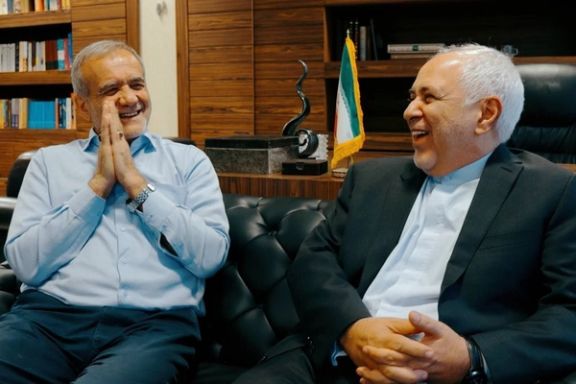
Iran's Presidential candidate Massoud Pezeshkian (left) and former foreign minister Mohammad Javad Zarif

Former Foreign Minister Mohammad Javad Zarif's presence in a TV program on Tuesday to support reformist candidate Massoud Pezeshkian's campaign has made waves on social media.

Zarif emerged from a three-year period of relative silence and stepped into the political arena to support the only candidate among six hand-picked individuals, who is known as a relative moderate, or a politician who does not belong to any hardliner group.

Journalist Reza Ghobeishavi wrote that "Zarif's involvement has taken the presidential campaigns into a new phase," adding, "This was the real debate, not what happened last night," referring to a largely uneventful TV debate among the six candidates.

In the interview, Zarif embarrassed the hardline participants by revealing their actions to obstruct negotiations between Iran and the United States during the final six months of the Rouhani administration in 2021.

Social media researcher Mohammad Rahbari also mentioned "a new phase in the campaigns," and added a graphic that showed Google search trends highlighting that Zarif's presence attracted more attention than all the news about conservative Mohammad Bagher Ghalibaf and ultraconservative Saeed Jalili, who are believed to be Pezeshkian's main rivals in the election.

Meanwhile, in an ironic post on X, Rahbari presented another graphic about the mood on Iranian social media before Monday night's debate and wrote: "The general mood before the debate favors Jalili, but the winner of the election is not supposed to be named by Internet robots."

He added: "There are three different views on the subject in Twitter (X):Jalili's supporters who simultaneously work against both Ghalibaf and Pezeshkian (27 percent). This comes while Ghalibaf's supporters comprise only 10 percent of the network in the graphic. The advocates of regime change, and other opposition groups form some 25 percent of the network. They mainly criticize Pezeshkian and call for boycotting the election. The revolutionaries (hardliners) hold only 5 percent of the network of reactions to the debate."

Since late Monday night, thousands of social media users in Iran harshly criticized all of the six candidates for their dull discussions, obnoxious appearance and the banality of Tehran Mayor Zakani's verbal attacks on the other candidates. Many pointed out that the real winner of the debate was conservative cleric Mostafa Pourmohammadi who was neatly dressed and spoke wisely and hesitantly as well as being the only one of the six men who had a real plan devoid of hollow slogans for presidency.

Iranian lawyer Mohammad Ali Bahmani Qajar opined that "The possibility of Pezeshkian's presidency looks like a mirage," and added that "the candidate’s supporters belong to one of the following six groups: Reformist journalists and those who work for reformist organizations and are simply fulfilling their organizational responsibility; those who have political projects to work on; people with ethnic interests; those who wish to fan the election mood; reformists who look forward to getting jobs in Pezeshkian's government, and the simpletons who believe a reformist president can change something in the system.

Many reformists criticized Qajar and said that he was too biased against reformists and Mr. Pezeshkian.

Very few social media users commented on a report that quoted former lawmaker Heshmatollah Falahatpisheh who had said that "Russia is seeking to exert its influence on the Iranian presidential elections." However, they mainly cracked jokes about who could be Russia's favorite candidate.

Social media researcher Mehdi Yahyanejad wrote: "It was a big risk by the reformists to support Pezeshkian. There is still no indication that he would be able to lend a momentum to the campaigns."

The lack of momentum that Yayanejad mentioned may have been reversed by Zarif's fiery attack on conservatives and hardliners on Tuesday.


Most Viewed

Ghalibaf defends Iran-US talks amid hardline backlash
1
INSIGHT

Ghalibaf defends Iran-US talks amid hardline backlash

2
ANALYSIS

From instability to influence: Pakistan’s pivotal role in US-Iran diplomacy

3
ANALYSIS

100 days on: why Iran’s January protests spread across social classes

4

War-hit homeowners feel abandoned as Iran’s reconstruction aid fades

5

Iran says no decision yet on talks as Pakistan prepares to host US team

Banner
Banner

Spotlight

  • Iran diplomacy wobbles as factions compete to avoid looking soft on US
    INSIGHT

    Iran diplomacy wobbles as factions compete to avoid looking soft on US

  • The politics of pink: how Iran uses cuteness to rebrand violence
    ANALYSIS

    The politics of pink: how Iran uses cuteness to rebrand violence

  • Bread shortages, soaring prices strain households in Iran, residents say
    VOICES FROM IRAN

    Bread shortages, soaring prices strain households in Iran, residents say

  • 100 days on: the anatomy of Iran’s January crackdown
    INSIGHT

    100 days on: the anatomy of Iran’s January crackdown

  • Ghalibaf defends Iran-US talks amid hardline backlash
    INSIGHT

    Ghalibaf defends Iran-US talks amid hardline backlash

  • From instability to influence: Pakistan’s pivotal role in US-Iran diplomacy
    ANALYSIS

    From instability to influence: Pakistan’s pivotal role in US-Iran diplomacy

•
•
•

More Stories

Canada Lists Iran’s IRGC as Terrorist Organization

Jun 19, 2024, 15:50 GMT+1

Canada has listed Iran's Revolutionary Guards as a "terrorist entity", the country's public safety minister Dominic LeBlanc announced Wednesday afternoon.

"This action sends a strong message that Canada will use all of the tools at its disposal to combat the terrorist entity of the IRGC," he said in a press conference that was also attended by Canada's Justice Minister Arif Virani and foreign minister Melanie Joly.

The Iranian community in Canada has been pressuring the Canadian government to proscribe the IRGC, led by the families of those killed onboard flight PS752, which was shot down a few minutes after take off from Tehran's international airport in January 2020.

"Our government will ensure that there's no immunity for Iran's unlawful actions and its support of terrorism," LeBlanc said.

The measure has been taken under Canada's criminal code, which means the country's law enforcement will be able to charge those who support the group financially or materially.

Hamed Esmaeilion, whose wife, Parisa Eghbalian and their 9 year-old-daughter, Reera were killed when the IRGC shot down PS752 told Iran International, he's very happy but the fight is still not over.

Hamed Esmaeilion with wife Parisa and daughter Reera on her ninth birthday.
100%
Hamed Esmaeilion with wife Parisa and daughter Reera on her ninth birthday.

"We hope that there's no change in the decision in the coming years. And we hope that this campaign actually continues on to spread to the rest of the world, to the European Union, to the UK and Australia and other countries," said Esmaeilion.

Esmaeilion, and the families of families of flight 752, have been vocal advocates pushing for the terrorist designation since the downing of the civilian aircraft, and even filed a 200 pages plus fact finding report to the federal government in 2023. It alleged that Iran deliberately kept its airspace open to use civilians as human shields against a possible American attack.

"The most important message is for the people in Iran, for the brave activists," said Esmaeilion.

He said the IRGC terrorist designation impacts all victims of atrocities committed by the Islamic Republic since its inception in 1979.

Potential retribution

Kazem Gharibabadi, the deputy chief of Iran's Judiciary, condemned Canada's "hostile" decision to designate the IRGC as a terrorist organization, and said the Revolutionary Guard "is responsible for guarding Iran's national security and confronting terrorism in the region."

Earlier Wednesday, IRGC commander in chief Hossein Salami said Iran has been able to impose its "magnificent power" on its " world enemies" in spite of many decades of "pressure" on the country.

"They seized our ships, so we seized theirs," Salami said. "They attacked some of our ships at sea, but when their ships were attacked, they realized that they couldn't engage with this country."

Canada is advising all Canadians and dual nationals to leave Iran and not to travel there due to heightened concerns over potential retribution.

Some PS752 families posted to X that Canada's foreign minister Melanie Joly sent an email to the families after the announcement, and assured them that the government was determined to protect Canadian citizens against the Iranian government's threats.

The IRGC was formed in 1979 to 'guard' the Islamic Revolution, as stipulated in the force's title. Since then, it has grown to become the most powerful player in Iran's domestic politics and economy, while its international wing, the Quds Force, arms, trains, and often fights alongside various armed groups across the Middle East.

The Canadian government, much like the administrations in Europe, have been grappling with the idea to proscribe the IRGC for many years. Such designation would put the Guards in the same category as al-Qaeda and Daesh (ISIS).

The move in Canada has been a long time coming, said several activists. In 2018, the House of Commons passed a resolution urging the Federal government to list the IRGC as a terrorist entity. The Liberal government backed the Conservative motion, but it still wasn't codified under the criminal code.

Prime Minister Justin Trudeau had resisted calls in the past to list the organization as a terror group because some Iranians are forced into the organization as part of their mandatory military service. That issue was acknowledged during Wednesday's press conference after a reporter with Canadian media asked.

Canada's Justice Minister Arif Virani said "he remains concerned about it," citing it as a "complex situation."

Virani said individuals would be assessed on a case by case basis.

The Conservatives and the NDP have criticized the Liberal government for delaying the designation.

“As a result of that delay, the IRGC has been able to grow stronger as a result of Trudeau’s inaction,” Conservative MP and foreign affairs critic Michael Chong said in a statement after the announcement.

Strong message

Iranian-Canadian human rights activist Nazanin Afshin-Jam said the announcement was a major step in the right direction that will further protect Canadians and send a strong message.

"My heart is beating fast. I'm so excited. It's a great day for security for Canada. It's a great day for sending a very strong message to people inside Iran that their voices have been heard. And it sends a very strong message to IRGC officials and their affiliates and the whole regime of the Islamic Republic, that crimes against humanity don't go with impunity," she said.

Tara Dachek, who is partnered with Afshin-Jam in the diaspora group the Iranian Justice Collective (IJC) was overjoyed that it "finally happened."

"We [IJC] have had meetings with MPs, members of House of Commons, Senate for the past two years to ask them to recognize the IRGC as a terrorist organization, " said Dachek.

The listing is an important tool to help law enforcement and fight terrorism, said Behnam Ben Taleblu, a senior fellow at the FDD where he focuses on Iranian security and political issues.

"This allows the Canadian government to better protect the rights of Iranian diaspora, who has legally migrated to Canada and is actually seeking to flee or build a better life, away from the Islamic Republic," said Taleblu.

In late January, two Canadian men, with Hells Angels ties, were accused of plotting to kill an Iranian defector living in the US, with the help of an Iranian national suspected of running a murder-for-hire scheme run by Iran.

The terrorist designation is important because it gives the justice system much more ammunition, according to Taleblu.

It will also effect the IRGC's financing as well, he added.


IRGC Chief Says Tehran Has Been Able to Impose its Power

Jun 19, 2024, 13:50 GMT+1

Iran has been able “to impose” its power “on the enemy,” Hossein Salami, commander in chief of the Revolutionary Guard said in a public gathering with educators on Wednesday.

Salami reiterated the official rhetoric that Islamic Republic’s enemies have been at work for 45 years to undermine and weaken “the revolution” using a wide variety of means and tactics. However, he insisted that the Islamic Republic has defied all the odds has not been deterred.

“We have been able to absorb and neutralize all these different pressures and impose the magnificent power of a nation on an arrayed world of enemies,” the IRGC chief commander said.

Iran’s rulers use the term ‘enemy’ to refer mainly to the United States and sometimes to Israel and European powers.

Claiming that the Islamic Republic has become the focus of the enemy, he stated, “The enemy is simultaneously targeting all pillars of the system [regime] and the revolution, converging all vectors of threat at a single point. This synergy and maximum pressure from the enemy have placed us in an exceptional position.”

Salami also told his audience that sanctions against Iran have not been effective, even though annual inflation has been hovering at above 40% for the past five years and the government has faced repeated rounds of popular protests. Despite harsh sanction during the Trump administration and some pressure since 2021, Iran has avoided a possible costly military confrontation with Israel and the United States. Its leaders insist that although the country has been enduring economic challenges, instead it enjoys security.

“If you see that you have security at the height of confrontation, it means you possess power,” Salami proclaimed. “If the enemy realizes that you can overcome their sanctions, they will try to encircle you. And if you see that sanctions have become ineffective in this country, it is because you possess power,” he added.

When the United States withdrew from the JCPOA nuclear deal in 2018 and imposed oil export sanctions, Iran lost almost 90% of revenues from selling around two million barrels per day. However, after the Biden administration took office, oil exports began to increase, with China buying almost all the shipments. After three years, Tehran is now selling over 1.3 million barrels per day to China with an estimated annual income of around $37 billion.

At the same time, it has continued expanding its nuclear program and has continued to support an array of armed proxy groups in the region that attack Israel and occasionally US forces. Critics of the Biden administration insist that deterrence should be re-established.

"They seized our ships, so we seized theirs. They wanted to capture our oil tankers en route to Venezuela, but as soon as we conducted a drill in front of their eyes, they backed off. They attacked some of our ships at sea, but when their ships were attacked, they realized that they couldn't engage with this country," Salami boasted.

He also made a veiled reference to Iran’s potential ability to disrupt oil supplies in the Persian Gulf. "Today, your exports and imports are conducted with complete security due to your power,” Salami told his audience, adding, “and in this matter, there is no difference between Trump and Biden. During Trump's time, we attacked Ain al-Asad and shot down the Global Hawk. They realized that if they wanted to stand against Iran, Iran, with its influence on the global economy, could impact the world through its actions."

Calls for Boycott of Iran's Presidential Election Calling Candidates 'Known Criminals'

Jun 19, 2024, 11:56 GMT+1

Masses of student, professional and civil activist groups have called for a boycott of the upcoming presidential election in Iran, slamming the candidates as "known criminals".

A joint statement issued by 12 student organizations criticised the presidential candidates, describing them as "a handful of known criminals against the Iranian people, returning to the scene for the presidency of a government at war with its people."

The signatories labeled the presidential election as a "farce," arguing that the candidates approved by the Guardian Council do not represent the Iranian people. They say that the candidates are "merely tools and mechanisms for appointing another perpetrator of crimes against humanity to the presidency."

The statement further asserted the lack of true choice in the candidates, selected ultimately by the Supreme Leader, Ali Khamanei. "Elections in the Islamic Republic are appointments from among the regime's agents who are committed to maintaining the policies of the Islamic dictatorship based on misogyny, imprisonment, torture, and execution," the groups said.

Six candidates will stand in the snap elections on June 28, after the sudden death of President Ebrahim Raisi in a freak helicopter crash. Only one is from the reformist camp, though even he has been accused with moving closer to Khamenei in a bid to win the seat.

Germany Warns of Growing Espionage, Cyber Threats from Iran

Jun 19, 2024, 11:33 GMT+1

German Interior Minister Nancy Faeser warned on Tuesday about the increasing espionage and cyber threats from foreign adversaries, particularly Russia, China, and Iran.

"The threat to our democracy from espionage, sabotage, disinformation, and cyberattacks has reached a new dimension," Faeser stated while presenting an annual report by Germany's domestic intelligence agency in Berlin.

The report also highlighted Iran's intelligence operations in Germany, focusing on surveilling Iranian opposition groups and individuals, especially after the 2022 anti-government protests which shook Iran's government.

The German government also expressed concern over China's cyberattacks, describing espionage aimed at stealing research, commercial, political, and technological information as major objectives of Beijing's operations in the country.

The Russian military intelligence service is also identified as a group that conducted attacks against German political targets, including the Social Democratic Party, in 2023.

In August 2023, the Federal Office for the Protection of the Constitution in Germany reported similar findings, highlighting the "attempts by Islamic Republic hackers to spy on regime opponents" in the country.

The government body named the group "Charming Kitten," affiliated with the Islamic Revolutionary Guard Corps (IRGC), stating that Iranian government hackers create fake identities to target Iranian individuals and organizations active against the regime.

It is the latest state to name Iran as a major domestic threat. Last year, British security services said it was one of the country's biggest foreign threats with multiple plots foiled including assassination and kidnap. Israeli intelligence also revealed last year it had foiled dozens of plots against Jews and Israelis globally, while just last month, Swedish and Israeli intelligence revealed Iran-backed Europe-wide plots continue against targets such as Iranian dissidents and Israeli embassies.

Iran, Taliban Discuss ‘Joint Actions’ Against Israel

Jun 19, 2024, 11:21 GMT+1

Iranian and Taliban officials have discussed potential "joint action" against Israel amid the war in Gaza and chances of a war between the Lebanese Hezbollah and Israel escalating.

During a Monday phone call, Ali Bagheri Kani and Amir Khan Muttaqi, the respective Foreign Ministers of Iran and the Taliban, underscored the imperative of unified Islamic efforts to exert pressure on Israel, particularly through the Organisation of Islamic Cooperation.

Iran's ambassador in Kabul recently declared that "martyrdom" forces from the Taliban would also be dispatched to Gaza, where Iran-backed Hamas is fighting Israel, if necessary. This is while Israeli forces control the borders of the strip.

Despite Iran seeking the Taliban's support in the event of further escalation, Aminullah Habibi, a senior international relations analyst, indicated to Afghan International that while Iran might sway some Afghans, the Taliban as a cohesive entity is unlikely to engage in a war against Israel.

However, Iran has been funding the Taliban to support its fight against the US, as disclosed by former US Defense Department adviser Carter Malkasian, who revealed that since 2012, Iran has given annually funding in the region of $100 million.

The relationship between Iran and the Taliban has been fraught with tension, primarily due to water rights and border security issues. The Helmand River, crucial for Iran’s eastern provinces, has been a major point of contention. Iran accuses Afghanistan of violating the 1973 Helmand River Treaty by restricting the river's flow, impacting agriculture and drinking water. In May last year, late Iranian President Ebrahim Raisi warned the Taliban about disregarding Iran's water rights, but the Taliban dismissed the threat mocking him, leading to heightened tensions and fatal border clashes.
The poorly demarcated Iran-Afghanistan border has also become a hotspot for smuggling, illegal crossings, and skirmishes. The Taliban's resurgence has exacerbated such issues, with frequent incidents of violence and mutual accusations.
Adding to these challenges is the influx of Afghan refugees into Iran following the Taliban's takeover has strained Iran's resources and infrastructure, heightening security concerns.

Since October 7, Iran's proxies in Syria, Yemen, Iraq and Lebanon have been attacking the Jewish state in allegiance with Hamas. On the deadliest single day for Jews since the Holocaust, over 3,000 Hamas forces invaded Israel killing 1,200 mostly civilians and taking another 251 hostage.

Since then, in allegiance with Hamas, Hezbollah has launched over 3,300 projectiles towards Israel with around 200,000 people displaced both on Lebanon's southern border and in Israel's north.

Israeli political and military chiefs have declared that measures are now in place should a war in Lebanon be authorized, as tensions between the two nations are the worst since the second Lebanon war.

Recent warnings from US officials cautioned Israel against a "limited" or "regional" war in Lebanon, highlighting the risk of uncontrollable escalation and potential Iranian intervention.






