• العربية
  • فارسی
Brand
  • Iran Insight
  • Politics
  • Economy
  • Analysis
  • Special Report
  • Opinion
  • Podcast
  • Iran Insight
  • Politics
  • Economy
  • Analysis
  • Special Report
  • Opinion
  • Podcast
  • Theme
  • Language
    • العربية
    • فارسی
  • Iran Insight
  • Politics
  • Economy
  • Analysis
  • Special Report
  • Opinion
  • Podcast
All rights reserved for Volant Media UK Limited
volant media logo

US says Iran must give up its nuclear program or else
Mar 16, 2025, 19:54 GMT+0Updated: 19:50 GMT+0
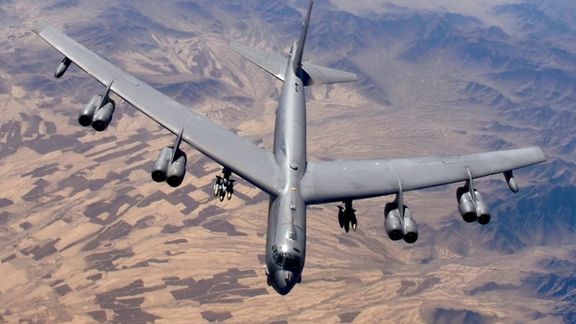
A B-52 Stratofortress flies over Afghanistan in this undated handout photo. U.S. Air Force

The Trump administration wants Iran to abandon all aspects of its nuclear program, the US national security advisor said on Sunday, warning that all options are on the table should Tehran refuse.

"Iran cannot have a nuclear weapon. All options are on the table to ensure it does not have one," Michael Waltz told ABC News on Sunday.

"And that’s all aspects of Iran's program. That’s the missiles, the weaponization, the enrichment. They can either hand it over and give it up in a way that is verifiable, or they can face a whole series of other consequences," he warned.

In 2015, Iran signed a nuclear deal with the United States and other world powers that imposed restrictions on its uranium enrichment capacity but effectively allowed it to maintain its nuclear program. It also did not directly address Tehran's ballistic missile program, focusing instead on nuclear-related issues.

While Iran is now signaling a willingness to accept similar restrictions on its nuclear program in exchange for sanctions relief, the Trump administration appears determined to put an end to Tehran's atomic ambitions.

The United Nations' nuclear watchdog warned on Saturday that the Islamic Republic is very close to developing a nuclear weapon.

"Iran has an extremely ambitious and extensive nuclear program, under which it is enriching uranium to nearly weapons-grade levels," Rafael Grossi, the director general of the International Atomic Energy Agency (IAEA) said.

Trump's national security advisor said on Sunday that "we cannot have a world with the ayatollahs with their finger on the nuclear button. And President Trump is determined (to prevent that), one way or another."

"Iran has been offered a way out of this to make sure that we don’t have a world that can be threatened by a radical regime," Waltz said, referring to Trump's direct letter to Iran's Supreme Leader.

Trump announced the overture at the same time he warned Iran to agree to a new nuclear deal or face military action.

While Supreme Leader Ali Khamenei has publicly ruled out talks, Iran’s foreign minister on Thursday signaled Tehran's willingness to engage in indirect negotiations with the United States through Oman.

On Sunday, Araghchi travelled to Muscat "to review bilateral and regional issues of mutual interest and concern."

"Our commitment is to diplomacy in defense of peace and stability, and I am always delighted to engage with my Omani counterpart in pursuit of these aims," he said, without explaining whether the issue of Omani mediation between Tehran and Washington had been discussed.

US may target Iranian assets in Red Sea

Araghchi's trip to Oman came hours after the US military started a series of large-scale airstrikes against Yemen's Houthis in what US officials described as a warning signal to their sponsors in Tehran.

US Defense Secretary Pete Hegseth said on Sunday the ongoing US airstrikes against Houthis serve as a warning to Iran to stop backing the group.

Washington would conduct "unrelenting" strikes against Yemen's Houthis until the Tehran-backed group ceases their military actions targeting US assets and global shipping, Hegseth told Fox News.

Secretary of State Marco Rubio also told CBS News that there was "no way" Yemen's Houthis would have the ability to attack global shipping without support from Iran.

In his Sunday interview with Fox News, Michael Waltz said the Trump administration "will hold not only the Houthis accountable, but we’re going to hold Iran, their backers, accountable as well.”

"And if that means they’re targeting ships that they have put in to – to help their Iranian trainers, IRGC and others, that intelligence, other things that they have put in to help the Houthis attack the global economy, those – those targets will be on the table too," he warned.

Iran allegedly operates reconnaissance ships in the Red Sea, including the commercial cargo ships Behshad and Saviz, which Washington says coordinate with the Houthis.

Despite scrutinizing their operations, neither the US nor Israeli militaries have targeted the ships.


Most Viewed

Ghalibaf defends Iran-US talks amid hardline backlash
1
INSIGHT

Ghalibaf defends Iran-US talks amid hardline backlash

2
ANALYSIS

From instability to influence: Pakistan’s pivotal role in US-Iran diplomacy

3
ANALYSIS

100 days on: why Iran’s January protests spread across social classes

4

War-hit homeowners feel abandoned as Iran’s reconstruction aid fades

5
INSIGHT

100 days on: the anatomy of Iran’s January crackdown

Banner
Banner

Spotlight

  • The politics of pink: how Iran uses cuteness to rebrand violence
    ANALYSIS

    The politics of pink: how Iran uses cuteness to rebrand violence

  • Bread shortages, soaring prices strain households in Iran, residents say
    VOICES FROM IRAN

    Bread shortages, soaring prices strain households in Iran, residents say

  • War-hit homeowners feel abandoned as Iran’s reconstruction aid fades

    War-hit homeowners feel abandoned as Iran’s reconstruction aid fades

  • 100 days on: the anatomy of Iran’s January crackdown
    INSIGHT

    100 days on: the anatomy of Iran’s January crackdown

  • Ghalibaf defends Iran-US talks amid hardline backlash
    INSIGHT

    Ghalibaf defends Iran-US talks amid hardline backlash

  • From instability to influence: Pakistan’s pivotal role in US-Iran diplomacy
    ANALYSIS

    From instability to influence: Pakistan’s pivotal role in US-Iran diplomacy

•
•
•

More Stories

Iran’s 45% minimum wage increase faces criticism over inflation gap

Mar 16, 2025, 16:38 GMT+0

Iran’s Supreme Labor Council approved a 45% increase in the minimum wage, setting the new base salary at 104.4 million rials ($110) per month, but the decision has drawn criticism from lawmakers and labor representatives who argue that it fails to match rising living costs.

Despite the wage hike, workers' representatives had demanded at least a 70% increase to keep pace with inflation.

The council did not issue a decision on housing allowances, leaving it at 9 million rials ($9.50) per month, while rent for a 50-square-meter apartment in Tehran averages 150 million rials ($160) per month.

Hussein-Ali Haji Deligani, a member of parliament, dismissed the 45% wage increase as insufficient in the country's collapsing economy.

“With 100 million rials ($106), a family cannot survive,” he said, calling for a fundamental adjustment of wages to match inflation.

The increase is 10 percentage points higher than last year’s 35% wage increase, but some lawmakers emphasized that percentage gains mean little when purchasing power declines.

Mojtaba Yousefi, an MP from Ahvaz, pointed out that “when wages rise slower than inflation, workers’ real income drops by 20%.”

According to Iran’s labor law, the minimum wage must be set in accordance with inflation and provide for a household’s basic needs.

A view of Tehran's Grand Bazaar (Undated)
100%
A view of Tehran's Grand Bazaar

Inflation has been consistently around 50 percent and the economic crisis has significantly diminished the purchasing power of ordinary Iranians, leading to tens of millions falling into the category of working poor.

Experts highlight that the poverty line for Tehran residents is approximately 300,000,000 rials (approx. $600) per month, three times the current minimum wage.

Ali Babaei Karnami, head of the parliamentary Social Committee, previously said that any increase below 50% would be “a deviation from the law.” He also cited reports estimating a household’s essential expenses at 260 million rials ($277) per month, more than twice the newly set minimum wage.

Under the new system, a married worker with two children will see their total monthly income rise from 116.9 million rials ($124) to 163.5 million rials ($174), while a single worker without seniority will earn 134.9 million rials ($144), up from 94.6 million rials ($101).

Each year, Iran’s labor ministry convenes negotiations between worker and employer representatives, but two key factors ultimately determine wages: the government’s salary increases in the annual budget and the inflation rate reported by the country’s statistics agency.

Critics argue that raising wages without broader economic reforms risks fueling further inflation while failing to improve workers’ real incomes. At least one third of Iran now lives below the poverty line.

In dollar terms, wages have barely grown due to the weakening rial, leaving many workers effectively poorer despite nominal increases.

ISIS-supporting illegal immigrant not deported to Iran - Telegraph

Mar 16, 2025, 14:01 GMT+0

An Iranian illegal immigrant in the UK, found to support Islamic State (ISIS) and pose a real and serious danger to the British public, will not face deportation for fear he will be tortured back in Iran, an investigation by The Telegraph has revealed.

The 32-year-old Sunni Muslim, released from the detention center in June after judges ruled that being confined was bad for his mental health, was spared deportation to Iran in January.

Named only as D8 in court documents, he entered Britain illegally twice, in 2017 and 2021.

In July 2022, the Home Office rejected his asylum application on national security grounds, saying that he had an Islamist mindset and maintained support for the Islamic State.

He has now been given five years’ leave to remain as a refugee in the system, which safeguards human rights before national security.

He is the latest case of many to be waived deportation on human rights grounds, most citing the right to a family life under the European Convention on Human Rights (ECHR), which limits the British government’s attempts to remove illegal migrants in spite of the UK leaving Europe.

In a hearing in January, the judges in the case said: “Drawing the threads together, the secretary of state has concluded that D8 is a danger to the national security of the United Kingdom."

"It is inherent in that conclusion, which the secretary of state was entitled to reach, that he represents a real and serious danger.”

The judges, however, said that if D8 were returned to Iran “his life would be put at risk” and he would be exposed to “a real risk of torture or other inhuman or degrading treatment”, likely due to his being a minority Sunni Muslim, and Iran’s own battle against Islamic State extremism on its own soil.

Iran uncovers oil pipeline taps amid fuel smuggling crisis

Mar 16, 2025, 12:38 GMT+0

Iranian authorities have discovered and sealed four illegal taps on a major oil pipeline near the southern city of Bandar Abbas as the country grapples with a massive fuel smuggling crisis, officials said on Sunday.

Mojtaba Ghahramani, head of the Hormozgan Province Judiciary, said that the unauthorized diversions were found on a natural gas pipeline between the villages of Sar-Rig and Isin.

"Technical and police measures have been initiated to identify the perpetrators of this fuel theft," Ghahramani said, adding that some of the taps appeared to be newly installed.

Ghahramani repeated the judiciary's past warnings to the Ministry of Petroleum about the need for enhanced monitoring and the installation of advanced metering systems.

The discovery follows heightened scrutiny of fuel smuggling in Iran, with President Masoud Pezeshkian recently decrying the daily loss of 20 to 30 million liters of fuel as a catastrophe amid a nationwide energy crisis.

Economists and officials have increasingly pointed to systemic, large-scale operations, rather than small-time smugglers, as the primary drivers of the illicit trade.

Estimates suggest that up to 50 million liters of fuel may be smuggled out of Iran daily, raising questions about high-level complicity.

"This volume of smuggling cannot be the work of small-time smugglers in border regions. It is definitely done by government entities," economist Hossein Raghfar told local media.

The sheer scale of the operation, involving potentially thousands of trucks or large tankers, has led experts to suspect the involvement of organized networks and even elements within the Islamic Revolutionary Guard Corps (IRGC).

The IRGC controls a significant portion of the country’s transportation networks and border crossings, which, according to economic journalist Reza Gheibi, makes it difficult to imagine that such large volumes of fuel could be smuggled out of the country without the IRGC’s knowledge or involvement.

The lucrative nature of fuel smuggling, driven by the disparity between subsidized domestic prices and higher international rates, has also fueled corruption within government ranks, evidenced by recent official arrests

In December 2022, Aref Akbari, the Public and Revolutionary Prosecutor of Hormozgan Province, announced the arrest of six rural mayors, three employees of the Ministry of Industry, and two members of the Engineering Organization on charges of collaborating with fuel smugglers.

The ongoing energy crisis, marked by power outages and disruptions to industrial and even government activity, has intensified calls for stricter oversight and technological solutions to curb fuel theft.

Iran praises Armenia-Azerbaijan peace agreement

Mar 16, 2025, 11:12 GMT+0

Iran's president has welcomed the recent peace agreement between Armenia and Azerbaijan, expressing Iran's commitment to regional stability, even as reports of border clashes surfaced.

In a phone call with Armenian Prime Minister Nikol Pashinyan, Masoud Pezeshkian expressed his satisfaction with the peace deal, emphasizing Iran's long-standing support for "peace, convergence, and stability in the region, especially among neighbors, while preserving the territorial integrity of countries," according to a statement from the Iranian presidency.

Pashinyan briefed Pezeshkian on the negotiation process. He also acknowledged the development and dynamism in bilateral relations with Iran under Pezeshkian's leadership, according to Iran’s state media.

However, the positive developments were overshadowed by renewed tensions on the ground. On Sunday, Azerbaijan's defense ministry accused Armenian forces of firing on Azerbaijani positions from Armenia's southern Syunik province, a claim Yerevan denied.

The Nagorno-Karabakh conflict, a decades-long dispute between Armenia and Azerbaijan, intensified after the Soviet Union's collapse. Nagorno-Karabakh, known as Artsakh by Armenians, is a mountainous region within Azerbaijan, internationally recognized as such, but until 2023, was predominantly inhabited by ethnic Armenians.

Despite the tensions, both Azerbaijan and Armenia announced on Thursday that they had agreed on the text of a peace agreement, marking a potential breakthrough in the decades-long conflict between the two South Caucasus nations.

Tehran has consistently emphasized its interest in maintaining stability along its northern 44-kilometer border, given the potential for regional conflicts to intersect with ethnic and religious tensions.

Tehran bans advertisements for global brands linked to Israel

Mar 16, 2025, 08:33 GMT+0

Tehran’s city council has voted to prohibit advertisements for global brands associated with Israeli companies such as Coca-Cola and Nestle, expanding the ban to sales in municipal markets and purchases by the city municipality.

Mehdi Babaei, head of the council’s safety committee, said the decision aligns with broader policies.

“Beyond banning advertisements, the sale of such goods in municipality chain stores and fruit and vegetable markets, as well as their procurement by the municipality, is now prohibited,” he said.

The measure explicitly targets brands identified as having Israeli ties, such as Coca-Cola and Nestlé, barring them from using the city’s advertising infrastructure, including billboards and urban media networks.

The council framed the move as a response to directives from Iran’s leadership, citing support for the Palestinian cause and efforts to restrict the economic influence of companies it considers linked to Israel.

The municipality is now tasked with implementing the policy across all advertising spaces under its control, ensuring that no municipality-affiliated stores or markets distribute the affected goods.

Officials say enforcement mechanisms will be detailed in the coming weeks, though past restrictions on Israeli-linked businesses in Iran have often relied on broader national trade policies rather than municipal oversight.

Last year, the Islamic Republic's Supreme Leader Ali Khamenei called on Muslim countries to isolate Israel.

He said Iran “has the definite expectation and suggestion” that Islamic countries sever political and economic ties with Israel, at least until Israel stops its war on Hamas, triggered by the Iran-backed group's assault on Israel on October 7, 2023.