• العربية
  • فارسی
Brand
  • Iran Insight
  • Politics
  • Economy
  • Analysis
  • Special Report
  • Opinion
  • Podcast
  • Iran Insight
  • Politics
  • Economy
  • Analysis
  • Special Report
  • Opinion
  • Podcast
  • Theme
  • Language
    • العربية
    • فارسی
  • Iran Insight
  • Politics
  • Economy
  • Analysis
  • Special Report
  • Opinion
  • Podcast
All rights reserved for Volant Media UK Limited
volant media logo

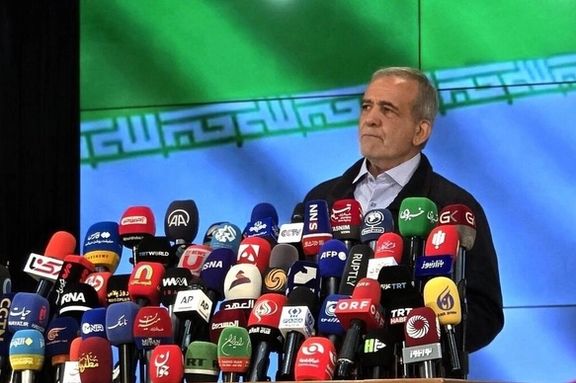
Pezeshkian under fire for boosting funding to propaganda institutions

Maryam Sinaiee
Maryam Sinaiee

Iran International

Feb 25, 2025, 12:39 GMT+0Updated: 10:38 GMT+0

Iranian media outlets and public figures are criticizing Tehran’s proposed budget for allocating substantial funds to the state-run Islamic Republic of Iran Broadcasting (IRIB) and religious institutions.

Critics saw the allocation of the 350 trillion rials (approximately $400 million) for IRIB as most contentious, noting an increase of 33% compared to last year.

This budget surpasses the combined allocations for several key ministries, including Oil, Foreign Affairs, Cultural Heritage, and Justice.

The $400 million allocation for IRIB would have been $800 million if not for the currency’s sharp devaluation.

In a commentary published by Etemad on Monday, prominent reformist commentator Abbas Abdi sharply criticized Iranian President Masoud Pezeshkian for increasing IRIB’s budget.

“What is the government’s justification for financing this inefficient institution? … Why should the public bear the cost of the state television’s revenue decline from advertising?” Abdi wrote, arguing that the drop in revenue is due to a shrinking audience.

IRIB, now dominated by ultra-hardliners aligned with the Paydari Party, offers limited entertainment, instead focusing on religious and political messaging.

Observers also point out that viewers have increasingly turned to foreign-based satellite channels, particularly Persian-language channels, and domestic video-on-demand platforms.

While IRIB claims a 72% viewership, a survey by the state-affiliated Iranian Students Polling Agency (ISPA) indicates a sharp decline. According to ISPA, only 12.5% of respondents now consider IRIB their primary news source, down from 51% in 2017.

Over the past years, the broadcaster has been sanctioned by many Western governments for its role in state propaganda, censorship, and broadcasting forced confessions.

Controversial funding for religious institutions

Beyond IRIB, the increased funding for state-run Islamic propaganda organizations and so-called "cultural institutions" has also sparked backlash. These organizations, which receive tens of millions of dollars in government funding, operate with little transparency and are not subject to government oversight.

Among them is an organization responsible for promoting group prayers in government offices, schools, and universities. Another is tasked with enforcing Islamic obligations, such as wearing the hijab and fasting, while discouraging what it deems sinful behavior.

Other recipients include the Qom-based Imam Khomeini Educational and Research Institute founded by the late Ayatollah Mohammad-Taghi Mesbah-Yazdi, often considered the spiritual father of the Islamic Republic's ultraconservatives, and Al-Mustafa International University in Qom that has branches in over fifty countries and sponsors hundreds of students annually, from China to Africa and Latin America, to study in Iran.

Many critics question the necessity of such expenditures at a time when the country faces severe economic challenges.

"Why is it necessary to spend so much money on foreign seminary students in a country where nearly a million students have dropped out of school mainly due to poverty," journalist Mohammad Parsi wrote on X.

Calls for budget revisions

Speaking to Entekhab last week, former moderate conservative lawmaker Jalal Rashidi Kouchi urged the Pezeshkian to eliminate funding for these institutions, arguing that these have “no [observable] achievement other than fueling public resentment toward the government.”

The government recently submitted the second part of its budget bill to parliament, detailing allocations to IRIB and these controversial cultural institutions. Lawmakers are currently reviewing the bill and must approve it before the Iranian New Year (Norouz) on March 20.

Economic challenges ahead

One of the biggest challenges facing Pezeshkian’s administration—exacerbated by an expected decline in oil exports, Iran’s primary source of revenue—is a growing budget deficit and inflation surpassing 40 percent. The situation has deteriorated further following US President Donald Trump’s recent reinstatement of his "maximum pressure" policy against Iran.

As the budget debate continues and food and commodity prices surge ahead of the Persian New Year, public scrutiny over government spending on propaganda and religious institutions is expected to grow.

According to in-house analysts, the hardline-dominated Parliament is not likely to yield to such concerns and may even approve further increases for some propaganda organizations.

Most Viewed

State media slam Araghchi's Hormuz tweet, say it let Trump claim victory
1

State media slam Araghchi's Hormuz tweet, say it let Trump claim victory

2

Iran International says it won’t be silenced after London arson attack

3
INSIGHT

How Tehran bends its own red lines to boost state rallies

4
VOICES FROM IRAN

Hope and anger in Iran as fragile ceasefire persists

5

Iran halts petrochemical exports to supply domestic market

Banner
Banner

Spotlight

  • Too early to tell who is winning Iran war, experts say
    PODCAST

    Too early to tell who is winning Iran war, experts say

  • How Tehran bends its own red lines to boost state rallies
    INSIGHT

    How Tehran bends its own red lines to boost state rallies

  • Iran blackout cripples freelancer, small business incomes
    VOICES FROM IRAN

    Iran blackout cripples freelancer, small business incomes

  • Ideology may be fading in Iran, but not in Kashmir's ‘Mini Iran'
    INSIGHT

    Ideology may be fading in Iran, but not in Kashmir's ‘Mini Iran'

  • US blockade enters murky phase as tankers spoof signals and buyers hesitate
    ANALYSIS

    US blockade enters murky phase as tankers spoof signals and buyers hesitate

  • Why the $100 billion Hormuz toll revenue is a myth
    ANALYSIS

    Why the $100 billion Hormuz toll revenue is a myth

•
•
•

More Stories

Experts, politicians warn of protests as Iran’s economic crisis deepens

Feb 25, 2025, 11:16 GMT+0
•
Behrouz Turani

A prominent sociologist in Tehran has warned that Iran could face widespread protests if the government fails to improve the country’s worsening financial situation and curb rising prices.

Taghi Azad Armaki told Etemad, a pro-reform newspaper supporting President Masoud Pezeshkian, that without lifting US sanctions a wave of protests over socio-economic issues is likely.

He criticized the government for converting social and economic problems into security issues by criminalizing actions such as protests and opposition to social media censorship, rather than addressing the underlying problems.

Armaki emphasized that soaring prices, especially in housing and healthcare, along with the rapid depreciation of the Iranian currency and widespread poverty, are placing immense pressure on Iranians. He noted that while government officials occasionally acknowledge these issues, they have yet to propose any meaningful solutions.

The sociologist warned, “If this situation continues, protests are likely to erupt in the near future.” He criticized the government for downplaying serious issues in energy, housing, poverty, and social delinquency.

He urged the government to acknowledge its limitations and focus its resources on meeting the nation’s basic needs, such as ensuring the proper distribution of essentials like bread, water and energy.

Former Interior Minister Abdolreza Rahmani Fazli echoed these concerns, telling the press that “the extent of accumulated demands and dissent in Iran is a serious cause for concern.” He noted that the current situation is even more troubling than in 2019, when hundreds of thousands protested against rising fuel prices.

During that sudden wave of unrest in over 100 cities, the government swiftly responded with military and vigilante forces, resulting in the deaths of 1,500 protesters, according to a Reuters estimate.

Meanwhile, the IRGC-linked newspaper Javan criticized hardliners in the parliament (Majles), warning that “while protests more intense than those of 2019 loom on the horizon, opponents of President Pezeshkian and even some who backed him in the election are wasting time and energy trying to unseat him and his ministers.”

Javan warned that this could trigger a series of deep-rooted political crises in the upcoming Iranian year, which begins in about four weeks. The newspaper suggested that the situation could worsen if combined with “foreign operations,” likely referring to potential Israeli attacks on Iran’s nuclear sites.

In a similar vein, conservative commentator Mohammad Mohajeri criticized hardline lawmakers for pushing to impeach Economy Minister Abdolnaser Hemmati, accusing him of “failing to improve the country’s economic situation.”

Mohajeri criticized the hardline lawmakers, saying, “The MPs think that dismissing the minister will improve the economic situation, but their approach is like an ugly man trying to calm a crying baby by making faces—his appearance only made the baby cry even harder.” He added, “You are the problem. It’s your actions that have created these insurmountable challenges.”

Several reports in Iranian media on Monday highlighted the severity of Iran’s economic crisis and the financial struggles facing its citizens. The conservative Nameh News website noted, “The government's inefficiency is worsening the economic crisis, compounded by significant shortcomings in sectors such as energy, housing, and healthcare.”

Economic expert and a well-known businessman, Majid Reza Hariri, told Nameh News that when he questioned some MPs about their push to impeach the economy minister, they admitted, “The situation might get worse, but we need to show our voters that we are just as dissatisfied with the current state of affairs.”

Commenting on the Pezeshkian administration's weaknesses, Hariri remarked, “I believe we effectively have no government, as no one is willing to take responsibility for the economic problems.”

Will Iran's ultra-hardliners make gains in upcoming local elections?

Feb 24, 2025, 15:07 GMT+0
•
Maryam Sinaiee

Ultra-hardliner Saeed Jalili and his allies—widely regarded as President Masoud Pezeshkian’s chief rivals—are maneuvering to expand their political influence through upcoming city and village council elections, according to Iranian media.

While Jalili only briefly referenced the importance of these elections in a speech last week, his public appearances and speeches have notably increased in recent months. In these speeches, Jalili emphasized that the development budget allocated to the country’s top cities exceeds the national development budget, pointing to the significance of these local councils.

“It appears that Jalili’s statements should be considered a signal of the [active] participation of him and his supporters in the seventh city council elections,” an article published by Rozan Online read on Saturday.

The publication’s report also argued that these elections could intensify rivalries within the hardliner/ultra-hardliner camp, particularly in cities like Tehran, where Parliament Speaker Mohammad-Bagher Ghalibaf, a former mayor of the capital, and his supporters still wield some influence in the municipality.

Jalili and his supporters’ plans for the elections on June 19 will not only heighten competition among three factions—led by Jalili, incumbent Tehran Mayor Alireza Zakani, and Ghalibaf—but could also lead to new coalitions or deeper divisions within this political faction, Rozan’s piece noted.

Ghalibaf has been relatively supportive of Pezeshkian’s “national unity” government and is often accused by Jalili’s supporters on social media of betraying the “revolutionary cause.”

Jalili has no executive experience. He led Iran’s nuclear negotiations during the presidency of populist Mahmoud Ahmadinejad and currently represents Supreme Leader Ali Khamenei in the Supreme National Security Council (SNSC). Additionally, he serves on the Expediency Discernment Council (EDC), also by Khamenei’s appointment.

“The Jalili circle has become hyperactive in parliament and on social media in unison with him,” a piece by Khabar Online read – a media outlet linked to former conservative parliamentary speaker Ali Larijani.

The publication speculated on Saturday that securing control over city and village councils could be a stepping stone for Jalili’s presidential ambitions in the next election.

Khabar Online’s report also suggested that if Jalili’s supporters gain a majority in the Tehran City Council, he could position himself as the mayor of the capital, following Ahmadinejad’s footsteps, who later became president.

Jalili, who competed against Pezeshkian in the June 2024 runoff presidential election, does not formally lead any political party. However, he has strong backing from the ultra-hardliner Paydari Party and its allies, including the Iran Morning Front (Jebhe-ye Sobh-e Iran), a political party established only a year ago. Both parties officially endorsed and campaigned for Jalili in the recent presidential election.

Jalili and his supporters are staunchly opposed to any negotiations with the United States regarding Iran's nuclear program, missile capabilities, and regional influence. They also reject Iran's accession to Financial Action Task Force (FATF) conventions, which could help remove Iran from the global money-laundering watchdog’s blacklist.

The ultra-hardliner Paydari Party, a small but influential faction in parliament, has been behind several controversial legislative efforts, including the strict hijab law and the recent attempt to impeach Economy Minister Abdolnasser Hemmati. The Paydari Party and the Iran Morning Front also have a strong presence in key state institutions, including the state-run broadcasting organization (IRIB), where Jalili’s brother, Vahid Jalili, serves as a cultural deputy. In this role, he wields significant influence over IRIB’s policy direction.

The city and village council elections are the only elections in Iran that do not require candidate vetting by the ultra-hardliner Guardian Council, allowing for broader participation than in parliamentary and other elections.

In smaller towns and villages, competition in local government council elections is often driven by ethnic and tribal factors which may bring more voters to the ballot boxes.

However, in major cities like Tehran, where political concerns take precedence, voter turnout could be very low like in last year’s parliamentary elections.

Economist warns of hyperinflation as Iran’s economy deteriorates

Feb 24, 2025, 11:41 GMT+0

An Iranian economist has warned that hyperinflation could take hold unless effective negotiations with the United States lead to the lifting of sanctions.

“Without easing sanctions through productive negotiations, reducing inflation seems unlikely,” Ghodratollah Emamverdi told Etemad newspaper on Monday. He cautioned that if monthly inflation reaches 50%, Iran could face hyperinflation. Currently, monthly inflation is at four percent, while annual inflation is estimated to be over 40%.

On Sunday, the only government agency reporting inflation figures announced an annual rate of 35%. However, labor groups and analysts contend that the government downplays negative economic news, suggesting the real inflation rate is much higher.

Emamverdi noted that although Iran’s inflation rate has not yet reached the critical 50% threshold, continued sanctions and internal political tensions could push the economy into hyperinflation.

Majid-Reza Hariri, former head of Iran’s chamber of commerce, criticized the presidential administration’s inability to address the current crisis, saying the government is effectively paralyzed.

“We either have a government or we don’t, and I personally believe we are facing a state of no government. If the government cannot solve economic problems, no one is forced to be president or minister,” Hariri said. He added that everyone in the current administration was aware of the situation by mid-2024 but still chose to run for office or accept ministerial positions.

President Masoud Pezeshkian has argued that Iran’s complex and deep-seated economic problems are too vast for his administration to resolve, implicitly pointing to the impact of sanctions. Following Supreme Leader Ali Khamenei’s ban on negotiations with the United States in early February, Pezeshkian expressed his support for the decision, aligning himself with Iran’s ultimate political authority. As the new Iranian year approaches on March 20, the government faces the challenge of setting pay raises for millions of workers, including those in government and quasi-public enterprises. Workers are demanding wage increases of up to 70% to keep pace with soaring inflation.

The Iranian rial has lost more than 50% of its value in the past six months, driving expectations of even higher inflation. Currently, the minimum wage stands at about $120 per month, while semi-official estimates indicate that at least $400 per month is needed to support a family of three.

The government is considering a wage increase of less than 50%, which would still leave workers struggling to afford basic necessities. However, even a smaller pay hike could further fuel inflation.

Ethnic activists in Iran call for education in mother tongues

Feb 23, 2025, 08:58 GMT+0
•
Maryam Sinaiee

Iran is a highly multilingual country, yet education in languages other than Persian is not permitted and its advocates often face persecution by security bodies for encouraging separatism.

This year, according to social media reports, activists in several northwestern cities, including Tabriz, Maragheh, and Ardabil, marked International Mother Language Day on February 21 by distributing children's books written in Torki on the streets. Torki is a Turkic language spoken by millions in the northwestern provinces of East and West Azarbaijan, Ardabil, and parts of Zanjan and other provinces.

Similarly, in some Kurdish cities, activists celebrated the occasion by distributing leaflets and posters to raise awareness of their cause.

The United Nations General Assembly designated February 21 as International Mother Language Day in 1999 to promote awareness of linguistic and cultural diversity and to promote multilingualism.

Iran is home to many ethnic groups, each with its own language, including Kurds, Torki, Gilaks, Baluchis, Arabs, and Turkmen. Torki, and Kurdish -- mostly spoken in western province -- have the largest number of speakers.

Children singing in Torki at a shopping mall in Tabriz, East Azarbaijan, on International Mother Language Day

There are no official statistics on the number of speakers of these or other languages, such as Arabic, which is spoken in the southwestern province of Khuzestan, or Balochi, spoken in the southeastern province of Sistan and Baluchestan.

Many members of ethnic groups, specially in urban centers, speak Persian as all education, including textbooks, is in Persian.

The government often view the demand for education in native languages as linked to separatism and suppress its organized advocacy.

Persian has been the official language of most Iranian dynasties throughout the Islamic period, including the Safavid and Qajar dynasties, whose rulers were native speakers of Torki. It has also served as the country’s literary language and lingua franca.

Activists distributing posters and leaflets in the Kurdish city of Marivan on International Mother Language Day.

Before the establishment of a modern educational system in 1925 by Reza Shah, the founder of the Pahlavi Dynasty, literacy was largely restricted to the upper class and the clergy, who ran small schools called maktab to teach literacy. In 1936, maktabs were shut down, and primary education in new public schools became compulsory for all children.

Since then, Persian has remained the sole language of government, media and education in Iran, despite Article 15 of the Constitution of the Islamic Republic, which was drafted months after the 1979 Islamic Revolution.

This article permits the use of ethnic languages in the press and media and allows for their literature to be taught alongside Persian in schools. However, the government has never implemented these provisions by incorporating ethnic languages into public education. Independent schools and language institutes are also barred from offering courses for other local languages.

While state-run provincial radio and television stations broadcast some programs in Kurdish, Torki, Arabic, Baluchi, and Turkmen, their content largely reflects the government’s Islamic ideology and propaganda.

Authorities frequently crack down on unofficial ethnic language classes conducted by volunteer “mother language” activists, particularly in Torki and Kurdish-speaking areas.

For example, on February 21, the Kurdish human rights group Kurdpa reported that seven activists had been arrested over the past year for promoting the teaching of the Kurdish language and were sentenced to a total of 16 years in prison.

Advocates for teaching ethnic languages argue that their cultures and languages are at risk due to the dominance of Persian in Iran’s educational system.

Critics, however, counter-argue that introducing education in non-Persian languages could weaken Persian’s role as the official language, threaten national unity by fueling sectarianism, complicate the education system, and increase its costs.

Iran's President Masoud Pezeshkian, a native speaker of both Torki and Kurdish, the languages spoken by his own parents, is one of the very few officials who has ever defended the right to giving official status to ethnic languages based on Article 15 of the Iranian Constitution.

He argued against critics, when he was a lawmaker, that using these languages in schools, contrary to their beliefs, could even strengthen national unity.

Iranians protest soaring prices and worsening economic crisis

Feb 22, 2025, 15:50 GMT+0

Citizens engaging with Iran International have sent videos reporting a sharp rise in the prices of essential goods and expressing deep dissatisfaction with the inefficiency and neglect by Islamic Republic officials.

In the reports, people highlight the increasing pressure on their livelihoods, complaining about the lack of response to their protests and the absence of effective measures to control prices.

One viewer, sharing a video, said that they had purchased only a few kilograms of potatoes, onions, and tomatoes, and the cost of these three items had reached 7,000,000 rials, approximately one-seventeenth of the average monthly Iranian salary.

The simultaneous surge in prices and worsening economic hardship, along with leaked reports of the Islamic Republic's financial aid to its supporters in Lebanon, has drawn significant attention from Iranian citizens.

One Iran International viewer, referring to the high food prices, said in a video: "The Iranian government gives money to the Lebanese, but does not care about its own people."

On Tuesday, Ali Khamenei, the Supreme Leader of the Islamic Republic, met in Tehran with leaders of Palestinian Islamic Jihad, who visited Tehran seeking financial assistance. Meanwhile, Hezbollah in Lebanon has been opening new branches of interest-free loan funds to distribute financial aid from the Islamic Republic.

Tehran has recently allocated more than $10,000 to each war-affected family in Lebanon to help cover rent and household expenses. This aid is distributed among Shiite Lebanese who are supporters of Hezbollah.

Naim Qassem, the newly appointed Secretary-General of Hezbollah, described the funds as a "gift from the Islamic Republic."

Inflation in Iran has reached an uncontrollable level, with the Iranian Statistics Center announcing that the country’s annual inflation rate for the 12 months leading up to February 2025 stands at 32%.

Shoppers at Tehran's historic Bazaar. File photo
100%
Shoppers at Tehran's historic Bazaar. File photo

The Iranian currency, rial, has depreciated by more than 50% since September fueling annual inflation, which has hovered around 40% in the past five years.

Citizens hold the Islamic Republic and its policies responsible for their economic hardship and the rising cost of food and medicine.

Even Islamic Republic officials have acknowledged their inability to resolve the current crises.

President Masoud Pezeshkian referring to shortages in various sectors—including energy, which the government labels as imbalances—said:

"Do you think I have a magic box? No. Six months ago, I was walking in Parliament, and now I am the President."

Speaking at a meeting with officials in western Tehran on Thursday, Pezeshkian added:

"Everywhere we look, there is an imbalance—in water, electricity, gas, money, land, schools, and hospital beds. Demand is unlimited, and our capacity is limited."

Meanwhile, on Friday, Mohammad Jamalian, a member of Parliament’s Health Committee, said:

"Currently, 350 to 400 types of medicine are in short supply, and in the best-case scenario, such shortages will worsen within the next one to two months."







