• العربية
  • فارسی
Brand
  • Iran Insight
  • Politics
  • Economy
  • Analysis
  • Special Report
  • Opinion
  • Podcast
  • Iran Insight
  • Politics
  • Economy
  • Analysis
  • Special Report
  • Opinion
  • Podcast
  • Theme
  • Language
    • العربية
    • فارسی
  • Iran Insight
  • Politics
  • Economy
  • Analysis
  • Special Report
  • Opinion
  • Podcast
All rights reserved for Volant Media UK Limited
volant media logo

Ethnic activists in Iran call for education in mother tongues

Maryam Sinaiee
Maryam Sinaiee

Iran International

Feb 23, 2025, 08:58 GMT+0Updated: 11:42 GMT+0
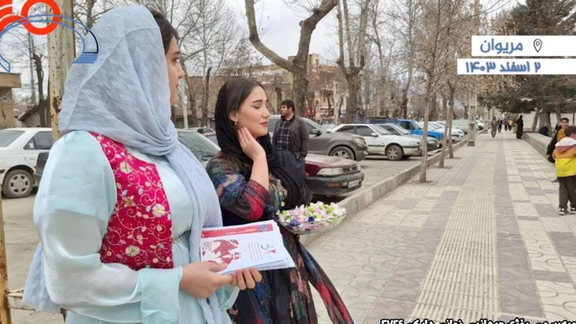
Kurdish activists distributing leaflets on International Mother Language Day in Marivan, Iran

Iran is a highly multilingual country, yet education in languages other than Persian is not permitted and its advocates often face persecution by security bodies for encouraging separatism.

This year, according to social media reports, activists in several northwestern cities, including Tabriz, Maragheh, and Ardabil, marked International Mother Language Day on February 21 by distributing children's books written in Torki on the streets. Torki is a Turkic language spoken by millions in the northwestern provinces of East and West Azarbaijan, Ardabil, and parts of Zanjan and other provinces.

Similarly, in some Kurdish cities, activists celebrated the occasion by distributing leaflets and posters to raise awareness of their cause.

The United Nations General Assembly designated February 21 as International Mother Language Day in 1999 to promote awareness of linguistic and cultural diversity and to promote multilingualism.

Iran is home to many ethnic groups, each with its own language, including Kurds, Torki, Gilaks, Baluchis, Arabs, and Turkmen. Torki, and Kurdish -- mostly spoken in western province -- have the largest number of speakers.

Children singing in Torki at a shopping mall in Tabriz, East Azarbaijan, on International Mother Language Day

There are no official statistics on the number of speakers of these or other languages, such as Arabic, which is spoken in the southwestern province of Khuzestan, or Balochi, spoken in the southeastern province of Sistan and Baluchestan.

Many members of ethnic groups, specially in urban centers, speak Persian as all education, including textbooks, is in Persian.

The government often view the demand for education in native languages as linked to separatism and suppress its organized advocacy.

Persian has been the official language of most Iranian dynasties throughout the Islamic period, including the Safavid and Qajar dynasties, whose rulers were native speakers of Torki. It has also served as the country’s literary language and lingua franca.

Activists distributing posters and leaflets in the Kurdish city of Marivan on International Mother Language Day.

Before the establishment of a modern educational system in 1925 by Reza Shah, the founder of the Pahlavi Dynasty, literacy was largely restricted to the upper class and the clergy, who ran small schools called maktab to teach literacy. In 1936, maktabs were shut down, and primary education in new public schools became compulsory for all children.

Since then, Persian has remained the sole language of government, media and education in Iran, despite Article 15 of the Constitution of the Islamic Republic, which was drafted months after the 1979 Islamic Revolution.

This article permits the use of ethnic languages in the press and media and allows for their literature to be taught alongside Persian in schools. However, the government has never implemented these provisions by incorporating ethnic languages into public education. Independent schools and language institutes are also barred from offering courses for other local languages.

While state-run provincial radio and television stations broadcast some programs in Kurdish, Torki, Arabic, Baluchi, and Turkmen, their content largely reflects the government’s Islamic ideology and propaganda.

Authorities frequently crack down on unofficial ethnic language classes conducted by volunteer “mother language” activists, particularly in Torki and Kurdish-speaking areas.

For example, on February 21, the Kurdish human rights group Kurdpa reported that seven activists had been arrested over the past year for promoting the teaching of the Kurdish language and were sentenced to a total of 16 years in prison.

Advocates for teaching ethnic languages argue that their cultures and languages are at risk due to the dominance of Persian in Iran’s educational system.

Critics, however, counter-argue that introducing education in non-Persian languages could weaken Persian’s role as the official language, threaten national unity by fueling sectarianism, complicate the education system, and increase its costs.

Iran's President Masoud Pezeshkian, a native speaker of both Torki and Kurdish, the languages spoken by his own parents, is one of the very few officials who has ever defended the right to giving official status to ethnic languages based on Article 15 of the Iranian Constitution.

He argued against critics, when he was a lawmaker, that using these languages in schools, contrary to their beliefs, could even strengthen national unity.

Most Viewed

Ideology may be fading in Iran, but not in Kashmir's ‘Mini Iran'
1
INSIGHT

Ideology may be fading in Iran, but not in Kashmir's ‘Mini Iran'

2
INSIGHT

Hardliners push Hormuz ‘red line’ as US blockade tests Iran’s leverage

3
VOICES FROM IRAN

Hope and anger in Iran as fragile ceasefire persists

4

Iran International says it won’t be silenced after London arson attack

5

US sanctions oil network tied to Iranian tycoon Shamkhani

Banner
Banner

Spotlight

  • Hardliners push Hormuz ‘red line’ as US blockade tests Iran’s leverage
    INSIGHT

    Hardliners push Hormuz ‘red line’ as US blockade tests Iran’s leverage

  • Ideology may be fading in Iran, but not in Kashmir's ‘Mini Iran'
    INSIGHT

    Ideology may be fading in Iran, but not in Kashmir's ‘Mini Iran'

  • War damage amounts to $3,000 per Iranian, with blockade set to add to losses
    INSIGHT

    War damage amounts to $3,000 per Iranian, with blockade set to add to losses

  • Why the $100 billion Hormuz toll revenue is a myth
    ANALYSIS

    Why the $100 billion Hormuz toll revenue is a myth

  • US blockade targets Iran oil boom amid regional disruption
    ANALYSIS

    US blockade targets Iran oil boom amid regional disruption

  • Iran's digital economy battered by prolonged blackout
    INSIGHT

    Iran's digital economy battered by prolonged blackout

•
•
•

More Stories

Iranians protest soaring prices and worsening economic crisis

Feb 22, 2025, 15:50 GMT+0

Citizens engaging with Iran International have sent videos reporting a sharp rise in the prices of essential goods and expressing deep dissatisfaction with the inefficiency and neglect by Islamic Republic officials.

In the reports, people highlight the increasing pressure on their livelihoods, complaining about the lack of response to their protests and the absence of effective measures to control prices.

One viewer, sharing a video, said that they had purchased only a few kilograms of potatoes, onions, and tomatoes, and the cost of these three items had reached 7,000,000 rials, approximately one-seventeenth of the average monthly Iranian salary.

The simultaneous surge in prices and worsening economic hardship, along with leaked reports of the Islamic Republic's financial aid to its supporters in Lebanon, has drawn significant attention from Iranian citizens.

One Iran International viewer, referring to the high food prices, said in a video: "The Iranian government gives money to the Lebanese, but does not care about its own people."

On Tuesday, Ali Khamenei, the Supreme Leader of the Islamic Republic, met in Tehran with leaders of Palestinian Islamic Jihad, who visited Tehran seeking financial assistance. Meanwhile, Hezbollah in Lebanon has been opening new branches of interest-free loan funds to distribute financial aid from the Islamic Republic.

Tehran has recently allocated more than $10,000 to each war-affected family in Lebanon to help cover rent and household expenses. This aid is distributed among Shiite Lebanese who are supporters of Hezbollah.

Naim Qassem, the newly appointed Secretary-General of Hezbollah, described the funds as a "gift from the Islamic Republic."

Inflation in Iran has reached an uncontrollable level, with the Iranian Statistics Center announcing that the country’s annual inflation rate for the 12 months leading up to February 2025 stands at 32%.

Shoppers at Tehran's historic Bazaar. File photo
100%
Shoppers at Tehran's historic Bazaar. File photo

The Iranian currency, rial, has depreciated by more than 50% since September fueling annual inflation, which has hovered around 40% in the past five years.

Citizens hold the Islamic Republic and its policies responsible for their economic hardship and the rising cost of food and medicine.

Even Islamic Republic officials have acknowledged their inability to resolve the current crises.

President Masoud Pezeshkian referring to shortages in various sectors—including energy, which the government labels as imbalances—said:

"Do you think I have a magic box? No. Six months ago, I was walking in Parliament, and now I am the President."

Speaking at a meeting with officials in western Tehran on Thursday, Pezeshkian added:

"Everywhere we look, there is an imbalance—in water, electricity, gas, money, land, schools, and hospital beds. Demand is unlimited, and our capacity is limited."

Meanwhile, on Friday, Mohammad Jamalian, a member of Parliament’s Health Committee, said:

"Currently, 350 to 400 types of medicine are in short supply, and in the best-case scenario, such shortages will worsen within the next one to two months."

Prominent lawmaker proposes Khamenei directly appoint Iran's presidents

Feb 22, 2025, 07:55 GMT+0
•
Behrouz Turani

A senior member of the Iranian parliament (Majles) has proposed replacing Iran's problematic presidential election system with a model in which the Supreme Leader directly appoints the President.

Speaking to Didban Iran (Iran Monitor) on Thursday, Osman Salari, the deputy chairman of the parliament's legal committee, defended his proposed system, arguing that it “is not against religious democracy.” In Iran’s political structure, this form of pseudo-democracy restricts voter choice by allowing only candidates approved and shortlisted by the hardliner-dominated Guardian Council to appear on the ballot. In addition, political parties are severely restricted, and media is either government owned or monitored and controlled.

Salari added that although the Supreme Leader is the true head of the government, there is nothing wrong with him appointing a President to lead the executive branch.

Several Iranian media outlets and politicians have previously suggested replacing the public election of the President with a parliamentary system in which the President is chosen by members of parliament.

Public trust in the president's office and the tightly controlled election system has declined over the past 15 years, as it has become increasingly clear that the president has limited authority over major state issues.

According to the government-owned Iranian Students News Agency (ISNA), the parliamentary system was most recently discussed in January 2022 when the agency analyzed the pros and cons of the two systems, drawing on the views of prominent Iranian political scientist Hossein Bashirieh.

ISNA outlined the advantages and disadvantages in a report, stating, "In the presidential system, both the parliament and the President are elected by the people for fixed terms. The parliament cannot remove the President from office, although it can impeach him. Conversely, the President does not have the authority to dissolve the parliament."

ISNA contrasted this with the parliamentary system, noting, "In the parliamentary system, the parliament can dismiss the head of the government (usually a prime minister) by withdrawing its vote of confidence. The Prime Minister also has the power to dissolve the parliament and call for new elections." The report also highlighted that the separation of the three branches of government is more clearly defined in the parliamentary system.

The push by Iranian politicians and media to change the political system stems from the ongoing conflict between the Supreme Leader and the President since the establishment of the Islamic Republic in 1979. Since Khamenei became Supreme Leader the situation has gradually worsened as he has systematically monopolized power.

As Salari observed in his interview with Didban Iran, "all of Iran's former Presidents since 1989 have been accused of deviation," and Khamenei distanced himself from each of them before the end of their terms. Salari added that although these Presidents initially received Khamenei's endorsement, they often pursued political, economic, and social policies that diverged from his views. This divergence complicated decision-making, particularly on key economic and foreign policy issues.

Salari argued that “directly appointing presidents by Khamenei is still democratic because Khamenei was indirectly elected by the people.” However, this claim is controversial given the circumstances of his election by the Assembly of Experts, which was heavily influenced by its former deputy chairman, Akbar Hashemi Rafsanjani. Videos available online show Rafsanjani using his considerable influence to suppress opposition to Khamenei’s election.

In 2011, Khamenei expressed support for the idea of the president being elected by parliament, but he did not pursue it further despite the concept being revisited several times since then.

However, Salari's proposal is fundamentally different, as it places the choice of a president in the hands of one individual. It is unlikely that this idea will progress beyond mere suggestion, as Khamenei has consistently avoided taking direct responsibility for decisions that could significantly impact the structure of the government. He appears to prefer having a president elected by others, allowing him to distance himself and criticize the president if things go wrong.

When to celebrate love in Iran: Valentine's Day or Espandgan?

Feb 21, 2025, 11:30 GMT+0
•
Maryam Sinaiee

Iran’s religious and political establishment is increasingly concerned that the growing popularity of pre-Islamic festivals, like Espandgan—celebrated as an alternative to Valentine’s Day—poses a threat to Islamic culture.

Over the past two decades, Valentine’s Day has grown increasingly popular in Iran, frustrating authorities who have spent nearly half a century trying to Islamicize society and shield young people from Western cultural influences.

In 2010, Iran’s police and judicial authorities condemned Valentine’s Day celebrations as part of a “Western cultural onslaught”, imposing a ban on businesses selling Valentine’s Day gifts and decorations.

Since then, police have occasionally cracked down on shops selling gifts and cafés hosting Valentine’s celebrations, where young people gather with red balloons, roses, teddy bears, and other tokens of affection. Despite these efforts, Valentine’s Day has continued to gain popularity, even spreading to religious cities such as Qom and Mashhad, home to two of Shiism’s most important shrines and seminaries.

Valentine's Day gift at a Tehran street market
100%
Valentine's Day gift at a Tehran street market

A call to revive Sepandarmazgan

Beyond government opposition, some Iranians also criticize the growing influence of Western holidays, advocating for the revival of ancient Iranian festivals instead. They argue that Sepandarmazgan, or Espandgan for short, offers a more culturally authentic alternative to Valentine’s Day.

Falling on February 23 this year, Sepandarmazgan is dedicated to Sepandarmaz (Holy Devotion), one of the seven divine entities emanating from Ahura Mazda, the Zoroastrian creator god.

In ancient Iranian tradition, Sepandarmaz was revered as a feminine divine force linked to the Earth and women, symbolizing fertility and prosperity. Unlike Anahita—an earlier goddess of love, fertility, and water whose worship was later absorbed into Zoroastrianism—Sepandarmaz was never portrayed in human form in ancient artifacts.

Sending text messages and giving gifts to loved ones on Espandgan instead of Valentine's Day has been gaining popularity in recent years.

According to a recent article published by the Student News Network, a hardline news outlet, presenting Espandgan as an alternative to Valentine’s Day fails to prevent the spread of Western cultural values. Instead, it merely repackages the same concepts in a form that contradicts the Islamic way of life.

Espandgan in history and modern Zoroastrianism

Iran’s Zoroastrian community, though now small, continues to celebrate Espandgan with solemn religious rituals and prayers, including recitations from the Avesta—their holy book—at fire temples and sacred shrines, such as Pir-e Sabz in Yazd.

According to the 11th-century historian Al-Biruni, however, Espandgan was widely observed in parts of Iran as a day honoring women. On this occasion, women were exempt from housework, and men showered their wives with gifts. Additionally, women freely expressed their love to the men they wished to marry, a tradition that resonates with modern romantic celebrations.

Government opposition to pre-Islamic traditions

Despite the historical significance of Espandgan, Iran’s religious and political establishment remains resistant to promoting pre-Islamic festivals as substitutes for Western celebrations like Valentine’s Day and Christmas—both of which remain widely celebrated despite official disapproval.

In recent years the celebration of Christmas has also become very popular in Iran.

Beyond Valentine's Day, the hardline religious and political establishment also opposes other ancient festivals including the Winter Solstice festival of Yalda (or Shab-e Chelleh) which marks the longest night of the year, and Charshanbeh Soori, a bonfire festival held on the evening of the last Tuesday before the Iranian New Year (Nowrouz) as relics of paganism.

Charshanbeh Soori often turns into a battle between the merry-making youth who celebrate it on the streets and the police, Basij militia of the Revolutionary Guards, and vigilante groups who crack down on them in larger cities such as Tehran.

In an attempt to counter pre-Islamic traditions and calendar events, authorities have sought to elevate Islamic occasions, designating the birthday of Fatima, daughter of Prophet Muhammad, as Women’s Day. The birthday of Imam Ali, the first Shiite Imam, has similarly been designated as Men’s Day while the anniversary of Fatima and Ali’s marriage has been added to the official calendar as Marriage Day.

Faced with economic woes and political rivals, Pezeshkian turns to poetry

Feb 20, 2025, 13:34 GMT+0
•
Behrouz Turani

Hardliners in Tehran keep blaming other officials for Iran’s economic crisis, despite broad recognition that US sanctions and the state-controlled economy are the main causes of inflation and currency devaluation.

The dominant hardline faction in the Iranian parliament is pushing to impeach Economy Minister Abdolnaser Hemmati just six months into his tenure, despite the economic crisis dating back to 2018, when then-President Donald Trump withdrew from the JCPOA nuclear deal and imposed strict sanctions.

In a show of support for his embattled economic team, President Masoud Pezeshkian visited Central Bank Governor Mohammad Reza Farzin on Tuesday and met with Economy Minister Abdolnaser Hemmati on Wednesday, following the formal submission of the impeachment motion against him.

Nonetheless, Pezeshkian’s appearance in parliament to defend his ministers did not stop the impeachment process from moving forward.

Although the parliamentary session was confidential, hardline lawmaker Hamid Rasai secretly recorded part of the proceedings and shared the footage on social media. The video captured Rasai sharply criticizing Hemmati, Farzin, and Pezeshkian himself.

Qasem Ravanbakhsh, an ultraconservative MP from Qom, sarcastically told reporters that during the meeting, Pezeshkian tried to blame everyone but himself for the country’s economic problems.

In response, Pezeshkian shared a video of his meeting with the economy minister, emphasizing that key economic policies were collectively decided by the country's leadership. He said, “I told the Majles that all banking, monetary, and foreign exchange policies were approved at meetings of the heads of the three branches of government, with Hemmati and Farzin also present. The minister did not set these policies. If anyone is to be blamed for the economic problems, it’s us—the heads of the three branches of government. So, come and arrest us!”

“To blame only one person is unfair,” Pezeshkian added.

Leaving some in the room perplexed, Pezeshkian continued by reciting a verse of classic Persian poetry by South Asian poet Sir Muhammad Iqbal of Lahore (1877–1938). The lines—“Open your eyes to yourself and close your eyes to others. Learn how to see and hear differently.”—did little to address the economic crisis, leaving many unsure of his intended message.

The pro-reform website Rouydad24 attributed Iran's economic troubles to US sanctions and regional tensions, including conflicts with Israel and Trump’s recent move to tighten sanctions. The site overlooked deeper structural issues within Iran’s economy and the disorganized political system that have also fueled the crisis.

Conservative politician Ali Mohammad Namazi told Nameh News that "People need to be convinced that the country's problems can be solved. However, Pezeshkian has failed to assure them that this is possible."

"Iranians are suffering from longstanding issues, and only effective solutions can restore their confidence," he added.

Namazi also warned that "people can no longer tolerate the economic hardships. They are struggling to live normal lives, and public dissent is growing. They might wait in the hope of a government solution, but this patience won’t last forever. Eventually, they will be compelled to protest."

The politician emphasized the urgency for officials to act swiftly, noting that lifting sanctions is the only way to address rising prices and inflation. He warned that without prompt action, the situation could become unpredictable if the inflation rate exceeds 50 percent.

He argued that Pezeshkian cannot claim ignorance of the country’s problems, given his extensive political experience as a multi-term parliament member and a former cabinet minister.

Pezeshkian’s main political rival is ultraconservative Saeed Jalili, who, according to Khabar Online, has obstructed nearly every initiative the president has pursued since June. This includes efforts to ease the compulsory hijab rule to gain women’s support, lift the ban on social media to appeal to young Iranians, and initiate minimal economic reforms.

Yet, despite the significance of this political rivalry, it is not Pezeshkian's biggest challenge. His primary issue is his admission during the election campaign that he had no clear plan for governing the country. This raises the question of how he managed to secure votes, even from the minority of Iranians who participated in the lackluster election, despite openly acknowledging his lack of a strategic agenda.

During the televised debates before the June election, Pezeshkian asked Jalili, “What will you do if Trump wins the US election?” Jalili confidently responded, “I have a plan. What about you?” Pezeshkian replied, “I will consult with experts.” Yet, if he has any expert advisors, they seem to have offered little in terms of solutions for the current impasse.

Tehran media warn of Moscow’s possible betrayal of Iran

Feb 20, 2025, 08:18 GMT+0
•
Maryam Sinaiee

The conservative Tehran newspaper Jomhouri Eslami has warned Iranian authorities that Moscow may sacrifice Iranian interests in exchange for concessions from Washington over the Ukraine conflict.

Referring to US-Russia negotiations over Ukraine that began earlier this week in Riyadh—talks that notably excluded Kyiv—the newspaper speculated on Wednesday that these discussions could lead to a Moscow-Washington agreement. Such a deal, it argued, might see Russia securing territorial gains in Ukraine in return for granting Washington more leverage to protect Israel’s interests in the Middle East.

“Iran will be drawn into this equation alongside Lebanon, Syria, Iraq, and Palestine… and Russia will turn a blind eye to any actions the United States may take against Iran,” the newspaper wrote in an editorial titled “Us and the Great Moscow-Washington Deal.” This editorial has been widely covered by other media outlets in Iran.

The article accused Russia of failing to support Iranian forces in Syria in the past when Israeli jets targeted their positions and of collaborating with the US and Israel against Iran’s ally, Bashar al-Assad, when Tahrir al-Sham militia forces made advances against his troops.

Jomhouri Eslami warned that Moscow could betray Iran again if Washington helps Russia emerge victorious in Ukraine. The paper urged Iranian authorities to remain vigilant and strategize ways to mitigate the consequences of such a deal.

A similar concern was raised by the reformist Shargh daily in an article titled “Will Tehran Be Sacrificed in a Trump-Putin Deal?” The publication urged Iranian authorities to swiftly decide whether to pursue direct negotiations with the United States over its nuclear program.

Foreign relations expert Rahman Ghahramanpour, interviewed by Shargh, suggested that any deal between Donald Trump and Vladimir Putin would first impact European nations that have supported Ukraine. However, he acknowledged that Iran’s position could become a bargaining chip in future discussions, given Moscow’s role in Iran’s 2015 nuclear agreement, the Joint Comprehensive Plan of Action (JCPOA).

Meanwhile, Russian Presidential Press Secretary Dmitry Peskov attempted to reassure Iran, stating in an exclusive interview with Iran’s official news agency (IRNA) on Wednesday that Moscow’s talks with the United States would not impact its relations with Tehran. Peskov confirmed that Iran’s nuclear program was mentioned in a February 12 phone call between Trump and Putin but insisted it was not a primary topic of discussion.

Peskov told IRNA that the cooperation between Iran and Russia was independent of the relations between the Kremlin and the White House. Peskov confirmed that Iran's nuclear program had been “mentioned” in the Trump and Putin’s phone call on February 12, but said it had not been a primary topic in the two presidents’ talk.

Iran faces a limited timeframe, as the European signatories of the 2015 nuclear deal could invoke the “snapback” mechanism in October, reinstating UN sanctions lifted under the agreement. In an interview with RIA Novostiast last week, Russia’s envoy in Tehran, Alexey Dedov, emphasized the importance of Russia and China in any nuclear negotiations, stating, “Without Russia and China, such discussions will not reach their goals and will remain unproductive.”

Trump has signaled a preference for striking a deal with Tehran but has also made clear that, failing diplomatic progress, he would not hesitate to consider military options to prevent Iran from acquiring nuclear weapons.

Iran has sought to deepen ties with Russia and China in line with Supreme Leader Ali Khamenei’s “Look East” policy in the past few years. This approach, which hardliners have actively promoted, posits that closer relations with non-Western powers will bolster Iran’s development and resilience against US pressure and sanctions. However, economic sanctions imposed by Trump in 2018 have led to a deep economic crisis in Iran, without any decisive assistance by Russia and China.

Trump’s stance on the Ukraine war and the concessions he appears willing to make to Putin have been widely criticized by US politicians and media, including by some conservatives who fear that bypassing Kyiv in negotiations could have serious security implications for Ukraine and its European allies.