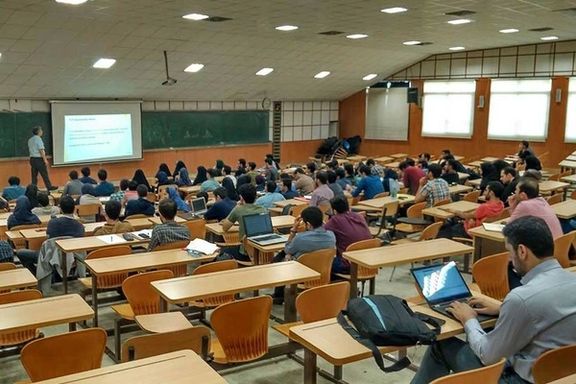
Students during a lecture at Sharif University in Tehran
Purging dissident professors in Iran, which commenced shortly after the protests of the Woman, Life, Freedom movement last September, has intensified in recent days.
News of the ongoing purge angered the public after Professor Ali Sharifi-Zarchi announced on X on August 26 that Sharif University of Technology had expelled him.
Sharifi-Zarchi, a member of the bioinformatics and AI Faculty of the university's computer engineering department, supported dissident students during the months-long nationwide protests sparked by Mahsa Amini's death in custody on September 16 last year.
In the past few days, the university has also invited three hardliner figures, including Amir-Hossein Sabeti, a television presenter, to teach Islamic subjects at the university.
Former Sharif University professor Ali Sharifi-Zarchi
Observers say the dismissal of dissident professors may be a preemptive move to reduce the chances of campus protests on the first anniversary of Amini's death.
Iran’s former nuclear chief Ali-Akbar Salehi, who is also the deputy head of the Academy of Sciences of the Islamic Republic of Iran, spoke to the reformist Jamaran news website about Sharifi-Zarchi's expulsion on Monday. He said the academic level of universities will deteriorate due to the "mass injection" of unqualified academicians replacing the expelled professors. "It can no longer be called a university!" he exclaimed.
Salehi added that he had tried to contact the university's chancellor and had sent messages to him, stating that decisions of such sensitivity should be made with tolerance and careful consideration, even if Sharifi-Zarchi had not fully abided by some of the university's rules and regulations, as they claim.
In the past couple of days, at least ten university professors from Sharif, Allameh Tabatabai, and Tehran universities were either sacked or suspended. In April, nine professors from Tehran Azad University, who had openly criticized the regime and its policies, were similarly purged through forced early retirement.
Iran’s former nuclear chief Ali-Akbar Salehi
According to the reformist Etemad newspaper, from 2006 to the end of August 2023, 157 tenured professors have been dismissed, forced into retirement, or banned from teaching due to their critical and dissenting views, as part of a broader initiative to cleanse universities of critics of the hardline establishment.
During the presidency of Mahmoud Ahmadinejad (2005-2013), who was closely aligned with hardliners, the regime also attempted to employ professors who were ideologically aligned with the hardline and religious establishment.
The intensification of the purge appears to have caused delays in the start of the academic term in some universities, with several institutions potentially resorting to online lectures.
Ameneh Aali, a psychology professor at Allameh Tabatabai University, who is among those sacked, told the Didban-e Iran news website on Saturday that she was informed of her expulsion over the phone and was not provided a reason for the termination of her contract with the university.
Ameneh Aali, a former psychology professor at Allameh Tabatabai University
She asserted that she was dismissed because she had signed statements supporting protesting students last year, participated in their sit-ins, and objected to the suspension of students.
While the Ministry of Higher Education has not commented on the issue, the Interior Ministry released a statement on Monday describing criticism of the expulsion of academics as "media propaganda" and asserting that the Higher Education Ministry had taken "revolutionary action."
The Interior Ministry's statement also accused the sacked professors, who had opposed the crackdown on students and supported those who were arrested or suspended, of "political immorality and media show-off," and of "defiling" the academic arena with their "factional and even anti-national views."
In a statement on Sunday, the National Union of Iranian University Professors criticized the "profuse meddling" of security bodies in academic affairs and warned about the "gradual decline" of universities.
Ghafour Kargari, president of iran's national paralympics committee
Two rights groups in France have lodged a legal complaint against Iran's Paralympic committee chief, accusing him of torture and crimes against humanity.
Ghafour Kargari, who currently serves as the president of Iran's national Paralympic committee, is presently in France attending a gathering with representatives from other nations participating in the 2024 Summer Paralympics games, according to statements from event organizers.
The two human rights groups assert that Kargari was a former commander of the Quds Force, a division of Iran's Islamic Revolutionary Guards Corps (IRGC) responsible for clandestine military operations and intelligence efforts throughout the Middle East.
Emmanuel Daoud, an attorney representing the French collective Femme Azadi and the Swedish NGO House of Liberty who filed the complaint, stated that France should not have issued him a visa for the meeting.
"The IRGC and the Quds group have been at the forefront of the violent repression of peaceful movements for democracy, civil rights and equality of men and women in Iran," they said in a document filed with France's anti-terror prosecutors and seen by AFP.
Given Kargari's high-ranking position in Iran's military hierarchy, the organizations assert that he was involved in formulating and executing strategies for these groups, leading them to argue that his actions "could also be qualified as crimes against humanity."
The 2024 Summer Paralympics are scheduled to be held from August 28 to September 8, featuring the participation of over 4,000 athletes.
An Iranian man looking at the prices of case-ready meat in a department store
Despite pervasive poverty in society, the Iranian government boasts about its performance but based on apparently fabricated data, a former official says.
To justify its inept handling of the economic situation, manifested in devaluation of the national currency and runaway inflation, the administration of President Ebrahim Raisi is falsifying statistics pertaining to the government of Hassan Rouhani to pretend there has been growth under his stewardship.
The sheer volume of inaccurate information has prompted Mohammad Bagher Nobakht, a vice president under Rouhani and the former head of the Planning and Budget Organization, to write an open letter to the incumbent, providing what he described as the correct data.
He pointed out that the current administration claims the average annual inflation rate was about 60 percent in July 2021 to justify the current figure of about 47 percent, but the real figure reported by the Statistical Center of Iran at the time was 45 percent.
Iran’s point-to-point inflation rate was about 64 percent in March, a figure only recorded twice since World War II. Then the government changed the “base year” from the Persian year 1395 to 1400, which ended on March 20, 2022. The new base year -- used for comparison in the measure of a business activity or economic or financial index – resulted in new figures at about 45 to 50 percent.
Mohammad Bagher Nobakht, a vice president under Hassan Rouhani and the former head of Plan and Budget Organization, (left) and President Ebrahim Raisi
Nobakht added that the economic growth rate of the country was also about three to four percent in the last year of Rouhani’s term and not the 0.4 percent that the current government claims. He also provided official reports by the Central Bank of Iran and the Statistical Center to back up the figures he cited. It should be noted that the numbers by the two government organizations are different from each other and also different from that of the World Bank. Moreover, the current administration puts the average economic growth rate of its first two years at 4.8 percent, but the World Banksays the growth rate in 2022 was 2.7percent.
“It is not possible to create an acceptable performance record for governments through comparing selective and unscientific economic indicators,” Nobakht noted, highlighting that the people will judge the success of the current government based on its announced commitments, such as the annual creation of one million housing units, one million jobs, reducing the inflation rate to less than 10 percent, and efforts to lift US sanctions.
Reacting to the letter, the official news agency of the government, IRNA, published two articles on Monday and Tuesday claiming that when the current administration took office, it inherited a huge burden of unsettled debts from previous administrations. However, according to a report in July, the current administration has been aggressively borrowing from quasi-public banks to fill its budgetary gap and keep its unprofitable companies afloat.
IRNA claimed that the remarks by Nobakht are in line with former officials’ attempts to justify their performance so that they can have a chance in the upcoming parliamentary elections.
Against the backdrop of political rivalries that are intensifying ahead of the elections, Iranian people are the ones who bear the brunt of the country’s inflation and currency devaluation no matter which officials hold office. The first years of Rouhani’s term coincided with the 2015 nuclear deal with world powers that led to removal of most sanctions and boosted the economy. But after the US withdrawal from the JCPOA and reimposition of sanctions, the country’s economy was on a nosedive.
The Islamic Republic has been struggling with high inflation since at least 2019, but the raging inflation in the past Iranian year which ended on March 20, was seriously different from previous years. The inflation rate factors in numerous commodities and services but the one most important for Iranians is increasing food prices, with some categories doubling or tripling in the past 12 months. Official figures show there was a sharp increase in food prices and most items witnessed a more-than 50 price inflation. The devaluation of Iran’s rial from 260,000 per US dollar to about 500,000 this year signals even higher economic woes for the people.
According to a report in Aftab News website, affiliated with reformists, in the past two years, the overall inflation for essential household needs was over 250% while the minimum wage has only increased 27%, quipping that the deputy labor minister calls this “an achievement” of the Raisi administration.
Protests appear to have reignited in Iran, with the city of Izeh in the southern Khuzestan province becoming the focal point of clashes between citizens and security forces.
The popular dissident Twitter account, 1500tasvir, which had been dormant for weeks, published correspondences with residents of Izeh this week claiming that regime agents have opened fire on people to quell the demonstrations. Although unconfirmed, reports suggest that these actions have indeed taken place.
Messages sent to 1500tasvir from city residents detailed the use of live ammunition by regime agents to assert control over the city. Additionally, videos have emerged online, depicting citizens chanting slogans against the regime.
While Iranian social media users discuss the unrest in Izeh, no official reports or images regarding the ongoing protests have been released online. A video circulating on the internet shows city residents chanting slogans in support of Iran's exiled prince, Reza Pahlavi, who has emerged as a prominent opposition figure.
It is apparent that this particular rally occurred weeks ago.The city witnessed clashes after a young protester named Kemar Tahmasbi was killed in an armed confrontation with regime forces just last week.
Iranian protester Kemar Tahmasbi
Tahmasbi was among the youth who actively participated in protests that unfolded between the 15th and 17th of November in Izeh. He shared camaraderie with Mustafa Ahmadpour, another protester killed on the 21st of July in a fierce armed confrontation with regime agents.
The IRGC issued a statement acknowledging that, in response to "organized actions by armed and criminal elements in Izeh, orders were issued to detain them after identifying their locations and activities. These individuals resisted arrest and, in the exchange of gunfire, two were killed, while three were apprehended."
In an earlier development in April, eight citizens detained during nationwide protests in Izeh were indicted on charges such as "waging war against God" and "corruption on earth," which carry potential death sentences. These arrests took place in November 2022 by the intelligence agents of the Islamic Revolutionary Guard Corps.
The regime's crackdown on dissent has intensified ahead of the anniversary of the Women, Life, Freedom movement. The uprising, sparked by the death in custody of Mahsa Amini in September, has been the most significant challenge to the clerical regime since its establishment in 1979. Regime repression forces killed over 500 people and arrested over 22,000 during the protest rallies.
In an attempt to stifle potential actions within universities, the regime has escalated its crackdown on academics in recent weeks. This includes dismissing tens of professors and banning even more students.
An Iranian daily article earlier this week revealed details about the regime's purge of university professors. Just last Sunday, at least 10 university professors were dismissed due to their support for the popular uprising.
The regime is replacing professors critical of the regime with "religious" and "revolutionary" professors.
Intelligence agents have threatened the families of protesters killed during the rallies, summoned all protesters released on bail, and issued warnings of severe punishments for those who participate in protests.
However, calls for protests and strikes in mid-September are increasing as the anniversary of Mahsa Amini's death serves as an opportunity for dissidents to reaffirm their commitment and solidarity against the regime.
A young Iranian woman without wearing a mandatory headscarf poses for a photograph while using her cell phone in the traditional grand bazaar (Market) in southern Tehran, June 28, 2023.
Tehran’s Grand Bazaar has always supported the regime, but recent remarks from officials about its relocation hint at a possible shift in sentiment among the merchants.
Relocation is currently being deliberated at Iran’s crisis management headquarters by high-profile figures, including Interior Minister Ahmad Vahidi as well as some Islamic Revolutionary Guard (IRGC) commanders, according to Tehran Governor Alireza Fakhari.
The Grand Bazaar of the capital played a key role in funding the 1979 Revolution, which reciprocated by allocating crucial positions in the government to certain Bazaar merchants, such as former Commerce Minister Habibollah Asgaroladi, Revolutionary Guard commander Mohsen Rafiqdoust, and former prosecutor Asadollah Lajevardi, also known as "the butcher of Evin Prison" assassinated at his shop in the Bazaar in 1998.
Since then, the overtly close ties between the regime and the Bazaar have been apparent, but conflicting comments from some regime officials about relocating the premises indicate that the alliance may be unraveling.
With the September 16 anniversary of Mahsa Amini’s death at the hands of morality police approaching, Abolfazl Shekarchi, a deputy at the general staff of the armed forces, described Bazaaris on Saturday as the “officers of economic war,” urging them not to participate in strikes that could potentially erupt alongside possible nationwide protests.
An Iranian young woman looks on as she and her mother walk along an area in Tehran Grand Bazaar (Market), December 3, 2022.
The Bazaar's countless narrow arcades and passageways create a labyrinth that poses a challenge for security forces to manage in the event of a massive protest scenario. Situated in downtown Tehran, the Bazaar holds a strategic location not far from important governmental sites, and a large demonstration could easily spill into the rest of the city, endangering critical locations. Relocating the Bazaar might potentially disperse the concentration of various Bazaari factions and hinder a coordinated anti-government strike.
Advocates of relocation, such as Fakhari, primarily argue that safety concerns make relocation essential. Another supporter of relocation is city council member Ahmad Sadeghi, who recently stated that the Bazaar “cannot be secured and must be relocated.”
By invoking the "public safety" rationale, these officials present a relatively logical justification to dismiss the notion that the Bazaar's direction might be changing, particularly in light of recent incidents of fires breaking out in the 110-hectare marketplace. They also contend that the dilapidated infrastructure is suboptimal for commercial activities.
However, opponents of relocation cite the intricate ownership issues within the marketplace, which is partially owned by a large-scale, quasi-governmental charity organization. Mahdi Chamran, a city council member, has unequivocally stated that “the Bazaar is not relocatable,” while Ahmad Alavi, the council’s tourism committee chairman, has asserted that the premises are no longer at risk due to existing security measures.
Alavi outright rejected the proposal, deeming it a "complex and grand project, unlikely to yield any results.” He described relocation as an “impossible thing” lying "outside the jurisdiction of the city or any single organization." The reasons for some officials' opposition to relocation are unclear, but it's possible they are not receiving a fair share of profits that officials generate from such projects or that they have hidden interests.
An Iranian man and two women walk along a corridor in Tehran Grand Bazaar (Market), December 3, 2022.
A source in Tehran Grand Bazaar, whom we'll refer to as Kian to protect his identity, informed Iran International that officials are “not even capable of relocating” the marketplace, even if they intended to. He cited the regime's failure to rebuild the Plasco Building since January 2017, when the 20-story high-rise in central Tehran collapsed following a massive fire.
Kian, who owns a shop in the heart of the Bazaar, also points out the "astronomical prices" of shops and the ambiguity surrounding ownership in some cases, claiming that relocation could “cause chaos” in the entire Iranian market.
He also confirms that dissent has escalated among Bazaaris as they find it increasingly challenging to conduct business in the current political climate, particularly in the aftermath of the Women, Life, Freedom movement.
The Tehran Grand Bazaar seems to have gradually shifted toward political dissent since the 2017 protests, with shopkeepers and their staff participating in outbreaks of demonstrations and strikes that continue to this day.
While the exact strategies employed by officials to gain control over the Bazaar are not entirely clear, the Tehran mayor appears to be projecting an image of unity by adopting a middle ground. Alireza Zakani recently remarked that the consideration of transferring the marketplace "to another location in the city" is just that – a consideration – implying that it might not necessarily come to fruition.
Whether the regime decides to relocate the Bazaar or successfully executes such a plan, the ongoing discussion around this issue serves as a clear indicator of growing dissent within a historically influential political group that played a pivotal role in the establishment of the Islamic Republic.
Iran’s media have reported that Ali Salehabadi, former governor of Iran's Central Bank, is set to assume the position of Iran's new ambassador to Qatar.
Salehabadi resigned as the governmental head of the Central Bank in December 2022 amid nationwide economic challenges. His new potential appointment appears timely as it coincides with the unfreezing of $6 billion of Iranian assets to Qatari banks and Iran’s hostage release of US citizens.
While no official confirmation has been released by either the Iranian government or Qatari authorities, this speculative appointment raises eyebrows due to Salehabadi's extensive financial background.
Salehabadi's tenure as the head of Iran's Central Bank was marked by a period of economic turbulence and uncertainty. Last year’s departure from the Central Bank was attributed to the complex economic problems that Iran faced during his term, including inflationary pressures and international sanctions.
The potential selection of Salehabadi as Iran's ambassador to Qatar, a role often filled by career diplomats, indicates a strategic shift in Iran's diplomatic approach. Experts speculate that this move might reflect Iran's intention to leverage Salehabadi's financial expertise to navigate the economic intricacies of the region, especially in light of the recent unfreezing of assets.
Iran’s deal with the US, which led to the release of the frozen funds, has been a point of contention within the international community. Critics argue that unfreezing these assets could inadvertently provide Iran with more resources to support its oppressive regime towards its citizens, while proponents suggest that it might pave the way for improved diplomatic relations.