• العربية
  • فارسی
Brand
  • Iran Insight
  • Politics
  • Economy
  • Analysis
  • Special Report
  • Opinion
  • Podcast
  • Iran Insight
  • Politics
  • Economy
  • Analysis
  • Special Report
  • Opinion
  • Podcast
  • Theme
  • Language
    • العربية
    • فارسی
  • Iran Insight
  • Politics
  • Economy
  • Analysis
  • Special Report
  • Opinion
  • Podcast
All rights reserved for Volant Media UK Limited
volant media logo

Millions Of Iranians Sinking Into Poverty As Social Risks Loom
Iran International Newsroom
Jul 26, 2023, 07:52 GMT+1Updated: 17:58 GMT+1
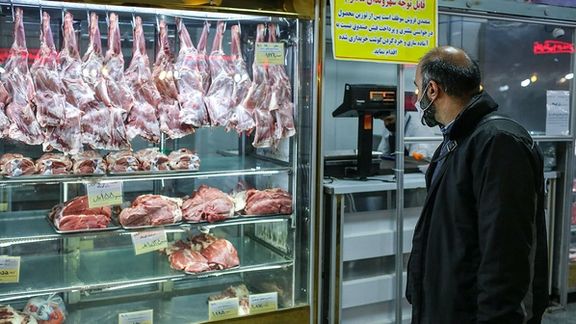
An Iranian shopper at the butcher's counter

Experts predict that an expected hike in inflation will sink millions of Iranians deeper into poverty with food prices being the most acutely affected.

Currently the official annual inflation rate is 47.5 percent – the highest rate in Iran for more than 30 years -- but prices for foodstuff are most affected, with the price of cooking oil rising by more than three times annual inflation at 145 percent, and the price of meat also rising by 78 percent over a one year period (point-to-point).

Economist Peyman Molavi told Iranian news website Rouydad24 on Tuesday that if the current status quo persists, the country will face an exponential rise in inflation rates and millions will be affected.

“If the economic growth rate in Iran approaches zero and the money supply (also known as market liquidity) increases more than 36%, the inflation rate will be between 55 to 60 percent,” he said.

He also warned that “if the money supply grows by more than 40 percent per month, and the economic growth is around one to two percent, we may witness an inflation rate of 70 percent.” However, the World Bank estimated Iran’s annual growth rate at 2.7 percent in 2022, mostly based on information it receives from official Iranian sources..

Economist Peyman Molavi  (undated)
100%
Economist Peyman Molavi 

Such a high rate will have crippling effects on regular citizens. According to a report published by ILNA website in Tehran in January, one-third of the country’s population is now living in extreme poverty, with the number almost doubling from 2020 to 2021. However, it is believed that the real number could be far higher. According to official figures released by Interior Ministry, around 60 percent of Iranians live under the relative poverty line.

"If we fail to address and tackle this situation seriously as part of the Seventh Development Plan, we will soon face a grave crisis in the social well-being of our society," Iranian lawmaker Mohsen Pirhadi said on Monday.

Since the 1940s, Iran has launched 12 plans to build infrastructure, establish key industries, expand public services and education. Five plans were launched under the monarchy until 1979, and seven during the Islamic Republic. Nevertheless, Iran is still considered a developing country, because it economic growth rate has averaged only 2.5 percent during the Islamic Republic.

Pirhadi added that the number of people living below the poverty line in the country has reached nearly 28 million.

Iranian lawmaker Mohsen Pirhadi  (undated)
100%
Iranian lawmaker Mohsen Pirhadi

The "poverty line" is a level of income that covers the minimum essential needs of a household, and incomes below the line are referred to as "absolute poverty”. According to Mohammad Bagheri Banai, a lawmaker and member of the parliament’s economic committee, the poverty line for residents of Tehran, is approximately 300,000,000 rials (approx $600) per month, which is three times as much as the minimum wage in Iran.

A leading economist said in May that at least half of Iran lives below the poverty line as the government fails to solve the economic crisis, and a report by the parliament’s research center released in July said the population below the absolute poverty line increased by 30.4% in 2021.

Pirhadi, the deputy head of the parliamentary committee for Iran’s Seventh National Development Plan, stated that the economic decline in the past decade has led to social decline and a rise in financial corruption, drug abuse, and increased migration to large cities.

Over the past decades, there have been several factors hindering Iran's economic development. The revolutionary chaos of the early 1980s, and the Iran-Iraq war that caused hundreds of thousands of casualties, derailed Iran from its modernization trajectory. The Islamic government, built on an anti-Western ideology that engaged in hostage taking and supporting militant groups left the country isolated. And in addition, the inefficiency of successive clerical governments and many years of international sanctions crippled the country's economy.

The remarks by Pirhadi came a few days before the latest report by Iran's Statistics Center -- whose director was sacked by the president earlier in July. Although Iran's Statistics Center is administered and funded by the government and operates under the umbrella of the Planning and Budget Organization, it maintained a veneer of credibility as one of the very scarce sources of both economic and social data. 

The Islamic Republic's authorities are trying to use new definitions and indices for the inflation so that the official figures do not increase to numbers that can create panic in the market. The country’s economy has proven especially vulnerable to sociopolitical developments, such as rumors about a possible revival of the nuclear deal or large labor strikes.

Most Viewed

US blockade enters murky phase as tankers spoof signals and buyers hesitate
1
ANALYSIS

US blockade enters murky phase as tankers spoof signals and buyers hesitate

2

US tightens financial squeeze on Iran, warns banks over oil money flows

3
INSIGHT

Ideology may be fading in Iran, but not in Kashmir's ‘Mini Iran'

4
INSIGHT

Hardliners push Hormuz ‘red line’ as US blockade tests Iran’s leverage

5
VOICES FROM IRAN

Hope and anger in Iran as fragile ceasefire persists

Banner
Banner

Spotlight

  • Hardliners push Hormuz ‘red line’ as US blockade tests Iran’s leverage
    INSIGHT

    Hardliners push Hormuz ‘red line’ as US blockade tests Iran’s leverage

  • Ideology may be fading in Iran, but not in Kashmir's ‘Mini Iran'
    INSIGHT

    Ideology may be fading in Iran, but not in Kashmir's ‘Mini Iran'

  • War damage amounts to $3,000 per Iranian, with blockade set to add to losses
    INSIGHT

    War damage amounts to $3,000 per Iranian, with blockade set to add to losses

  • Why the $100 billion Hormuz toll revenue is a myth
    ANALYSIS

    Why the $100 billion Hormuz toll revenue is a myth

  • US blockade targets Iran oil boom amid regional disruption
    ANALYSIS

    US blockade targets Iran oil boom amid regional disruption

  • Iran's digital economy battered by prolonged blackout
    INSIGHT

    Iran's digital economy battered by prolonged blackout

•
•
•

More Stories

Iran And Its Proxies See Opportunity In Israel’s Crisis

Jul 25, 2023, 22:53 GMT+1

Iran’s IRGC held a three-hour meeting last week with the Lebanese Hezbollah and Palestinian Hamas to see how they can take advantage of Israel’s internal problems.

Reuters quoted an Iranian diplomat as saying that the Revolutionary Guard’s (IRGC) Quds Force attended the three-hour meeting, as Israel’s foes see an opportunity in Israel’s political turmoil related to Prime Minister Benjamin Netanyahu’s judicial reforms.

Iran and its proxy groups have been devoting special attention to the crisis at closed-door meetings, perceiving this as a potential turning point for Israel, Reuters said.

The Islamic government in Iran began encouraging Palestinian groups for intensified attacks on Israel in March, after it reached a deal with Saudi Arabia to revive diplomatic relations that month. That resulted in the April military clashes that saw hundreds of rockets fired at Israel and retaliatory strikes on Gaza.

But in their meeting last week Iran and its proxies concluded that the crisis had already weakened Israel and agreed they should refrain from any "direct interference", believing this could give Prime Minister Benjamin Netanyahu the chance to shift blame to foreign adversaries.

A Hamas source declined to comment to Reuters on the account, saying there are ongoing discussions between Hamas, Iran and the Quds Force "over the whole situation and to discuss ways to upgrade the work of resistance".

A mounted police officer scuffles with protesters blocking Ayalon Highway during a demonstration following a parliament vote on a contested bill that limits Supreme Court powers to void some government decisions, in Tel Aviv, Israel July 24, 2023.
100%
A mounted police officer scuffles with protesters blocking Ayalon Highway during a demonstration following a parliament vote on a contested bill that limits Supreme Court powers to void some government decisions, in Tel Aviv, Israel July 24, 2023.

Hezbollah On Patrol

The upheaval marks one of the most serious domestic crises since Israel was established in 1948, ushering in decades of conflict with Arab countries and Palestinians.

Israel's parliament Monday ratified a first bill of the judicial overhaul, limiting the powers of the country's Supreme Court, prompting more protests by Israelis who see the moves as a menace to their democracy.

The divisions have seeped into the Israeli military, which has fought numerous conflicts with Lebanon's Hezbollah and the Palestinian factions Hamas and Islamic Jihad, that receive arms and money from Iran.

Israeli protest leaders have said thousands of volunteer reservists could abstain from duty if the government stays the course, and former senior military officials have warned that Israel's war-readiness could be at risk.

A video shared on social media on Tuesday showed elite fighters from Hezbollah mounting a rare patrol directly at the fenced Lebanese border with Israel, according to a Lebanese source familiar with the deployment.

The source said the patrol along the rugged frontier, where tensions have been running high of late, had nothing to do with events in Israel. 

The source said however that Hezbollah officials have discussed the crisis in detail at the highest levels. The group views the crisis as a development to be exploited in the future, the source added.

People demonstrate on the highway on the 'Day of National Resistance' in protest against Israeli Prime Minister Benjamin Netanyahu and his nationalist coalition government's judicial overhaul, in Tel Aviv, Israel July 18, 2023.
100%
People demonstrate on the highway on the 'Day of National Resistance' in protest against Israeli Prime Minister Benjamin Netanyahu and his nationalist coalition government's judicial overhaul, in Tel Aviv, Israel July 18, 2023.

Israeli Finance Minister Bezalel Smotrich said on Tuesday the Israeli military "is combat-ready and will remain combat-ready" despite the protesting reservists, whom he accused of trying to "put a gun to the head of the government".

Hezbollah leader Sayyed Hassan Nasrallah, in a speech on Monday, said Israel was on a "path of collapse and fragmentation".

Iranian Foreign ministry spokesperson Nasser Kanaani referred to Netanyahu's recently fitted pacemaker when tweeting about the crisis, saying "the heart of the Zionist regime is in deeper crisis than the crisis in the heart of its prime minister".

The threat of renewed large-scale clashes with Palestinians is ever present, with smaller violent incidents occurring regularly.

A demonstrator scuffles with a police officer as people demonstrate on the 'Day of National Resistance' in protest against Israeli Prime Minister Benjamin Netanyahu and his nationalist coalition government's judicial overhaul, in Jerusalem July 18, 2023.
100%
A demonstrator scuffles with a police officer as people demonstrate on the 'Day of National Resistance' in protest against Israeli Prime Minister Benjamin Netanyahu and his nationalist coalition government's judicial overhaul, in Jerusalem July 18, 2023.

Sources close to Hamas and the Islamic Jihad say the two groups are monitoring closely the protests in Israel, enjoying the images, and hoping the tensions worsen.

But they are also wary of the risk of Netanyahu seeking to divert attention from the domestic crisis through conflict against Israel's enemies that could unite its people.

“They are following it seriously to assess how this could reflect on them and whether Israel could export its internal crisis,” Gaza political analyst Adnan Abu Amer said.

(Based on a report by Reuters)


Irish Prisoner Speaks Out About PTSD After Release From Iranian Jail

Jul 25, 2023, 21:59 GMT+1

Bernard Phelan, a 64-year-old Irish man with dual French citizenship, revealed the harrowing experiences he endured during his imprisonment in Iran.

In an interview with RTÉ's Six One News, Phelan, a Paris-based tourism consultant, said he had been detained in Iran in October, marking his fifth visit to the country.

Phelan was arrested amid anti-regime protests that erupted across the country after the death of Mahsa Amini in police custody in September. Allegedly, Phelan had been capturing images of the protests and a mosque that had been set ablaze.

In mid-May, Iran eventually released Phelan, who had been sentenced to 6.5 years in prison on charges of "providing information to another country."

During his time in detention, Phelan faced severe physical and psychological hardships, leading to post-traumatic stress disorder (PTSD). He recounted the haunting words of a judge who warned him that he would "die in prison." This threat was a part of what he described as "white torture," a tactic employed to break prisoners psychologically.

"There are nightmares. I don't sleep well, I'm on sleeping tablets - nightmares of being on the floor and being kicked by somebody," Phelan noted.

Human rights organizations have raised concerns over what they call "hostage diplomacy" by Iran, where an undisclosed number of Western prisoners are being held. These individuals face charges of espionage or other alleged crimes, and some have been languishing in detention for extended periods without access to legal representation or a fair trial.

In response to the allegations, the Islamic Republic maintains that the prisoners are lawfully held for valid reasons and denies any wrongdoing.

Iranian Politicians Frustrated Over Political, Economic Situation

Jul 25, 2023, 18:59 GMT+1
•
Iran International Newsroom

A relatively pragmatic politician in Iran has expressed concern that voters turning their backs on the Islamic Republic's elections is like poison for the political system.

Mansour Haqiqatpour, a former lawmaker, local governor general and a former deputy commander of IRGC Quds Force, told the Khabar Online website that the policy of purification, which has effectively excluded all political groups other than hardliners from the government, has silenced key figures in both leading political factions, reformists, and conservatives.

Haqiqatpour said: "During the fasting month of Ramadan Supreme Ledaer Ali Khamenei called for a competitive, safe and secure election. More than 30 days have passed since he made the statement, but nobody has come up with a strategy to make that happen.”

Rhetorically he asked, "Who should do that? The Guardian Council? The state television? The Expediency Council? the Interior Ministry or the President's Office? The state TV has not discussed the issue even once."

However, it remains uncertain if Khamenei will allow all regime factions and politicians to run in the March 2024 parliamentary elections. The Guardian Council, under his supervision, disqualified most reformist and moderate candidates in the 2020 parliamentary and 2021 presidential elections.

Haqiqatpour continued, "We did not have a good turnout in the parliamentary elections of 2020 and the presidential elections of 2021."

Iranian politician Mansour Haqiqatpour  (undated)
100%
Iranian politician Mansour Haqiqatpour

He further expressed concern, saying, "It is a shame that the turnout in elections in Turkey is around 80 percent, and we in Iran have been facing turnout rates as low as 20 to 25 percent." He warned Iranian leaders that a failure to achieve a 60-percent turnout in next year’s elections would be a serious setback.

Politicians and sociologists have been saying since 2020 that a low turnout means that the regime lacks legitimacy and that its social support is in decline, while it claims to be a cradle of democracy in the region and a powerful state backed by its people. 

President Ebrahim Raisi has recently said that it was clear based on polls before the 2021 election that he was going to win. Haqiqatpour pointed out that since major candidates such as former Speaker Ali Larijani were not allowed to run that surely made Raisi the only viable winner.

Asked about his way out of the political impasse, he said: "We should allow political competition,” and added that “unfortunately, rational individuals in both of the leading political factions are left out of political competition. Everyone including the moderates should be represented in the elections. 

Haghighatpoor complained about the monopoly of power given to hardliners. "We should break the isolation created by hardliners. Left and right should cooperate,” and "Protesters should not be called the advocate of regime change. They just wanted their grievances to be heard. 

In another development, Jalil Rahimi Jahanabadi, a member the National Security Committee of the parliament told Rouydad24 website in Tehran that "The country's economic situation is extremely bad." Jahanabadi warned the country's leaders: "The reality is different from what you see on TV. The people in the streets see the prices in the shops and they realize the realities when they put their hand in their pocket to make a payment." 

Meanwhile, another Iranian lawmaker, Mohammad Reza Sabbaghian Bafghi highlighted the difference between the living standards of officials and the people. "Officials enjoy good food and live in good houses, but the people do not have enough money and they cannot afford paying their rent."

He further warned the officials that price rises are beyond what people can tolerate. Bafghi said in parliament on Sunday: "Three out of every four Iranians complain about the rising prices. The high cost of housing is backbreaking and when we go to our constituencies, we are ashamed before those who voted for us. " He added: "The President should be accountable for that."

Hiker Allegedly Paralyzed In Iran Attack On Tourists

Jul 25, 2023, 16:56 GMT+1

A hiker, who was injured in a recent attack in a village in Iran's Semnan province, has disclosed that one of his companions suffered permanent paralysis.

The hiker, whose identity remains undisclosed, conveyed details of the attack, which targeted tourists, to Faraz news website on Tuesday. He recounted that the attackers were “approximately 18 or 19 years old, wearing cargo pants, and concealing their faces with keffiyehs."

"They targeted both men and women, but the men seemed to bear the brunt of their aggression. Unfortunately, my teammate now faces a life of paralysis due to the impact of the shocker on his back," he said. A shocker – or electroshock weapon is an incapacitating weapon that delivers an electric shock that temporarily disrupts muscle functions. It does not normally cause lasting damage but can cause permanent disability to muscle or nerve tissue.

The attack occurred on Friday when a group of tourists was exploring the picturesque mountainous region of Opert, situated on the border of Semnan and Mazandaran provinces. The assault was orchestrated by an unidentified armed group.

Pictures shared on social media revealed that the attackers were armed with firearms and electric shocker devices. In addition to the paralyzed hiker, multiple individuals sustained injuries and bruises.

During the attack, the group justified the assault, citing it as a response to "hiking on the third night of Muharram," a time when Shiites mourn the martyrdom of their third Imam.

Iran International has been unable to independently verify these details, and so far, no official reactions have been reported regarding this incident.

However, over recent years, there have been numerous reports of restrictions imposed on Iranian tourists and nature enthusiasts.

This recent attack coincides with the regime's ongoing push for obligatory hijab, adding to concerns over personal safety and freedom of expression.

Iran Tries To Quell Scandal Over Official’s Same-Sex Video

Jul 25, 2023, 14:43 GMT+1
•
Maryam Sinaiee

Iran’s parliament speaker has criticized the leaking of a video showing an official engaging in sex with a young man, stating that it goes against Sharia law. 

"I had previously warned against such methods that go against the law and Sharia during a meeting of the Supreme National Security Council," Mohammad-Bagher Ghalibaf said in response to the scandal, following similarly critical remarks made by hardliner lawmakers on the parliament floor.

This is a typical response by regime officials in Iran who usually advocate ‘killing the messenger’ when faced with evidence of corruption or forbidden activities by insiders. 

Meanwhile, what Sharia in Iran clearly forbids is homosexuality among men, which it says is punishable by death.

The video that has gone viral on social media since Wednesday allegedly shows Reza Seqati (Seghati), a married man and the director general of the Islamic Culture and Guidance ministry in the northern Gilan Province who has close ties with the hardliner Paydari Front, engaging in sex with a young man, apparently at a ministry guesthouse. 

A few days after the publication of the video, the Islamic culture and guidance department announced that it had suspended Seqati and referred his case to the judiciary for further investigation.

Ghalibaf added that such matters could only be made public after the alleged crime is proven and a judge’s order is acquired. 

A session of the Iranian parliament on July 24, 2023
100%
A session of the Iranian parliament on July 24, 2023

The presidential administration, the judiciary and senior clerics have so far remained silent about the revelation. 

Hardliner lawmakers, Mojtaba Zolnouri and Kazem Delkhosh, had complained that the official should not be judged before investigations by judicial and law enforcement officials are completed and he is found guilty. 

The situation is completely different when it comes to dissidents or protesters. Not only they are often arrested without a warrant by plainclothes agents and taken to unknown locations, but immediate reprisals against their family members follow, and they spend month in prison without being indicted.

Zolnour who is deputy speaker has also said those who published the video had committed a much bigger crime than the person they made revelations about and demanded their punishment.

But another conservative member of parliament, Morteza Mahmoudvand blasted the silence and apparent inaction of parliament and top officials during a session Tuesday. He urged President Raisi to intervene "in the name of God," and called for the minister of Islamic guidance to resign.

The hardliners' silence or attempts to downplay the significance of the official's sex video have angered many Iranians. They argue that ordinary people are harshly punished for what the authorities consider 'immoral' actions, but when it involves regime loyalists, leniency seems to be the prevailing approach.

The reformist Mardomsalari newspaper highlighted on Saturday that the mere removal of Seqati from his position and the silence of hardliners regarding his alleged wrongdoing, where they would typically raise a storm if someone with different political affiliations were involved, is proof of hardliners' double standards in ethical and moral matters.

“Would they be so compassionate if a person from the rival political camp had done the same thing or would call him an agent of the CIA and Mossad in Iran who had taken money from the West to morally corrupt the [Iranian] youth,” Mardomsalari asked. 

The paper also drew attention to reports of Seqati’s close affiliation to former nuclear negotiator Saeed Jalili, one of the leaders of the ultra-conservative Paydari group, his brother Vahid Jalili, and their political circle. 

Photos of Saeed Jalili and Seqati have been widely circulating on social media. Some news websites and social media users have speculated that the publication of the video may have something to do with internal conflicts in the hardliner camp and was meant to bring disgrace to Jalili and his immediate associates. 

Most social media users have expressed anger about Seqati’s hypocrisy as he was well known for his efforts to encourage hijab as an Islamic “value” but engaging in homosexuality which is a very serious offense in Islam and punishable by death according to Iran's Islamic Penal Code.






