• العربية
  • فارسی
Brand
  • Iran Insight
  • Politics
  • Economy
  • Analysis
  • Special Report
  • Opinion
  • Podcast
  • Iran Insight
  • Politics
  • Economy
  • Analysis
  • Special Report
  • Opinion
  • Podcast
  • Theme
  • Language
    • العربية
    • فارسی
  • Iran Insight
  • Politics
  • Economy
  • Analysis
  • Special Report
  • Opinion
  • Podcast
All rights reserved for Volant Media UK Limited
volant media logo

US Continues To Evade Details Of Iran Deal
Iran International Newsroom
Aug 15, 2023, 12:31 GMT+1Updated: 17:37 GMT+1
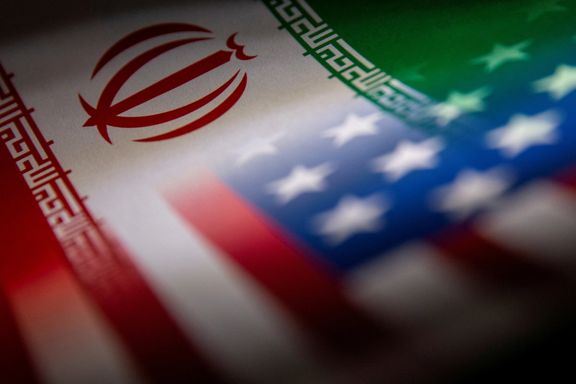
Iran's and US' flags are seen printed on paper in this illustration taken January 27, 2022.

US officials remain tight-lipped on the release of $6bn of frozen funds from South Korea to Iran as questions on its use remain unclear.

In the latest US State Department press briefing, Vedant Patel continued to push the line that the funds would primarily be used for “humanitarian” purposes, in line with the rules surrounding sanctions.

During a barrage of questions from the world’s media, he said: “It’s Iran’s money and allowing Iran to use such funds for humanitarian purposes is consistent with longstanding US policy to ensure that our sanctions do not prevent humanitarian goods and services from flowing to ordinary people no matter how objectionable or problematic their government is.”

However, the big question is, will the “ordinary people” see any benefit of the released funds, or will it simply get channeled into the regime’s military machine. Iranian officials have said that the funds will be transferred into euros once sent to Qatar, which will mean the US will not have a direct way to track wire transfers from accounts in Qatar that hold the money.

Meanwhile, as Iran International reported this week, additional media reports suggest not only a $6 billion release from South Korean banks, but also the unlocking of frozen funds in Iraq (estimated between $11-12 billion) and over $3 billion from Japan. These funds will be held in Qatar and Oman, designated for Iran's purchases of essential goods such as food, medicine, and other humanitarian items.

Vendat Patel, the spokesperson for the US Department of State (Undated)
100%
Vendat Patel, the spokesperson for the US Department of State

In a bid to calm the storm, Patel said “any kinds of funds that move will be subject to the same rigorous restrictions once it moves out of South Korea”.

Attempting to explain the situation, his attempts were not well received. He added: “The reason these funds are in South Korea in the first place is because the previous administration allowed several countries to continue purchasing oil from Iran and to place those funds in special accounts. These funds have been available to Iran to use for humanitarian transactions, like food and medicine, since the previous administration.”

While Patel acknowledged the very real threat which remains of the regime’s destabilizing actions across the Middle East and beyond, including its provision of drones for Russia’s war on Ukraine and the suppression of human rights in Iran, he offered no answers as to how he could guarantee the funds would not somehow be funnelled into Iran’s terror campaign.

Focusing on the recent release to home arrest of five American citizens, Patel attempted to divert attention to the seeming success of the talks, though he refused to share further information about the length of house arrest and next steps to bring the hostages home.

“What this is about is bringing American citizens home and we hope that a process has started last week, and we hope that at the end of this process, these five American citizens will be able to come back to the United States, and that’s what we’re going to continue to work for,” he said.

When quizzed on the status of Shahab Dalili, who is still in prison in Iran and who has, along with his son outside the White House, just begun hunger strikes, Patel questioned his being wrongfully imprisoned. Dalili, 60, was a shipping captain who had emigrated to the United States after retiring, and was detained in Tehran in April 2016 during a visit for his father's funeral.

“In the case of Mr. Dalili, it has not yet been determined if he is being wrongfully detained,” he said, claiming that stand-in envoy Abram Paley has spoken to the family while details are hammered out. He was charged with aiding and abetting a foreign country and was handed a 10-year prison sentence that he is serving in Iran's Evin prison which holds many political prisoners. The father-son hunger strike is a desperate cry for help for the ageing American excluded from the latest round of releases.

The situation of dismissed envoy Robert Malley, on charges of leaking confidential information, was also a point of contention. While the US Envoy to Iran’s Twitter picture has been changed, amidst a complex investigation, including by the Federal Bureau of Investigation, Patel only said he had no further details other than that “Rob Malley is on leave; Abram Paley is leading the department’s work in this area, and I will leave it at that”.

While many questions remain, Patel claimed the US has “not changed any aspect of our overall approach to Iran”, whether that relates to the nuclear program, the regime’s malign activities in the region or human rights crackdowns. But as most companies are either tied to the IRGC or the regime, it seems hard to believe that this new influx of funding would be used for anything more than bolstering Iran’s defenses either at home or abroad.

As worries continue, Iran’s foreign ministry has denied the weight of US controls, claiming “the Islamic Republic will decide how to use the released funds, and these funds will be appropriated for the various needs of the country by the appropriate authorities”. The truth of this, is yet to be seen.

Most Viewed

US blockade enters murky phase as tankers spoof signals and buyers hesitate
1
ANALYSIS

US blockade enters murky phase as tankers spoof signals and buyers hesitate

2

US tightens financial squeeze on Iran, warns banks over oil money flows

3
INSIGHT

Ideology may be fading in Iran, but not in Kashmir's ‘Mini Iran'

4
INSIGHT

Hardliners push Hormuz ‘red line’ as US blockade tests Iran’s leverage

5
VOICES FROM IRAN

Hope and anger in Iran as fragile ceasefire persists

Banner
Banner

Spotlight

  • Hardliners push Hormuz ‘red line’ as US blockade tests Iran’s leverage
    INSIGHT

    Hardliners push Hormuz ‘red line’ as US blockade tests Iran’s leverage

  • Ideology may be fading in Iran, but not in Kashmir's ‘Mini Iran'
    INSIGHT

    Ideology may be fading in Iran, but not in Kashmir's ‘Mini Iran'

  • War damage amounts to $3,000 per Iranian, with blockade set to add to losses
    INSIGHT

    War damage amounts to $3,000 per Iranian, with blockade set to add to losses

  • Why the $100 billion Hormuz toll revenue is a myth
    ANALYSIS

    Why the $100 billion Hormuz toll revenue is a myth

  • US blockade targets Iran oil boom amid regional disruption
    ANALYSIS

    US blockade targets Iran oil boom amid regional disruption

  • Iran's digital economy battered by prolonged blackout
    INSIGHT

    Iran's digital economy battered by prolonged blackout

•
•
•

More Stories

As Thick As Thieves? Russia Stops Fuel Supply To Iran

Aug 15, 2023, 08:44 GMT+1
•
Iran International Newsroom

Russia has ceased its gasoline exports to Iran for the past few months, an informed Iranian oil ministry official told Iran International on Monday.

The source said the Ministry had intended to import up to 10 million liters of gasoline daily from Russia to compensate for the gap in gasoline production and consumption. However, the Russian authorities, aware of Iran's needs, have halted the sale of gasoline to Iran, disrupting the planned efforts to address the fuel deficit. The expected volume from Russia would constitute roughly 10 percent of Iran's daily consumption in 2022.

The shortage has led to reductions in gasoline shipments to gas stations and long lines forming with cars rushing to fill their tanks.

According to the source, several other Commonwealth of Independent States (CIS) countries have also been pushed by Moscow not to sell gasoline to Iran, further compounding the challenges faced by Iran. The CIS is a regional intergovernmental organization in Eurasia, formed following the dissolution of the Soviet Union in 1991.

One possible explanations could be Moscow's desire to raise the price of its gasoline, amid serious financial and economic challenges it faces following its invasion of Ukraine. Russia's currency the ruble fell again on Monday against the US dollar, breaking the psychological barrier of 100 rubles per dollar.

After Western countries slashed energy imports from Russia, Moscow started exporting gasoline and diesel to Iran by rail this year for the first time since it lost its traditional customers. In February and March, Russia supplied up to 30,000 tons of gasoline and diesel to Iran, Reuters reported.

A view shows a local oil refinery in Omsk, Russia June 6, 2022.
100%
A view shows a local oil refinery in Omsk, Russia June 6, 2022.

Subsequently, Ahmad Maroufkhani, the head of Iranian Oil, Gas and Petrochemical Products Exporters' Union, disclosed that Iran was procuring each ton of petroleum products from Russia at a price $150 higher than global market rates. He told Tajaarat News that in addition to Russia Turkmenistan and Uzbekistan had also supplied fuel this year. According to Reuters, the shipments were made by rail from Russia via Kazakhstan and Turkmenistan.

Iran has been struggling with gasoline shortages since at least the beginning of the summer of 2022 and was forced to release one-third of its strategic gasoline reserves by the end of the same year. A source at the oil ministry told Iran International Sunday that the National Iranian Oil Refining and Distribution Company (NIORDC), a department within the ministry, has released around 900 million liters of strategic gasoline reserves into the market in an effort to make up the deficit. Iran has also scaled back its distribution, announced as a needed step to curb smuggling, limiting each refueling session to only 30 to 40 liters.

Earlier in the month, NIORDC deputy manager Ali Ziyar said that the average daily consumption of gasoline has hit 124 million liters, indicating a 20-percent increase compared with the previous year. “In recent years, the maximum annual growth in gasoline consumption has been seven percent, but this year we have suddenly experienced a 20 percent increase in consumption,” he said, tacitly acknowledging that a large amount of fuel is being smuggled out of the country because it is much cheaper than Iran’s neighboring countries. He also stated that the daily gap between production and consumption is 17 million liters.

Congestion at an Iranian gas station  (file photo)
100%
Congestion at an Iranian gas station

In recent days, rumors of an impending gasoline price increase have once again ignited, prompting a rush to gas stations. One of the main reasons that the Islamic Republic has not increased prices is because a fuel price hike would risk another wave of protests and strikes across Iran, especially with the first anniversary of Mahsa Amini’s death in police custody -- the starting point of the ‘Women, Life, Liberty’ movement on the horizon.

Reza Ghorashi, a professor of Economics at Stockton University in the US, told Iran International that a large strike by the fuel truck drivers amid tensions over prices can cripple the regime’s economy. He said in addition to economic repercussions, such an action is also a bold political statement in support of the popular street protests. Truckers, who do the heavy lifting of transporting goods mainly to and from Iran’s border areas and ports across the country, have already held several rounds of weeks-long strikes that brought the flow of goods and the supply chain to a grinding halt.

An military ally of Russia providing drones and missiles, the Iranian regime is also involved in a bitter confrontation with the West. Iran and Russia’s alliance may prove to be very flimsy as both countries are grappling with Western sanctions that and further economic woes for their people. 

Iran Says Unfrozen S. Korean Funds Already In Europe

Aug 15, 2023, 04:07 GMT+1
•
Iran International Newsroom

Islamic Republic of Iran’s foreign minister Hossein Amir-Abdollahian announced Monday that unfrozen funds from South Korea have been transferred to a European bank.

Amir-Abdollahian who was speaking at a gathering in the foreign ministry said the funds were already sent from South Korea to a European bank on August 10, the day when a hostage release deal the United States was announced.

The US agreed to allow $6 billion held in two South Korean banks to be released in exchange for five Americans taken hostage in Iran in the past few years. The funds were frozen due to US banking sanctions on Iran imposed after Washington pulled out of the JCPOA nuclear deal in 2018.

The Iranian foreign minister also stated that in the original agreement with the United States and different parties it was agreed to release the funds in a few batches, “not to inflict a shock on Korea’s financial system,” but later it was agreed “to transfer most of the funds to Europe except a small portion in order not to close the bank accounts in Seoul.” He did not name the European bank.

Media reports both in Iran and abroad have said that the funds will be transferred from South Korea to Switzerland, converted into euros and then transferred to Iranian bank accounts in Qatar. The money will stay there and be allowed to be disbursed for humanitarian needs, such as food and medicine, with the United States involved in the process. However, it is not clear exactly how Washington will make sure that Iranians do not cheat, given their years of experience in manipulating financial systems and circumventing sanctions. 

South Korea's First Vice Foreign Minister Choi Jong-kun (2nd from L) meets with his Iranian counterpart, Ali Bagheri Kani, in Vienna on Jan. 6, 2021, to discuss the issue of Tehran's frozen assets under US sanctions.
100%
South Korea's First Vice Foreign Minister Choi Jong-kun (2nd from L) meets with his Iranian counterpart, Ali Bagheri Kani, in Vienna on Jan. 6, 2021, to discuss the issue of Tehran's frozen assets under US sanctions.

One worrying factor is that the released funds will be deposited in Qatar in euros, which will hamper the US ability to closely monitor wire transfers unlike dollar transactions.

Despite earlier Iranian statements that as soon as the funds reach Qatar the five US citizens will be allowed to leave, Amir-Abdollahian said that “the two issues are not related.” The Biden administration has come under sharp criticism for what many say is a ransom paid for hostages that will enrich Iran’s regime and embolden would be hostage takers.

Almost immediately, Amir-Abdollahian seemed to correct his statement, saying that through an intermediary, Iran and the United States have two separate documents, one about the release of the funds and another for freeing the hostages.

Informed sources earlier told Western media that the process of fund transfers could take 30-45 days, but according to Iran’s foreign minister the money is already in Europe.

Foreign Ministry Spokesman Nasser Kanani told reporters on Monday that disclosing specifics of the deal to the media would not be "helpful" given the current circumstances. “The details of this understanding in the media are not helpful at this point in time," Kanaani added. 

The withholding of information comes in the face of increasing criticism and protests against the agreement, both in Iran and internationally, particularly in the United States.

The Wall Street Journal in an editorial on Sunday harshly criticized the Biden administration for paying $1.2 billion per hostage and dismissed the claim that the funds will only be used for humanitarian needs.

“Iran will use the cash the same way it did the money it received from the Barack Obama-John Kerry 2015 nuclear deal—to spread mayhem in the Middle East and beyond,” WSJ said. It also argued that “Money is fungible, as the White House knows, and its ‘humanitarian purposes’ line is best understood as political cover to justify the money-for-hostages deal. In a competition for the funds between the Islamic Revolutionary Guard Corps and the public health of the Iranian people, who do you think wins?”


Iran Keeps Details Of Tehran-Washington Deal Under Wraps

Aug 14, 2023, 16:45 GMT+1

The Ministry of Foreign Affairs in Iran refuses to disclose details of the recent Tehran-Washington agreement involving prisoner release and access to frozen funds.

Foreign Ministry Spokesman Nasser Kanaani said that disclosing specifics to the media would not be "helpful" given the current circumstances.

During a press conference on Monday, Kanani said, "The details of this understanding in the media are not helpful at this point in time." The withholding of information comes in the face of increasing criticism and protests against the agreement, both within Iran and internationally, including in the United States and Israel.

However, Kanaani said that “the Iranian government had prioritized the release of its citizens unjustly detained by the American government, as well as the partial release of Iran's blocked assets, which had been frozen due to what Iran contends is illegal pressure by the United States.”

Notably absent from Kanani's comments was any mention of the release of American hostages imprisoned in Iran. When questioned about the timeline for the agreement's implementation, Kanani responded, "We negotiated with the American government through mediation, and a time frame has been set for the realization of both issues."

Refuting reports of $23 billion in released Iranian assets under the agreement, with $5 billion from Japan, Kanani stated, "I do not confirm either the $5 billion nor the other number you mentioned."

Iran's frozen funds are primarily held in banks across South Korea, Iraq, Japan, China, and India, originating from pre-2018 oil transactions prior to the United States' withdrawal from the JCPOA and subsequent sanctions.


Impact And Concerns Surround US-Iran Frozen Funds Deal

Aug 14, 2023, 12:57 GMT+1
•
Iran International Newsroom

The US-Iran deal to release Tehran’s frozen funds has had little impact on the battered rial as traders understand that no hard cash will enter the market.

The Iranian currency has lingered just below 500,000 per dollar, a trend persisting for weeks. Consequently, the substantial inflationary pressures burdening Iran's economy are unlikely to abate soon, as long as US banking sanctions remain intact, obstructing the repatriation of hard currencies accrued from oil exports.

Shipments of crude remain high, with Iranian officials saying that the government’s target of 1.4 million barrels per day has been reached, but this does not mean Tehran is receiving full payments in dollars or euros from its main customer, China.

Meanwhile, additional media reports suggest not only a $6 billion release from South Korean banks, but also the unlocking of frozen funds in Iraq (estimated between 11-12 billion dollars) and over $3 billion from Japan. These funds will be held in Qatar and Oman, designated for Iran's purchases of essential goods such as food, medicine, and other humanitarian items.

South Korea's First Vice Foreign Minister Choi Jong-kun (2nd from L) meets with his Iranian counterpart, Ali Bagheri Kani, in Vienna on Jan. 6, 2021, to discuss the issue of Tehran's frozen assets under US sanctions.
100%
South Korea's First Vice Foreign Minister Choi Jong-kun (2nd from L) meets with his Iranian counterpart, Ali Bagheri Kani, in Vienna on Jan. 6, 2021, to discuss the issue of Tehran's frozen assets under US sanctions.

Al Jazeera reported Sunday that up to $23 billion will be released from South Korea, Iraq and Japan although it will not bring a substantial boost to Iran’s economy. It hinted that the deal was not just a hostage release agreement, but it also aims at freezing Iran’s nuclear program at current levels. This begs the question if US sanctions will be enforced until the US presidential elections next year, or there is perhaps a secret deal to ease the pressure.

This is just part of the concerns critics of the deal in the United States have. The main objection to pay $6 billion for 5 hostages is the potential danger it creates for American citizens around the world, who can be arrested or taken hostage by an array of hostile actors, not excluding China and Russia.

The Wall Street Journal in an editorial on Sunday slammed the Biden administration for paying $1.2 billion per hostage and dismissed the claim by the administration that the funds will only be available for humanitarian needs. 

“Iran will use the cash the same way it did the money it received from the Barack Obama-John Kerry 2015 nuclear deal—to spread mayhem in the Middle East and beyond,” WSJ said. The newspaper also argued that “Money is fungible, as the White House knows, and its ‘humanitarian purposes’ line is best understood as political cover to justify the money-for-hostages deal. In a competition for the funds between the Islamic Revolutionary Guard Corps and the public health of the Iranian people, who do you think wins?”

The argument that money is fungible is even more applicable to Iran, which has an opaque political system not accountable to the people. Most companies that would be involved in the ‘humanitarian’ imports with the released funds are controlled by regime insiders and the Revolutionary Guard.

The WSJ also predicted that the deal is not limited to releasing the American hostages and could be prelude to an informal agreement to ease sanctions in return for an Iranian promise not to escalate its nuclear program.

“This new informal nuclear deal sounds like a less enforceable version of the 2015 pact. Call it money and sanctions relief for promises, and don’t expect Congress to have any say in approving it,” the editorial stated.

Iran Aims To Expand Trade With Russia Amid Sanctions

Aug 14, 2023, 05:59 GMT+1
•
Iran International Newsroom

The intensification of international sanctions against Russia has made Iran a potentially major trade partner for Moscow, a website in Tehran said on Saturday.

According to Rouydad24, Iranian officials have started to think of Russia as a $100 billion market for Iranian goods. This, however, is an outlandish expectation given Iran’s own isolation due to sanctions, its crippled economy, and the need for technology and raw materials hard for Iran to acquire.

The volume of trade between Moscow and Tehran reached $4 billion between January and October 2022, a far cry from the $100 billion figure. Russian officials have said that the volume of trade will reach $7.5 billion by 2025.

However, the main area of cooperation between Moscow and Tehran is political and military. The two have been allies in the Syrian civil war and their military ties have been expanding since Russia’s invasion of Ukraine. Iran supplied hundreds of kamikaze drones to Russia that have been extensively used against Ukrainian civilian and infrastructure targets.

Western countries have imposed new sanctions on Iranian individuals and entities for aiding Russia in the war, but a recent move by the United States to release billions of dollars in frozen Iranian funds in exchange for 5 American hostages means Tehran will remain undeterred to expand military ties with Moscow.

Rouydad24 quoted Iranian exporter Ali Hosseinian as saying that the figure will be initially increased to $8 billion, but the final target for trade between Iran and Russia is $40 billion per year.

In the meantime, Russia's export to Iran has grown by 27 percent while Iran's export to Russia also grew by 10 percent in 2022. Iran and the Eurasia Economic Union consisting of Russia, Kazakhstan, Belorussia, Armenia and Kirgizstan signed an agreement in early 2023 to boost exchange of goods, services and labor. Meanwhile, Iran and Russia agreed to cooperate in the areas of technology and logistics, while also signing several other agreements for cooperation in the areas of aircraft manufacturing, oil and gas pipelines and natural gas field development.

Iran is Rusia's second biggest trade partner among the Caspian Sea littoral countries, Rouiydad24 wrote, adding that some 90 percent of Russia's export to Iran are food and agricultural products. At the same time, some 60 percent of Iran's exports to Russia also consist of agricultural products. The rest of its exports to Russia include minerals, construction material, and plastics.

Meanwhile, Iran has called for a boost in Russia's exports to Iran particularly for wheat, grains, maze and cooking oil ingredients. According to the Rouydad24 Russia is capable of providing these items. Iran imports around $10 billion of wheat, maze, various edible oils and animal feed annually and potentially Russia can provide all these as a single-source exporter.

According to Reuters, one controversial item among Iran's imports from Russia is gasoline which Russia sells to Iran at a price $12 per ton higher than market prices.

Earlier this year Russia's VTB Bank opened a branch in Tehran and Iranian experts said that the branch will facilitate Iran's safe and low-cost access to the banking systems of Europe, Africa and Asia. It is not clear how this can be done while the Western and other international sanctions are in place against both Tehran and Moscow. International access for Russia’s own banking system has been severely restricted.



