• العربية
  • فارسی
Brand
  • Iran Insight
  • Politics
  • Economy
  • Analysis
  • Special Report
  • Opinion
  • Podcast
  • Iran Insight
  • Politics
  • Economy
  • Analysis
  • Special Report
  • Opinion
  • Podcast
  • Theme
  • Language
    • العربية
    • فارسی
  • Iran Insight
  • Politics
  • Economy
  • Analysis
  • Special Report
  • Opinion
  • Podcast
All rights reserved for Volant Media UK Limited
volant media logo

Iran Says Unfrozen S. Korean Funds Already In Europe
Iran International Newsroom
Aug 15, 2023, 04:07 GMT+1Updated: 18:12 GMT+1
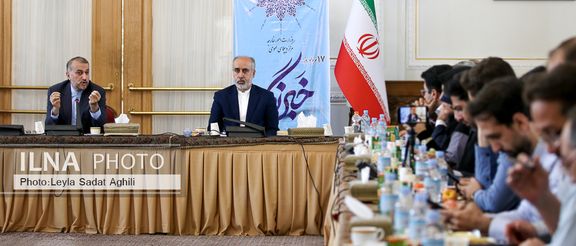
Iran’s foreign minister Hossein Amir-Abdollahian speaking to reporters in Tehran on August 14, 2023

Islamic Republic of Iran’s foreign minister Hossein Amir-Abdollahian announced Monday that unfrozen funds from South Korea have been transferred to a European bank.

Amir-Abdollahian who was speaking at a gathering in the foreign ministry said the funds were already sent from South Korea to a European bank on August 10, the day when a hostage release deal the United States was announced.

The US agreed to allow $6 billion held in two South Korean banks to be released in exchange for five Americans taken hostage in Iran in the past few years. The funds were frozen due to US banking sanctions on Iran imposed after Washington pulled out of the JCPOA nuclear deal in 2018.

The Iranian foreign minister also stated that in the original agreement with the United States and different parties it was agreed to release the funds in a few batches, “not to inflict a shock on Korea’s financial system,” but later it was agreed “to transfer most of the funds to Europe except a small portion in order not to close the bank accounts in Seoul.” He did not name the European bank.

Media reports both in Iran and abroad have said that the funds will be transferred from South Korea to Switzerland, converted into euros and then transferred to Iranian bank accounts in Qatar. The money will stay there and be allowed to be disbursed for humanitarian needs, such as food and medicine, with the United States involved in the process. However, it is not clear exactly how Washington will make sure that Iranians do not cheat, given their years of experience in manipulating financial systems and circumventing sanctions. 

South Korea's First Vice Foreign Minister Choi Jong-kun (2nd from L) meets with his Iranian counterpart, Ali Bagheri Kani, in Vienna on Jan. 6, 2021, to discuss the issue of Tehran's frozen assets under US sanctions.
100%
South Korea's First Vice Foreign Minister Choi Jong-kun (2nd from L) meets with his Iranian counterpart, Ali Bagheri Kani, in Vienna on Jan. 6, 2021, to discuss the issue of Tehran's frozen assets under US sanctions.

One worrying factor is that the released funds will be deposited in Qatar in euros, which will hamper the US ability to closely monitor wire transfers unlike dollar transactions.

Despite earlier Iranian statements that as soon as the funds reach Qatar the five US citizens will be allowed to leave, Amir-Abdollahian said that “the two issues are not related.” The Biden administration has come under sharp criticism for what many say is a ransom paid for hostages that will enrich Iran’s regime and embolden would be hostage takers.

Almost immediately, Amir-Abdollahian seemed to correct his statement, saying that through an intermediary, Iran and the United States have two separate documents, one about the release of the funds and another for freeing the hostages.

Informed sources earlier told Western media that the process of fund transfers could take 30-45 days, but according to Iran’s foreign minister the money is already in Europe.

Foreign Ministry Spokesman Nasser Kanani told reporters on Monday that disclosing specifics of the deal to the media would not be "helpful" given the current circumstances. “The details of this understanding in the media are not helpful at this point in time," Kanaani added. 

The withholding of information comes in the face of increasing criticism and protests against the agreement, both in Iran and internationally, particularly in the United States.

The Wall Street Journal in an editorial on Sunday harshly criticized the Biden administration for paying $1.2 billion per hostage and dismissed the claim that the funds will only be used for humanitarian needs.

“Iran will use the cash the same way it did the money it received from the Barack Obama-John Kerry 2015 nuclear deal—to spread mayhem in the Middle East and beyond,” WSJ said. It also argued that “Money is fungible, as the White House knows, and its ‘humanitarian purposes’ line is best understood as political cover to justify the money-for-hostages deal. In a competition for the funds between the Islamic Revolutionary Guard Corps and the public health of the Iranian people, who do you think wins?”



Most Viewed

State media slam Araghchi's Hormuz tweet, say it let Trump claim victory
1

State media slam Araghchi's Hormuz tweet, say it let Trump claim victory

2

Iran International says it won’t be silenced after London arson attack

3
INSIGHT

How Tehran bends its own red lines to boost state rallies

4

Iran halts petrochemical exports to supply domestic market

5

US arrests Iranian national over alleged Basij-linked visa fraud

Banner
Banner

Spotlight

  • Too early to tell who is winning Iran war, experts say
    PODCAST

    Too early to tell who is winning Iran war, experts say

  • How Tehran bends its own red lines to boost state rallies
    INSIGHT

    How Tehran bends its own red lines to boost state rallies

  • Iran blackout cripples freelancer, small business incomes
    VOICES FROM IRAN

    Iran blackout cripples freelancer, small business incomes

  • Ideology may be fading in Iran, but not in Kashmir's ‘Mini Iran'
    INSIGHT

    Ideology may be fading in Iran, but not in Kashmir's ‘Mini Iran'

  • US blockade enters murky phase as tankers spoof signals and buyers hesitate
    ANALYSIS

    US blockade enters murky phase as tankers spoof signals and buyers hesitate

  • Why the $100 billion Hormuz toll revenue is a myth
    ANALYSIS

    Why the $100 billion Hormuz toll revenue is a myth

•
•
•

More Stories

Iran Keeps Details Of Tehran-Washington Deal Under Wraps

Aug 14, 2023, 16:45 GMT+1

The Ministry of Foreign Affairs in Iran refuses to disclose details of the recent Tehran-Washington agreement involving prisoner release and access to frozen funds.

Foreign Ministry Spokesman Nasser Kanaani said that disclosing specifics to the media would not be "helpful" given the current circumstances.

During a press conference on Monday, Kanani said, "The details of this understanding in the media are not helpful at this point in time." The withholding of information comes in the face of increasing criticism and protests against the agreement, both within Iran and internationally, including in the United States and Israel.

However, Kanaani said that “the Iranian government had prioritized the release of its citizens unjustly detained by the American government, as well as the partial release of Iran's blocked assets, which had been frozen due to what Iran contends is illegal pressure by the United States.”

Notably absent from Kanani's comments was any mention of the release of American hostages imprisoned in Iran. When questioned about the timeline for the agreement's implementation, Kanani responded, "We negotiated with the American government through mediation, and a time frame has been set for the realization of both issues."

Refuting reports of $23 billion in released Iranian assets under the agreement, with $5 billion from Japan, Kanani stated, "I do not confirm either the $5 billion nor the other number you mentioned."

Iran's frozen funds are primarily held in banks across South Korea, Iraq, Japan, China, and India, originating from pre-2018 oil transactions prior to the United States' withdrawal from the JCPOA and subsequent sanctions.


Iranian Poultry Farmers Protest Lack of Animal Feed

Aug 14, 2023, 14:36 GMT+1

Iranian poultry farmers gathered outside the Ministry of Agriculture on Saturday to protest government's failure to deliver essential animal feed.

Despite having paid for soybean and corn inputs over a year ago, the group of angry farmers from poultry production units in Qazvin province, have not received their orders from the Ministry of Agriculture, nor have they been reimbursed. Their accrued losses over this period amount to 100,000 billion rials ($200 million).

The protestors held placards berating the Ministry for placing them in a crippling financial situation and that they had reached breaking point.

They also raised additional concerns at the practice of government agencies buying their produced poultry at slashed prices using coercive measures and threats.

Supply of livestock and poultry production inputs is a systemic and ongoing issue. It has been more than a year since subsidies were reduced and cuts were made to the allocation of discounted foreign currency to essential goods importers. This has resulted in a disturbing cycle of shortages, delivery delays, and outright unavailability of necessary production inputs, negatively impacting the livelihoods of the country's livestock and poultry producers.

Schools Evacuated In Iran Due To Land Subsidence

Aug 14, 2023, 13:10 GMT+1

Iran’s Deputy Minister of Education has said that several schools in the central province of Esfahan (Isfahan) have been evacuated due to land subsidence.

Hamidreza Khan-Mohammadi also raised concerns about the situation in schools located in Yazd and Tehran.

Speaking to the ILNA news agency on Sunday, Khan-Mohammadi highlighted the severity of the subsidence issue in Esfahan province, stating that "we have evacuated some schools" due to the problem. He assured that these evacuated schools would be renovated to strengthen them against the threat of land slippage.

The provinces of Tehran, Khorasan Razavi, and Esfahan are at highest risk of land subsidence, with Esfahan metropolis under particular threat. Khan-Mohammadi confirmed this emphasizing that Esfahan faced the greatest challenge of subsidence with limited cases being reported in Tehran. Yazd also experienced subsidence, which resulted in damage to schools, although the extent of damage was reported to be less significant.

Recent assessments indicate that around 4.24 million residential units in land subsidence zones lack proper structural support.

The issue of land subsidence extends beyond major urban centers to large construction projects. Across numerous regions in Iran, ground cracks and significant depressions resembling meteor craters have emerged on the surface in recent years.

According to experts, over-extraction of groundwater has played a pivotal role in the creation of underground cavities, resulting in the occurrence of land subsidence.

Impact And Concerns Surround US-Iran Frozen Funds Deal

Aug 14, 2023, 12:57 GMT+1
•
Iran International Newsroom

The US-Iran deal to release Tehran’s frozen funds has had little impact on the battered rial as traders understand that no hard cash will enter the market.

The Iranian currency has lingered just below 500,000 per dollar, a trend persisting for weeks. Consequently, the substantial inflationary pressures burdening Iran's economy are unlikely to abate soon, as long as US banking sanctions remain intact, obstructing the repatriation of hard currencies accrued from oil exports.

Shipments of crude remain high, with Iranian officials saying that the government’s target of 1.4 million barrels per day has been reached, but this does not mean Tehran is receiving full payments in dollars or euros from its main customer, China.

Meanwhile, additional media reports suggest not only a $6 billion release from South Korean banks, but also the unlocking of frozen funds in Iraq (estimated between 11-12 billion dollars) and over $3 billion from Japan. These funds will be held in Qatar and Oman, designated for Iran's purchases of essential goods such as food, medicine, and other humanitarian items.

South Korea's First Vice Foreign Minister Choi Jong-kun (2nd from L) meets with his Iranian counterpart, Ali Bagheri Kani, in Vienna on Jan. 6, 2021, to discuss the issue of Tehran's frozen assets under US sanctions.
100%
South Korea's First Vice Foreign Minister Choi Jong-kun (2nd from L) meets with his Iranian counterpart, Ali Bagheri Kani, in Vienna on Jan. 6, 2021, to discuss the issue of Tehran's frozen assets under US sanctions.

Al Jazeera reported Sunday that up to $23 billion will be released from South Korea, Iraq and Japan although it will not bring a substantial boost to Iran’s economy. It hinted that the deal was not just a hostage release agreement, but it also aims at freezing Iran’s nuclear program at current levels. This begs the question if US sanctions will be enforced until the US presidential elections next year, or there is perhaps a secret deal to ease the pressure.

This is just part of the concerns critics of the deal in the United States have. The main objection to pay $6 billion for 5 hostages is the potential danger it creates for American citizens around the world, who can be arrested or taken hostage by an array of hostile actors, not excluding China and Russia.

The Wall Street Journal in an editorial on Sunday slammed the Biden administration for paying $1.2 billion per hostage and dismissed the claim by the administration that the funds will only be available for humanitarian needs. 

“Iran will use the cash the same way it did the money it received from the Barack Obama-John Kerry 2015 nuclear deal—to spread mayhem in the Middle East and beyond,” WSJ said. The newspaper also argued that “Money is fungible, as the White House knows, and its ‘humanitarian purposes’ line is best understood as political cover to justify the money-for-hostages deal. In a competition for the funds between the Islamic Revolutionary Guard Corps and the public health of the Iranian people, who do you think wins?”

The argument that money is fungible is even more applicable to Iran, which has an opaque political system not accountable to the people. Most companies that would be involved in the ‘humanitarian’ imports with the released funds are controlled by regime insiders and the Revolutionary Guard.

The WSJ also predicted that the deal is not limited to releasing the American hostages and could be prelude to an informal agreement to ease sanctions in return for an Iranian promise not to escalate its nuclear program.

“This new informal nuclear deal sounds like a less enforceable version of the 2015 pact. Call it money and sanctions relief for promises, and don’t expect Congress to have any say in approving it,” the editorial stated.

Iran Aims To Expand Trade With Russia Amid Sanctions

Aug 14, 2023, 05:59 GMT+1
•
Iran International Newsroom

The intensification of international sanctions against Russia has made Iran a potentially major trade partner for Moscow, a website in Tehran said on Saturday.

According to Rouydad24, Iranian officials have started to think of Russia as a $100 billion market for Iranian goods. This, however, is an outlandish expectation given Iran’s own isolation due to sanctions, its crippled economy, and the need for technology and raw materials hard for Iran to acquire.

The volume of trade between Moscow and Tehran reached $4 billion between January and October 2022, a far cry from the $100 billion figure. Russian officials have said that the volume of trade will reach $7.5 billion by 2025.

However, the main area of cooperation between Moscow and Tehran is political and military. The two have been allies in the Syrian civil war and their military ties have been expanding since Russia’s invasion of Ukraine. Iran supplied hundreds of kamikaze drones to Russia that have been extensively used against Ukrainian civilian and infrastructure targets.

Western countries have imposed new sanctions on Iranian individuals and entities for aiding Russia in the war, but a recent move by the United States to release billions of dollars in frozen Iranian funds in exchange for 5 American hostages means Tehran will remain undeterred to expand military ties with Moscow.

Rouydad24 quoted Iranian exporter Ali Hosseinian as saying that the figure will be initially increased to $8 billion, but the final target for trade between Iran and Russia is $40 billion per year.

In the meantime, Russia's export to Iran has grown by 27 percent while Iran's export to Russia also grew by 10 percent in 2022. Iran and the Eurasia Economic Union consisting of Russia, Kazakhstan, Belorussia, Armenia and Kirgizstan signed an agreement in early 2023 to boost exchange of goods, services and labor. Meanwhile, Iran and Russia agreed to cooperate in the areas of technology and logistics, while also signing several other agreements for cooperation in the areas of aircraft manufacturing, oil and gas pipelines and natural gas field development.

Iran is Rusia's second biggest trade partner among the Caspian Sea littoral countries, Rouiydad24 wrote, adding that some 90 percent of Russia's export to Iran are food and agricultural products. At the same time, some 60 percent of Iran's exports to Russia also consist of agricultural products. The rest of its exports to Russia include minerals, construction material, and plastics.

Meanwhile, Iran has called for a boost in Russia's exports to Iran particularly for wheat, grains, maze and cooking oil ingredients. According to the Rouydad24 Russia is capable of providing these items. Iran imports around $10 billion of wheat, maze, various edible oils and animal feed annually and potentially Russia can provide all these as a single-source exporter.

According to Reuters, one controversial item among Iran's imports from Russia is gasoline which Russia sells to Iran at a price $12 per ton higher than market prices.

Earlier this year Russia's VTB Bank opened a branch in Tehran and Iranian experts said that the branch will facilitate Iran's safe and low-cost access to the banking systems of Europe, Africa and Asia. It is not clear how this can be done while the Western and other international sanctions are in place against both Tehran and Moscow. International access for Russia’s own banking system has been severely restricted.