• العربية
  • فارسی
Brand
  • Iran Insight
  • Politics
  • Economy
  • Analysis
  • Special Report
  • Opinion
  • Podcast
  • Iran Insight
  • Politics
  • Economy
  • Analysis
  • Special Report
  • Opinion
  • Podcast
  • Theme
  • Language
    • العربية
    • فارسی
  • Iran Insight
  • Politics
  • Economy
  • Analysis
  • Special Report
  • Opinion
  • Podcast
All rights reserved for Volant Media UK Limited
volant media logo

Pentagon Leaders Reiterate US Policy To Deny Iran Nuclear Weapons
Iran International Newsroom
May 12, 2023, 10:51 GMT+1Updated: 17:23 GMT+1
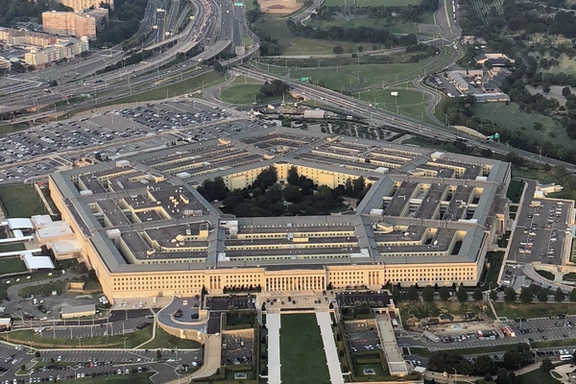
The Pentagon, headquarters of the US Department of Defense

Top US military leaders told a Senate committee hearing Thursday that Iran could produce a nuclear weapon in several months once a decision is made.

Defense Secretary Lloyd Austin and Chairman of the Joint Chiefs Gen Mark Milley testified before the Senate Defense Appropriations subcommittee, where they called for budgetary support in the face of Russian, Chinese and Iranian threats.

“Iran threatens to push the Middle East yet again into instability by supporting terrorists and proxy forces and they continue to improve the capability to produce a nuclear weapon,” Gen. Milley said.

“From the time of Iranian decision by the Supreme Leader, Iran could produce enough fissile material for a nuclear weapon in less than two weeks from time of decision. It will take several more months to produce an actual nuclear weapon. United States policy remains the same. United States remains committed that Iran will never have a nuclear weapon,” he added.

Although this has always been the Biden administration’s position, Gen. Milley’s previous testimony at the House Appropriations subcommittee on Defense in March had raised questions.

Gen. Milley at the time said that “the United States remains committed as a matter of policy that Iran will not have a fielded nuclear weapon.”

The term “fielded” led to questions about what the Biden administration’s policy exactly is regarding Iran becoming a nuclear power. Previously, President Joe Biden and all top officials had repeatedly said that US policy is not to allow the Islamic Republic to acquire a nuclear weapon, threatening that all options were on the table.

It was not clear what Gen. Milley meant by a “fielded” nuclear weapon. Did it mean the administration would allow Iran to build a bomb but not “field” it, which in essence is a vague concept.

Defense Secretary Lloyd Austin (left) and Chairman of the Joint Chiefs Gen Mark Milley (undated)
100%
Defense Secretary Lloyd Austin (left) and Chairman of the Joint Chiefs Gen Mark Milley

Being a nuclear threshold state is a familiar concept, meaning that a country has the fissile material and the knowhow to build a nuclear bomb but has not decided to do so, but once a bomb is produced, it is not clear what the difference would be between a bomb in the basement and one “fielded.”

But in the Senate testimony on Thursday both Austin and Milley were clear that the administration is committed to prevent any Iranian nuclear weapon.

Secretary Austin in response to a question by Senator Susan Collins also emphasized that his responsibility is to present options to the President for making sure that the United States can prevent Iran from building a bomb.

Iran began to breach the low-level uranium enrichment it was allowed under the 2015 nuclear accord, the JCPOA, when former President Donald Trump withdrew from the agreement and imposed economic sanctions in 2018. But Tehran accelerated the enrichment, stockpiling 20-percent and 60-percent enriched uranium once the Biden administration began talks in early 2021 to revive the JCPOA. Currently it is believed that Iran has enough enriched fissile material for 2-5 nuclear bombs.

Israel has repeatedly vowed to resort to military force to stop Iran from crossing the threshold and has reportedly been behind several sabotage attacks against Iran’s nuclear facilities since July 2020.

The US has expanded military cooperation with Israel and regional Arab states in the past two years, conducting large military drills with the Israeli armed forces in January.

Most Viewed

Iran diplomacy wobbles as factions compete to avoid looking soft on US
1
INSIGHT

Iran diplomacy wobbles as factions compete to avoid looking soft on US

2
ANALYSIS

The politics of pink: how Iran uses cuteness to rebrand violence

3

Scam messages seek crypto for ships’ safe passage through Hormuz, firm warns

4
EXCLUSIVE

Family told missing teen was alive, then received his body 60 days later

5
INSIGHT

Is Iran entering its Gorbachev moment?

Banner
Banner

Spotlight

  • Diplomacy tolls at Hormuz as conflict returns to its doorstep
    OPINION

    Diplomacy tolls at Hormuz as conflict returns to its doorstep

  • Opposition to US talks grows in Tehran as ceasefire deadline nears
    INSIGHT

    Opposition to US talks grows in Tehran as ceasefire deadline nears

  • Tehran moderates see ‘no deal–no war’ limbo as worst outcome
    INSIGHT

    Tehran moderates see ‘no deal–no war’ limbo as worst outcome

  • The future has been switched off here
    TEHRAN INSIDER

    The future has been switched off here

  • Lights out, then gunfire: Witnesses recount Mashhad protest crackdown
    VOICES FROM IRAN

    Lights out, then gunfire: Witnesses recount Mashhad protest crackdown

  • Is Iran entering its Gorbachev moment?
    INSIGHT

    Is Iran entering its Gorbachev moment?

•
•
•

More Stories

US Seizes $80M Worth Of Heroin Departing From Iran

May 11, 2023, 14:14 GMT+1
•
Iran International Newsroom

The US Coast Guard has seized $80 million worth of heroin from a fishing vessel transiting the Gulf of Oman on Wednesday.

US Central Command said on Thursday that USCGC Glen Harris was operating in support of the Combined Task Force when a team discovered 1,964 kilograms of heroin on a vessel transiting international waters after departing Chabahar, Iran.

The team also seized $30 million worth of methamphetamine and heroin two days ago from another fishing vessel that departed the same port. So far this year, the navy's Combined Task Force 150 has seized illegal narcotics worth $200 million.

“I’m very proud of my crew and all we’ve been able to accomplish as a team this week,” said Lt. Nick Jabs, Glen Harris’s commanding officer. Glen Harris cutter, a Sentinel Class ship, arrived in the region last year and is capable of intercepting drugs smuggled by boat.

“We’re out here to work with regional partners and disrupt any destabilizing maritime activity at sea. We will continue getting after it.”

Bags of illegal drugs sit on the deck of a fishing vessel seized by U.S. Coast Guard fast response cutter USCGC Glen Harris (WPC 1144) in the Gulf of Oman, May 10, 2023.
100%
Bags of illegal drugs sit on the deck of a fishing vessel seized by U.S. Coast Guard fast response cutter USCGC Glen Harris (WPC 1144) in the Gulf of Oman, May 10, 2023.

An earlier seizure on May 8 resulted in the seizure of 580 kilograms of methamphetamine and 35 kilograms of heroin in Glen Harris's possession.The destination of the shipment has not yet been disclosed.

Earlier this week, Jordan carried out rare air strikes on southern Syria, hitting a Iran-linked drugs factory and killing a smuggler allegedly behind big hauls across the two countries' border.

The sources said one strike hit an abandoned drug facility in Syria's southern Deraa province linked to the Iran-backed Lebanese group Hezbollah, which is allied to Syria's government.

In recent years, Iran has been accused of using its proxies in Iraq, Syria, Lebanon and Yemen to transport illicit narcotics.

According to the US State Department’s 2022 International Narcotics Control Strategy Report, Iran is a significant transit and destination country for opiates, cannabis products, and methamphetamine, the vast majority originating in Afghanistan.

“Some corrupt Islamic Revolutionary Guard Corps personnel reportedly facilitate illicit drug smuggling or profit from the drug trade,” adds the report.

An estimated 9,000 metric tons of drugs pass through Iran annually, according to Iranian press reports. There was a notable increase in drug seizures and violent incidents along the Iran-Azerbaijan border in 2021.

The Iranian government has been accused of using its proxies to smuggle drugs into other countries for a variety of reasons. The most common reason is to fund its own activities, such as its support for the Syrian government and its involvement in the war in Yemen.

The Iranian government has been accused of using its proxies to smuggle drugs into other countries in order to destabilize them and gain political leverage.


Iran Slams Sullivan’s Remarks, Vows To Respond To Any Israeli Attack

May 11, 2023, 11:11 GMT+1

Iran has stressed its right to retaliate against any Israeli action on the country’s nuclear program, threatening to hold the US accountable.

In a letter Tuesday, Iran's permanent representative to the UN, Saeid Iravani, made the comments to UN Secretary-General Antonio Guterres and the Security Council's president.

The ambassador's threats came after US National Security Advisor Jake Sullivan said Washington stood ready to do whatever it could to prevent Iran from acquiring a nuclear weapon and that "freedom of action" was given to Israel.

Sullivan, speaking at the Washington Institute for Near East Policy, said last week that: “We have made clear to Iran that it can never be permitted to obtain a nuclear weapon. As President Biden has repeatedly reaffirmed, he will take the actions that are necessary to stand by this statement, including by recognizing Israel’s freedom of action.”

The Iranian diplomat in his letter called the remarks by Sullivan “irresponsible, provocative, and belligerent” that violates international law and the United Nations Charter “as it threatens to use force against the peaceful nuclear facilities of a Member State of the United Nations.”

The letter said the statement “implies the United States’ potential complicity in any future acts of terrorism or aggression carried out by the Israeli regime against Iran, including against its peaceful nuclear facilities.”

Undeterred, he said Tehran “reserves its inherent and legitimate right under international law to take all necessary measures to protect and defend its citizens, interests, installations, and sovereignty against any aggression, including any terrorist, military, or sabotage acts.”

US Congress Eying New Measures Against Iran’s Missile Program

May 11, 2023, 07:09 GMT+1
•
Iran International Newsroom

The US Congress is mulling over new punitive measures against a wide range of activities supporting Iran’s missile and drone programs.

The new measures are in the framework of a bill, titled Fight CRIME Act, introduced on Tuesday by House Foreign Affairs Committee Chairman Michael McCaul (R-TX) and Ranking Member Gregory W. Meeks (D-NY), along with Subcommittee on the Middle East, North Africa, and Central Asia Chairman Joe Wilson (R-SC) and Ranking Member Dean Phillips (D-MN).

The bipartisan bill would impose sanctions on activities related to the Islamic Republic’s missile and drone programs ahead of the October 2023 expiration of the UN missile ban on Iran.

"Even with the UN restrictions in place, Iran's missiles and drones are targeting US troops, allies, and partners across the Middle East and increasingly fueling Vladimir Putin's illegal war of aggression against Ukraine,” said the lawmakers. “Without urgent action, Iran's missiles and drones could wreak even greater havoc around the globe come October.”

The new bill came as Tehran has continued its malign activities in the Middle Eastr and and talks to revivie the 2015 nuclear deal have failed despite long negotiations in 2021 and 2022.

"We are proud to introduce the Fight CRIME Act to constrain Iran's arsenal, deter malign actors from supporting Iran and its proxies, and keep these dangerous weapons from proliferating onto new battlefields, regardless of whether UN restrictions remain in place," read a statement by the congresspeople who introduced the bill.

The measure would impose mandatory property blocking and visa sanctions on anyone involved in the supply, sale, or transfer of, or support for, Iran’s missiles and drones including by acquiring or transferring Iranian missiles and drones; providing Iran or its proxies with items that may contribute to the development of missiles or drones; participating in joint missile or drone development with Iran or its proxies; and importing or exporting any restricted missile or drone-related materiel to or from Iran.

The new act also requires the Biden administration to submit a report on Iranian missiles and drones to Congress, specifically outlining a strategy to prevent missile and drone-related restrictions under Annex B to UNSCR 2231 from lapsing in October; and an assessment of the impact a lapse would have on Iran’s malign activities and potential financial benefits to the regime.

Iranian President Ebrahim Raisi during the ceremony of the National Army Day parade in Tehran, Iran, April 18, 2023
100%
Iranian President Ebrahim Raisi during the ceremony of the National Army Day parade in Tehran, Iran, April 18, 2023

The measure also calls for a description of the role sanctioned Iranian airlines are playing in the regime’s weapons proliferation, and a list of violators of UN missile and drone-related restrictions on Iran and international efforts to hold them to account.

The Islamic Republic has tried for a long time to keep its missile program apart from the US and global sanctions on its nuclear program, but recently – particularly after the Russian invasion of Ukraine – the threats of its missile program have become more apparent to the West. Iran keeps supplying drones for the Russian forces as well as its proxies across the region, but insists that the missile program is meant for deterrence.

However, the Islamic Republic’s state media keep bragging about developing missiles and drones and distributing them among allies throughout the Middle East.

In an article in December, media affiliated with the Revolutionary Guards boasted about its “integrated missile network” and how it has armed the axis of “resistance” in the Middle East, a term which refers to a network of pro-Iranian proxies and Tehran-backed militias across the region, particularly Hezbollah, the Palestinian groups and Houthis in Yemen.

In February, France said that there must be a stronger "international response" to the threat posed by Iran's ballistic missiles program, with French Foreign Minister Catherine Colonna conveying her country’s position to her US counterpart Antony Blinken. "The minister mentioned Iran's destabilizing activities and the increasing threat posed by the increase of its ballistic missiles arsenal, the proliferation of missiles including towards non-state actors (...) and the need to strengthen the international response to this threat," said the ministry, regarding Colonna's talks with Blinken.


Swedish Parliament Votes To Designate Iran’s IRGC As Terrorist

May 10, 2023, 15:50 GMT+1

The Swedish Parliament voted in favor of designating the Islamic Revolutionary Guard Corps (IRGC) as a terrorist organization today [May 10].

It followed the execution this week of Swedish-Iranian Habib Chaab (Asyud) which saw Sweden's Ministry of Foreign Affairs summon Iran's charge d'affaires in protest of the execution, one of hundreds since the start of the year.

Iran's relations with Sweden have been strained since July when a Swedish court sentenced a former Iranian jailor, Hamid Nouri, to life imprisonment over executions of political prisoners in 1988.

The European Parliament overwhelmingly passed a resolution in January calling on the EU and member states to designate Iran’s Revolutionary Guard as a terrorist group.

The resolution demanded Iranian authorities end the crackdown on popular protests that started last September after a 22-year-old woman was killed in hijab police custody.

It also demanded that Europe should sanction the Islamic Republic’s Supreme Leader Ali Khamenei and its president Ebrahim Raisi.

Despite numerous requests and rallies by Iranians living abroad, the European Union has not yet proscribed the IRGC.

The United States designated the IRGC as a global terrorist organization in 2019. It has carried out multiple cyber-attacks and threats to the lives of Iranians abroad, including staff at Iran International based in the UK.

Iranian Hacking Groups Join Attacks On PaperCut

May 10, 2023, 15:01 GMT+1

Microsoft claims two Iranian state-sponsored hacking groups are exploiting the popular print management software known as PaperCut.

Numerous financially motivated threat actors have exploited PaperCut to deliver ransomware since its initial disclosure and patching on March 8.

The tech giant's threat intelligence team said it observed both Mango Sandstorm (Mercury) and Mint Sandstorm (Phosphorus), which are Iranian hacking groups, carry out operations to achieve initial access.

"The PaperCut exploitation activity by Mint Sandstorm appears opportunistic, affecting organizations across sectors and geographies," the Microsoft Threat Intelligence team said over the weekend.

The PaperCut developer claims more than 100 million users from more than 70,000 companies use this enterprise printing management software worldwide.

“As more threat actors begin to use this vulnerability in their attacks, organizations are strongly urged to prioritize applying the updates provided by PaperCut to reduce their attack surface,” wrote Microsoft in a tweet.

The tech giant also warned last week that Iran continues to be a global threat with its state-backed hackers expanding their activities.

To achieve its geopolitical goals, Iran is now expanding its cyber playbook to include disinformation campaigns, Microsoft said.

According to the report, the Iranian government has been involved in 24 "cyber-enabled influence operations" in 2022, three times higher than 2021, when there were seven.

The majority of these operations are attributed to Emennet Pasargad, a sanctioned Iranian state actor that is seeking to undermine the poll integrity in 2020.



