• العربية
  • فارسی
Brand
  • Iran Insight
  • Politics
  • Economy
  • Analysis
  • Special Report
  • Opinion
  • Podcast
  • Iran Insight
  • Politics
  • Economy
  • Analysis
  • Special Report
  • Opinion
  • Podcast
  • Theme
  • Language
    • العربية
    • فارسی
  • Iran Insight
  • Politics
  • Economy
  • Analysis
  • Special Report
  • Opinion
  • Podcast
All rights reserved for Volant Media UK Limited
volant media logo

US Seizes $80M Worth Of Heroin Departing From Iran
Iran International Newsroom
May 11, 2023, 14:14 GMT+1Updated: 17:43 GMT+1
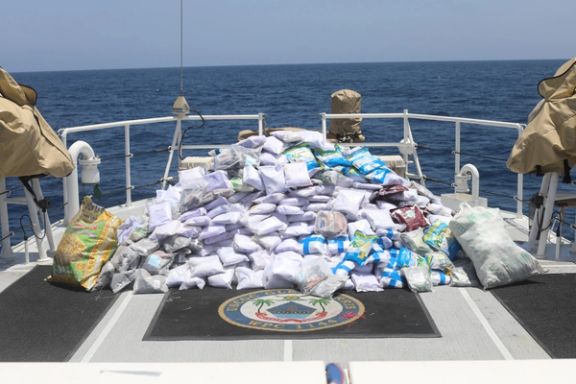
Bags of illegal drugs sit on the deck of US Coast Guard fast response cutter USCGC Glen Harris (WPC 1144) for inventory during a seizure in the Gulf of Oman, May 10, 2023.

The US Coast Guard has seized $80 million worth of heroin from a fishing vessel transiting the Gulf of Oman on Wednesday.

US Central Command said on Thursday that USCGC Glen Harris was operating in support of the Combined Task Force when a team discovered 1,964 kilograms of heroin on a vessel transiting international waters after departing Chabahar, Iran.

The team also seized $30 million worth of methamphetamine and heroin two days ago from another fishing vessel that departed the same port. So far this year, the navy's Combined Task Force 150 has seized illegal narcotics worth $200 million.

“I’m very proud of my crew and all we’ve been able to accomplish as a team this week,” said Lt. Nick Jabs, Glen Harris’s commanding officer. Glen Harris cutter, a Sentinel Class ship, arrived in the region last year and is capable of intercepting drugs smuggled by boat.

“We’re out here to work with regional partners and disrupt any destabilizing maritime activity at sea. We will continue getting after it.”

Bags of illegal drugs sit on the deck of a fishing vessel seized by U.S. Coast Guard fast response cutter USCGC Glen Harris (WPC 1144) in the Gulf of Oman, May 10, 2023.
100%
Bags of illegal drugs sit on the deck of a fishing vessel seized by U.S. Coast Guard fast response cutter USCGC Glen Harris (WPC 1144) in the Gulf of Oman, May 10, 2023.

An earlier seizure on May 8 resulted in the seizure of 580 kilograms of methamphetamine and 35 kilograms of heroin in Glen Harris's possession.The destination of the shipment has not yet been disclosed.

Earlier this week, Jordan carried out rare air strikes on southern Syria, hitting a Iran-linked drugs factory and killing a smuggler allegedly behind big hauls across the two countries' border.

The sources said one strike hit an abandoned drug facility in Syria's southern Deraa province linked to the Iran-backed Lebanese group Hezbollah, which is allied to Syria's government.

In recent years, Iran has been accused of using its proxies in Iraq, Syria, Lebanon and Yemen to transport illicit narcotics.

According to the US State Department’s 2022 International Narcotics Control Strategy Report, Iran is a significant transit and destination country for opiates, cannabis products, and methamphetamine, the vast majority originating in Afghanistan.

“Some corrupt Islamic Revolutionary Guard Corps personnel reportedly facilitate illicit drug smuggling or profit from the drug trade,” adds the report.

An estimated 9,000 metric tons of drugs pass through Iran annually, according to Iranian press reports. There was a notable increase in drug seizures and violent incidents along the Iran-Azerbaijan border in 2021.

The Iranian government has been accused of using its proxies to smuggle drugs into other countries for a variety of reasons. The most common reason is to fund its own activities, such as its support for the Syrian government and its involvement in the war in Yemen.

The Iranian government has been accused of using its proxies to smuggle drugs into other countries in order to destabilize them and gain political leverage.




Most Viewed

Ideology may be fading in Iran, but not in Kashmir's ‘Mini Iran'
1
INSIGHT

Ideology may be fading in Iran, but not in Kashmir's ‘Mini Iran'

2
INSIGHT

Hardliners push Hormuz ‘red line’ as US blockade tests Iran’s leverage

3
VOICES FROM IRAN

Hope and anger in Iran as fragile ceasefire persists

4

Iran International says it won’t be silenced after London arson attack

5

US sanctions oil network tied to Iranian tycoon Shamkhani

Banner
Banner

Spotlight

  • Hardliners push Hormuz ‘red line’ as US blockade tests Iran’s leverage
    INSIGHT

    Hardliners push Hormuz ‘red line’ as US blockade tests Iran’s leverage

  • Ideology may be fading in Iran, but not in Kashmir's ‘Mini Iran'
    INSIGHT

    Ideology may be fading in Iran, but not in Kashmir's ‘Mini Iran'

  • War damage amounts to $3,000 per Iranian, with blockade set to add to losses
    INSIGHT

    War damage amounts to $3,000 per Iranian, with blockade set to add to losses

  • Why the $100 billion Hormuz toll revenue is a myth
    ANALYSIS

    Why the $100 billion Hormuz toll revenue is a myth

  • US blockade targets Iran oil boom amid regional disruption
    ANALYSIS

    US blockade targets Iran oil boom amid regional disruption

  • Iran's digital economy battered by prolonged blackout
    INSIGHT

    Iran's digital economy battered by prolonged blackout

•
•
•

More Stories

Iran Slams Sullivan’s Remarks, Vows To Respond To Any Israeli Attack

May 11, 2023, 11:11 GMT+1

Iran has stressed its right to retaliate against any Israeli action on the country’s nuclear program, threatening to hold the US accountable.

In a letter Tuesday, Iran's permanent representative to the UN, Saeid Iravani, made the comments to UN Secretary-General Antonio Guterres and the Security Council's president.

The ambassador's threats came after US National Security Advisor Jake Sullivan said Washington stood ready to do whatever it could to prevent Iran from acquiring a nuclear weapon and that "freedom of action" was given to Israel.

Sullivan, speaking at the Washington Institute for Near East Policy, said last week that: “We have made clear to Iran that it can never be permitted to obtain a nuclear weapon. As President Biden has repeatedly reaffirmed, he will take the actions that are necessary to stand by this statement, including by recognizing Israel’s freedom of action.”

The Iranian diplomat in his letter called the remarks by Sullivan “irresponsible, provocative, and belligerent” that violates international law and the United Nations Charter “as it threatens to use force against the peaceful nuclear facilities of a Member State of the United Nations.”

The letter said the statement “implies the United States’ potential complicity in any future acts of terrorism or aggression carried out by the Israeli regime against Iran, including against its peaceful nuclear facilities.”

Undeterred, he said Tehran “reserves its inherent and legitimate right under international law to take all necessary measures to protect and defend its citizens, interests, installations, and sovereignty against any aggression, including any terrorist, military, or sabotage acts.”

Iranian Pundits Call for Pragmatism, Change In Foreign Policy

May 11, 2023, 10:40 GMT+1
•
Iran International Newsroom

A former Iranian diplomat says Tehran may have concluded that it should replace idealism with pragmatism to end the long-standing impasse in its foreign policy.

At the same time, a reformist commentator in Tehran has also said that it is essential for Tehran to reform its foreign policy as a precondition to attract foreign and domestic investment.

Hojjatollah Joudaki, a former Iranian diplomat in Egypt, told Etemad Onlinethat a recent trend of changing tens of street names in Tehran could be the first move in the interest of pragmatism. 

Iran had named many streets after terrorist figures such as Khaled Eslamboli, the man who assassinated President Anwar Sadat for giving asylum to the Shah of Iran. The street's name was changed following the resumption of ties with Saudi Arabia in anticipation of further extending the regional rapprochement. 

The interview with Joudaki coincided with media reports indicating that talks took place between Iranian and Egyptian officials in Oman. 

Hojjatollah Joudaki, a former Iranian diplomat (undated)
100%
Hojjatollah Joudaki, a former Iranian diplomat

Joudaki argued that the hard core of the Iranian regime might have finally noticed the Islamic Republic’s isolation in the region.

He claimed that the resumption of Iran's ties with Egypt was hindered by the United States and Saudi Arabia. Now that Iran has made peace with Saudi Arabia, it is time to think of resuming the ties between Tehran and Cairo. He added that hardliners who were against restoring ties with Egypt also think that maintaining relations with Cairo and other regional capitals could help Iran to surmount its economic problems. 

"While there seems to be no hope in the revival of the JCPOA, one solution for Iran could be restoring its ties with its neighbors and regional states," said Joudaki, adding that Iranian leaders have concluded that it is advantageous to end their international isolation. He added that the pressure groups who prevented better relations with Iran's neighbors are still there, but they have realized what have they done to the country. 

Reformist commentator Abbas Adi (Undated)
100%
Reformist commentator Abbas Adi

Meanwhile, in a commentary in Etemad daily, reformist commentator Abas Adi wrote: "reforming Iran's foreign policy is a must. Without solving the problem of [nuclear accord] JCPOA and maintaining stable foreign relations, it is not possible for Iran to attract any domestic or foreign investment." 

Abdi wrote that Supreme Leader Ali Khamenei's plan for the current year, that is "harnessing inflation and boosting production" requires large investments that would facilitate the 8 percent economic growth envisaged by Khamenei." He wrote, "This can be made possible only through restoring the country's infrastructure. But if you ask me, the key here is prioritizing domestic investment over foreign investment."

Abdi’s preference for domestic investment is a more practical approach, as he probably knows that Tehran is not inclined to improve relations with the West, which could unblock foreign investments. 

"At the same time, we need to look for foreign investment. But the reason for prioritizing domestic investment is that domestic capital is either invested in non-productive areas or is exiting the country."

Abdi added that priority should be given to the private sector as the government lacks the resources for investment. 

He further pointed out that Iran needs to remove major obstacles such as the state-controlled banking system, instability in policymaking, financial corruption, and the absence of free media. All of these are obstacles to an efficient economy with inflation and economic growth, Abdi said. 

UK Charity Regulator Dismisses Trustees Of Iran-Affiliated Islamic Center

May 11, 2023, 10:31 GMT+1

The UK’s Charity Commission has removed trustees from the board of the Islamic Center of England for its links to Iran.

The UK's security minister Tom Tugendhat welcomed the decision by the regulator, saying its leadership was appointed by the head of the Islamic Republic of Iran. "It is reported to have celebrated the lives of people like Gen Soleimani, the head of the IRGC, who [did] so much to spread hatred, death and destruction, not just in the Middle East, but around the world,” he said.

Last week, a temporary manager was appointed after the charity was inspected by the regulator. There were serious concerns about the charity's governance, with the organization previously being warned.

Tugendhat added: “In recent months, I've warned often about the threat that Iran poses to us here in the United Kingdom. The actions of the Iranian Revolutionary Guard Corps and its agents have put lives in danger in our own country.”

The Charity Commission ruled that trustees violated their legal duties and responsibilities, failing to protect the charity's assets.

It was revealed in 2021 that the Islamic Centre of England in London run by the UK representative of Ayatollah Ali Khamenei, had received more than £100,000 in coronavirus aid from the British government’s coronavirus job retention scheme.

Meanwhile, a Muslim group in Germany, Secular Islam Association, urged authorities on Wednesday to immediately ban Iran’s Islamic Center of Hamburg and shut down its Imam Ali Mosque.

The Islamic Republic, controlled by Khamenei, does not allow the presence of international institutions or non-governmental organizations in Iran, but it directly and indirectly has a network of associations and offices around the world, including Western countries.

Newspaper Prosecuted For Report On Rise of Body Organ Sales In Iran

May 11, 2023, 09:41 GMT+1

An Iranian newspaper has been prosecuted for publishing a report on the rising illegal organ trade.

An investigation in Jahan-e-Sanat revealed that the illegal sale of organs is becoming increasingly common in Iran amidst rising poverty, claiming the government was turning a blind eye to the problem.

The newspaper claimed middlemen operating online send the prospective donors to neighboring countries such as the United Arab Emirates, Turkey, and Iraq to sell body parts for $7,000 to $15,000, with most donors coming from impoverished backgrounds. In some cases, people have even been forced to sell organs to pay for medical bills or support their families.

The Judiciary announced Tuesday that the daily has been charged for “publishing false information without providing evidence".

While Iran has a domestic system for organ sales, it is a long and expensive process, prohibitive to most ordinary Iranians. The trafficking of organs abroad is not regulated and poses huge risks to patients, offering no safeguards for the many who are vulnerable and desperate.

The organ trafficking industry has been estimated to be worth millions of dollars, with organs being sold to wealthy individuals. The organs are usually obtained through coercion or deception, with some being promised money and then never receiving it once the organ has been removed.

US Congress Eying New Measures Against Iran’s Missile Program

May 11, 2023, 07:09 GMT+1
•
Iran International Newsroom

The US Congress is mulling over new punitive measures against a wide range of activities supporting Iran’s missile and drone programs.

The new measures are in the framework of a bill, titled Fight CRIME Act, introduced on Tuesday by House Foreign Affairs Committee Chairman Michael McCaul (R-TX) and Ranking Member Gregory W. Meeks (D-NY), along with Subcommittee on the Middle East, North Africa, and Central Asia Chairman Joe Wilson (R-SC) and Ranking Member Dean Phillips (D-MN).

The bipartisan bill would impose sanctions on activities related to the Islamic Republic’s missile and drone programs ahead of the October 2023 expiration of the UN missile ban on Iran.

"Even with the UN restrictions in place, Iran's missiles and drones are targeting US troops, allies, and partners across the Middle East and increasingly fueling Vladimir Putin's illegal war of aggression against Ukraine,” said the lawmakers. “Without urgent action, Iran's missiles and drones could wreak even greater havoc around the globe come October.”

The new bill came as Tehran has continued its malign activities in the Middle Eastr and and talks to revivie the 2015 nuclear deal have failed despite long negotiations in 2021 and 2022.

"We are proud to introduce the Fight CRIME Act to constrain Iran's arsenal, deter malign actors from supporting Iran and its proxies, and keep these dangerous weapons from proliferating onto new battlefields, regardless of whether UN restrictions remain in place," read a statement by the congresspeople who introduced the bill.

The measure would impose mandatory property blocking and visa sanctions on anyone involved in the supply, sale, or transfer of, or support for, Iran’s missiles and drones including by acquiring or transferring Iranian missiles and drones; providing Iran or its proxies with items that may contribute to the development of missiles or drones; participating in joint missile or drone development with Iran or its proxies; and importing or exporting any restricted missile or drone-related materiel to or from Iran.

The new act also requires the Biden administration to submit a report on Iranian missiles and drones to Congress, specifically outlining a strategy to prevent missile and drone-related restrictions under Annex B to UNSCR 2231 from lapsing in October; and an assessment of the impact a lapse would have on Iran’s malign activities and potential financial benefits to the regime.

Iranian President Ebrahim Raisi during the ceremony of the National Army Day parade in Tehran, Iran, April 18, 2023
100%
Iranian President Ebrahim Raisi during the ceremony of the National Army Day parade in Tehran, Iran, April 18, 2023

The measure also calls for a description of the role sanctioned Iranian airlines are playing in the regime’s weapons proliferation, and a list of violators of UN missile and drone-related restrictions on Iran and international efforts to hold them to account.

The Islamic Republic has tried for a long time to keep its missile program apart from the US and global sanctions on its nuclear program, but recently – particularly after the Russian invasion of Ukraine – the threats of its missile program have become more apparent to the West. Iran keeps supplying drones for the Russian forces as well as its proxies across the region, but insists that the missile program is meant for deterrence.

However, the Islamic Republic’s state media keep bragging about developing missiles and drones and distributing them among allies throughout the Middle East.

In an article in December, media affiliated with the Revolutionary Guards boasted about its “integrated missile network” and how it has armed the axis of “resistance” in the Middle East, a term which refers to a network of pro-Iranian proxies and Tehran-backed militias across the region, particularly Hezbollah, the Palestinian groups and Houthis in Yemen.

In February, France said that there must be a stronger "international response" to the threat posed by Iran's ballistic missiles program, with French Foreign Minister Catherine Colonna conveying her country’s position to her US counterpart Antony Blinken. "The minister mentioned Iran's destabilizing activities and the increasing threat posed by the increase of its ballistic missiles arsenal, the proliferation of missiles including towards non-state actors (...) and the need to strengthen the international response to this threat," said the ministry, regarding Colonna's talks with Blinken.




