• العربية
  • فارسی
Brand
  • Iran Insight
  • Politics
  • Economy
  • Analysis
  • Special Report
  • Opinion
  • Podcast
  • Iran Insight
  • Politics
  • Economy
  • Analysis
  • Special Report
  • Opinion
  • Podcast
  • Theme
  • Language
    • العربية
    • فارسی
  • Iran Insight
  • Politics
  • Economy
  • Analysis
  • Special Report
  • Opinion
  • Podcast
All rights reserved for Volant Media UK Limited
volant media logo
OPINION

Diplomacy tolls at Hormuz as conflict returns to its doorstep

Shahram Kholdi
Shahram Kholdi

International Security and Law Analyst

Apr 21, 2026, 20:43 GMT+1
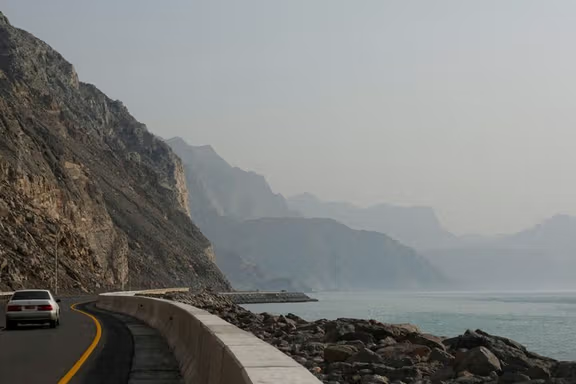
A car rides along the coast of Musandam overlooking the Strait of Hormuz amid the US-Israeli conflict with Iran, Oman, March 2, 2026.

The fragile truce between Tehran and Washington expires on April 22. With it ends restraint. Conflict will return, though its scale remains uncertain.

For two decades, the United States sought a durable nuclear settlement with Iran. Each failure strengthened the Islamic Republic. It deepened ties with Russia and China, expanded proxies from Iraq to the Red Sea, and built a missile and drone arsenal while burying key infrastructure underground—beyond inspection and reach.

The revelation of the Pickaxe Mountain facility in June 2025 ended ambiguity. In Washington and Jerusalem, red lines hardened into a single demand: effective surrender of Iran’s military-nuclear-industrial complex.

For all intents and purposes, the Khamenei–IRGC refusal of American–Israeli demands precipitated the February 28–April 8, 2026 conflict—the 40-day war. To outsiders, Tehran’s refusal appeared reckless. The regime, however, believed too much had been invested—in blood and treasure—to retreat without resistance.

With President Trump’s April 8 ceasefire declaration, a new round of diplomacy began in Islamabad (April 11–12, 2026). It lasted twenty-one hours and yielded nothing. Vice President Vance stated plainly that Iran had rejected American terms.

Reports indicated that senior IRGC figures, including Vahidi and Zolghadr, vetoed any concession. Authority was fractured; Ghalibaf’s delegation could not bind the state. The collapse exposed internal divisions and set the pattern ahead.

Tehran signalled its readiness to escalate—threatening to close the Strait of Hormuz, recover concealed arsenals, with strikes on Gulf monarchies’ energy infrastructure.

Trump ordered a naval blockade of Iranian ports. As both sides manoeuvred behind the scenes, Tehran’s April 17 declaration that the strait remained open was swiftly overtaken, as Washington seized upon it as evidence of capitulation while maintaining the blockade. Trump nevertheless indicated that talks would continue.

Yet Vice President Vance’s planned return to Islamabad has now been placed on hold after Tehran failed to respond to American negotiating positions. The diplomatic track is no longer merely fragile—it is suspended.

Even if revived at short notice, the underlying reality remains unchanged: any Iranian delegation would face the same internal veto, and any concession would deepen recent humiliations—the decapitation of senior leadership and the degradation of strategic infrastructure.

It is at sea that the confrontation sharpens.

Washington maintains that its blockade is a lawful belligerent measure under the law of armed conflict at sea, subject to effectiveness, proportionality, and notification as reflected in customary law and articulated in the San Remo Manual (1994).

Tehran, by contrast, operates under narrower constraints. Though not party to the UN Convention on the Law of the Sea (1982), it remains bound by customary international law.

Transit passage through the Strait of Hormuz—Articles 37–44 of UNCLOS—cannot be suspended, even in armed conflict, as affirmed in the Corfu Channel case (1949) and reflected in the 1958 Territorial Sea Convention. Any attempt to mine or disrupt the strait would violate both the law of the sea and the law of armed conflict at sea and fail the tests of necessity and proportionality under Article 51.

What once served Tehran as deterrence now operates as constraint. Geography, turned against it, has become Washington’s leverage.

That leverage is already being applied through calibrated force. The recent strike on the Toska vessel, confined to the engine room, demonstrated how force may be applied with precision and restraint at once. Restraint, therefore, has been calculation, not limitation. This is not indiscriminate destruction but controlled degradation.

During the 40-day war, US–Israeli strikes targeted steel, gas, and petrochemical hubs with precision. They may resort to that practice again.

There is precedent. During Operation Allied Force in Kosovo in 1999, NATO struck power plants, depriving Serbia of over seventy per cent of its electricity. The logic was calibrated escalation in the service of coercion.

Should negotiations fail, the next rungs are visible: precision strikes on power grids, bridges, and transport arteries. The Kosovo template may yet be reprised in the Persian Gulf.

Over the past year—across Ukraine, Gaza, and in dealings with China—President Trump has demonstrated a consistent posture: he neither retreats nor entertains settlements that suggest humiliation.

Lest we forget the chorus that once insisted President Trump would refrain from a prolonged conflict—that oil shocks would stay his hand, that he would restrain Israel, or that he would contrive accommodation with Tehran.

Events have ruthlessly overtaken these assumptions, leaving in their place a single, unambiguous note: the President now declares that the blockade “is absolutely destroying Iran” and will not be lifted until there is a “deal”—one he insists will be “far better” than the JCPOA.

Across the divide, Ghalibaf answers in a discordant key, rejecting negotiations “under the shadow of threats” while signalling preparation for escalation.

Trump is dividing and conquering on two fronts. He drives a lethal wedge between Ghalibaf’s faction—seeking a face-saving accommodation—and hardliners such as Vahidi and Zolghadr who command the instruments of force.

If Ghalibaf prevails, Trump imposes his terms and claims victory. If the hardliners purge him, they will be branded irredeemable extremists, and what remains of the regime will be subjected to decisive force. In either outcome, the structure of pressure favours Washington.

This is coercive diplomacy in its classical form. It draws from Thomas Schelling’s The Strategy of Conflict and Arms and Influence, fused with what Jeffrey Sonnenfeld describes as Trump’s “divide and conquer” doctrine—his so-called Ten Commandments.

A public commitment device raises audience costs and forces a stark binary: agreement or refusal. The “threat that leaves something to chance”—brinkmanship—is fully engaged. Each rung narrows retreat and magnifies miscalculation.

Contrary to prevailing punditry, the 40-day war has turned Tehran and Washington into adversaries locked in a contest of endurance. Attacks on regional energy infrastructure have eroded tolerance, while American resilience has diminished Iran’s deterrent card. What once compelled caution now invites pressure.

Vice President Vance’s journey to Islamabad has now been halted. If no credible Iranian response emerges, detonation will follow—not in metaphor, but in action. The United States and Israel may then treat the remaining IRGC leadership as beyond restraint—men whose decisions invite elimination rather than negotiation.

The outcome now narrows to a single choice: acceptance—or detonation.

Most Viewed

Iran diplomacy wobbles as factions compete to avoid looking soft on US
1
INSIGHT

Iran diplomacy wobbles as factions compete to avoid looking soft on US

2
ANALYSIS

The politics of pink: how Iran uses cuteness to rebrand violence

3

Scam messages seek crypto for ships’ safe passage through Hormuz, firm warns

4
EXCLUSIVE

Family told missing teen was alive, then received his body 60 days later

5
INSIGHT

Is Iran entering its Gorbachev moment?

Banner
Banner

Spotlight

  • Diplomacy tolls at Hormuz as conflict returns to its doorstep
    OPINION

    Diplomacy tolls at Hormuz as conflict returns to its doorstep

  • Opposition to US talks grows in Tehran as ceasefire deadline nears
    INSIGHT

    Opposition to US talks grows in Tehran as ceasefire deadline nears

  • Tehran moderates see ‘no deal–no war’ limbo as worst outcome
    INSIGHT

    Tehran moderates see ‘no deal–no war’ limbo as worst outcome

  • The future has been switched off here
    TEHRAN INSIDER

    The future has been switched off here

  • Lights out, then gunfire: Witnesses recount Mashhad protest crackdown
    VOICES FROM IRAN

    Lights out, then gunfire: Witnesses recount Mashhad protest crackdown

  • Is Iran entering its Gorbachev moment?
    INSIGHT

    Is Iran entering its Gorbachev moment?

•
•
•

More Stories

Iran says no decision yet on talks as Pakistan prepares to host US team

Apr 20, 2026, 12:05 GMT+1

Iran said on Monday it had not yet decided whether to join a second round of talks with the United States, even as Pakistan prepared to host a US delegation, with Tehran accusing Washington of violating the ceasefire and showing no real seriousness about diplomacy.

Foreign Ministry spokesperson Esmaeil Baghaei said Iran had no plan as of now for the next round of negotiations and said US actions had only deepened mistrust.

“As I am speaking to you now, we have no plan for the next round of negotiations,” he said.

Baghaei said Washington had undermined the process from the outset of the ceasefire.

He said the United States first tried to argue that Lebanon was not part of the truce, despite Pakistan’s mediator saying otherwise, and then continued what Iran describes as a naval blockade and other hostile actions in and around the Strait of Hormuz, including an attack on an Iranian commercial vessel.

He said such actions were clear ceasefire violations and that the blockade itself amounted to aggression under international law.

“Behavior and words are completely incompatible,” he said, adding that Iran would decide its next steps based only on national interests, not deadlines or ultimatums.

Baghaei said Iran had not started the war and had acted only in self-defense. He warned that if the United States or Israel launched any new attack, Iran’s armed forces would respond.

He also said Tehran could not forget what he called two US betrayals of diplomacy over the past year, saying Washington had twice attacked Iran during diplomatic processes.

“We cannot forget that twice America betrayed diplomacy,” he said.

Pakistan remains sole mediator

Baghaei said Pakistan remained Iran’s only formal mediator, though other countries were making efforts.

He said Iran was still reviewing the latest package conveyed through Pakistan after a US 15-point proposal, Iran’s 10-point response, discussions in Islamabad and further review during Pakistani army chief Asim Munir’s visit to Tehran.

He rejected suggestions that Iran had made a wholly new proposal, saying Tehran’s position had remained steady while the US side kept changing its demands.

“The American side keeps changing its demands, but we have remained steadfast,” he said.

He said some US demands were unacceptable and that repeated insistence on them would not change Iran’s position.

Baghaei also dismissed trust as a basis for negotiations with Washington.

“There is no trust,” he said.

Hormuz, Europe and red lines

Much of Baghaei’s remarks focused on the Strait of Hormuz. He said Iran’s actions there were lawful and defensive, arguing that before the US and Israeli attacks there had been no problem in the waterway.

“Before February 28, the Strait of Hormuz was safe and secure,” he said.

He said the international community should hold the United States and Israel responsible for the current insecurity, not Iran.

He added that Iranian authorities were still examining whether recent incidents involving Indian-linked ships had in fact been caused by Iranian forces.

Baghaei said as long as the current situation continued, it was unrealistic to speak of a full return to normal traffic through Hormuz. He said Iran had concluded that new rules or protocols would be needed to ensure safe passage in the future.

He also rejected European criticism, including comments from EU foreign policy chief Kaja Kallas, saying Europe could not invoke international law selectively.

“You cannot use international law as a convenient tool,” he said.

Baghaei said Iran would not negotiate over its defense capabilities and said the transfer of enriched uranium had never been an Iranian option in the talks.

On oil, he said Iran was using all available means to keep its oil industry functioning and maintain exports despite the blockade and wartime pressure.

From instability to influence: Pakistan’s pivotal role in US-Iran diplomacy

Apr 19, 2026, 11:16 GMT+1
•
Mahboob Shah Mahboob

Despite deep political turmoil, economic distress, militant violence, and a fraying security landscape at home, Pakistan has unexpectedly emerged as the publicly acknowledged central mediator between Washington and Tehran.

Since late February 2026, the war involving the United States, Israel, and Iran has widened, with traffic through the Strait of Hormuz becoming a major pressure point for the global economy.

Under that pressure, a temporary ceasefire was first announced with Pakistani mediation. That was followed by rare direct talks between the United States and Iran in Islamabad.

Pakistan’s role was publicly acknowledged by both Washington and Tehran, each of which described it as the “central mediator.”

The talks held in Islamabad on April 11-12 lasted more than 20 hours and ended without an immediate agreement. Even so, the channel remained open, and efforts to prepare a second round have continued.

That process has raised a central question: was Pakistan merely passing messages, or was it managing a broader peace process?

Although the direct US-Iran talks took place in Islamabad, Pakistan’s role can be seen across several parallel tracks.

Hidden channels of communication

From the beginning of the war, Pakistan helped facilitate the exchange of messages between Washington and Tehran.

A number of Pakistani politicians have openly acknowledged that US proposals – at times in the form of specific points or clauses – were conveyed to Iran through Pakistan, and that Iran’s responses were then relayed back to Washington.

That role became particularly important at a moment when some of the Persian Gulf’s traditional mediators, including Qatar, were themselves under severe security pressure and were being targeted daily by Iran.

Structuring the agenda of the talks

By hosting the talks, Islamabad took three practical steps.

First, it provided a secure environment and the necessary logistics for both sides, which trusted Pakistan’s capacity in that area.

Second, it separated the negotiations into distinct tracks: the nuclear program, sanctions, frozen assets, the Strait of Hormuz, and regional security.

Third, it pressed for a timetable and a mechanism for a “second phase” of talks and for dialogue to continue.

Although the talks ended without an immediate outcome, Pakistan succeeded on the first two fronts. That is why it did not remain passive afterward and continued its mediation efforts in preparation for a second round.

Coordination with regional partners

Pakistan has also sought to widen support for a ceasefire and renewed talks by securing broader backing – especially from Saudi Arabia, Turkey, Egypt.

That coordination matters because it allows each side to use its influence and reduces the likelihood of disruptive action by spoilers.

Why trusting Pakistan?

Although there are countries in the region more powerful than Pakistan – India being the clearest example – trust in Pakistan has not stemmed from moral authority. It has come from necessity, leverage, and calculation.

Pakistan has long-standing security ties with the United States, as well as neighborly and working relations with Iran. Together, those ties provide a minimum level of mutual trust for both sides.

For Washington, the need was for a country able to transmit messages within a framework aligned with US interests and to provide a negotiating venue acceptable to Donald Trump’s administration.

In that context, India was not a suitable choice for the United States, because the degree of influence and leverage the Trump administration has over Pakistan does not exist in the same way over India.

At the same time, America’s Arab allies are not only under intense pressure, but are also seen by Iran as direct partners of Washington and therefore lack the credibility needed for mediation. The United States also needed an Islamic country with nuclear capability to play that role. From that perspective, Pakistan was the best available option.

Pakistan also has workable relations with Saudi Arabia, Qatar, and the United Arab Emirates, and its trust-building efforts during the talks could prove useful.

Pakistan depends on the Persian Gulf and the wider Middle East for energy, labor remittances, and regional stability. A prolonged war would therefore carry domestic economic and security costs. Those costs, in turn, increase Islamabad’s incentive to preserve the ceasefire and keep negotiations alive.

There is also a domestic political calculation. Pakistan’s government is trying to ease both internal and external pressure, particularly amid the country’s political crisis and the imprisonment of former prime minister Imran Khan. By taking part in a process in which the United States is one of the parties, Islamabad may hope to reduce pressure on Shehbaz Sharif’s government.

Economic distress is another dimension. Pakistan hopes that these talks may help it secure US economic support as well as financial aid and loans from Arab states – a need Islamabad understands well.

At the same time, Pakistan has security and defense agreements with Saudi Arabia and could, if the war dragged on, come under pressure to support Riyadh. That concern appears to have pushed Pakistan to avoid direct entry into the conflict: first by opening confrontations in Afghanistan to signal to its allies that internal instability left it unable to cooperate militarily against Iran, and then by presenting itself as a mediator for peace.

For Iran, too, Pakistan may not be the ideal mediator, but in practice there are few alternatives. Tehran has targeted many Arab countries, while Qatar – which had previously played a mediating role – has itself become a casualty of the war. That leaves Pakistan, as an Islamic country, as the remaining option. For that reason, Tehran has also welcomed Pakistani mediation.

The role of the security institutions and the army

In a crisis of this kind, guaranteeing a ceasefire and ensuring the safe passage of messages is difficult without the involvement of security institutions.

According to reports, Pakistan’s army chief is seen in Washington as a reliable channel for direct contact, and that has accelerated decision-making.

Pakistan has also previously hosted and facilitated confidential contacts between major powers, including during the period of rapprochement between China and the United States. That history suggests Islamabad has experience in closed-door diplomacy.

Reports further indicate that direct contact between the Trump administration and General Asim Munir helped smooth the decision-making process, and that Washington believes Pakistan has practical influence over security commitments, can preserve its relationship with Iran, maintain its ties to the Arab world, and is itself affected by instability in the Middle East.

Why is the army chief at the center of this diplomacy?

In this mediation effort, it has been not the prime minister or foreign minister, but Pakistan’s military chief, Field Marshal Asim Munir, who has emerged as the main figure in the negotiations.

Pakistan’s military has more than 51 years of experience dealing with US and Iranian security and military circles. Pakistani officials say responsibility for maintaining confidential channels with the political and military leadership in Tehran and Washington has been placed in Munir’s hands. In a crisis like this, security guarantees carry greater weight than purely political commitments.

Prime Minister Shehbaz Sharif said in a speech that Munir had played an especially prominent role in the talks. He added that Munir received the Iranian delegation in full field marshal dress and welcomed the American delegation in formal Western attire – a symbolic message suggesting that Pakistan was guaranteeing the process not only at the level of the civilian government, but at the level of the state and security establishment.

After the imprisonment of Imran Khan, public discontent with the army in Pakistan had risen sharply, and many came to see the military as the root of the country’s crises. Munir appears to have understood that mood clearly, and by accepting a mediating role at such a sensitive moment, he has, to a considerable extent, managed to rebuild some of the public trust that had been lost.

According to a source in the Pakistani prime minister’s office, Trump’s office contacted Munir directly 12 times after the first round of talks.

That suggests Pakistan’s army chief is effectively acting as an indirect representative of the United States while also handling the transmission of messages.

Political parties and civilian institutions in Pakistan, however, are unhappy with that role and worry that, if the talks succeed, the army’s power will grow further and the already weakened political sphere will fall more deeply under military influence.

After the first round ended, Munir traveled to Tehran to prepare the ground for a second round of talks and to convey Washington’s messages and proposals to the Iranian side. The trip was directly linked to efforts to shape the next phase and extend the ceasefire.

The prospects for success in talks

Although the first round ended without a final result, the repeated trips by Pakistan’s army chief and the pressure created by the situation in the Strait of Hormuz – on both the United States and global markets – have increased the chances of at least a partial agreement.

The path ahead, however, is far from straightforward, because the disagreements are more structural than merely technical.

Several difficult but essential steps could improve the prospects for success.

  • A step-by-step agreement: first, an extension of the ceasefire, a temporary mechanism for Hormuz, and limited sanctions relief; then deeper discussions on nuclear and regional issues.
  • A package of guarantees: balanced guarantees – rather than automatic snapback mechanisms –in the event of a ceasefire breach, with Pakistan seeking to underpin those guarantees through security channels.

Statements by Pakistani officials suggest they are trying to lay the groundwork for those two stages and hope that Islamabad will reap what they describe as “the sweetest fruit” from both Washington and Tehran.

That expectation rests on a broader calculation. Tehran no longer has the capacity for a long war and wants relief for its weak economy from sanctions pressure, while the United States has shown signs of willingness to ease some of those sanctions.

On the other side, the Trump administration is facing rising domestic political and economic pressure, while Iran has sent positive – though conditional – signals on the nuclear file.

For those reasons, hopes for the success of the talks have increased.

100 days after carnage: Iran economy reels from war, inflation, unemployment

Apr 18, 2026, 18:10 GMT+1
•
Maryam Sinaiee

One hundred days after thousands of protesters were massacred on January 8 and 9, Iran's already fragile economy has sharply deteriorated, with millions feared to be unemployed as a devastating war compounds the crisis and accelerates economic collapse.

The protests that started in the Grand Bazaar of Tehran in late December and quickly spread across the country were followed by what has been described as the deadliest crackdown on protesters in Iran’s contemporary history in January.

Shortly thereafter, a war involving the United States and Israel began, compounding the country’s economic distress.

The service sector was hit hard during the protests. Advertising agencies, technical consulting firms, digital service providers, and hospitality and tourism businesses have since suffered further, and in many cases irreparable, damage because of the war.

Three weeks of internet disruptions during the protests, and over 1,100 hours since the beginning of the war on February 28, have effectively paralyzed large parts of the digital economy.

"According to official estimates released by Iranian authorities, more than 10 million people in Iran earn their income directly through the internet. As a result, any disruption or shutdown of internet services poses a serious threat to their livelihoods," Dadban, a legal advisory and training center for activists, said in a report.

"With the continuation of this situation, millions have faced a sharp drop in income or unemployment," Dadban added.

More significantly, the conflict has inflicted severe damage on critical economic infrastructure, including key petrochemical industries and steel production across multiple cities. These sectors, considered the backbone of Iran’s industrial economy, have suffered extensive losses.

The destruction of major industries has disrupted the supply of raw materials, triggering cascading effects across manufacturing and related sectors.

Widespread layoffs have followed, affecting not only workers in these industries but also those employed in dependent businesses.

At the same time, exports have declined sharply, further constraining an already limited flow of foreign revenue.

The scale of the economic shock is underscored by official estimates. A government spokesperson has put total war damages at around $270 billion—roughly 57 percent of Iran’s gross domestic product and several times larger than the country’s annual oil revenues.

The figure is estimated to be nearly three times the government’s general budget, highlighting the unprecedented fiscal strain facing the state.

Stagflation and rising risk of renewed unrest

Iran’s economy has now entered a period of stagflation, combining high inflation with economic stagnation and rising unemployment.

Even if the conflict were to end in the near term, economists warn that recovery will be protracted and uneven.

These worsening conditions have heightened the risk of renewed social unrest.

Without a political resolution—particularly an agreement with the United States—analysts suggest that further protests, potentially larger than those seen in December, are increasingly likely.

Public anger boils over online

Public sentiment, particularly on social media, reflects growing frustration and despair.

One user highlighted the desperation faced by unemployed citizens: “I live in Tehran, I’m married and renting. Since January I was working reduced hours, and I was officially laid off on March 25.”

Another user described the collapse of freelance work: “In this situation, most jobs have shut down, especially for people like us who worked freelance. Our income has dropped to zero, and we don’t know what we can do if the war and internet outages continue.”

A third user wrote: “Given the brutality of the clerical regime and its supporters, the skyrocketing prices of basic necessities, and the bizarre inflation that keeps getting worse… I think people are just waiting for a spark to come back to the streets. Death is no longer the issue—this situation is worse than death and must end.”

Inflation surges to historic highs

Inflation has risen dramatically over the past 100 days. Official data show point-to-point inflation, already above 50 percent at the end of December, climbed to over 70 percent by late February—before the war—reaching its highest level in decades.

In essential goods such as meat, dairy, oil, rice, fruits, and vegetables, inflation has exceeded 110 percent. Prices of critical medications, including some types of insulin, have multiplied several times—when they are available at all.

Although updated overall inflation figures have not been released, some experts believe the rate may already have entered triple digits, with further increases expected.

Survival economy takes hold

Some Iranians say the absence of severe shortages during the war reflects collapsing demand rather than stable or sufficient supply. With incomes sharply reduced, many households can no longer afford basic goods.

To cope, families are increasingly relying on savings, rental deposits, or loans from banks and relatives—placing them at risk of losing their homes. In some cases, household are selling personal belongings just to afford food.

Business owners are also under pressure. Many have begun selling equipment, with online marketplaces now flooded with listings for café and restaurant supplies and electronic devices—often with little or no buyer interest.

Meanwhile, the government faces mounting fiscal constraints. Even before the war, it struggled to meet budgetary obligations. Now, with millions feared to be unemployed, the government lacks the capacity to provide adequate unemployment benefits, and some workers report being unable to access them at all.

The Hormuz get out of jail card turned to a grave

Apr 17, 2026, 22:10 GMT+1
•
Avi Avidan

For decades the IRGC relied on its ability to threaten closure of the Strait of Hormuz as its premier economic shield and golden get out of jail card.

Roughly 21 million barrels per day of oil and petroleum products normally transit the strait. That volume accounts for one fifth of global petroleum liquids consumption and one quarter of all seaborne traded oil.

Yet the destinations of those flows expose the asymmetry that ultimately doomed the strategy.

In the first half of 2025 ~89% percent of crude oil and condensate flowed eastward to Asian markets.

China absorbed 37.7 percent of the total followed by India at 14.7 percent South Korea at 12 percent Japan at 10.9 percent and other Asian buyers at 13.9 percent.

Europe received just 3.8 percent and the United States only 2.5 percent. The IRGC was never holding the West hostage. It holds the East.

By throttling traffic during the conflict the regime exercised its only economic "card". Ship transits collapsed to under ten percent of normal levels even after the ceasefire. Insurance rates soared and oil prices spiked.

The move they thought would delivered short term tactical breathing room and helped force negotiations. Yet the decision transformed a potent deterrent into a wasting asset.
The primary victims were Asian importers especially China and India. Those nations faced immediate cost spikes and supply uncertainty.

Beijing responded by drawing down its strategic petroleum reserve which covers more than four months of imports while accelerating purchases of Russian African and Latin American crude.

India pursued parallel diversification.

More critically Persian Gulf producers gained the political urgency and capital they needed to lock in permanent bypass infrastructure.

Saudi Arabia ramped its East West Petroline to near its seven million barrels per day capacity routing crude to Red Sea terminals at Yanbu.

The United Arab Emirates expanded the Abu Dhabi Crude Oil Pipeline to Fujairah on the Gulf of Oman. Additional overland proposals and expanded export terminals emerged almost immediately.

Once those routes reach commercial scale the strait loses its status as a global chokepoint. It becomes a regional inconvenience whose disruption matters far less to the broader market.

Simultaneously United States crude exports have surged to a record 4.9 million barrels per day in April 2026 with forecasts pointing toward five million or higher in coming months. That volume covers roughly 23 percent of normal full Hormuz traffic and about one third of the crude and condensate segment.

Asian refiners have redirected demand toward US Gulf Coast barrels to fill the shortfall from Middle East shut ins estimated at 7.5 to 9.1 million barrels per day. The surge not only caps price spikes but also cements American producers as the flexible swing supplier to Asia.
This development accelerates the very diversification that erodes Iranian leverage.

The one year five year and ten year horizons reveal starkly divergent outcomes.

For IRGC the picture darkens at every stage. In the first year oil revenues collapse despite temporary price spikes because export volumes remain minimal. The economy already contracting from war damage and sanctions faces hyperinflation in food prices and widespread shortages.
Over five years bypass pipelines and alternative supply chains become permanent fixtures. Petrodollar inflows never recover and sanctions compound the isolation.

By year ten Iran confronts structural marginalization as a secondary supplier at best. Internal pressures from economic rot and factional rivalry mount inexorably.

The regime is forced to move first. It cannot sustain years of revenue denial while rivals reroute around it. Diplomatic capitulation or escalated domestic repression becomes inevitable well before the five year mark.

China absorbs the heaviest short term pain yet emerges stronger. Higher import costs slow some refinery runs in the first year but strategic reserves Russian pipelines and surging United States imports prevent outright shortages.

Over five years Beijing locks in new sourcing habits and accelerates renewables and domestic production. By year ten China enjoys markedly improved energy security with far less exposure to any single chokepoint. The crisis ultimately serves as an expensive but effective catalyst for diversification but shines a light on Chinese dependency on US rendering any multipolar aspirations null, China isn't a pole probably never was if it can't survive without IRGC cheap oil paid with the blood of Iranians.

The United States stands as the unambiguous winner across all horizons. Export revenues boom in the first year as shale producers respond to sustained high prices.

Over five and ten years America solidifies its role as the reliable Atlantic basin supplier to Asian demand. Strategic leverage deepens without proportional domestic pain.

Arab states astride the Persian Gulf also gain by converting crisis into durable infrastructure and expanded market access.

In strategic terms the IRGC executed a classic use it or lose it blunder. By weaponizing the eastern hostage it compelled the very adaptations that render the hostage irrelevant. Global energy flows have begun a permanent eastward rerouting that favors flexible producers over vulnerable chokepoint holders.

The 2026 crisis therefore accelerates the long term isolation of Iran. It diminishes the regime's economic shield permanently and hastens the internal collapse dynamics already evident before the conflict.

What began as a tactical gambit to survive immediate pressure has instead locked in decades of strategic decline. The geography of oil trade the scale of United States export capacity and the self interest of Asian importers have combined to ensure that the IRGC traded its last "card" for time it didn't get and burned what it could not afford to waste relevance and economic potential to climb out of the grave it dug itself.

The Hormuz closure wasn't a surprise to any serious person, one might argue Trump turned what the enemy believed to be a leverage to a ticking time bomb trap the IRGC just walked into.

IRGC was never the end goal, China is.

Iran blackout cripples freelancer, small business incomes

Apr 16, 2026, 10:32 GMT+1
•
Hooman Abedi

Freelancers and small business owners say their incomes have collapsed and daily operations have halted during Iran’s prolonged internet shutdown, which NetBlocks said has caused $1.8 billion in losses over 48 days.

“I work as a freelance web developer and my income has dropped to zero because of the internet outage. I am selling my belongings to cover debts,” a citizen wrote in a message to Iran International.

Another said: “As a student and computer technician, I am stuck in uncertainty. Online classes are heavily disrupted, and I cannot even access the internet to complete projects. My workplace has no customers.”

NetBlocks said on Thursday the disruption had lasted 1,128 hours, describing the shutdown as unprecedented in scale for a country with deep reliance on global connectivity. The group added that its estimate, based on its COST methodology, also reflects wider social and human rights impacts.

Digital economy grinds to a halt

The outage has hit Iran’s digital sector, which had absorbed part of the country’s unemployment pressure over the past decade. Online businesses have lost access to customers, payment systems, and essential tools tied to the global internet.

The Rokna news website said on Wednesday the disruption amounted to a shutdown of the digital economy, noting that the cut to international internet access dealt a direct blow to online businesses.

A couple walk in a park overlooking Tehran, with the iconic Milad Tower seen in the background, April 1, 2026.
100%
A couple walk in a park overlooking Tehran, with the iconic Milad Tower seen in the background, April 1, 2026.

Hundreds of small digital enterprises have been unable to maintain sales, customer communication, or after-sales services. Layoffs have spread across technology firms and media organizations, affecting employees whose work depends on stable connectivity, the outlet added.

Journalists and media workers have also faced income losses and job cuts as communication channels narrowed and publishing operations slowed, according to the report.

Workers face mounting financial strain

“I managed to connect briefly using expensive VPNs, but I have lost my job due to the internet disruption. I have loans to repay and rent to cover, and many others are in the same situation,” another citizen told Iran International.

  • War and inflation batter Iran’s workforce

    War and inflation batter Iran’s workforce

Accounts from across the country point to a broader slowdown. “Prices have increased several times over. Many people have lost their jobs. At least 50 percent of shops are closed,” one resident said, adding that only essential services such as repair shops and small markets remain partially active.

Delays in salary payments have become more common in some businesses, increasing pressure on workers already affected by rising prices. Inflation has further reduced real wages, leaving even those still employed struggling to cover basic living costs.

File photo of a young Iranian man who checks his phone outside a store
100%
File photo of a young Iranian man who checks his phone outside a store

Professional networks also reflect the downturn. Users on LinkedIn have publicly said they are seeking new job opportunities, indicating a rise in job seekers among skilled and experienced workers.

Experts warn of lasting damage

Economic journalist Arezoo Karimi said the losses extend beyond immediate income declines, warning of wider consequences for employment and growth.

“This means zero income for businesses that depend on international connectivity. It leads to layoffs and rising unemployment,” Karimi said, adding that daily losses run into tens of millions of dollars.

Karimi said the broader economic impact could reach several times the direct losses, pointing to reduced production and slower economic growth. Inflation, already elevated, is likely to worsen if disruptions continue.

  • Iran's digital economy battered by prolonged blackout

    Iran's digital economy battered by prolonged blackout

“Businesses are not only losing income, they are losing their position in international markets and online visibility. These are damages that cannot easily be reversed,” Karimi added.

With limited access to global markets and tools, many digital workers now face a choice between prolonged uncertainty and leaving the country.

The outage has exposed the dependence of Iran’s digital economy on stable international connectivity, with weeks of disruption enough to dismantle businesses built over years.