• العربية
  • فارسی
Brand
  • Iran Insight
  • Politics
  • Economy
  • Analysis
  • Special Report
  • Opinion
  • Podcast
  • Iran Insight
  • Politics
  • Economy
  • Analysis
  • Special Report
  • Opinion
  • Podcast
  • Theme
  • Language
    • العربية
    • فارسی
  • Iran Insight
  • Politics
  • Economy
  • Analysis
  • Special Report
  • Opinion
  • Podcast
All rights reserved for Volant Media UK Limited
volant media logo

Exclusive: Story Of Bahar Who Died In Early Days Of Iran Protests
Iran International Newsroom
Jan 10, 2023, 23:20 GMT+0Updated: 17:39 GMT+1
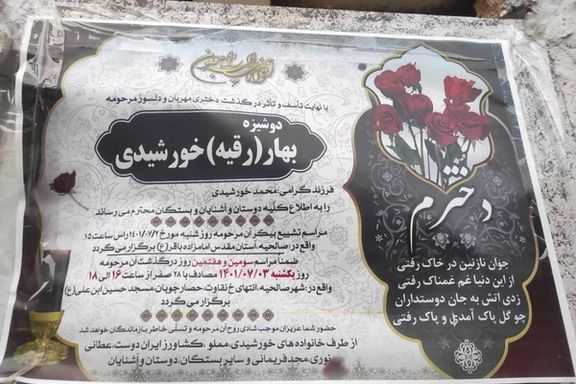
The obituary of Bahar Khorshidi

Bahar Khorshidi was an English and painting teacher who fell to her death from the fourth-floor window of her home when security forces came looking for her. 

According to information obtained by Iran International, 23-year-old Bahar had left home in Robat Karim town near the capital Tehran along with her 18-year-old sister Reyhaneh to distribute flyers with hashtags in support of Mahsa Amini and the motto of the current wave of protests “Women, life, liberty.”

Those days were the early days of the protests, a few days after Mahsa was killed in police custody on September 16, triggering the biggest uprising the Islamic Republic has ever experienced. 

Bahar Khorshidi  (file photo)
100%
Bahar Khorshidi

According to one of the neighbors, they were identified and chased by plainclothes agents, so they escaped to a tailor’s shop they know in their neighborhood. From there, Bahar, who was suffering from heart problems, was taken home but before she returned home, the agents had raided their home and had detained her mother and sister and were taken to the office of the Intelligence Organization of the Revolutionary Guard in the city. 

A few hours later, on September 23, the agents who had chased Bahar and knew she was about to arrive home, raided their home again while only Bahar and her 11-year-old sister and eight-year-old brother were home. After a few minutes, in which it is still unclear what happened, Bahar fell from or was thrown out of the fourth-floor window.

According to Iran International sources, it is not clear if she threw herself down in fear of the officers, or was thrown during a scuffle with them, or the agents threw her down from the window.

A few hours after the incident, her mother and sister were released and they were told that "Bahar committed suicide and threw herself down".

One of the neighbors told Iran International that the building was surrounded by dozens of security agents after the incident, apparently in fear of a reaction by the people who were aware of the tragic event. 

Bahar Khorshidi (file photo)
100%
Bahar Khorshidi

Under the pressure of the security agents, Bahar was buried the following day in a local cemetery with numerous agents in attendance. Iran International sources say the cause of death of the young protester was announced as suicide, and the family left their city to live in a small town in northern Iran to get rid of the pressure by security forces who did not want them to talk to the media.

In addition to over 500 protesters who have been killed during nearly four months of unrest, more than a dozen detainees have been sentenced to death. The Islamic Republic has already executed four people over their participation in demonstrations. Security forces and the hardliner Judiciary have claimed that many of the dead protesters committed suicide or medical preconditions.


Most Viewed

Ghalibaf defends Iran-US talks amid hardline backlash
1
INSIGHT

Ghalibaf defends Iran-US talks amid hardline backlash

2
VOICES FROM IRAN

Bread shortages, soaring prices strain households in Iran, residents say

3
ANALYSIS

From instability to influence: Pakistan’s pivotal role in US-Iran diplomacy

4
ANALYSIS

100 days on: why Iran’s January protests spread across social classes

5

War-hit homeowners feel abandoned as Iran’s reconstruction aid fades

Banner
Banner

Spotlight

  • Is Iran entering its Gorbachev moment?
    INSIGHT

    Is Iran entering its Gorbachev moment?

  • Iran crackdown reaches cemeteries as graves of slain protesters defaced
    EXCLUSIVE

    Iran crackdown reaches cemeteries as graves of slain protesters defaced

  • Iran diplomacy wobbles as factions compete to avoid looking soft on US
    INSIGHT

    Iran diplomacy wobbles as factions compete to avoid looking soft on US

  • The politics of pink: how Iran uses cuteness to rebrand violence
    ANALYSIS

    The politics of pink: how Iran uses cuteness to rebrand violence

  • Bread shortages, soaring prices strain households in Iran, residents say
    VOICES FROM IRAN

    Bread shortages, soaring prices strain households in Iran, residents say

  • Ghalibaf defends Iran-US talks amid hardline backlash
    INSIGHT

    Ghalibaf defends Iran-US talks amid hardline backlash

•
•
•

More Stories

Three More Protesters Sentenced To Death In Iran

Jan 10, 2023, 22:02 GMT+0

Reports say three more Iranian citizens arrested during antigovernment protests in Iran’s northern city of Nowshahr, have been sentenced to death.

The three are identified as Javad Rouhi, Kimia Javadi and Mehdi Mohammadifar.

Mizan news agency affiliated with the judiciary said Tuesday that Javad Rouhi was sentenced to death on charges of "corruption on earth" and "moharebeh" or “War against God”.

The Judiciary claimed Javad Rouhi has been one of the leaders of the protests in the city and insulted the religious sanctities by setting fire to Quran.

Mizan claimed that five people have been killed during the protests in Nowshahr on December 11 when Javad Rouhi “was leading the unrest”.

The accusations come as the regime does not let the defendants have access to their lawyers and holds sham trials based on forced confessions.

Mizan wrote that the decision can be appealed in the Supreme Court.

According to the Norway-based Iran Human Rights Organization, at least 109 Iranian protesters are currently at risk of execution or facing death sentences.

Iran Human Rights organization also stressed that repression through arbitrary arrests, physical torture, sexual assault and rape in detention and the mass issuance of sentences has been intensified.

The Islamic Republic has executed four protesters up to now amid international condemnations.

EU, UK Summon Islamic Republic’s Envoys Over Executions

Jan 9, 2023, 22:55 GMT+0

Global consequences of hanging of two more protesters continue for Iran with the EU and UK summoning the Islamic Republic’s ambassadors on Monday.

Stefano Sannino, the secretary-general of the European External Action Service (EEAS), reiterated the European Union's outrage to the ambassador, Hossein Dehghani, saying that the bloc is appalled by the executions at the weekend of two Iranians arrested in the course of the regime’s crackdown on anti-government protests, ignited by the death of Mahsa Amini in custody of hijab police.

He also repeated an EU call on the regime’s authorities to annul without delay death sentences already pronounced against other protesters. Iran's judiciary said Monday that a court has sentenced three more protesters to death for “war against God”.

Earlier in the day, Britain's foreign minister James Cleverly summoned Iran’s most senior diplomat on Monday after Iranian authorities executed protestors Mohammad Mahdi Karami and Seyyed Mohammad Hosseini."Today I have summoned the Iranian Chargé d’Affaires to condemn in the strongest possible terms the abhorrent executions we witnessed over the weekend," he said in a statement.

The two men were hanged on Saturday for their alleged role in the killing of a government agent during protests that followed the death of Amini, creating uproar in the international community against the Iranian regime.The latest execution brings the number of protesters officially known to have been executed since the unrest to four.

Over 100 Iranian Protesters At Risk Of Death Penalty: Rights Monitor

Jan 9, 2023, 22:12 GMT+0

A Norway-based human rights organization says at least 109 Iranian protesters are currently at risk of execution or facing death penalty sentences.

The Oslo-based Iran Human Rights Organization announced in its latest report that is a minimum estimate as most families are under pressure to stay quiet, and the real number is believed to be much higher. 

The list includes both officially reported cases and those reported by family members and citizen journalists.

Since December 27 when it first released a list, nine people have been released on bail, one is no longer in custody, and two who were executed, have been removed.

21 other protesters who are at risk of death penalty charges, sentences or execution have been added to the current list, noted the human right body.

Iran Human Rights organization also stressed that repression through arbitrary arrests, physical torture, sexual assault and rape in detention and the mass issuance of sentences has been intensified.

“There have been enough cases reported throughout the country to conclude that it is not merely isolated incidents but a systematic policy by the government,” underlined the IHRNGO.

It also announced that at least 481 people including 64 children and 35 women, have been killed by security forces since mid-September, following the death of Mahsa Amini in police custody, which triggered the protests.

It further pointed out that the Islamic Republic is intentionally creating confusion by sharing contradicting statements, particularly in death penalty cases.

Meta Allows ‘Death To Khamenei’ From Now On

Jan 9, 2023, 18:13 GMT+0
•
Iran International Newsroom

After numerous calls by Iranians and human rights activists against censoring content about ongoing protests in Iran, Meta, the owner of Instagram and Facebook, has revised its policies.

Meta's Oversight Board on Monday overturned the company's decision to remove a Facebook post that used the slogan "death to Khamenei" in support of the Iranians’ antigovernment protests, saying it did not violate a rule that bars “violent threats.”

The board, which is funded by Meta but operates independently, said in a ruling that the phrase is often used to mean "down with Khamenei" in referring to the Islamic Republic’s Supreme Leader Ali Khamenei, who has been leading the violent crackdown on nationwide protests ignited by the death in custody of 22-year-old Mahsa Amini.

The board underlined that "In the context of the post, and the broader social, political and linguistic situation in Iran, 'marg bar Khamenei' -- Persian for ‘death to Khamenei’ -- should be understood as 'down with.' It is a rhetorical, political slogan, not a credible threat.” 

It also urged the company to develop better ways of factoring such context into its content policies and outline clearly when rhetorical threats against heads of state were permitted. 

The protests, which are described as the biggest challenge to the clerical regime since its establishment in 1979, are also reflected in cyberspace by many Iranians and foreigners, creating a conundrum for Meta, which has wavered repeatedly in its treatment of violent political rhetoric on its platforms. 

A political graffiti in Iran that reads “Death to Khamenei” (file photo)
100%
A political graffiti in Iran that reads 'Death to Khamenei'

The company claims that it bans language that incites "serious violence" but aims to avoid overreach by limiting enforcement to credible threats, leaving ambiguity as to when and how the rule applies. After Russia invaded Ukraine last year, for example, Meta introduced a temporary exemption to allow calls for death to Russian President Vladimir Putin, aiming to give users in the region space to express their anger over the war, but days later it reversed the exemption. 

Even before the current wave of protests, the company was accused of censoring content deemed critical of the Islamic Republic and its leaders. In August, following reports that the social media giant might be aiding the Iranian government amid a wave of protests, the US Congress launched an investigation into the claims. Three US Republican lawmakers on the House Foreign Affairs and Armed Services Committees launched a probe into the matter, and also urged Meta to investigate claims that Instagram has "been infiltrated by those sympathetic to the Islamic Republic in Iran."

The probe came following reports alleging that Instagram content moderators are deleting and censoring accounts that have documented the regime’s human rights abuses during the protests, including content showing Iranian security forces beating protesters and firing tear gas into crowds.

 A political graffiti on the entrance of a seminary in central Iran that reads “Death to Khamenei” (November 2022)
100%
A political graffiti on the entrance of a seminary in central Iran that reads “Death to Khamenei”

BBC’s sources alleged that pro-regime employees of the German branch of Telus International, a Canadian contractor which provides content moderation to Instagram with over 400 Iranian employees for reviewing Persian-language content, are responsible for restricting anti-government content of Iranian users. In an investigative report, Deutsche Welle Farsi revealed that Mehdi Norouzi, the son of a former Islamic Republic envoy to Bulgaria -- Abdollah Norouzi, works at the Telas International branch in Sofia.

In October, three human rights groups, namely digital civil rights group Access Now, London-based rights organization Article 19, and New York-based Center for Human Rights in Iran, met with a senior official from Meta to convey their concerns over the company censoring content by Iranian dissidents and democracy advocates. The groups said they made recommendations to Meta and Meta’s Oversight Board in an effort to streamline processes to ensure freedom of expression is protected for users who rely on their platform in Iran, especially during protests.

Three More Protesters Sentenced To Death In Iran

Jan 9, 2023, 14:56 GMT+0
•
Maryam Sinaiee

Amid outrage over the execution of two protesters Saturday, Iran's judiciary said Monday that a court has sentenced three others to death for “war against God”.

The three men – Saleh Mir-Hashemi, Majid Kazemi, and Saeed Yaghoubi –were charged with ‘moharebeh’, meaning “war against God”, a vague religious concept, for their alleged role in the shooting of three government agents during a day of protests at Khane-ye Esfahan neighborhood on November 16.

The ‘Khane-ye Esfahan case’ involves several other protesters. Another defendant, footballer Amir Nasr-Azadani, was sentenced to a total of twenty-one years in prison on charges of “aiding in the war against God and “assembly and collusion leading to security-related crimes”.

The sentences can be appealed, the judiciary said, but in other cases involving protesters, the appeal process has not overturned verdicts in sham trials.

The convictions were based on confessions made in the absence of lawyers appointed by the accused. As in many other security-related cases, the judiciary has published videos in which the accused confess to the crimes they were charged with.

Three protesters who are sentenced to death (January 2023)
100%
Three protesters who are sentenced to death

Many security prisoners who have made such confessions, usually for television audiences, later recanted saying they were made under torture and duress.

In 2019, Mazyar Ebrahimi, a businessman, disclosed how he was tortured non-stop for forty days by the intelligence ministry into confessing to spying for Israel and assassinating Iranian nuclear scientists between 2010 and 2012.

Ebrahimi’s confessions were broadcast by the state broadcaster (IRIB). He also said the judge who tried him and others on these bogus charges, Abolghasem Salavati constantly threatened them with a death sentence to make them accept “to cooperate” with their interrogators and accept to play in the script they had written.

Salavati has recently sentenced several protesters, including Mohammad Beroghani and Saman Seydi, to death.

In a rare incident, Ebrahimi and others were exonerated when the rival IRGC intelligence found discrepancies in the testimonies fabricated by the intelligence ministry.

The Islamic Republic has so far hanged four protesters: Mohsen Mirshekari in Tehran and Majidreza Rahnavard in Mashhad on December 12, and Mohammad-Mehdi Karami and Seyed Mohammad Hosseini in Karaj on Saturday.

“Mohammad-Mehdi Karami and [Seyed] Mohammad Hosseini were both executed in gross violation of the law and their right to have appointed attorneys,” prominent human rights lawyer Nasrin Sotoudeh said in a Facebook post Monday.

“The right to freely choose a lawyer is one of the most important reasons for the faultiness of these [death and prison] sentences,” she wrote, adding that hasty executions are “sheer murder” by lack of due process in the trials.

Hosseini’s lawyer, Ali Sharifzadeh-Ardakani, who was only allowed to represent him after the trial said that the judiciary carried out the executions so hastily that they had no time for taking any legal action in these cases. “I was on my way to the Supreme Court [to apply for a re-trial] when I heard my client had been executed,” he said in a tweet Saturday.

Sharifzadeh-Ardakani was summoned by the public and revolutionary prosecutor of Karaj on Tuesday, a day after his client was hanged, charged with “propaganda against the regime” for speaking about his client’s tortures. He was released on bail on the same day.

“I met with Seyed-Mohammad [Hosseini] at Karaj Prison [for the first time]. He cried through his account of tortures, being beaten with tied hands and legs and blindfolded, to being kicked in the head and losing consciousness, the soles of his feet beaten with an iron rod to being tased in different parts of the body,” Sharifzadeh had said in a tweet on December 18.

Mohammad Aghasi, the lawyer of Mohammad-Mehdi Karami, also said in an interview that “They executed my client so quickly that they didn't even give him a chance to write a petition for retrial.”