• العربية
  • فارسی
Brand
  • Iran Insight
  • Politics
  • Economy
  • Analysis
  • Special Report
  • Opinion
  • Podcast
  • Iran Insight
  • Politics
  • Economy
  • Analysis
  • Special Report
  • Opinion
  • Podcast
  • Theme
  • Language
    • العربية
    • فارسی
  • Iran Insight
  • Politics
  • Economy
  • Analysis
  • Special Report
  • Opinion
  • Podcast
All rights reserved for Volant Media UK Limited
volant media logo

Meta Allows ‘Death To Khamenei’ From Now On
Iran International Newsroom
Jan 9, 2023, 18:13 GMT+0Updated: 17:37 GMT+1
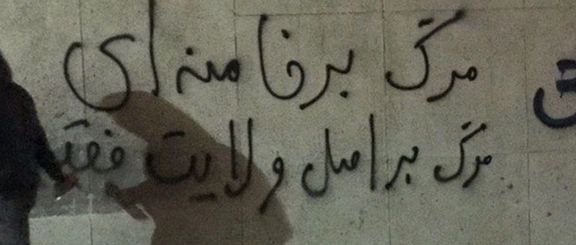
A political graffiti in Iran that reads 'Death to Khamenei'

After numerous calls by Iranians and human rights activists against censoring content about ongoing protests in Iran, Meta, the owner of Instagram and Facebook, has revised its policies.

Meta's Oversight Board on Monday overturned the company's decision to remove a Facebook post that used the slogan "death to Khamenei" in support of the Iranians’ antigovernment protests, saying it did not violate a rule that bars “violent threats.”

The board, which is funded by Meta but operates independently, said in a ruling that the phrase is often used to mean "down with Khamenei" in referring to the Islamic Republic’s Supreme Leader Ali Khamenei, who has been leading the violent crackdown on nationwide protests ignited by the death in custody of 22-year-old Mahsa Amini.

The board underlined that "In the context of the post, and the broader social, political and linguistic situation in Iran, 'marg bar Khamenei' -- Persian for ‘death to Khamenei’ -- should be understood as 'down with.' It is a rhetorical, political slogan, not a credible threat.” 

It also urged the company to develop better ways of factoring such context into its content policies and outline clearly when rhetorical threats against heads of state were permitted. 

The protests, which are described as the biggest challenge to the clerical regime since its establishment in 1979, are also reflected in cyberspace by many Iranians and foreigners, creating a conundrum for Meta, which has wavered repeatedly in its treatment of violent political rhetoric on its platforms. 

A political graffiti in Iran that reads “Death to Khamenei” (file photo)
100%
A political graffiti in Iran that reads 'Death to Khamenei'

The company claims that it bans language that incites "serious violence" but aims to avoid overreach by limiting enforcement to credible threats, leaving ambiguity as to when and how the rule applies. After Russia invaded Ukraine last year, for example, Meta introduced a temporary exemption to allow calls for death to Russian President Vladimir Putin, aiming to give users in the region space to express their anger over the war, but days later it reversed the exemption. 

Even before the current wave of protests, the company was accused of censoring content deemed critical of the Islamic Republic and its leaders. In August, following reports that the social media giant might be aiding the Iranian government amid a wave of protests, the US Congress launched an investigation into the claims. Three US Republican lawmakers on the House Foreign Affairs and Armed Services Committees launched a probe into the matter, and also urged Meta to investigate claims that Instagram has "been infiltrated by those sympathetic to the Islamic Republic in Iran."

The probe came following reports alleging that Instagram content moderators are deleting and censoring accounts that have documented the regime’s human rights abuses during the protests, including content showing Iranian security forces beating protesters and firing tear gas into crowds.

 A political graffiti on the entrance of a seminary in central Iran that reads “Death to Khamenei” (November 2022)
100%
A political graffiti on the entrance of a seminary in central Iran that reads “Death to Khamenei”

BBC’s sources alleged that pro-regime employees of the German branch of Telus International, a Canadian contractor which provides content moderation to Instagram with over 400 Iranian employees for reviewing Persian-language content, are responsible for restricting anti-government content of Iranian users. In an investigative report, Deutsche Welle Farsi revealed that Mehdi Norouzi, the son of a former Islamic Republic envoy to Bulgaria -- Abdollah Norouzi, works at the Telas International branch in Sofia.

In October, three human rights groups, namely digital civil rights group Access Now, London-based rights organization Article 19, and New York-based Center for Human Rights in Iran, met with a senior official from Meta to convey their concerns over the company censoring content by Iranian dissidents and democracy advocates. The groups said they made recommendations to Meta and Meta’s Oversight Board in an effort to streamline processes to ensure freedom of expression is protected for users who rely on their platform in Iran, especially during protests.


Most Viewed

Ghalibaf defends Iran-US talks amid hardline backlash
1
INSIGHT

Ghalibaf defends Iran-US talks amid hardline backlash

2
INSIGHT

100 days after carnage: Iran economy reels from war, inflation, unemployment

3
INSIGHT

A nation in limbo: 100 days after the massacre, has the world moved on?

4
ANALYSIS

From instability to influence: Pakistan’s pivotal role in US-Iran diplomacy

5
ANALYSIS

100 days on: why Iran’s January protests spread across social classes

Banner
Banner

Spotlight

  • War-hit homeowners feel abandoned as Iran’s reconstruction aid fades

    War-hit homeowners feel abandoned as Iran’s reconstruction aid fades

  • 100 days on: the anatomy of Iran’s January crackdown
    INSIGHT

    100 days on: the anatomy of Iran’s January crackdown

  • Ghalibaf defends Iran-US talks amid hardline backlash
    INSIGHT

    Ghalibaf defends Iran-US talks amid hardline backlash

  • 100 days on: why Iran’s January protests spread across social classes
    ANALYSIS

    100 days on: why Iran’s January protests spread across social classes

  • From instability to influence: Pakistan’s pivotal role in US-Iran diplomacy
    ANALYSIS

    From instability to influence: Pakistan’s pivotal role in US-Iran diplomacy

  • A nation in limbo: 100 days after the massacre, has the world moved on?
    INSIGHT

    A nation in limbo: 100 days after the massacre, has the world moved on?

•
•
•

More Stories

Three More Protesters Sentenced To Death In Iran

Jan 9, 2023, 14:56 GMT+0
•
Maryam Sinaiee

Amid outrage over the execution of two protesters Saturday, Iran's judiciary said Monday that a court has sentenced three others to death for “war against God”.

The three men – Saleh Mir-Hashemi, Majid Kazemi, and Saeed Yaghoubi –were charged with ‘moharebeh’, meaning “war against God”, a vague religious concept, for their alleged role in the shooting of three government agents during a day of protests at Khane-ye Esfahan neighborhood on November 16.

The ‘Khane-ye Esfahan case’ involves several other protesters. Another defendant, footballer Amir Nasr-Azadani, was sentenced to a total of twenty-one years in prison on charges of “aiding in the war against God and “assembly and collusion leading to security-related crimes”.

The sentences can be appealed, the judiciary said, but in other cases involving protesters, the appeal process has not overturned verdicts in sham trials.

The convictions were based on confessions made in the absence of lawyers appointed by the accused. As in many other security-related cases, the judiciary has published videos in which the accused confess to the crimes they were charged with.

Three protesters who are sentenced to death (January 2023)
100%
Three protesters who are sentenced to death

Many security prisoners who have made such confessions, usually for television audiences, later recanted saying they were made under torture and duress.

In 2019, Mazyar Ebrahimi, a businessman, disclosed how he was tortured non-stop for forty days by the intelligence ministry into confessing to spying for Israel and assassinating Iranian nuclear scientists between 2010 and 2012.

Ebrahimi’s confessions were broadcast by the state broadcaster (IRIB). He also said the judge who tried him and others on these bogus charges, Abolghasem Salavati constantly threatened them with a death sentence to make them accept “to cooperate” with their interrogators and accept to play in the script they had written.

Salavati has recently sentenced several protesters, including Mohammad Beroghani and Saman Seydi, to death.

In a rare incident, Ebrahimi and others were exonerated when the rival IRGC intelligence found discrepancies in the testimonies fabricated by the intelligence ministry.

The Islamic Republic has so far hanged four protesters: Mohsen Mirshekari in Tehran and Majidreza Rahnavard in Mashhad on December 12, and Mohammad-Mehdi Karami and Seyed Mohammad Hosseini in Karaj on Saturday.

“Mohammad-Mehdi Karami and [Seyed] Mohammad Hosseini were both executed in gross violation of the law and their right to have appointed attorneys,” prominent human rights lawyer Nasrin Sotoudeh said in a Facebook post Monday.

“The right to freely choose a lawyer is one of the most important reasons for the faultiness of these [death and prison] sentences,” she wrote, adding that hasty executions are “sheer murder” by lack of due process in the trials.

Hosseini’s lawyer, Ali Sharifzadeh-Ardakani, who was only allowed to represent him after the trial said that the judiciary carried out the executions so hastily that they had no time for taking any legal action in these cases. “I was on my way to the Supreme Court [to apply for a re-trial] when I heard my client had been executed,” he said in a tweet Saturday.

Sharifzadeh-Ardakani was summoned by the public and revolutionary prosecutor of Karaj on Tuesday, a day after his client was hanged, charged with “propaganda against the regime” for speaking about his client’s tortures. He was released on bail on the same day.

“I met with Seyed-Mohammad [Hosseini] at Karaj Prison [for the first time]. He cried through his account of tortures, being beaten with tied hands and legs and blindfolded, to being kicked in the head and losing consciousness, the soles of his feet beaten with an iron rod to being tased in different parts of the body,” Sharifzadeh had said in a tweet on December 18.

Mohammad Aghasi, the lawyer of Mohammad-Mehdi Karami, also said in an interview that “They executed my client so quickly that they didn't even give him a chance to write a petition for retrial.”

Pope Francis Condemns Iran’s Use Of Death Penalty For Protesters

Jan 9, 2023, 13:36 GMT+0

Pope Francis has slammed the use of the death penalty by the Iranian regime to quell nationwide anti-government protests.

The Pope’s remarks are his first public comments against the Iranian clerical rulers over the protests’ crackdown.

In his annual speech to diplomats accredited to the Vatican on Monday, he said “The right to life is also threatened in those places where the death penalty continues to be imposed, as is the case in these days in Iran, following the recent demonstrations demanding greater respect for the dignity of women.”

“The death penalty cannot be employed for a purported state justice, since it does not constitute a deterrent nor render justice to victims, but only fuels the thirst for vengeance,” he stressed.

These statements by Pope Francis are expressed in a situation that the Islamic Republic has so far executed four protesters and issued death sentences for several others.

Iran has been the scene of nationwide protests after the death of Mahsa Amini in ‘hijab police’ custody in mid-September.

Earlier, the Pope had refused to comment on Iran protests and the role of women after his trip to the region.

The execution of protestors in Iran has drawn a wave of international condemnations, but the Islamic Republic still issues new death sentences against some detained demonstrators.

Germany Wants To Increase Pressure On Iran After Latest Executions

Jan 9, 2023, 13:21 GMT+0

German Chancellor Olaf Scholz Monday condemned Iran for using the death penalty against protestors, and his spokesperson said Berlin wanted to increase pressure on Tehran with new international measures.

Iran hanged two men on Saturday for allegedly killing a member of the security forces during nationwide protests that followed the death of 22-year-old Kurdish Iranian woman Mahsa Zhina Amini on September 16, drawing condemnation from the European Union, the United States and other Western nations.

"With the executions, the Iranian regime is employing the death penalty as a means of repression," Scholz wrote on Twitter. "That is horrifying."

He said Iran should refrain from further executions after the killings of 22-year-old Mohammad Mehdi Karami and 39-year-old Seyyed Mohammad Hosseini, whose deaths bring the number of executions linked to the protests to four.

"Together with our international partners, we will increase the pressure further on the Iranian regime," the government spokesperson told a regular news conference, adding that Iran needed to see that there would be a price to pay for continuing.

A German foreign ministry spokesperson said the goal was to agree a fourth package of sanctions with other European Union member states in response to the crackdown.

European lawmakers and activists are demanding that the EU list Iran’s Revolutionary Guard as a terrorist organization. A group of French Senators have tables a resolution to end nuclear talks with Tehran aimed at reviving the 2015 nuclear deal, the JCPOA.

With reporting by Reuters

Khamenei Insists Protests Are Conspiracy To Weaken Regime

Jan 9, 2023, 11:40 GMT+0
•
Mardo Soghom

Iran’s ruler Ali Khamenei in a speech Monday once again blamed anitgovernment protests on foreign conspiracies, saying the goal was to weaken the Islamic Republic.

Khamenei, who is facing the most serious challenge to his rule since 1989 when he became Supreme Leader, claimed that protesters are not angry about government inefficiency, managerial and economic weaknesses, but on the contrary the antigovernment movement is meant to weaken a strong Islamic Republic.

Popular protests broke out in mid-September when a 22-year-old woman was fatally wounded after being arrested by Iran’s notorious ‘hijab police’. After years of economic decline, increasing poverty and government interference in the private lives of citizens, the incident triggered pent-up frustrations that blew up in street demonstrations.

But unlike previous rounds of unrest, the government was not able to crush the protests in a matter of days and the demonstrators were not asking for reforms but demanding a regime change. Nevertheless, security forces killed more than 500 civilians and arrested close to 20,000 people by the end of December. The government has also hanged four protesters after sham trials, triggering Western condemnations, and isolating the clerical regime.

“In the recent riots, the hand of foreigners was visible, although some have denied it. As soon as we say foreign enemy, some deny it,” Khamenei said, referring to domestic pundits and politicians that say the protesters have genuine grievances.

‘Foreign enemy’ is a favorite term for the 83-year-old authoritarian ruler, who is a staunch opponent of the West and believes he is the leader of the Muslim world, although as a Shiite cleric he cannot be accepted by most Muslims, who are Sunnis.

‘The enemy’, usually refers to the United States, Israel, Western Europe and even some Arab countries – in short, whoever disagrees with Khamenei’s quest to dominate the region, eradicate all manifestations of Western presence, and destroy Israel.

Khamenei attributes almost all political and economic failures and shortcomings to conspiracies by ‘the enemy’, and the ongoing protests are no exception.

He began blaming foreigners as early as September and his loyalists and media controlled by hardliners immediately tuned their propaganda to his message.

“Actions by America, by Europeans…each somehow intervened in this issue [protests] in an obvious manner, not hidden from view,” Khamenei said.

The United States and Europe only gradually increased their criticism of Tehran as the story of Mahsa Amini, the woman killed by the ‘hijab police’ spread around the world and garnered sympathy, the West began to react. Reports of teenage protesters being killed by trigger-happy regime forces in the early weeks of the protests brought on more and more Western criticism.

Khamenei went on to blame international, Arab and Hebrew media for propaganda in favor of the protests. Here is where, he claimed that the protests were meant to weaken the Islamic Republic and had nothing to do with its shortcomings. It was “the strengths” they wanted to destroy, he claimed.

Khamenei’s Islamic Republic has survived with oil export income for more than three decades and US sanctions imposed on its crude exports since 2018 have further weakened a shaky economy. Millions of middle-class citizens have become poor as inflation has reached nearly 50 percent and the national currency has lost its value more than tenfold in five years.

Khamenei has refused to resolve his differences with the West over Iran’s nuclear program seen as a threat by many countries. But parts of his speech Monday revealed what could be interpreted as anxiety over the political and economic deadlock his regime faces.

“Big works should be accomplished. Transformational work must get done. I believe it can be done. We have pious, hardworking officials,” Khamenei said and reminisced about the 1979 revolution that toppled the monarchy.

The problem is that millions of people now reject that revolution and aspire to establishing a secular and democratic country.

Iran's New Police Chief Hates Ties For Men And Loves Hijab For Women

Jan 9, 2023, 08:59 GMT+0
•
Iran International Newsroom

Islamic Republic's Supreme Leader Ali Khamenei appointed Brigadier General Ahmadreza Radan as Iran's police chief last week, after four months of popular protests.

With Radan's track record as the heavy-handed former police chief of Greater Tehran, Kordestan and Sistan-Baluchistan provinces the appointment was immediately questioned by social media and foreign-based Persian media.

Most of Radan's ill reputation dates back to his role as police chief during the post-election unrest in 2009 and the performance of his men at the Kahrizak detention center where several young protesters including children of some state officials were killed as a result of police brutality. He was interrogated for long hours for the casualty toll of the post-election unrest.

Like many other intelligence and police officials, Radan is a veteran of the Iran-Iraq war in the 1980s and in essence an IRGC officer.

Radan's men were also seen in police vehicles running over the protesters in the streets of Tehran on several occasions in 2009 and 2010. There is also a famous audio recording posted on social media in which Radan is ordering his men in Tehran to shoot anyone they can among protesters.

Clearly his ruthless treatment of demonstrators and his violent enforcement of the compulsory hijab are among the reasons why Khamenei decided to bring him back from his comfort zone or possibly his exile at the police's Strategic Studies Center to the troubled and turbulent streets of Iran.

Radan was sanctioned for his human rights violations by the United States as early as 2010 and has been blacklisted by the European Union.

Special riot police attacking protesters in Tehran, in June 2009
100%
Special riot police attacking protesters in Tehran, in June 2009

The right man for Khamenei

During the past month the press speculated that Khamenei was unhappy with former police chief Hossein Ashtari's performance in quashing anti-regime protests. Although Khamenei said that Ashtari left his post at the end of his term of office, the press revealed that he had still more than two years to serve.

According to Etemad Online, Radan's hard-line views about security make him the right man to serve alongside a consolidated conservative government. He has been known for his ultraconservative positions about hijab and security since the time he joined the IRGC as a young man. He served as the Police Chief of Kordestan, a challenging region, from 1997 to 2000. Then he worked until 2004 as the police chief of Sistan-Baluchistan, another difficult area with a porous border, poverty and an oppressed Sunni population. He was transferred to Tehran in 2005 as the police chief of Greater Tehran and served until 2009.

He was one of the pioneers of enforcing a religious dress code through the ‘morality police’ where he expressed strict opposition to men wearing ties and women wearing boots and tight manteaus. President Ebrahim Raisi referred to this in his congratulatory message to Radan's. IRGC-linked Javan newspaper also praised Radan for tackling the hijab issue in the past years.

Ahmadreza Radan (C) as an IRGC fighter in the Iran-Iraq was in the 1980s
100%
Ahmadreza Radan (C) as an IRGC fighter in the Iran-Iraq was in the 1980s

Radan has said that his "success" in that role was due to targeting the hijab issue right at clothing production centers where "the enemies were silently attacking religious values." He shut down many barber shops in Tehran for introducing new hair styles for the youth. Nonetheless, his strongest point, as far as Khamenei was concerned, was his violent crackdown on the 2009 protests. An experience that could come handy in the turbulent period of 2022 and 2023.

A man of no apologies

Radan says that "success" was the outcome of the police's close cooperation with Basij and the Intelligence Ministry, Rouydad24 reported. The two organizations provided the plainclothes forces who would recognize no barrier whatsoever in violently cracking down on protests.

Iranian media have said that Radan has come back to the forefront of tackling the protests with more power than before. Many Iranians still remember him in a controversial interview on state television in which he dismissed all the criticisms about his performance and insisted that "I am absolutely serious about security and hijab. People know what is right and what is not, and we know what to do if we want to take people with us and they refuse to come with us."

However, what happened to Mahsa Zhina Amini in police custody in mid-September showed that nothing is yet clear about what the police may and may not do. Some say former police chief Ashtari was removed from his post because he could not convince anyone, including Khamenei, that his plainclothes agents could stop the protests, although they beat and shot protesters at point blank range, and are responsible for hundreds of deaths since September.

What Radan will probably begin to understand during the next months is that today's protesters are extremely different from those in 2009. Instead of turning the other cheek they might slap back his men in the face.





