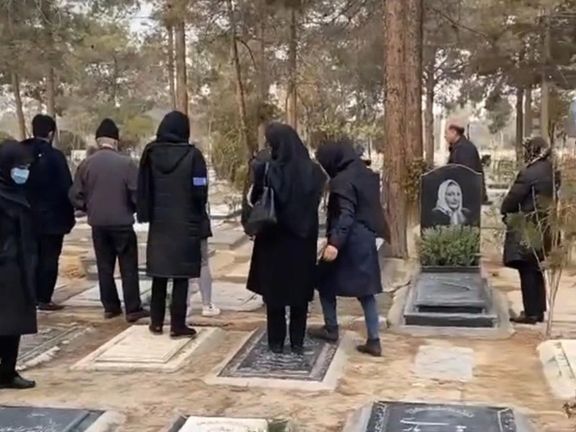
Only a handful of family members was allowed to attend Mohsen Shekari’s heavily guarded burial in Tehran on December 9, 2022.
As in many other previous cases, Iranian authorities Friday allowed only a handful of family members to attend Mohsen Shekari’s heavily guarded burial to prevent a possible protest.
A video posted on Twitter shows a few people quietly standing at his grave at Tehran’s Behesht Zahra Cemetery. Shekari, 23, was hanged Thursday morning after a hasty and unfair trial, which has sparked deep anger among Iranians.
Many believe he was hanged to instill fear among other protesters as his sentence for blocking a street and inflicting a minor injury on a paramilitary Basij member, was harsher than anyone could imagine.
Some people took to the street in his neighborhood Thursday evening and chanted “We will kill the one who killed our brother” and “Death to the Dictator.” People were indiscriminately tear-gassed and shot at with pellet guns whether they were on foot or in their cars, and even inside shopping arcades.
Anti-government protesters have planned further rallies on Saturday and Sunday in Iran and abroad in the memory of Shekari and other protesters killed by the security forces.
Mohsen Shekari, a young protester hanged for injuring a security guard with a knife and closing off a street in the capital Tehran
For the fear of funerary events turning into protests, authorities have “snatched” the bodies of several protesters from the morgue or hospital and buried them secretly in nearly three months since protests began following the death in custody of Mahsa Amini. In some cases, families have taken the bodies home for fear of being deprived of a proper burial at their preferred cemeteries.
In November, the mother of ten-year-old Kian Pirfalak who was shot by security forces in the family car in Izeh, a small city in Khuzestan Province, had to take her son’s body to a relative’s home from the hospital with the help of her relatives and cover it with ice until the next day when she could give him a proper burial. The event turned into a massive anti-government protest with the mother, Zaynab Molaei-Rad, making a fiery speech and accusing the Supreme Leader Ali Khamenei of being responsible for her son’s death.
For decades the Islamic Republic has “stolen bodies” or buried people in unknown graves to deny families a proper burial or conceal atrocities.
In 1988 in what came to be known as the massacre of political prisoners, thousands were tried summarily and executed within a few months. The bodies were buried in unmarked graves at Tehran’s Khavaran cemetery and elsewhere. Thousands of families are still searching for their loved ones’ graves including many minors.
The extent of “body snatching” has gone beyond those executed or killed in protests. In October, Sara Haghighatnejad had to go through massive paperwork to bring the body of her dissident journalist brother, Reza Haghighatnejad, home from Germany where he died of cancer only to see the body snatched by security forces at Shiraz Airport. The family were then left in the dark for four days before they found out the body had been secretly buried, not at their family cemetery in his hometown, but in a remote village in their absence.
Britain on Friday summoned Iran's most senior diplomat in London to protest the hanging of Mohsen Shekari, the first such execution over ongoing antigovernment unrest.
"The execution of Mohsen Shekari by the Iranian regime is abhorrent. He is a tragic victim of a legal system in which disproportionate sentences, politically motivated trials and forced confessions are rife," Foreign Secretary James Cleverly said in a statement.
"We have made our views clear to the Iranian authorities – Iran must immediately halt executions and end the violence against its own people," Cleverly added.
On Thursday, Germany also summoned Iran’s ambassadorover the execution, with Foreign Minister Annalena Baerbock describing the Iranian regime's contempt for humanity as “boundless."
Earlier on Thursday, the Islamic Republic hanged Mohsen Shekari, a young protester sentenced to death in a sham trial for injuring a regime supporter and closing off a street in the capital Tehran. The revolutionary court had accused him of Moharebeh, an Islamic-Arabic term meaning ‘fighting against God” which carries the death sentence.
The execution, widely seen as a measure to intimidate the protesters, has drawn international condemnationwith EU countries vowing further coordinated action against the clerical regime.
Mohsen Shekari, a young protester hanged for injuring a security guard with a knife and closing off a street in the capital Tehran
Rejecting international reactions over the execution of a protester for injuring a Basij paramilitary agent, the Islamic Republic defends it as a standard procedure.
In a short statement on its Twitter account, the regime’s Ministry of Foreign Affairs claimed that the government has "exercised the utmost restraint in dealing with the riots".
“In countering riots, the Islamic Republic has shown utmost restraint and -- unlike many Western regimes who smear and violently crack down even on peaceful protesters -- Iran has employed proportionate and standard anti-riot methods. The same is true for the judicial process: restraint and proportionality,” the statement read.
The ministry then repeated the official rhetoric, blaming other countries for the protests, saying that “Yet, public security is a redline. Armed assault and vandalism aren't tolerable, even to Western regimes... Instead of exposing its mendacity by politicized statements, the West must stop hosting, backing and encouraging terrorists.”
In his first speech after the execution of the first protester, Mohsen Shekari, President Ebrahim Raisi announced that "the trial and punishment of the protesters" will continue. Also, Ahmad Khatami, a hardliner cleric and Friday prayer Imam expressed his gratitude “for the decisiveness of the judiciary, which sent the first rioter to the gallows.”
President Ebrahim Raisi
Judiciary spokesman Masoud Setayeshi had announced Tuesday that five more people indicted in the killing of a Basij militia member, Rouhollah Ajamian, were sentenced to death.
People across Iran, especially the capital Tehran and Zahedan, the provincial capital of Sistan-Baluchestan province, held rallies in protest to Shekari’s execution and many others who are in danger of imminent execution.
The UN Human Rights council also deplored the hanging of Shekari and expressed concerns for at least 11 other protesters sentenced to death. “We call for an immediate halt to executions. Death penalty is incompatible with human rights and cannot be reconciled with right to life," the body said.
The global outcry over the executions is not limited to politicians and state officials as many celebrities and right activists have also denounced the act with grassroot activists, known as the youth of Tehran's neighborhoods calling for a demonstration on Saturday afternoon.
Canada-based activist Hamed Esmaeilion, whose daughter and wife were killed by the IRGC, have also called for rallies in many cities of the world on Saturday and Sunday in protest to Shekari’s execution and all the others planned to take place in the coming days.
British entrepreneur and business magnate Richard Branson called the execution “unacceptable and cruel.” saying “Iran’s brutal and corrupt regime must be held accountable by the international community.”
British author and philanthropist J. K. Rowling said in a tweet on Friday that “Mohsen Shekari was murdered by the state for wanting freedoms so many of us take for granted.”
Following his death, Shekari came to be known among the Iranian social media users as an avid gamer, which drew a lot of reaction from the gaming community. David Jaffe, a video game designer best known for creating the God of War series, called his execution “Sad, pathetic, and heart breaking.” “ANYONE who stands up against the sort of 'leadership' they have in Iran is a hero in my book. Rest in Peace and Power, Mohsen Shekari. Hoping your bravery, strength, and activism serve as an inspiration for millions,” he tweeted.
Young Iranians are displaying pictures of their peers killed by government security forces. October 29, 2022
Britain announced sanctions Friday against 30 people worldwide, including Iranian officials, for serious rights violations, such as the violence on protesters.
The move came a day after France announced plans for new European Union sanctions against Iran over human rights abuses in its security crackdown on popular unrest there as well as its supply of drones to Russia before Moscow's invasion of Ukraine. The proposed sanctions will be taken up by the EU early next week.
Iran executed the first detained protester December 8 after a sham trial, sparking worldwide outrage and condemnations. The execution is seen as part of a government strategy to intimidate ordinary people and activists from pursuing the almost three-month-old antigovernment protests movement.
The British government said its sanctions were coordinated with international partners to mark International Anti-Corruption Day and Global Human Rights Day. They encompassed individuals involved in activities including the torture of prisoners and the mobilization of troops to rape civilians.
"Today our sanctions go further to expose those behind the heinous violations of our most fundamental rights," Foreign Secretary James Cleverly said in a statement.
Britain sanctioned 10 Iranian officials connected to Iran's prison systems. This included six people linked to the Revolutionary Courts that have been responsible for prosecuting protesters with sentences including the death penalty.
Nationwide protests that erupted after the death in police custody of 22-year-old Kurdish Iranian woman Mahsa Amini on September 16 have posed one of the biggest challenges to the Islamic Republic since its establishment in 1979.
The British government sanctioned Ali Cheharmahali and Gholamreza Ziyayi, former directors of Evin prison in Tehran, which it said was a facility notorious for the mistreatment of both Iranian and foreign detainees. Evin houses many political prisoners, where torture and forces confessions are conducted.
The foreign office said the sanctions against 11 countries across seven sanctions regimes were the most that Britain has ever imposed in one package.
Britain also sanctioned figures involved in Myanmar's military, which it said were involved in committing massacres, torture and rape.
Among those sanctioned by Britain were Myanmar's Office of the Chief of Military and Security Affairs, which it said had been involved in torture since last year's military coup, including rape and sexual violence.
Those sanctioned also include Russian Colonel Ramil Rakhmatulovich Ibatullin for his role as the commander of the 90th Tank Division, which has been involved in fighting since Russia's invasion of Ukraine earlier this year.
The government said there have been multiple allegations made against serving members of the 90th Tank Division, including the conviction in Ukraine of a senior lieutenant on sexual abuse charges during the conflict.
Russia, which has said it is conducting a "special military operation" in Ukraine to eliminate threats to its security, has denied committing war crimes or targeting civilians.
But extensive evidence has existed since the beginning of the conflict attesting to large-scale human rights violations that some believe constitute war crimes.
Iranian security forces waiting in Tehran to attack a university on October 3, 2022
Canada imposed fresh sanctions on Iran, Russia and Myanmar Friday, citing human rights violations by their governments.
Sanctions were imposed on 22 individuals in Iran, who included senior members of the judiciary, prison system and law enforcement, as well as political leaders, such as senior aides to Iran's Supreme Leader Ayatollah Ali Khamenei and figures in state-directed media outlets, the statement added.
Sanctions on Iran came a day after the Islamic Republic hanged a man convicted in a sham trial of injuring a security guard with a knife and blocking a street in Tehran, the first such execution over recent anti-government unrest. Nationwide protests erupted after the death of 22-year-old Kurdish Iranian woman Mahsa Amini in police custody on September 16.
Western countries have issued repeated statements condemning the government in Tehran for gross disregard of the rights of protesters and have imposed some sanctions on individuals and entities. But they have not imposed more serious economic sanctions or designation of it top leaders for killing of civilians.
The measures also included sanctions against 33 current or former senior Russian officials and six entities involved in alleged "systematic human rights violations" against Russian citizens who protested against Russia's invasion of Ukraine, the Canadian foreign ministry said in a statement.
Since Russia's invasion on Feb. 24, Canada has imposed sanctions on more than 1,500 individuals and entities from Russia, Ukraine and Belarus.
"There is more work to be done, but Canada will never stop standing up for human rights," Canadian Foreign Minister Melanie Joly said.
Germany summoned Iran’s ambassador Thursday after the Islamic Republic executed the first Iranian arrested during the current wave of antigovernment protests.
A diplomatic source broke the news but did not provide any details about what transpired. Earlier on Thursday, the Islamic Republic hanged Mohsen Shekari, a young protester sentenced to death in a sham trial for injuring a regime supporter and closing off a street in the capital Tehran. The revolutionary court had accused him of Moharebeh, an Islamic-Arabic term meaning ‘fighting against God” which carries the death sentence.
The execution, widely seen as a measure to intimidate the protesters, has drawn international condemnation with EU countries vowing further coordinated action against the clerical regime.
German Foreign Minister Annalena Baerbock described the Iranian regime's contempt for humanity as “boundless," saying that Shekari was “tried and executed in a perfidious summary trial because he disagreed with the regime. But the threat of execution will not stifle people's desire for freedom.”
Moreover, Vice-President of the German Parliament Katrin Göring-Eckardt tweeted that the execution “reacts with all (un)imaginable brutality to protests."
So far, around 500 civilians have been killed by security forces and at least 18,000 arrested. While many have been released, around 1,500 face criminal charges, and at least 80 detainees face the death sentence.